
Several weeks before last November’s elections, dozens of students from Charlottesville and Albemarle County spent time thinking about how democracy shows up in their everyday lives and in the lives of their loved ones. The students also explored their hopes and dreams for democracy.
After turning their thoughts into poetry and prose, 42 students in grades six through 12 submitted their work to the Voices of Democracy: What Democracy Means to Me writing contest presented by the University of Virginia’s Equity Center and the Karsh Institute of Democracy. The contest also commemorates the groundbreaking of the new Karsh Institute of Democracy building scheduled to open in late 2026, according to University of Virginia’s Equity Center website.
Aanya Sonkusare, an eighth grader at Joseph T. Henley Middle School in Albemarle County, won the grand prize for her seven-stanza poem that centers on language in President Abraham Lincoln’s 1863 Gettysburg Address.
“Government of the people, by the people, for the people” reflects democracy, despite a future that often “resembles dough, messy and unpredictable,” wrote Sonkusare, 13.
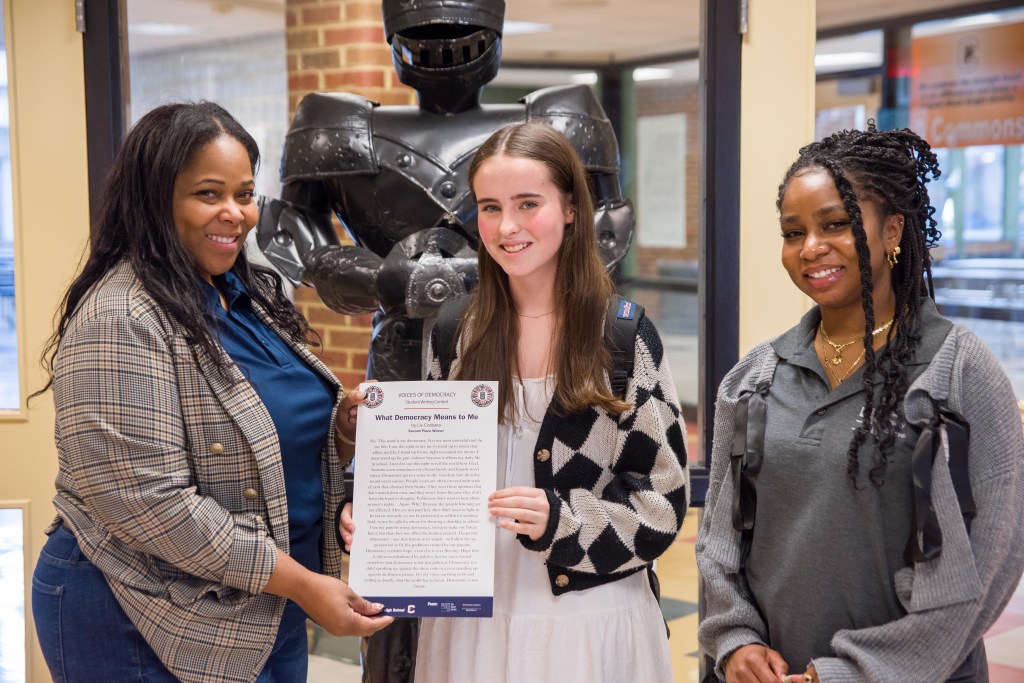
Liv Cordano, 14, a freshman at Charlottesville High School, won second place. In her piece, she said she sees democracy as both a shield and a weapon in “giving a voice to the voiceless,” even when “the sound never carries.”
The third-place prize went to Eleanor Carter, 17, a junior at St. Anne’s Belfield. She said she believes that true democracy is shown by people who persevere while also feeling unseen or unheard.
During a reception on Oct. 17, 2024, at UVA’s Rotunda, Sonkusare, Cordano and Carter were rewarded for their entries. Sonkusare received $500 for her poem, “Democracy and me.” Cordano won second place and received $250 and Carter, the third-place winner, received $100.
On Dec. 19, 2024, officials from The Equity Center visited each of the top three winners at their schools to present them with a physical copy of their submissions.
“The essays provided a rich exploration of how democracy affects the daily lives of students and their communities,” notes The Equity Center’s website. “Teachers in Charlottesville and Albemarle County also incorporated the contest’s prompts as an instructional tool, helping students engage deeply with the concept of democracy. Even though many of these essays were not submitted for the contest, the feedback has shown that the exercise was a valuable and dynamic classroom experience.”
Sherica Jones-Lewis, director of community research for The Equity Center, further said that the contest helped the judges understand that the next generation often views democracy “as a deeply personal and fluid concept, not confined to institutions but present in everyday actions and choices.”
Because the students emphasize a desire for community-driven change, their voices help current leaders “understand the importance of empowering youth voices in shaping a democracy that truly serves everyone,” added Jones-Lewis.
Three additional honorable mentions included Amerson-Joi “AJ” Wright of Jackson P. Burley Middle School, Halil Stinnie of Journey Middle School and Max Harris of Western Albemarle High School. They each received $50.
Charlottesville Tomorrow Community Reporter Tamica Jean-Charles spoke with Sonkusare, Cordano and Carter to learn more about their poetry and prose.
Aanya Sonkusare, first-place winner, Henley Middle School
Jean-Charles: What made you want to craft your response through a poem?
Sonkusare: For me, poetry is a really meaningful way to communicate things. You can take things many different ways in poetry instead of just one set way, so I try to incorporate that into my poem a little bit.
Jean-Charles: How do you envision the next four years once President-elect [Donald] Trump takes office?
Sonkusare: I think either way, some people might be sad or happy about the president. “It’s up to the people,” as I said in my poem. I think if you work hard and work toward what you want, you will help.
Jean-Charles: In your piece, you said that “democracy is something that is in our hands.” How will you carry forth your words?
Sonkusare: I want to give back to what America has given me. So maybe through volunteering and taking part in things that can help other people, you know, showing my consent of being governed.
Jean-Charles: Some people may not feel so hopeful in our democracy right now. What are your hopes for democracy?
Sonkusare: People have been feeling a little less optimistic about democracy lately. I think things like this competition can definitely give people hope. [One] of my reasons for making the poem was to try to give people hope.
Liv Cordano, second-place winner, Charlottesville High School
Jean-Charles: I noticed that your piece revolves about women’s rights. Why is women’s rights important to you?
Cordano: It’s something that’s going to affect me in the coming years as I get older. So it’s something that I feel passionate about, especially with [recent] political results. I’ve also been influenced a lot by my friends who are vocal about advocating for women’s rights.
Jean-Charles: How are you feeling going into the next four years?
Cordano: I try to stay out of it as I cannot actually vote yet, so I try not to stress myself out. But I think it’s a little disappointing to see other people believe in things that are not OK to believe in.
Jean-Charles: How do you see yourself upholding your sense of democracy in the next four years?
Cordano: I’m really interested in debates and presentations. I see myself getting more involved in women’s rights as that’s something I feel strongly about, and advocating for better representation for everybody.

Eleanor Carter, third-place winner, St. Anne’s Belfield
Jean-Charles: In your piece, you talk a lot about democracy being crafted through uncomfortable experiences. What are some of your experiences that led you to say this?
Carter: I think a great example of this is when I got to interview an author by the name of Scott Shigeoka last year. I learned from him that you truly see your own individual viewpoint through disagreeing with others. For example, he went to a Trump rally as a Democratic person, and talked to people, which is a very uncomfortable thing to do, especially with people you disagree with. But you truly find democracy through believing in democratic principles and also understanding other viewpoints.
Jean-Charles: And how have you practiced this in this last election cycle involving Donald Trump’s election?
Carter: For me, obviously, I’m a Democrat so Vice President Kamala Harris’ loss was a tough blow. It was definitely something that I had large hopes for, but also the general process of seeing that glimmer of hope of not only having a Democrat as president, but also a woman was definitely something that I think helped strengthen the Democratic party a lot. So, even though it was definitely very difficult to have that loss, and it definitely did show a lot of how America still has much to go in terms of democracy, it was just a very small step that I think was absolutely necessary in having a stronger backbone to democracy and more hope in it as well.
Jean-Charles: In the next election you will be 21 and able to vote. How do you feel about voting?
Carter: I’m incredibly excited. One of the reasons I wanted to do this contest was because I really do want to make a difference in terms of politics, even if I’m not at an age where I can legally do that yet. But in the next cycle, I’ll be incredibly honored to have a voice, especially with all the things going on right now and all of the issues in the world. But I’m just absolutely honored and so excited to be able to make a difference.