
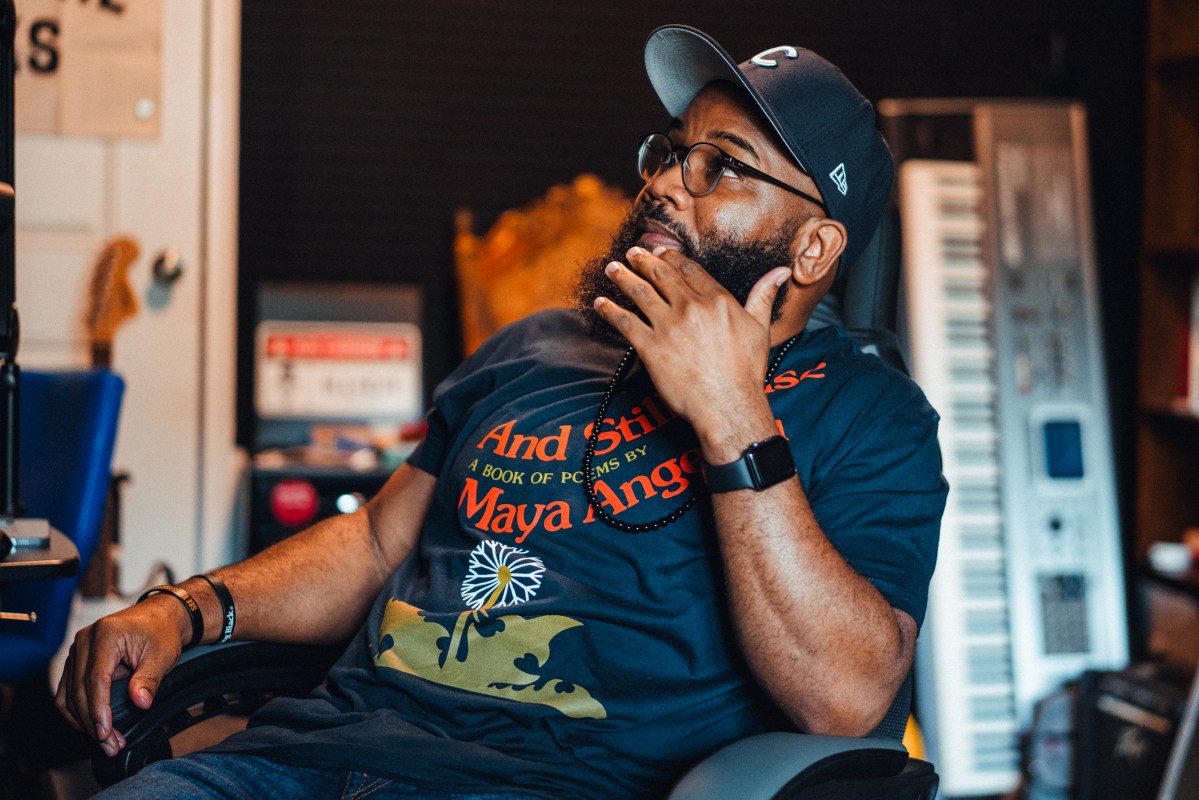
A.D. Carson arrived in Charlottesville on May 15, 2017. It was just two days after white nationalists gathered at the Robert E. Lee statue in Market Street Park, protesting the city’s plans to remove it.
The poet, rap artist, activist and newly hired UVA professor watched the chaos unfold in a city he would soon call home.
In his new book, “Being Dope: Hip Hop and Theory through Mixtape Memoir,” Carson describes the protest and others that would erupt later that year in August and result in multiple deaths. What he witnessed on both occasions is now featured, through music, prose, poetry and rap, in his 400-page book that was released on Nov. 19.
“Most of the people assembled at the monument brought torches to the nighttime gathering, giving it the optics of an old-timey Klan meeting you might see in a documentary about how much this country has progressed,” he writes, drawing information from what he watched on television. “Instead, it was evidence of how untrue that might be.”
When the white nationalists returned to Charlottesville three months later on Aug. 11, this time on UVA’s campus, Carson was preparing to teach courses there as an assistant professor of hip-hop and the Global South.
“They were back, with their torches, this time marching them across the campus, ending in a violent clash with a group of students, staff, and faculty beneath the statue of Thomas Jefferson outside his Rotunda,” Carson notes in the book’s first section “Burn Down the Plantation Regardless: Owning My Masters.”
The unrest that exploded in Charlottesville on Aug. 12, 2017 features prominently in Carson’s work, including “See the Stripes,” from “Owning My Masters: The Rhetorics of Rhymes & Revolutions,” and “Charlottesville, Summer ’17,” from “Sleepwalking Vol 1: A Mixtape.”
A “Unite the Right” rally drew demonstrators who arrived in downtown Charlottesville around 8:30 a.m., and violence erupted two hours later. In the aftermath, 32-year-old Heather Heyer was killed after James Alex Fields Jr. drove a vehicle into a group of counter-protesters. Heyer was among the counter-protesters, at the intersection of 4th St. SE and Water St., according to the Final Report of an Independent Review of the 2017 Protests prepared by Hunton and Williams law firm.
Fields, 22, was convicted of first-degree murder and other charges in 2018. Two Virginia State Police troopers also were killed when their helicopter crashed while responding to the protests, and 19 others were hospitalized.
“August 12, 2017, will likely be remembered in this country because of the tragedy that unfolded in my new home over the course of the day,” Carson writes in his book.
“It resulted in the injury of many and the loss of the life of one of thousands of people who stood face-to-face with white supremacist terrorists as a direct repudiation of their ideology and their plans for this city and this country.”
Heading south for higher learning
Carson, who’d delivered a speech/rap in McGuffey Park the morning of the August protest, is no stranger to advocating for Black, brown and other marginalized people. He’s also accustomed to taking risks.
When studying for his doctoral degree at Clemson University in South Carolina, Carson often compared the city to Anna, Illinois, a place he nervously once visited with his mother, he writes in “Being Dope.” Anna is a “sundown town” about three hours south of Carson’s hometown in Decatur, Illinois. Historically, “sundown towns” only tolerated Black people during the daylight; Black people were expected to be out of Anna before sunset.
Memories of Anna followed Carson on and off Clemson’s campus. In his book, he reflects on a quote from a former South Carolina governor that was spray painted on a wall in Clemson’s Old Main Hall in July 2015.
“Blacks must remain subordinate or be exterminated – Tillman.” The reference was to former South Carolina governor and U.S. Senator Benjamin Tillman, a white supremacist who led efforts to disenfranchise South Carolina’s Black voters in the late 1800s.
The building’s vandals were never identified.
In response to the graffitied Main Hall at Clemson, white supremacists raised a Confederate flag on the same campus building while holding a “heritage” rally, Carson writes in “Being Dope” and in a July 9, 2015 opinion piece in The Guardian.
The next morning, the “campus was scrubbed clean of both the condemnatory graffiti and Confederate flags just in time for all the orientation groups and campus tours filled with bright-eyed prospective Clemson Tigers,” Carson wrote.
“Neither incident was addressed responsibly by the university,” Carson added. “The students who were currently enrolled and the potential students there to visit were sold a whitewashed version of the school’s racist history.”
Nine months later, in April 2016, rotting bananas hanging from a campus banner commemorating Black history prompted a nine-day student sit-in in Sikes Hall, Clemson’s administration building. Carson was one of five students who was arrested for trespassing after refusing to leave the building, the Associated Press reported. Subsequent meetings between the students and Clemson’s president prompted the university to say it was expanding its approach to African-American history and focus on attracting more Black students and faculty and scholarships.
Carson left Clemson before seeing whether that would happen. In 2017, a year after the sit-in, he successfully defended his dissertation by writing and producing a 34-song rap album. That work, “Owning My Masters: The Rhetorics of Rhymes & Revolutions,” earned him his Ph.D in rhetorics, communication and information design at Clemson University.
‘He is never far in his mind or his heart from his family and his people’
Carson’s combined degrees and artistry landed him at UVA for a job that he almost didn’t apply for, he said in a 2018 CVILLE Weekly interview.
“By the end of his time at Clemson, he’d tired of how Black students and professors were treated in academia, and though he was certain he’d continue to teach, either in the classroom or through his music, he wanted to escape the ivory tower,” Carson told Erin O’Hare, a former CVILLE Weekly journalist who now writes for Charlottesville Tomorrow.
“A few people sent him the job posting, but Carson hesitated. ‘What does a professor of hip-hop even do?’ he asked. But then one of his mentors said something to the effect of, “If you’re not teaching hip-hop, imagine who will?”
Carson later realized that if he cared about hip-hop and his work, he could contribute to the ongoing conversation and have a say in what was happening, O’Hare wrote.
In a recent interview with Charlottesville Tomorrow, Carson said that being a UVA professor of hip-hop, while seemingly contradictory, allows him to critically examine the role from within. The position also enables him to further define its purpose and challenge its legitimacy, while exploring what meaningful work and conversations his role can generate.
“Being Dope” opens with an enticing rhythm, delivering hip-hop through titles such as the “Conspiracy Theory Ecosystem” and “Deploying Language,” while dipping into the craft’s technical structure with sections on rap composition, rhyming techniques and a scholarly glossary of structural and rhetorical devices.
Carson shares other lessons in the book, too, such as how he calmly responded to someone at a listening party that he was not there to discuss whether Thomas Jefferson “would love that UVA has a professor of hip-hop.” (Someone actually asked him that question, Carson said.)
Or pointing out that Aug. 11, 1973 is the “purported birthday of Hip Hop.” (Aug. 11 is the same date of the white nationalists’ rally at UVA.)
After accepting UVA’s job offer, Carson thought about his new home and the violence he’d seen since arriving in Charlottesville. He decided that Charlottesville wasn’t much different from Clemson, South Carolina or Anna, Illinois. He also did what always makes him feel at home — write music and poetry.
“Dope” is a term that Carson traces through a number of different sources, from Dutch ‘doop’ dipping sauce, opium smoking and stereotypes of Black people to rappers reclaiming the term in 1980s as “superlative music, lyrics, fashion or anything considered praiseworthy.”
Meredith Clark believes the latter definition is perfectly suited for Carson. An associate professor of race and political communication at the University of North Carolina at Chapel Hill, Clark is the author of “We Tried to Tell Y’all: Black Twitter and the Rise of Digital Counternarratives.” She met Carson in 2017 when they became assistant professors at UVA.
Since leaving UVA several years ago, Clark has remained close to Carson and continues to admire him and his work.
“To me, A.D. is the epitome of all of the potential and contradictions that people may not expect to find in a Black man, and he is really connected to where he’s from,” she said in an interview with Charlottesville Tomorrow. “It grounds him. It guides him. He is never far in his mind or his heart from his family and his people, and that shows up in so much of what he does, like in everyday conversation.”
Evidence of Clark’s words appears in Carson’s book. The introduction is written by Carson’s longtime friend, Jay, who was incarcerated when he wrote the passage that reads, in part: “When A.D. asked me to write the introduction for his book, I didn’t know what he expected me to say. He told me that the book was going to be about music but it’s also about life. He said he would call it Being Dope. All of these are things we have in common.
“The places we are today are different stops on the same path,” Jay continues. “We share successes and failures. His are mine, and mine are his. He is a professor at a state university in the Southeast, and I’m an inmate at a federal prison in the Midwest. We are more than where we live now and have lived in the past. We are both sons, brothers, and uncles. I’m a father and grandfather. We are friends.”
Carson’s personal connections also are reflected when he mentions men who became his mentors while honing his rap skills. Men such as Kelvin Grimble in Springfield, Illinois and Barry Billman in Decatur, Illinois who let him spend time in their studios where they taught him about musical equipment, engineering and how to mix.
“One of the things that I really appreciate about him is just how deeply he thinks about everything,” said Clark. “Llike having a conversation with A.D. is never having a surface-level conversation, right? Because you’re always going to be talking about history, power, context… the realities that people don’t want to call out and name.”

A few weeks before releasing “Being Dope,” Carson freely discussed his life, music and work — from his passion for reading, rhyming and writing as a youngster — to meeting Gwendolyn Brooks, the renowned poet-laureate. Brooks, whose many triumphs include winning the Pulitzer Prize for Poetry in 1950 for “Annie Allen” — the first Black woman to do so — became his coach and mentor.
Carson met Brooks when she visited Eisenhower High School, one of several schools he attended. His family tended to move a lot because “there was never enough money to stay in one place too long,” he said.
Brooks likely was at Eisenhower in her role as Illinois’ poet laureate, which she served for 32 years, according to the Poetry Foundation.
But for Carson, Brooks became an important part of his development. After she read a poem that he wrote, she gave him the book that she had just read to the class. She then “wrote her address down and told me to send her more of my poetry,” Carson recalled. “So that year, my English teacher said ‘you’ve got a call from a higher authority.’ And so I got to go to the library every day and work on my writing to send to Gwendolyn Brooks.”
Carson’s passion for rapping and writing poetry continued after he graduated from Stephen Decatur High School and Milliken University, where he majored in creative writing and education. He went on to teach high school students in Decatur and Springfield, Illinois before earning his master’s degree in English at the University of Illinois’ Springfield campus.
On weekends, he wrote raps and read hip-hop magazines while traveling across the Midwest to perform, he said. “During my master’s program I wrote an album and critical analysis for my thesis and eventually published it as a multimedia novel.”
Helping students find freedom without fear
For many in academia, being awarded tenure is a seal of approval for a professor’s scholarship, teaching and service. It also means — to a certain degree — the freedom to explore and discuss controversial topics without fear of retaliation.
“Tenure provides the conditions for faculty to pursue research and innovation and draw evidence-based conclusions free from corporate or political pressure,” according to the American Association of University Professors.
Carson, who was awarded tenure and promoted to associate professor in 2023, said that he’s “proud to be able to use hip-hop to push boundaries that shouldn’t exist,” and to have presented his scholarship as rap music, according to a 2024 UVA Today article.
Yet, Carson faces many challenges, such as being on Turning Point USA’s “Professor Watchlist” that claims to “expose and document college professors who discriminate against conservative students and advance leftist propaganda in the classroom.” Educators on the list have said they have been targets of harassment, intimidation and violent threats, according to reports from Capital B News, The Grio and other media outlets.
Despite this, Carson sees UVA as a place of opportunity. His students extend beyond the classroom, including those who engage with his music, writing and social media, he said. He notes that his popular hip-hop classes attract a diverse student body.
“You know, I feel like it’s remarkable that, not just that a professor of hip-hop exists, but also that the University of Virginia gave somebody tenure as a professor of hip-hop,” he said in an interview with Charlottesville Tomorrow.
As such, Carson said that he hopes students understand that external limitations are imposed by others and not reflective of their own potential. He encourages students to defy perceived boundaries and challenge what others believe is not possible.