
On a crisp Sunday morning in early November, about two dozen worshippers at Bright Hope Baptist Church clapped and shouted “Amen” as Rev. Damaro Robinson reminded the congregants that by standing firm in their faith, “other doors are already open and waiting for you to come through.”
Bright Hope Baptist’s members are accustomed to their church opening its doors to the community during uncertain times. After being established in 1882 by freedmen and freedwomen in Louisa County during the Reconstruction era after the Civil War, the church soon became more than a place of worship. Historical records reflect how the white, Gothic Revival-style structure has long educated Black youth, provided holiday meals to local residents and hosted revival meetings offering prayer, preaching and songs.
On Sept. 18, Bright Hope Baptist Church and Cemetery’s legacy of leadership, cultural preservation and opening doors was recognized when the Commonwealth’s Board of Historic Resources approved it for designation on the Virginia Landmarks Register (VLR). The VLR is Virginia’s official list of places of historic, architectural, archaeological and cultural significance.
Members of the church’s congregation are elated by the news.
Lisa Aaron, Bright Hope’s secretary and Sunday service videographer, proudly noted the influence of Rev. Fountain M. Perkins, the church’s first ordained pastor who served Bright Hope after the church was established.
Before leading Bright Hope, Perkins spoke at political meetings and was considered a candidate for the Constitutional Convention of 1867–1868, the first election in which Virginia’s African American men could vote, according to the Virginia House of Delegates Clerk’s Office. In 1869, he won one of the county’s two seats in the House of Delegates. “He voted to ratify the Fourteenth and Fifteenth amendments to the U.S. Constitution, which the state was required to do before being re-admitted to the United States,” according to his biography published on the clerk’s office website.
Perkins did not run for reelection in 1871, but remained active in local politics and served as an election judge, the clerk’s office further states.
Another well-regarded leader who served Bright Hope was Rev. Dr. David N. Vassar. Considered to be Bright Hope’s first trained minister when he came there around 1892, Vassar was a graduate of the Theological Seminary in Richmond and taught at the Richmond Theological Institute from 1878-1899. During his tenure, he stressed the importance of education and encouraged several of the church’s women members to attend what is now Virginia State University, according to the church’s history.
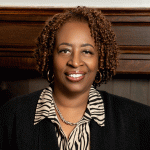
Aaron and others credit the late Gloria Gilmore, a community leader in central Virginia, for helping Bright Hope earn the historic landmark designation through her nonprofit, One Shared Story. It was founded in 2018 to promote African American history in local communities, churches and schools.
Earlier this year, Gilmore passed away on Valentine’s Day before Bright Hope’s designation was announced.
Aaron recalled Gilmore’s passion for preserving the histories of African American churches, and how she often advised Gilmore to “write down” her knowledge about Gordonsville and Louisa counties’ history.
“Oh my goodness, she would help anybody get their family history together,” said Aaron. “It was just amazing, the things that she knew and the people that she knew. And she loved it—sitting down and talking to people. You could tell that she loved it.”

Robin Patton is One Shared Story’s treasurer. As a retired environmental engineer, she also contributed to Bright Hope’s research and application for its historic and national landmark status. That information is available on DHR’s National Register of Historic Places Multiple Property Documentation site.
“It’s been a very lengthy process, and a lot of people have really worked hard for it,” Patton told Charlottesville Tomorrow. She added that readers of the 153-page nomination form will discover what Black churches have done to uncover their history and document their support of the community.
Patton also applauded Gilmore’s work in pursuing Bright Hope’s historic designation. Gilmore, she said, was “a natural at conveying messages with such a presence. Plus, she was fearless, and she had done enough of her own family genealogy to trace her roots back behind the law of slavery.”
Robinson became Bright Hope’s pastor in 2018. After his Nov. 2 sermon, he discussed the church’s journey and recent recognition as a historic landmark. Bright Hope can seat 250 people, but now maintains 30 to 50 members. Like many churches, attendance declined during the onset of COVID-19 pandemic in 2020. Yet, Bright Hope’s doors stayed open.
“We opened up our church service outside, and we did it faithfully every week,” Robinson continued. “And there were people coming from everywhere.”
Community outreach projects continue at Bright Hope, including its annual “Turkey Trot” where food is provided to hundreds of area families during the Thanksgiving holidays. Various county departments and organizations help, including the fire and police departments, he said.
Robinson also is proud of Bright Hope’s participation in the Spirit of Truth Community Choir that combines several local church choirs. Although Gilmore was not a member of Bright Hope — her home church was Zion Hill Baptist Church in Keswick — she was a member of the Spirit of Truth Community Choir.
The choir will perform its annual Christmas Gospel Concert on Dec.14 at Louisa County High School in Mineral.
Referring to Gilmore, Robinson said, “Her work and her efforts did not go in vain. And you know, she really did something that blessed this church … she and Robin put something together. They pushed for this to happen here in this county and in this area. So we are very grateful and thankful for them.”
Editor’s note: This article was updated on Dec. 12, 2025 to correct Gloria Gilmore’s name.