


Casey was 24 years old when his name was recorded as part of an assessment of property at a plantation in Albemarle County.
Washington was 7. Robin was 65. Eliza was 34, and her daughter, Nancy, was 2 months.
They are among the hundreds of people who were bought and sold into slavery at the behest of the Albemarle County Chancery Court between 1830 and 1865. And they are among the more than 300 people whose names are listed inside a few dusty books that sat, ignored, on a shelf for generations.
But new research from The Memory Project at the Karsh Institute for Democracy at the University of Virginia brings their names — and some details of their lives — to light.
For the past three years, graduate student researchers in UVA’s Department of History pored over six volumes of the Albemarle County Chancery Court order books in the courthouse archives. They scrutinized hundreds of pages loaded with dense, handwritten orders that mention enslaved people. Words such as “slave,” “hands,” and “negro” guided the researchers to any details about them.
Their research is compiled in a 202-page report, “Enslavement by the Book: An Index to the Albemarle County Chancery Court cases with mentions of Enslaved People, 1831-1865.”
The goal of the research was to create a resource that descendants of enslaved communities in Albemarle County could use to make genealogical connections to their newly-identified ancestors.
That’s already happening.
Bertha French, vice president of the Descendants of Enslaved Communities at UVA, said several of the group’s members “have discovered family connections to the names that appeared in the archival research, adding another dimension to understanding our collective history.” The group saw the report in the spring, before it was released to the general public in September.
“Of course there are surprises in the research findings, but giving families time to process the information is of paramount importance and requires a trauma-informed approach,” French wrote in an email to Charlottesville Tomorrow.
But the chancery court order books revealed something else that previous research hadn’t illuminated so fully: The Albemarle County government was highly involved in local enslavement and human trafficking.
“This is Albemarle County actually engaging in slave trading,” said Jake Calhoun, one of the researchers on the project and a postdoctoral associate at the Albemarle-Charlottesville Historical Society.
More than nothing, memory matters
The horrors of enslavement in Albemarle County have never been secret. It’s well-known that in this area during the 17th, 18th and 19th centuries, white landowners enslaved Black people and treated them as property rather than as people. It’s known that society not only allowed it, but encouraged it.
Descendants of those who were enslaved in Albemarle County have memorialized their ancestors in various ways, both public and private, for generations.
But only recently has the broader Charlottesville community shown interest in learning more about this history and memorializing it in a public space — especially in Court Square in downtown Charlottesville, where both city and county courthouses are located.
The first recorded attempt to publicly mark Court Square’s role in the trafficking of enslaved people came in the 1970s, said Jeffrey Werner, Charlottesville’s historic preservation and design planner. The city installed a slate plaque on the side of Number Nothing Court Square, a nondescript, privately-owned building that still stands today. The plaque read “site of slave block.”
The slate plaque disappeared in the early 2000s, and some community members were upset about it, according to Werner. In response, the city created a new, bronze plaque that said, “Slave Auction Block: On this site slaves were bought and sold,” and hoped to install it where the slate one had been. The building’s owner at the time did not want it on the side of the building, but allowed it to be embedded in the sidewalk out front. That happened in 2011 or 2012, according to Werner’s records.
Still, community members weren’t happy. In a letter to the editor published in The Daily Progress in 2014, local civil rights activist Eugene Williams criticized the decision to put the plaque in the ground where it was difficult to see, and even harder to read.
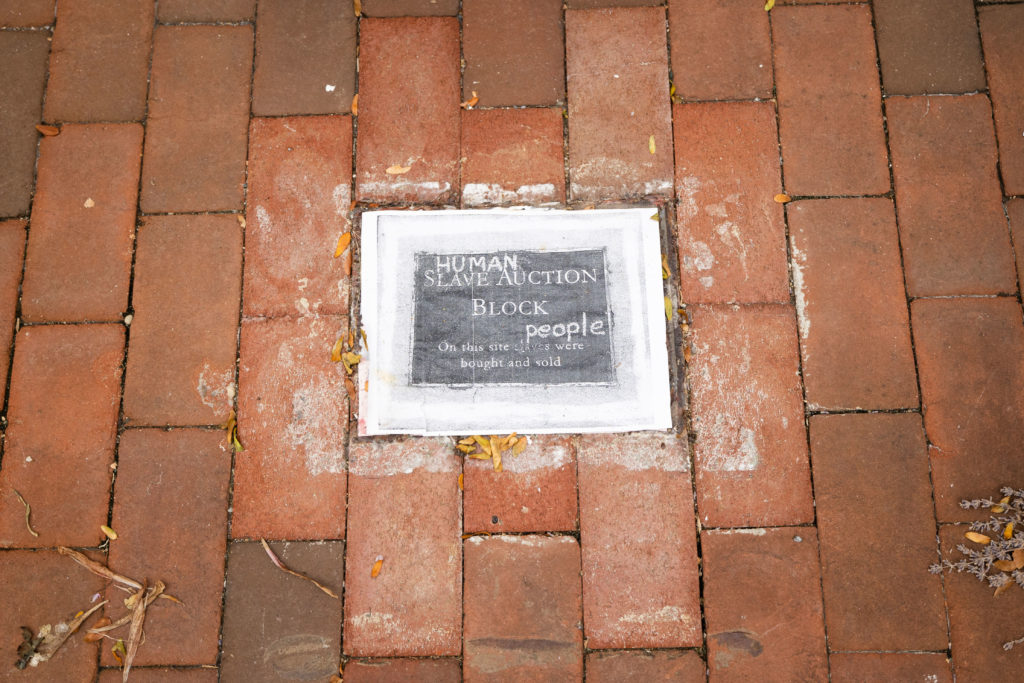
At times, community members would edit the plaque with chalk, or with permanent marker and slivers of cardboard, amending it to say “Human Auction Block: On this site humans were bought and sold.”
In 2016, Charlottesville City Council established the Blue Ribbon Commission on Race, Memorials, and Public Spaces in response to then-high school student Zyahna Bryant’s petition to remove the Robert E. Lee and Thomas J. “Stonewall” Jackson statues from public parks. The commission was tasked with examining what was memorialized in local public spaces, and whether those memorials reflected the community’s values.
As a result, the commission recommended that four statues throughout the city be removed. It also recommended that the city take a closer look at some of the history that was not memorialized, including the history of human trafficking in Court Square.
On Feb. 6, 2020, community member Richard “Freeman” Hobs Allan stole the plaque and flung it in the James River. He cited Williams’ letter to the Daily Progress when asked for his reasoning.
Soon after, on Feb. 17, 2020, the city’s Historic Resources Committee recommended installation of a temporary marker at Number Nothing. A couple of weeks after that, an HRC subcommittee and members of a descendant community requested that the city wait to install a temporary marker until having a broader discussion with the descendant community.
On March 1, 2020, descendants led a community vigil commemorating the lives of the people bought and sold at various sites throughout Court Square.
However, before the HRC could formally discuss the descendants’ request, the COVID-19 pandemic hit and halted the discussion, Werner said.
As the community continued to confront the ugliest parts of its history, the statues came down, some new memorials went up, and community members continued to mark the history of Number Nothing Court Square on their own.
There was a recreation of the “Site of Slave Block” plaque placed on a signpost on the street next to Number Nothing. Someone put a “1619” sticker on a lamppost outside of the building, referencing the year enslaved Africans landed at Point Comfort, in what is today Hampton, Virginia. Bouquets of fresh flowers frequently adorn the site.
Others have placed new text, printed on paper, over the hole in the sidewalk where the bronze plaque used to be. There have been two different versions of this, one with an edited version of the bronze plaque’s text, and another with longer text. This action has been particularly controversial because some see it as going against the descendants’ request to have a conversation with the city before re-installing a temporary plaque, said Werner.
Descendants have held various events where they read aloud the names of their ancestors — some of whom were bought and sold in Court Square — read poetry, and pour libations in their memory.
So much focus was put on Number Nothing Court Square, in part because of all of the controversy surrounding the various plaques. But historians disagree on whether Number Nothing had an actual auction block, and where it might have been.
What they do agree on is that for more than 100 years, people were bought and sold at various sites throughout Court Square — at Number Nothing, but also at the Eagle Tavern (now 300 Court Square), outside the courthouse, and probably other places as well.
That will be commemorated in a historic marker approved earlier this year by the Virginia Department of Historic Resources.
The marker will be placed at the south end of Court Square Park, above the low brick wall that runs along East Jefferson Street, near the lawn in front of the Albemarle County Courthouse and across the street from Number Nothing. The city hoped to install it this fall, but there is a “significant backlog” at the foundry that is creating the marker, said Werner. He doesn’t expect it to be delivered until sometime early next year.
“The intent is a factual statement about this history and is in no way, shape or form intended to serve as a monument or memorial,” Werner told Charlottesville Tomorrow in an email earlier this year.
Memory Project aides ancestry search
All along, descendants have been wanting to know more about their ancestors’ identities. Some, such as Myra Anderson, can trace their lineage directly back to people who were bought and sold in Court Square.
Anderson knows through genealogical records that she is a descendant of the Hern family. Six members of that family were sold in the final estate sale of Thomas Jefferson on Jan. 1, 1829. The Richmond Enquirer printed an advertisement for the sale, which took place outside of the Eagle Tavern — a curator at Monticello found it and shared it with Anderson.
Anderson’s situation is not common. Personal information about enslaved people is hard to obtain for several reasons. If records were kept at all, they are often incomplete, missing or destroyed. Most surviving document sets, such as court minutes, deed books and newspaper archives, contain tidbits of information at best, said Jake Calhoun, one of the “Enslavement By The Book” researchers.
As a result, what most descendants know about their ancestors is based on family, church and community oral histories. But there is always hope that new records will be discovered, and there were still some local records that historians and descendants’ groups hadn’t yet examined — like the Albemarle County chancery court order books.
So, on the advice of some local historians and descendants’ groups, that’s where The Memory Project researchers looked.
It was strategic, Calhoun explained.
Chancery court is an archaic term for property court. Usually, a case came before the chancery court of Albemarle when someone died without a will, with multiple wills, or if multiple people laid claim to a will.
“People would be trying to divvy up property, and this became very difficult for the courts, because in antebellum Virginia, a substantial amount of property — in fact, the most expensive property — was human beings,” said Calhoun.
That’s because the transatlantic slave trade ended legally in 1807, so during the time period the researchers were looking at — 1831 to 1865 — there were no more enslaved people being brought to the U.S. from other countries. But demand for enslaved people was growing as cotton and tobacco production increased on plantations in the Deep South. The only way to acquire more enslaved workers was to get them from other states.
And Virginia had the largest enslaved population of any state in the Union prior to the Civil War.
To put that in perspective, more than half of the people living in Albemarle County at the time were Black and enslaved. (At the time, Charlottesville was a town and the judicial seat of Albemarle County. It didn’t become an independent city until 1888, and even then, it was composed of just 780 acres in the area that today is known as North Downtown.)
When people disputed a will in the Albemarle County chancery court, the court sent a commissioner of the court to the estate to create an inventory of all the property on it — including people. Commissioner of the court was an appointed position, one given to community members with a certain amount of status, usually property owners themselves who the court thought wouldn’t be tempted to steal from the estate they were assessing, said Calhoun.
“Essentially, these [men] became court-appointed slave traders and human traffickers,” said Calhoun. “They would engage in these sales on behalf of the court system.”
For instance, in his inventory of the Viewmont Plantation and the Snowden Estate, commissioner Francis B. Dyer wrote down the name, the age, and in some cases, physical information like “diseased” or “subject to fits,” for each of the 69 people enslaved there between 1834 and 1836. Dyer also assigned each person a monetary value. He decided that Caleb, age 24, was worth $530 — nearly $19,000 in today’s money. Nancy, just two months old, was worth $75, about $3,400 today.
To resolve the property disputes, the court usually did one of two things. A certain number of enslaved people would go to one claimant, and a certain number would go to another. Or, the court would order the people to be sold at auction with the profits to be split among the claimants.
That information was logged in the chancery court order books, which is how the researchers uncovered so many names.
There are no details about any auction or sales events in the order books, but it’s easy to imagine how dehumanizing the process would have been, said Calhoun, noting how the commissioners of court might have examined enslaved people as if they were livestock, poking and prodding their bodies, opening their mouths to look at their teeth.
“It’s a horrific, horrific thing,” said Calhoun.
Some of the cases that the researchers read went on for five years or longer. This left the people enslaved on the land for years, said Calhoun.
“It would have been a very, very stressful time for a lot of folks. They didn’t know what was going to happen to them, what their fate was going to be.”
Research shows that enslaved people who tried to escape usually did so when they knew they were going to be sold, said Calhoun. Not knowing whether they would be separated from their families, or whether their new enslaver would be worse than their old one, many people chose to try for freedom.
Not all were successful.
The researchers saw some cases where an enslaver manumitted, or freed, the people he enslaved, in his will. In those cases, the enslaver was expected to provide enough money to send them to another state, or to Liberia, Africa.
According to the index, at least one Albemarle County enslaver put money aside for the people he enslaved to move to Pennsylvania, buy land, and start a free settlement.
But Nat Turner’s Revolt in 1831 stoked fear among white enslavers that a free Black population would instigate a widespread rebellion. Turner was enslaved on a plantation in Southampton County, Virginia, about 150 miles southwest of Albemarle County, and tried to escape multiple times in his life. On the night of Aug. 21-22, 1831, he and his allies killed 55 white men, women and children in a single night. Their rebellion was thwarted within a day, and white landowners in the area reasserted their control by killing roughly three dozen Black people without trial.
In 1850, Congress passed the Fugitive Slave Act, which mandated the return of free Black people to their enslavers. And while the court sometimes allowed for manumission, at other times it did not, said Calhoun.
It wasn’t unusual for the court to keep enslaved someone who was manumitted or declared free in a will. Reasons for this practice included that a free Black person couldn’t be trusted with their freedom, or that their enslaver hadn’t left enough money, or that keeping them enslaved was a better option for the good of the community.
“We have the idea of the court as a neutral arbiter,” said Calhoun. “But it’s very much not during this time.”
There are no details in the chancery order books about auctions or sales themselves, said Calhoun. And in some cases, if a large number of enslaved people were being sold off with the property they lived and worked on, it’s not likely they were all brought to Court Square for such an event.
“Most sales of enslaved people never took place at the courthouse,” said Calhoun. “They might be recorded, they might be mentioned in formal records, but the participants would never have brought the enslaved people to the courthouse. Court Square is one node of a very wide network of enslavement.
“It’s worth remembering, too, that this was a fraction of enslaved people sold in Albemarle County,” Calhoun added. “We’ve only scratched the surface.”
The unknown is what haunts Bethany Bell, another researcher on the project.
“The names I can’t get out of my head are the ones that are not listed, specifically the names of children,” Bell, who is pursuing a graduate degree in history at UVA, wrote in an email to Charlottesville Tomorrow.
“Often a court record will mention the name of a woman ‘and her children,’ or ‘and her increase,'” Bell wrote. “It is always staggering to consider the impact of slavery on children and families. Black enslaved families went to great lengths to remain together and were sometimes successful in doing so, but there were no guarantees that would be the case. The Chancery Court records reinforce the chilling reality of family separation, a threat that always hung over the heads of enslaved families.”
The records included more than names, too. In some cases, the researchers came across stories. There was the story of Pandanerium in Pennsylvania. When Charles D. Everett, the personal physician to Thomas Jefferson and James Monroe, died, he manumitted the people he enslaved, leaving them enough money to move to Pennsylvania to start a free community. They called it Pandenarium, and it lasted until after the Civil War.
“You do find, it’s not all horror,” said Calhoun. “But the moments of hope are mired in horror,” because the moments of hope are about escaping this institution of enslavement.”
Calhoun often thinks about the story of a woman named Lucinda who was enslaved by a man named John Danielle. Danielle was in debt, and the court seized his most valuable property — the people he enslaved — to pay his debts.
“Lucinda was sold at public auction to basically pay for John Danielle’s poor business decisions,” said Calhoun. “These things stick out at you.”
Seeking repair and recognition
What the community will do with this new information is uncertain.
“How can we account for the fact that Court Square, which is supposed to be the seat of justice in the community, was the site of so many sales of enslaved residents from the community?” asked Jalane Schmidt, director of The Memory Project.
That’s up for the public to decide, she said, noting that the City of Charlottesville and Albemarle County both are currently reimagining various spaces around Court Square, which houses all but one court for both localities.
Charlottesville Parks & Recreation is creating a master plan for city parks, including Court Square Park. And Albemarle County is renovating and expanding its courts complex.
“This is an ideal time for the public to say ‘we want public history in our public places that is really being true and honest to the history of our community,'” said Schmidt.
Meanwhile, Bell likes to remind people about the origins of slavery, stating that “slavery was not just a custom engaged in by individual slaveholders, but an institution enforced, upheld and protected by law.”
Recognizing that history is key, said Calhoun of the Albemarle Charlottesville Historical Society.
“These sites that we walk past every day, they are historic and we should remember them,” he said. “We should understand their significance, but also remember that they were sites of horror and trauma for thousands of people. Recognizing that is extremely important — Court Square is historic, but why it’s historic matters.”
Calhoun further believes that everyone bears responsibility “to try to repair what has been done, because the after-effects have been far reaching and continue to this day. The first step is just acknowledging that it happened.”
Some of that repair comes from connecting descendants with their ancestors, as the “Enslavement By the Book” index is already doing. But there’s more to be done, said Bertha French, of the Descendants of Enslaved Communities at UVA group.
“The city of Charlottesville has an opportunity to continue to support research efforts and preserve the archives by making them accessible to all. She hopes the city and county will continue to coordinate with academic institutions such as UVA on this research, noting that, much like the city and the county, UVA owes its existence “in no small part” to the work of enslaved laborers and their descendants who continue to work there today.
The city, the county, and UVA appear to be catching on. Charlottesville’s Historic Resources Committee is working with descendants on research about Court Square and other sites. In 2019, with the help of local activists and historians, including Schdmit, Albemarle County installed a historical marker about the lynching of John Henry James. In 2021, UVA dedicated a Memorial to Enslaved Laborers on its campus. In 2023, an Albemarle County judge dismissed James’ wrongful indictment from the record 125 years after his death.
For its part, the descendants’ group doesn’t have a particular recommendation about what the broader community should do with the “Enslavement By the Book” research at this time, but it does have a request.
“While we do not prescribe a particular action,” French wrote in an email, “we continue to underscore that all acts should work toward repair and should continue to center descendant communities in ways that can foster healing and reparation.”