

Confused about what a “yes” or “no” vote means in the fast-approaching special election on redistricting?
You’re not alone.
This is not a typical election. Instead of choosing candidates, voters are being asked to weigh in on a complicated change to how Virginia draws its electoral maps, in a vote happening at an unusual time. On top of that, over the past weeks, Virginia residents have been inundated with ads, mailers and messages about the upcoming vote that have fueled confusion about what the amendment would do.
We’ll get into that campaign in a moment. But first, let’s clear up any confusion.
The question Virginia voters must answer is:
Should the Constitution of Virginia be amended to allow the General Assembly to temporarily adopt new congressional districts to restore fairness in the upcoming elections, while ensuring Virginia’s standard redistricting process resumes for all future redistricting after the 2030 census?
What a ‘yes’ vote means
A “yes” vote on April 21 supports a proposal to allow Virginia lawmakers to redraw the state’s electoral district maps one time ahead of this year’s Congressional elections in November. The proposal was put forward by Democrats who control Virginia’s state government after sweeping the November 2025 elections.
Because Democrats control state government, they have said they would then redraw the maps in a way that increases the chances of sending more Democratic representatives to the U.S. House this fall. This comes as Republicans and Democrats in other states are also redrawing maps to increase their parties’ representation in Congress.
What a ‘no’ vote means
A “no” vote would prevent Democrats from redrawing the electoral maps this year — an outcome Republicans support. If the measure is voted down, Virginia will keep its current districts, which were created after the 2020 Census.
The proposed new map
Virginia Democrats have already released the new map they intend to create should this referendum be successful. Charlottesville Tomorrow’s Data Lead Leela Prasad built some interactive versions of the current and proposed maps for you to explore.
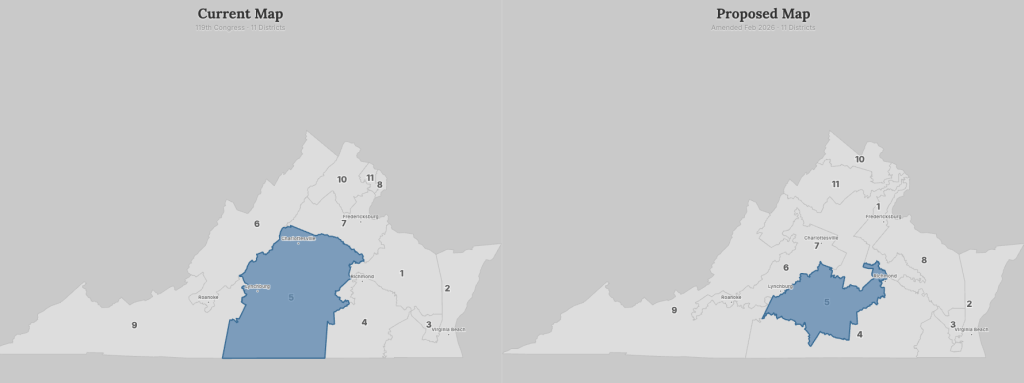
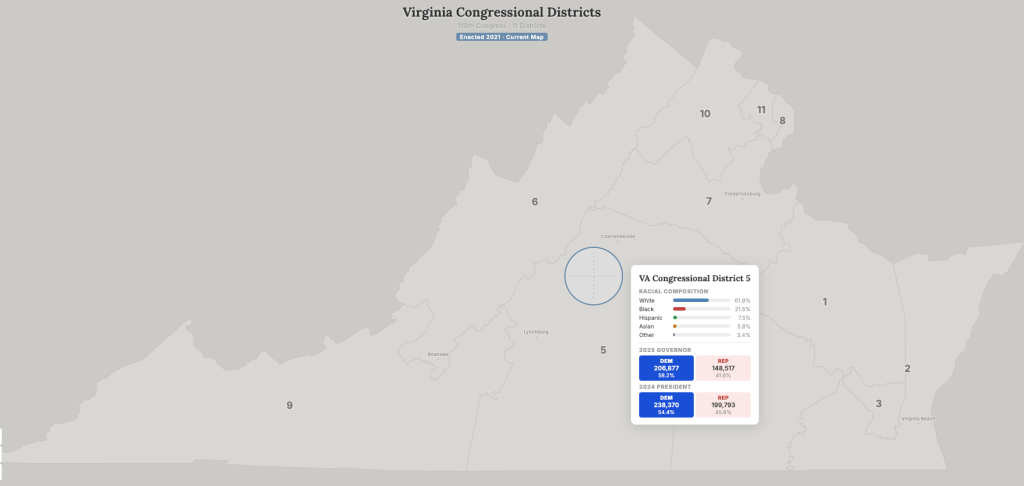
You’ll quickly see that the new maps put many Virginian voters in entirely new districts. In the central Virginia region that our Voter Guide covers, Greene, Madison, Culpeper and Orange counties will remain in the 7th District. Lousia County will move from the 5th District to the 7th District. To the south, the City of Charlottesville along with Albemarle, Fluvanna and Nelson counties will move from the 5th District into the 6th District. And a much smaller 5th District will include Appomattox and Prince Edward counties, along with most of Buckingham and Cumberland counties. Part of Cumberland County and Buckingham County will move into the 7th District.
If you’d like to dig in deeper on each new district, the Virginia Public Access Project has compiled troves of information, check it out here.
Why is this happening?
The Democrats’ proposal is gerrymandering, something that legislators said they were trying to eliminate when Virginia last redrew its maps during the standard post-Census redistricting process in 2020. Lawmakers have been clear that this effort is meant to increase the likelihood that Virginia will send more Democratic representatives to the U.S. House in this fall’s election.
But Virginia’s action comes as many other states are also gerrymandering their electoral maps. So far, six states have redrawn their maps ahead of this year’s election, and Virginia is one of four that are currently deciding whether to redistrict. This is not normal. Normally, congressional district maps are re-made once a decade after the U.S. Census is updated to reflect current populations.
The current wave of mid-decade redistricting began in 2025 after President Donald Trump pushed Republicans in other states to pursue redistricting so the party would maintain control of the U.S. House after the elections in November. Texas was the first of several Republican states to do so. That prompted Democratic-led states to pursue their own redistricting in response — turning what is typically a once-a-decade process into a more immediate, national political fight.
Ballotpedia has a wealth of information about the national effort. As of this week, the redistrictings will likely increase the number of Republican representatives in the House next year by nine members. Democrats redistricting efforts have added six.
If voters allow Virginia lawmakers to redistrict, our state could add as many as three Democratic representatives — essentially evening out the number of representatives to the same number as before the redistricting efforts began.
Why is this confusing?
There’s a lot at play here, beginning with the wording of the measure itself, which can be difficult to interpret. Rather than asking voters directly whether they support a new map, it asks whether lawmakers should be allowed to redraw district lines. This requires voters to understand how that authority might be used.
Political groups opposing the referendum have capitalized on this inherent confusion, and filled Virginian’s mailboxes and inboxes with messages that make it appear like Democratic leaders oppose the amendment.
Various members of our newsroom have received mailers from the Justice for Democracy PAC with photos of former President Barack Obama and Gov. Abigail Spanberger appearing to encourage voters to vote “no” on the referendum. In fact, they have both been actively campaigning for “yes” votes.
The campaign has been particularly targeted toward minority voters, highlighting that the redistricting effort would disperse communities of color across multiple districts. (It’s worth noting here that the NAACP has actively supported the amendment, and released multiple statements condemning the campaign, you can read one such statement here.)
Multiple media outlets have written about this campaign. For a sense of who is behind the campaigns, I recommend this April 13 report from Cardinal News. For an overview of the redistricting attempt itself, the Center for Politics did an analysis of the proposed maps that I also found interesting.
How to cast your vote
If you’re still with me, my guess is that you’re interested in this referendum and would like to vote!
Your guide to local elections in 11 central Virginia counties
You can still vote early at your local registrar’s office Friday and Saturday. If you miss those, Tuesday, April 21, is Election Day! You’ll need to head to your polling place to cast your ballot.
- If you don’t know where your polling place is, registered voters can look it up here.
- If you’re not registered, you can still vote! Here’s where non-registered voters can find your polling location. Once you’re there, poll workers will register you on the spot.
Happy voting, everyone!
Jessie Higgins, Democracy Editor