


Weeks after the local authorities lifted the “do-not-use” water advisory for eastern Orange County, Cassi Hernandez, a single mother of three in Locust Grove, still forbids her children from drinking the water.
“I’m completely terrified about digesting the water for myself and for my kids. I am concerned about any health issues this may cause. It may be a delayed effect,” she said in a message to Charlottesville Tomorrow.
Despite the early suspicion that the contamination came from the river, now the investigators from the Virginia Health Department and Virginia Department of Environmental Quality think that it originated in the Wilderness Water Treatment Plant when three submersible water pumps failed in a span of four days and spilled mineral oil in the water in the process.
These failures were catastrophic, authorities said on the official updates page as well as public and private comments.
The crisis began shortly before the Virginia Health Department and Rapidan Service Authority, or RSA, the local water treatment plant operator, issued a “Do Not Use” water advisory on Aug. 21 after residents of eastern Orange County served by the Wilderness Water Treatment Plant started to report a strange petroleum-like odor in their water. Some said their water had a strange taste or turned brown. Hernandez’s water in the Lake of the Woods neighborhood had some of that odor, she said.
The “Do Not Use” advisory, which restricted all forms of use but flushing the toilet, was changed to “Do Not Drink,” which only limited ingestion of the water, on Aug. 24 and then lifted entirely on Aug. 27. But Hernandez still refuses to let her kids even brush their teeth with it.
Now, more than two weeks after the advisory was lifted and the tumultuous investigation into the cause of contamination is easing toward its conclusion, Hernandez is among many residents of Locust Grove who are still distrustful of the water, as well as the authorities responsible for keeping it safe.
More than a dozen Locust Grove residents spoke with Charlottesville Tomorrow and expressed their distrust in the water, even after the advisory was lifted. Several said they still don’t drink or cook with it. Some are installing their own water-filtration systems, while others are wondering whether they should move out of the area altogether.
Hernandez is thinking about moving too.
“It’s just kind of hard to trust them with their word,” she said. “I will not feel completely safe or satisfied until the water company takes accountability and is honest about the situation.”
Tim Clemons, Rapidan Service Authority (RSA) General Manager, understands why his customers feel this way.
“We’re gonna have to continue to try to provide as good customer service as we can. I’m willing to talk to any and every customer we have down there. I’ve talked to quite a few through this,” said Clemons.
“There’s nothing that the Service Authority did that created this, but we have to deal with it. We will just have to do what we can to try to rebuild trust.”
It’s not easy to sniff out the cause of water contamination

It appears that all of it might have started on Aug. 20, when one of the three submersible water pumps on the Wilderness Water Treatment Plant failed.
The submersible water pumps are used to pump raw water through the treatment system and usually just one of them works at a time, so when the first one failed, the plant just turned on another one. The second pump failed on Aug. 24, and the third pump, once activated, failed shortly after.
Pumps normally fail when one of their seals do, as a result of the abrasive material coming up from the river, RSA’s Clemons explained during The Orange County Board of Supervisors meeting on Sept. 10.
It’s uncommon, however, that all three failed within a span of a few days, Clemons told Charlottesville Tomorrow over a call. These were relatively new pumps, too.
“That is not normal,” he said. “We’re still investigating why.”
Clemons said that the pumps were operating on temporary wiring due to the construction work done at the plant. He can’t be certain that caused a problem until their investigation is over, but it’s a possibility.
As a result of the failures, mineral oil used as a pump lubricant spilled into the water. It’s that heated oil that likely caused the odor and the taste, an expert Virginia Health Department (VHD) consulted in Texas concluded.
“We ruled out everything but the pumps,” said Dwayne Roadcap, the Director of the VHD Office of Drinking Water, in an interview.
The first reports of the odors started coming in on Aug. 21 and resulted in the “Do-not-use” water advisory issued the same day. The RSA, VHD, the Department of Environmental Quality (DEQ) and the Virginia Department of Emergency Management started to investigate the cause — they collected and tested samples from the water treatment plant, the Rapidan River, among others.
The screening analysis quickly showed hydrocarbons, or organic compounds associated with crude oil and natural gas. Later, the tests found bis(2-chloroethyl) ether, or BCEE, a by-product of chlorination used to disinfect water, as well as other compounds. However, they weren’t responsible for the odor, the experts said.
Odors and tastes in the water are notoriously difficult to investigate, experts told Charlottesville Tomorrow, and in many ways the weeks-long investigation into the eastern Orange County water crisis is reflective of it.
“The human nose can smell whatever compound or chemical or contaminant might exist, and the nose can be more sensitive than the lab testing that’s available,” said Roadcap.
We need a new and better and improved plant.
—Orange County Supervisor Crystal Hale
Usually, the public drinking water is monitored and treated for over 90 different contaminants that are determined to be harmful by the U.S. Environmental Protection Agency, or EPA. That means that the tests available to public officials are designed to detect those contaminants once they reach a certain concentration threshold. If the tests don’t register any, that usually means the water is considered safe to drink.
That’s why the “do-not-use” water advisory became “do-not-drink” and was lifted before the investigation established the cause of the contamination — the water was found to be safe based on the federal regulations. There are no federal regulations controlling odor or taste, but RSA recommended any customers who still experienced these issues to proceed with caution, flush their water system and, if that didn’t help, reach out to RSA.
The investigation, however, continued hoping to determine the cause for the odor and flavor as well as the hydrocarbons and other compounds found in the water.
“It’s worse than finding a needle in a haystack. You have to find something in the hay that’s not hay, and there is just a little bit of it there. It takes a lot of investigative effort,” explained Andrea Dietrich, a water quality expert at Virginia Tech whose research focuses on aspects of water quality such as taste, odor, and appearance. She is also one of the experts VHD has been consulting.
“It’s really hard to find small amounts, especially since we don’t know what this chemical is,” said Dietrich.
That’s arguably one of the reasons why the investigation has been taking longer than Orange residents wished. When the authorities ran out of regular tests and expertise, they turned to more sophisticated laboratory tests and outside experts as consultants and eventually identified a chemical they believe could be responsible for the smell — isovanillin, a vanilla-scented chemical used in fragrances and flavorings.
Now that investigators ruled out the river and everything else as the possible source of contamination, according to Roadcap, they believe that the pump failures were indeed the likely cause for all of these abnormalities in odor, taste and test results.
It’s likely that these chemicals came from burnt pump components, said Roadcap. The experts, however, don’t have evidence yet that isovanillin came from the mineral oil. They suspect, but it’s not a certainty.
The next stage of the investigation would focus on determining the reason behind it.
“The thing we’re trying to do is figure out how to make sure this doesn’t happen again,” said Roadcap.
Take Action
Do you want to hear directly from the Rapidan Service Authority Board about how the eastern Orange County’s water was contaminated in August? The Board will give an update on the Wilderness Water Treatment Plant on Thursday, Sept. 19 at 2 p.m. during its monthly meeting in Orange County Public Safety Building Board Room, 11282 Government Center Dr., Orange.
This meeting is open to the public and allows time for public comments.
Residents remain distressed about the safety of their water

It’s all cold comfort for residents in Locust Grove.
“It’s very disappointing the way RSA and local agencies are handling the water situation,” Hernandez said.
“They also need to publicly apologize and come out and test the water with a professional showing that the water is safe to use and educate people on what safe water levels are and how to find out if it’s not.”
She has had to spend a lot of time learning the science to keep up with the updates about something as essential as safe drinking water. In the end, she said she would rather go back to the early stages of the COVID-19 pandemic when people were wiping down their groceries than to being unable to use her water.
Other Locust Grove residents who spoke with Charlottesville Tomorrow shared Hernandez’s feelings.
“Would we have even heard about the pump failures if it wasn’t investigated as part of the odor? I have no confidence that my water is safe. We still aren’t using it,” said Jamie Ellison.
She is installing her own water filtration system, which cost her $5,600, and she paid $540 out of pocket to test her house water after RSA didn’t respond to her filed complaint. Her water smelled more like strong chlorine, she said. Her family stayed several nights at a hotel just so they could shower and do laundry.
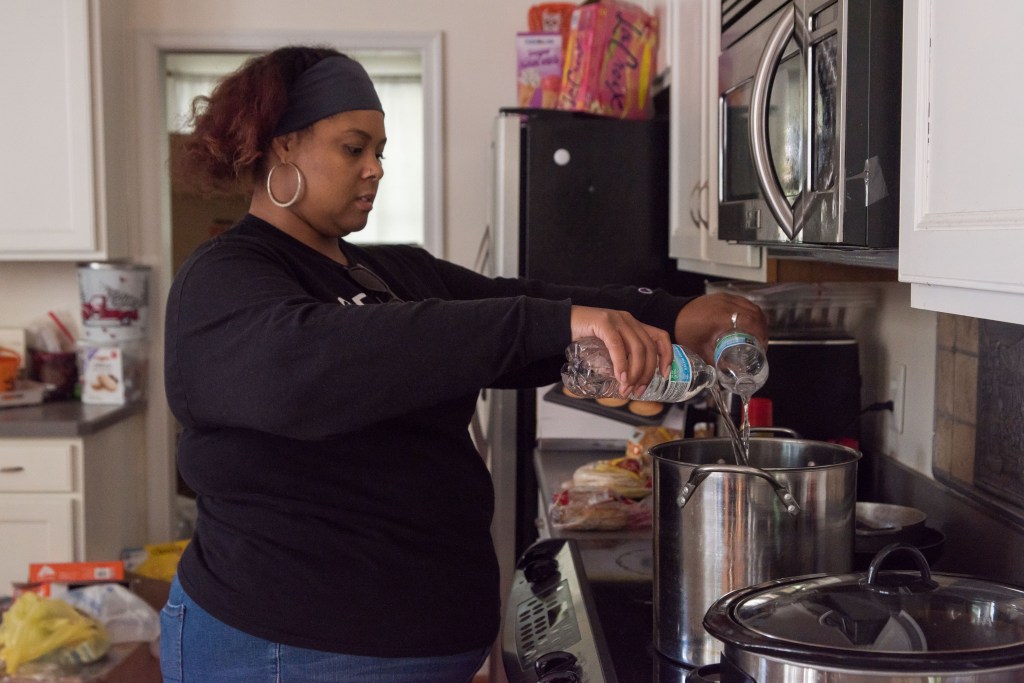
Ellison is among the residents who have been keeping an eye on the water and RSA even before this crisis.
Earlier this year, RSA sent out notifications saying that the levels of Haloacetic Acids in the water were above the EPA Drinking Water Standards. Haloacetic Acids are chemicals formed as a byproduct of water disinfection. It’s a standard practice to disinfect drinking water; it just happened that RSA did too much of it, at least in the second quarter of the year when the water tests caught it.
Based on limited studies, one of the notices from RSA said, Haloacetic Acids are not a concern unless the exposure is prolonged or the person consuming it has pre-existing health concerns. Animal studies suggested it could, over a long time, increase the risk of cancer.
With so much attention on reports of chemicals in the water and a weeks-long investigation, some residents are uncomfortable with how many chemicals make it into the water without warranting a water advisory.
“The problem is now, after digging into the samples on the VDH website, I no longer feel safe using the water and have a constant anxiety about what we are being subjected to,” said Sabrina Hakenson Morgan, Locust Grove resident and a mother of three, in a message to a Charlottesville Tomorrow reporter.
“We love our home in Lake of the Woods, but we are considering putting our home up for sale in the spring. I don’t know where we will go, but every time I shower, I wonder what chemicals my skin is soaking up. I won’t let the kids take baths to avoid having them sit in it. They can only shower.”
To address the possibility of the future contaminations as well as to address the higher Haloacetic Acids levels, Clemons, RSA’s general manager, said that the water authority has been looking into the possibility of adding a granular activated carbon treatment process, or GAC, to its water treatment toolkit.
GAC is a standard and widely used water treatment method during which water passes through carbon granules to remove chemicals, tastes, and odors. It would even help with the Haloacetic Acids formed due to the excess of disinfection.
“We learned that if we had something like granular activated carbon, there’s a very good chance this would have never gotten out whatever it was, whether it was oil, whether it was something else, it would have been caught in those filters. So that is something that we are evaluating,” said Clemons.
GAC is, however, expensive to add and to run. Clemons inquired with the Health Department about possible assistance — according to Roadcap, VHD has low-interest loans that could help RSA add GAC treatment.
The matter isn’t “pursued formally yet,” according to Clemons, but, if they decide to pursue it, they will take the idea to the RSA Board and hopefully have a decision within 60 days.
“I think that it would solve two concerns down there. One would be this type of event that just happened, the other would be Haloacetic Acids.”
In the long term, there might be local political will for bigger changes. In fact, county leaders were talking about building a new water plant before this water crisis. It came up in a town hall meeting at the Lake of the Woods neighborhood, Supervisor Crystal Hale pointed out at a Sept. 10 Board meeting.
“Water and the water treatment plant and the water issues are going to be in prime focus,” she said. “Long term, we need a new and better and improved plant.”