

The icy hills and roads that Charlottesville-area residents had to navigate last week meant, unsurprisingly, a lot of injuries.
The UVA Health Emergency Department has seen a surge of ice-related injuries over the last week, said Andrew Muck, chair of the Department of Emergency Medicine at the UVA School of Medicine, and Valerie Quick, trauma program manager at UVA Health Trauma Center. Incidents ranged from head trauma while sledding to broken bones from slip-and-fall incidents to car accidents and, in rare cases, pedestrians hit by cars after stepping on the road to avoid icy sidewalks.
“The sidewalks have been really difficult to clear, and with any of the snow plows coming through, it’s just compiled on the sidewalks,” said Quick. “Then the roads themselves aren’t fully plowed, so you’ve got reduced space there for cars. Where it may have been a two- or four-lane road, it’s down to two lanes, and then you got pedestrians on that.”
From Sunday, Jan. 25, when the ice first formed, to Friday, Jan. 30, roughly 200 people came to UVA’s emergency department with ice-related injuries. A good share of these cases were serious enough to get the trauma team involved in some capacity.
This is just a fraction of the total number of ice-related injuries in Charlottesville, as not all patients with urgent cases will seek care at the UVA Health Emergency Department. Some people go to Martha Jefferson instead, some to orthopedic clinics and some to their primary care doctors. Muck expects that there are also a number of people with such injuries who are waiting for the weather to get warmer and roads cleaner before coming to the emergency department.
According to data from the Virginia Department of Health, 4,044 people sought urgent care due to slips, trips and falls in central Virginia between Jan. 27 and Feb 2. That was an average of 578 people a day, compared to an average of 159 per day in December 2025 and January 2026 before the storm. In Virginia as a whole, there were more than 12,000 such emergency department and urgent care visits in the week after the storm.
Martha Jefferson didn’t respond to Charlottesville Tomorrow’s request for a comment in time for publication.
Either way, last week was unusually busy for doctors.
“The remarkable thing is just the concentrated nature of it,” said Muck. “We might see these numbers over the entire winter of slips and falls on ice, but we’re getting them all in this singular week, which puts a little bit of strain on resources.”
A lot of the injuries seen at UVA — about 60 to 70 out of the 200 — were sledding-related, according to Quick.
“I don’t ever remember seeing those types of numbers in any year past,” said Quick.
These sledding injuries were predominantly, but not exclusively, among younger patients, especially students who were out of school and needed something to do, she added.
“They go out on these really icy hills, and unfortunately, that’s where we see head injuries. You never know where that sled is going to end up. And if you’re not really thoughtful about what’s in front of you, if you don’t see the poles and the trees and road traffic, it’s very easy to have them be a target that you’re going to land on,” said Quick.
Then there were the other reasons that caused people to slip and fall. Some fell while they were out with their pets or kids, leaving safe sidewalks to traverse more slippery areas.
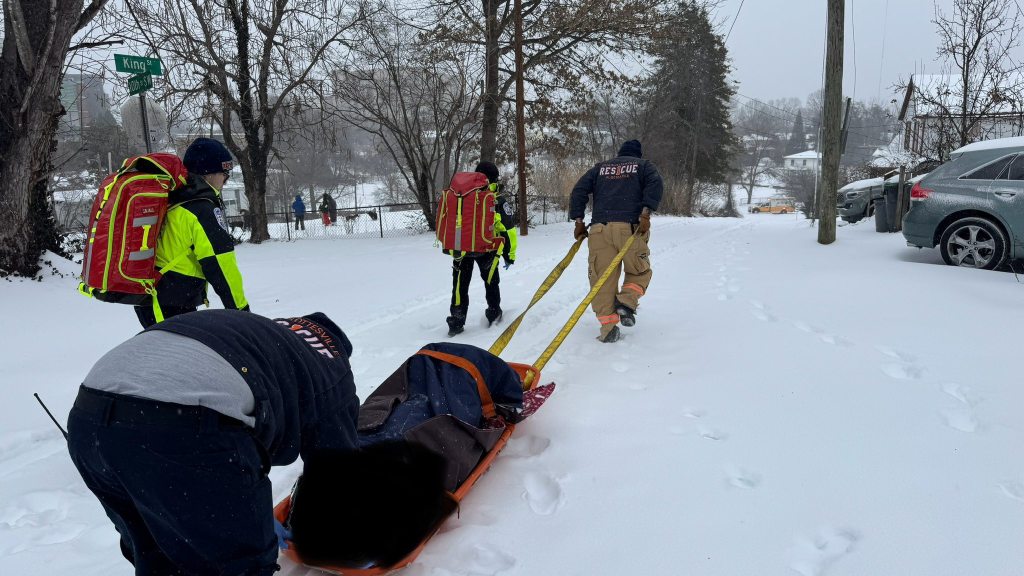
Some people started to slip and, unable to catch their footing due to the ice, slid down a hill or embankment. There were some complicated rescues of people who slid all the way down into embankments and other hard-to-access places, requiring ropes to get them out, said Quick.
Charlottesville-Albemarle Rescue Squad, a volunteer rescue team, told Charlottesville Tomorrow last week about the high volume of calls they answered just between Jan. 24 and Jan. 26, and the complicated rescues they performed.
On Feb. 5, Squad Chief Daniel Paxton said that last week they performed 16 rescues that were more complex than normal.
It was common to see dogs sliding down a hill and their owners going down to retrieve them and getting injured as a result, he said. In one case, a person stepped just two steps away from their house, slipped and slid down a hill. Luckily, after a while, a neighbor noticed their absence and called for help.
Overall, the Rescue Squad received 33% more calls than usual last week, with a good share of them having something to do with fall, said Paxton.
“This storm has been non-ageist. We have seen all age groups affected,” said Muck.
As the days are getting warmer with nighttime temperatures falling below freezing, Quick cautions everyone to stay careful and watch out for black ice on the roads.
Editor’s note: This article was updated on Feb. 5, 2026, to include additional information from the Charlottesville-Albemarle Rescue Squad.