

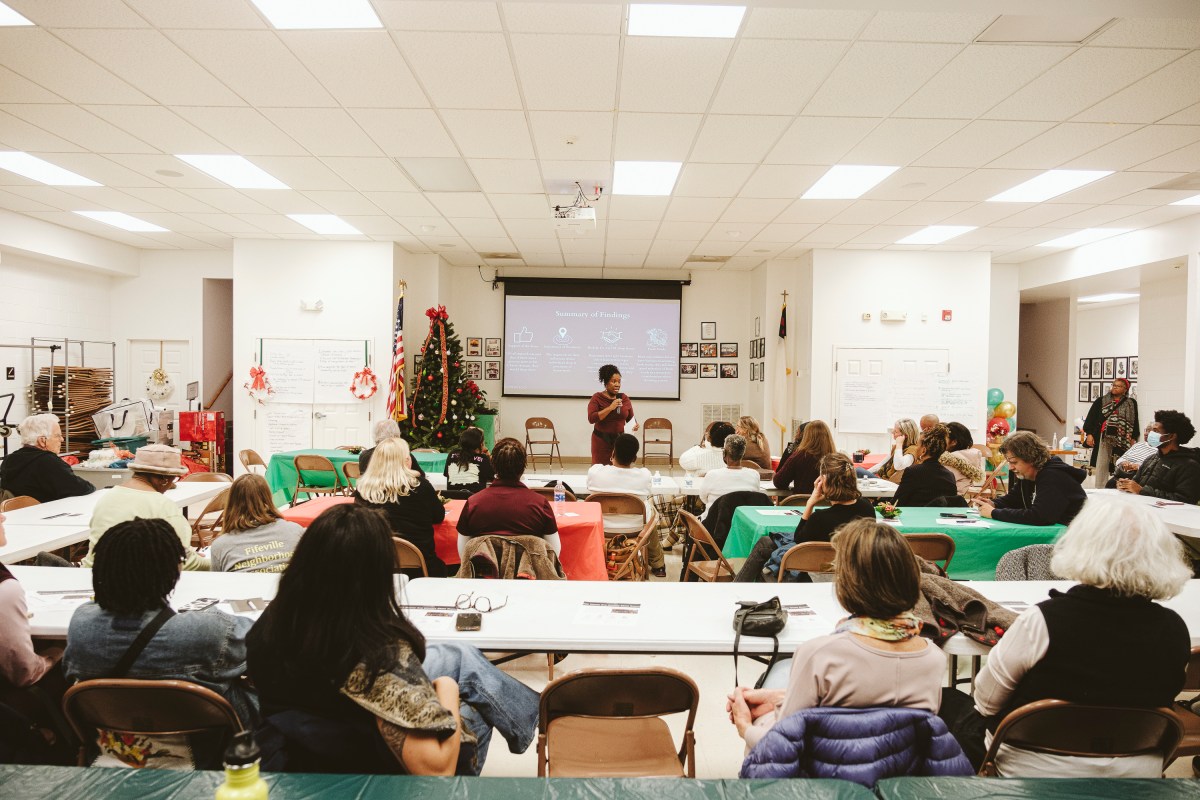
The twinkling holiday decor at Mount Zion First African Baptist Church couldn’t distract 60 community members from their purpose Monday night: Getting an update on whether or not they’ll see a grocery store at 501 Cherry Avenue and if so, who might run it.
There’s still no definite decision about the store, but the neighborhood seems to be inching closer to one.
For decades, a grocery store operated at 501 Cherry Ave. — Estes IGA Foodliner, and later Kim’s Market. When Kim’s closed about five years ago, the building sat mostly unused, and in recent years it’s started to sag. Woodard Properties, a local developer that owns quite a bit of property in the neighborhood, bought the site in 2022. When it did, the neighborhood asked to have a say in what Woodard did with the property. Woodard agreed.
Woodard knew it wanted to make space for the Music Resource Center, a youth-based music nonprofit that has been looking for a new home. The neighborhood liked that idea, and asked for a couple more things: affordable housing and a grocery store.
Back in September, there was some uncertainty about the project. Piedmont Housing Alliance was waiting to secure funding, including federal taxpayer money, in order to finally forge ahead with the housing component. And no one had expressed interest in operating a grocery store on the site, despite the neighborhood’s desire for one.
“My hope is that we are able to give the community what they ask for,” Carmelita Wood, president of the Fifeville Neighborhood Association, said at the time. “My fear is that we will fail.”
But there’s more optimism about the project now.
“Since the last meeting, the news we’ve received is mixed,” Sunshine Mathon, executive director of Piedmont Housing Alliance, told Charlottesville Tomorrow in an email after the meeting. “Nonetheless, I’m feeling quite optimistic about both the residential and the grocery space. There are still some unknowns, of course, but the progress is good and we have a couple of funding pathways to achieve success.”
And four groups have come forward to say they’d like to run a grocery store. They are:
- Good Foods Grocery, a natural foods store in Richmond that opened 1985. Since 2023, it has been owned by Commonwealth Autism, a nonprofit autism advocacy organization, which runs a workforce training program for adults with autism at the store.
- Laziz Fresh Produce, a Charlottesville-based produce stand that is currently a vendor at the City Market. Laziz is particularly interested in carrying foods and products familiar to Middle Eastern communities.
- GoodWill Industries of Valleys — yes, GoodWill, like the thrift store. Earlier this year, this organization opened the Market on Melrose grocery store in northwest Roanoke, an area that had previously been without a grocery store.
- A newly-formed local co-op steering committee, which currently has more than a dozen members, most of them women of color. Co-op grocery stores (“co-op” is short for “cooperative”) are community-owned stores. Anyone can shop there, but only member-owners of the store are involved in the decision-making and receive a cut of the store’s profits.
The Fifeville Neighborhood Association has been talking with all of the groups, and will make an official recommendation to the developer soon, Wood said during Monday’s gathering. Ultimately, the decision will be up to Woodard Properties.
None of the interested groups spoke at the meeting.

This meeting was the fourth and final one in the Buy Back the Block series, hosted by the Fifeville Neighborhood Association and RN HeartWork LLC. The series, which was funded by a grant from the Charlottesville Area Community Foundation, was meant to encourage more community involvement in the 501 Cherry Ave. plan. A few dozen people have shown up to each of the events, though it hasn’t always been the same group of people each time.
The purpose of Monday night’s meeting, the event organizers said, was to share the results of a recent community survey about whether residents were still interested in a grocery store on Cherry Ave.
“That has been a resounding yes,” said Deanna McDonald with RN HeartWork.
Not only do they want a grocery store, said McDonald, the survey showed they want an affordable one.
The response to the survey was “pretty remarkable,” said Jessica Harris, community research program manager for the Equity Center at the University of Virginia, reported Monday night — 504 people filled it out.

The survey was open to both Charlottesville and Albemarle County residents, and the neighborhood with the most respondents — 118 — was Fifeville. The next-most represented neighborhoods were other historically Black ones, including 10th &and Page, Ridge Street, and Rose Hill. The survey was open to both Charlottesville and Albemarle County residents, and people from other areas of the city and the county did respond, Harris said.
The main findings of the survey were that:
- Three-quarters (75%) of the respondents indicated that they would shop at a grocery store at 501 Cherry Ave. if one opened there. About 21% said they might shop there;
- Proximity matters. The factor that most influences where someone shops is how close it is to their home or work;
- Respondents would prefer the store be owned by either a community-based co-op led by a majority of Black residents, or someone/a group with deep ties to the neighborhood and/or the community;
- Residents did not report having trouble accessing fresh food, but they named it as a priority. Cost was another priority.
Yet another of the more revealing results was what people want that space in the development to be if it does not become a grocery store: a childcare facility, a farmer’s market, or a community-centered business or service (suggestions included a YMCA, a skating rink, a medical clinic, and a laundromat).
After Harris presented the survey findings, the meeting attendees broke off into small groups to talk about their impressions of the survey findings — what they learned, what they wanted to know more about, and what they hope to see next.
Most groups said they were pleased with the number of responses to the survey, and that so many Black residents — about 200 — responded. They also said they felt encouraged by the fact that so many people want the grocery store.
Some groups said they wanted more information on the alternatives to a grocery store. Others said they wanted more clarity on some of the measures, like whether or not who owns the grocery store would influence people’s decision to shop there.
Some folks said they still wanted to know more about how — and whether — a grocery store is feasible at the site. They also wanted to hear more from the groups interested in running the store.

As for what they want to see next, one participant put it succinctly.
“Some decisions,” she said. “If it’s a co-op, let’s get busy!”
After the group discussions, Harris, McDonald and Wood sat for a quick panel discussion moderated by Sarad Davenport, a consultant who also serves as chief operating officer for Vinegar Hill Magazine, a Black-led publication.
The panelists took some questions from the audience, and a few folks asked if they could hear from the parties interested in running the store, who were also at the meeting. Representatives from Good Foods Grocery, as well as the local co-op steering committee, were in the room.
McDonald said that she hadn’t asked the interested parties to prepare a statement, so she didn’t want to put them on the spot. Instead, she encouraged people who wanted to talk with them to do so after the meeting. She also suggested that the Fifeville Neighborhood Association consider inviting all four of the interested parties to a neighborhood association meeting so that residents can hear from them.
McDonald emphasized that with the end of the Buy Back the Block series, the onus was now on the community to come up with the next steps.
The current plan for the 501 Cherry Ave. project is to build space for the Music Resource Center, space for a grocery store, and, in collaboration with local housing nonprofit Piedmont Housing Alliance, an affordable housing development.
The project will include 71 apartments, all of which will be affordable to families earning 60% of the Area Median Income or below. Area Median Income is calculated by the U.S. Office of Housing and Urban Development annually, so it is a changing number. In 2024, a family of four earning 60% AMI in the Charlottesville area makes $73,260 per year.