

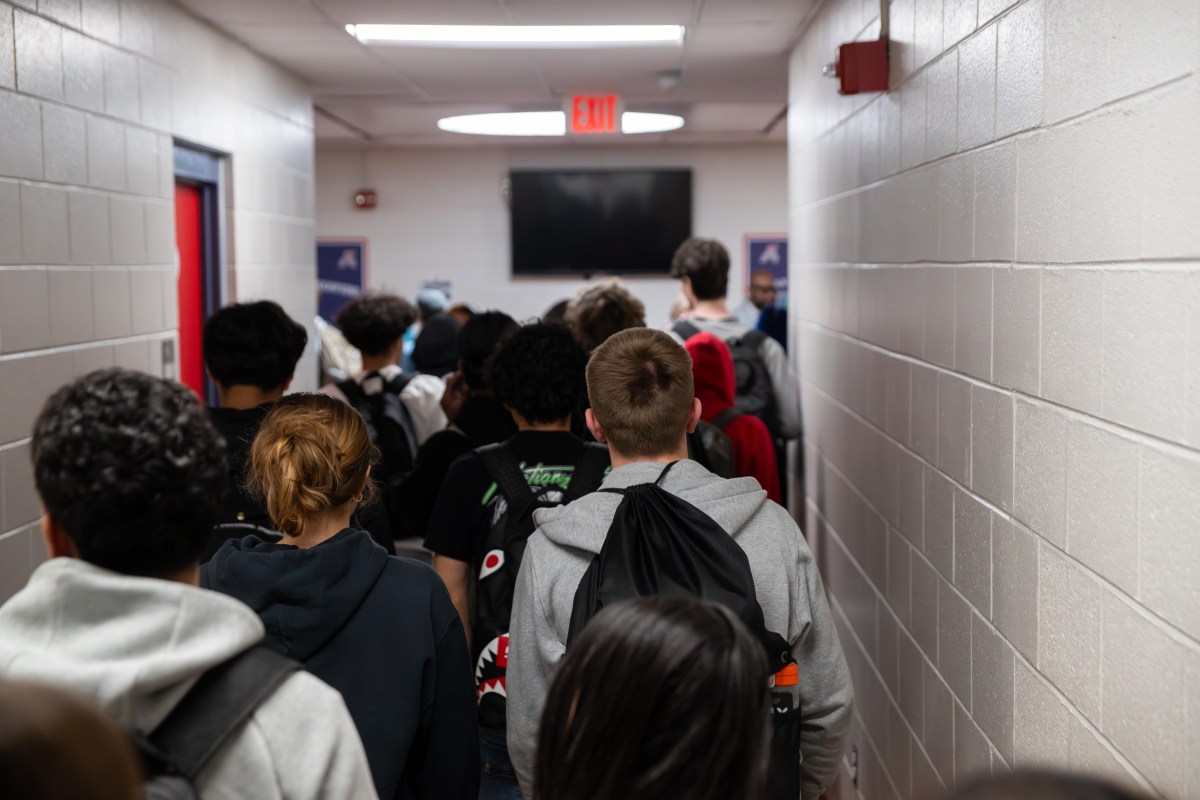
Frustrated, confined, controlled, overwhelmed — these are emotions that some students at Albemarle County Public Schools (ACPS) are experiencing due to overcrowding. And if the latest joint meeting between the School Board and the Board of Supervisors is any indication, those feelings won’t soon go away.
Earlier this month, School Board Chair Kate Acuff and ACPS Superintendent Matthew Haas presented their five-year-plan to the Supervisors that included a new high school, as well as additions and upgrades to existing county schools, at an estimated total cost of $600 million.
Supervisor Mike Pruitt called the proposed construction of a new high school, which was estimated to cost over $200 million, a “failure in long-range planning.” Still, he said during the joint meeting on Dec. 4 that he is for the building of a new school, if the data supports it.
“If this is what the school division needs, we will try to figure out how the hell we can make it happen,” he said.
Pruitt also questioned whether building a new school should be a year-one priority for the county, and if the School Board’s proposed timeline for it was realistic. “It does not seem like a possible proposal for the timeline presented,” he said, adding that it could be more feasible in later years.
Both Pruitt and Supervisor Diantha McKeel criticized the School Board’s 2017 decision to adopt the “center model,” which involves constructing supplemental education buildings near existing schools, instead of building a new high school.
In December 2017, the School Board voted 5-2 to accept a consultant’s recommendation to create smaller educational centers dedicated to project-based learning for high school students while modernizing academic spaces at the county’s existing high schools. At that time, the School Board also projected that enrollment for the centers would be over 2,000 students by 2024.
On Dec. 4 however, Supervisor McKeel asked if it was time for ACPS to do away with the center model completely since enrollment for the centers was lower than projected.
Acuff said ACPS is moving forward with the centers, adding that she was confident they would be “heavily attended” if they have a curriculum with the “right career explorations” that would entice students.
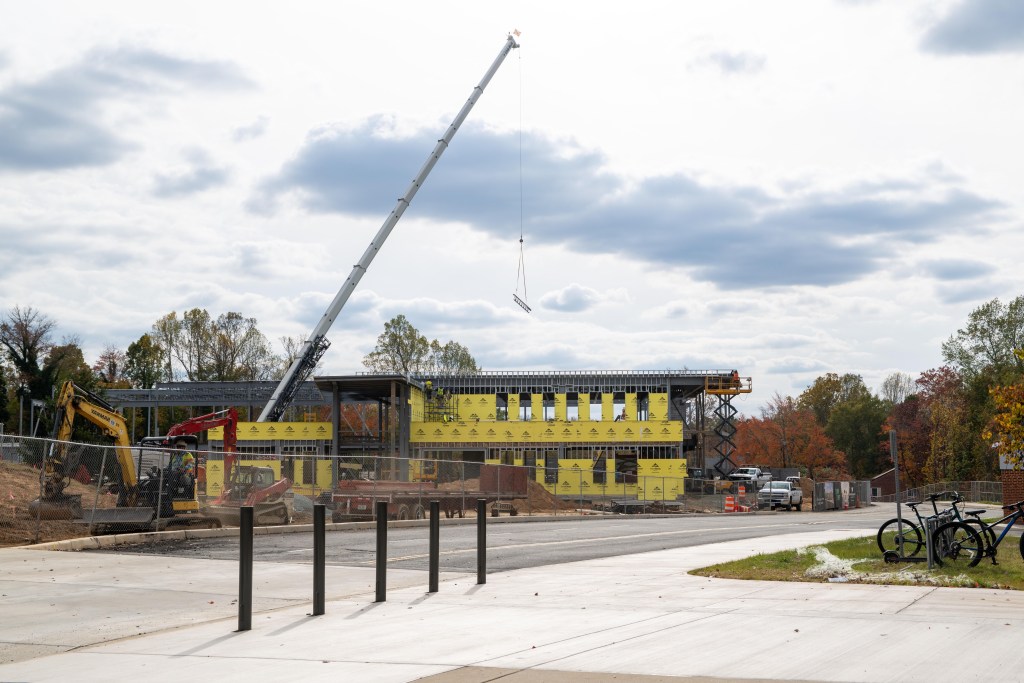
Supervisor Ned Gallaway chimed in and said, “maybe the high school needs to be top priority for year five or six,” of the proposed budget, adding his disappointment that to-date the center model had not resolved overcrowding in the county’s schools. Gallaway also noted that he was thrilled that two elementary schools were currently being built, but agreed with his colleagues that more data was needed before the board could agree to build a new high school.
The Supervisors asked the School Board to gather additional data that would show the expected growth of school-aged children in the county for the next five years.
While Acuff agreed to get data that “we are all happy with,” neither the Supervisors nor the School Board members set a date to present the new data.
In the meantime, students will have to continue navigating packed halls and classrooms.
Students say they’re overwhelmed and emotionally drained
“Hallways are packed, classrooms are crammed. During lunch, many students, especially underclassmen, who aren’t allowed to leave campus, have nowhere to sit,” said Indigo Mathon, a senior at Albemarle High School during the public comment section of the Sept. 11 school board meeting.
Mathon was one of two students that spoke up at that meeting on how overcrowding is affecting students’ attendance and academic performance.
“Despite all of this, our administration strongly promotes the importance of attendance and mental health,” Mathon continued. “But how can you expect students to show up when it’s physically hard to get in the door, emotionally draining to stay and logistically impossible to meet basic needs?”
Overcrowding can have several negative effects on students and teachers, according to a report from Walden University.
Those effects include less personalized and less one-on-one instruction time — which students at AHS said they don’t have enough of — as well as an increase in noise levels, which can distract students.
The report also notes that overcrowded schools often have poor building and environmental conditions, such as poor air quality and poor heating and cooling ability. Some AHS students said they have experienced physical discomfort in classrooms.
“You’re overwhelmed, because there’s always people breathing on you,” one AHS student told Charlottesville Tomorrow. “The rooms would get really warm because of how many people are in there. And so it’s like, a lot.”
In order to manage the overcrowding, ACPS relies on classroom trailers, or “pods.” AHS has 16 classrooms in two pods, located at the rear of the campus. Access to these pods is carefully monitored, as students have to press a button to gain access, and teachers and support staff have access with a key card.
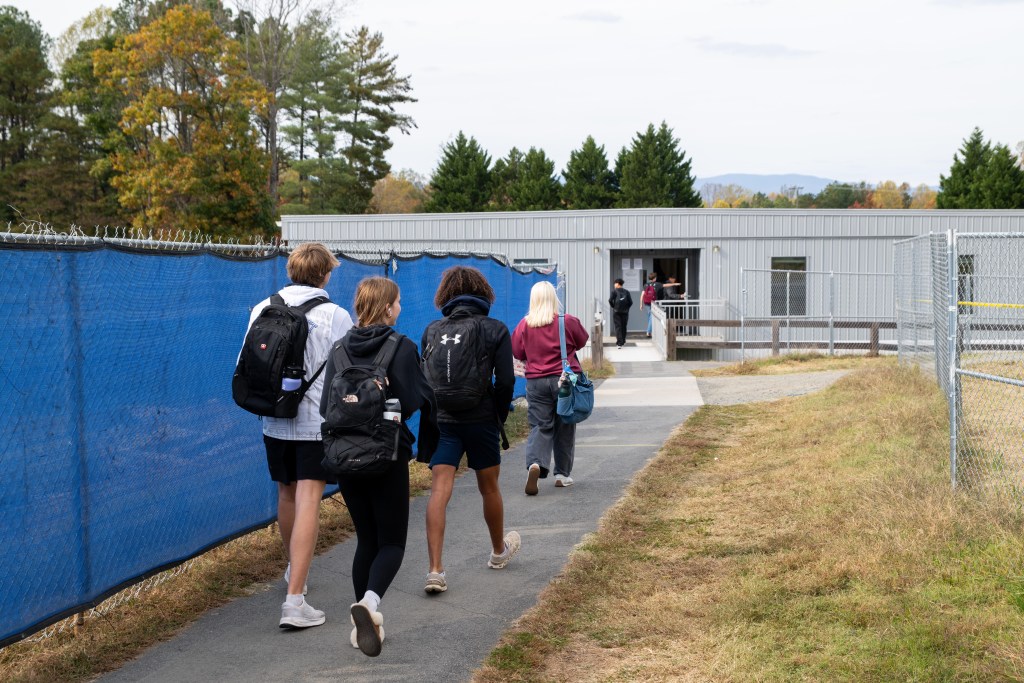
Across the county, there are 78 such trailers, with Monticello High School and Western Albemarle High School each having eight classrooms in trailers each. Mountain View Elementary’s entire fifth grade is using 12 classroom trailers, according to Acuff.
Lack of capacity and potential for overcrowding has been a concern for ACPS for at least a decade, and according to Acuff, the issues started over 15 years ago.
“The challenge has been that, since the Great Recession in 2008, the County’s financing of school projects has fallen significantly behind, and again during the COVID-19 pandemic, the County ‘pushed pause’ on some of our already approved projects. So, we are playing catch-up,” Acuff said in an email to Charlottesville Tomorrow.
ACPS previously contracted HB Architecture & Interior Design and Fielding Nair International to conduct a county-wide study, which was released in Dec. 2017. That study resulted in “recommendations to address both existing facility needs and future capacity concerns,” said a spokesperson for ACPS.
These recommendations were approved by the school board that same year, and included “adding additional capacity through specialty centers combined with extensive renovations to existing high schools,” the spokesperson said. “This approach was designed to be agile and to account for available funding, equitable access for students, and parity across facilities.”
But those projects haven’t moved forward fast enough to cover the gap, according to Acuff.
Parents raise safety concerns, students say getting to class on time is a challenge
In early October, an AHS student who did not want to be named spoke to Charlottesville Tomorrow and expressed their concerns about how the current school environment is affecting them, including feeling rushed when transitioning between classes.
“We have about six to eight minutes to get from a class to another point, and they expect us to use the bathroom and do all this other stuff in those six minutes when we can barely get from one point to the second point in six minutes,” the student said.
According to the AHS student handbook, students have up to 15 minutes to get to class before they are marked “unexcused tardy.” Tardies are subject to disciplinary action, which can include lunch detention for AHS students.
Students in lunch detention go to the school’s auditorium, and according to Sally Duncan, who ran unopposed or the Jack Jouett District seat of the Albemarle Board of Supervisors, the auditorium does not comply with the “Alert, Lockdown, Inform, Counter, and Evacuate,” or A.L.I.C.E safety protocols, which are used by ACPS in dangerous situations, such as an active shooter.
With one child attending AHS, and one arriving at the high school next year, Duncan spoke to Charlottesville Tomorrow as a concerned parent for this story.
“They’re sitting ducks, and so I am very concerned about this,” said Duncan. “This makes me very uncomfortable, because you’re literally just in a theater auditorium.”
One AHS student also raised a concern over the number of students in lunch detention on a given day. “I stepped in there this morning, and there were over 65 kids in there, in the auditorium,” said the student. “That’s where they’re doing lunch detention, because they can’t hold it in another room, because there’s no big enough space.”
According to the Department of Homeland Security protocols, in case of an emergency incident, like that of an active shooter, schools should have a lockdown and evacuation plan. However, auditorium doors — many of which swing outward to open — are harder to secure, making them more challenging to manage during a lockdown, according to the A.L.I.C.E protocol video.
Charlottesville Tomorrow reached out to ACPS to address Duncan’s concerns about the use of the auditorium for lunch detention, and the possibility of an emergency occurring on campus.
“By that rationale, schools would not use auditoriums, cafeterias, stadiums, or gymnasiums since they hold a large number of students at one time,” Jason Grant, the new chief spokesperson for ACPS, told Charlottesville tomorrow. “Also, auditoriums are at far greater capacity when there is an event (and for a longer duration of time) than when used for detention, classroom instruction, or other small group activities.”
Grant added that the schools use every space available to them in the case of an emergency, which complies with not only A.L.I.C.E protocol, but ACPS’ emergency response protocols.
‘Students were largely running the building’
Safety was top of mind for AHS Principal Damean Barfield when he took on his role, and he explained that the various time restrictions placed on students — 15 minutes for class transitions for example — are not only important for structure, but came as a result of him learning about the staff’s safety concerns.
“Structures, procedures, and protocols are always an important part of any high-performing school or organization,” said Barfield. “Prior to my arrival, after interviewing 202 teachers and staff members, the overwhelming feedback was that they did not feel safe, that students were largely running the building, and that there were not sufficient structures in place.”
Barfield further stated that the “lack of those structures contributed to an environment that was not conducive to teaching and learning, and that the number of students in the hallways could exceed 100 at any given time during classroom instruction.”
Some of those systems include timed bathroom breaks, which are monitored with a digital pass which Barfield implemented when he began working at the high school.

AHS uses a SmartPass — an electronic hall pass system — that signs students in and out for a 10-minute restroom break. The system was implemented this school year, after a test-run during last school year, according to Barfield.
Barfield said the system has been working well so far, though he acknowledged that sometimes students end up waiting to use the restroom.
During a recent tour of AHS by Charlottesville Tomorrow, there were, in fact, few to no students in the halls during instruction time.
However, some students claimed that the school does not have enough functioning bathroom stalls to accommodate the nearly 2,000 students that attend AHS.
ACPS told Charlottesville Tomorrow that while the current custodial staffing number meets industry standards, they do recognize there is a need to expand.
“With the exception of occasional issues with individual fixtures, bathrooms at Albemarle High School are kept functioning,” said an ACPS spokesperson. “We do recognize the need to expand the size of our floating custodial crew, which provides coverage during daily and long-term absences. A request to increase this team will be included as part of the 2026-27 budget development process.”
Overcrowding impacts individualized instruction
Some students said that overcrowding led to other issues, such as getting less time with teachers for one-on-one instruction.
“I went to my English teacher for Patriot period one day last week, and there were 20 other students in there, and it’s only 40 minutes,” the student said. “So she only got to about five out of the 20 students for in-person help, so then the other 15 of us were just sitting there, kind of waiting, and then she never got to us.”
“Patriot period” is the time where students can work with their teachers or peers on a one-on-one basis to get extra help with school work. Students can also use the time to attend clubs or work on other assignments.
Barfield said that since coming to AHS in 2024, he has tried to ensure that teachers keep a relatively low number of students per class. AHS currently averages about 20 students per teacher. According to the “Standards of Quality” prescribed by the Virginia Board of Education and incorporated into the Virginia code, schools need to maintain a 21-1 student-to-teacher ratio in high schools. Research has also shown that students in smaller classes generally perform better due to increased one-on-one time with educators and teachers being able to better adapt to individual learning styles, Chalkbeat reported.
Dr. Chandra Hayes, assistant superintendent for instruction for ACPS, added that the county provides support for teachers by trying to keep their class size low to maintain “strong student-teacher connections and instructional quality.”
Additionally Hayes said ACPS provides “teachers with access to instructional coaches who partner with them to strengthen classroom practice and support ongoing professional growth.”
‘We need to be able to sell it to our community’
Some community members say a new high school is the best path forward.
“We need a new northern high school,” said Heidi Gilman-Bennett, parent, advocate and officer at the Family Council, a nonprofit that aims to connect and inform parents of ACPS students.
“These are our children. This is the future of our community, and I know that this is a community that values public schools and values our kids and values our families, but you’re just not seeing it in the investment of our schools,” said Gilman-Bennett. “We’ve been falling further and further behind in the funding of new school buildings and improvements to the existing school buildings.
In order to make that happen, the Board of Supervisors and the School Board need to work together, and they need to find the money, according to Supervisor Diantha McKeel.
“We need to be able to sell it to our community. We need $200 million for this school,” McKeel said. “And I would argue that data would be informative not only for the schools, but for the county government as well. We work best when we work as a team.”
In terms of funding, the Board of Supervisors told Charlottesville Tomorrow in an email that their “legislative priorities include supporting the One Cent Sales Tax for Schools Capital legislation, which would dedicate a portion of sales tax revenue specifically to school capital projects.”
Last year, Virginia legislators passed SB 1307 which would have allowed the county to implement an additional one-cent sales tax that would have gone towards capital improvement and school projects. The bill was vetoed by Gov. Glen Youngkin.
“The Commonwealth should pursue a tax policy that unleashes economic development and prioritizes job and wage growth through innovative reforms,” Youngkin wrote as an explanation for the veto. “These reforms must allow hardworking Virginians to keep more of their money, not less; any proposal that increases the cost of living and the cost of business is not a policy we should pursue.”
However, this could change in 2026 as Gov.-elect Abigail Spanberger supports the measure, and the initiative has garnered bipartisan support in the state legislature, according to Virginia Public Radio.
“We know the county is going to keep growing,” Sally Duncan told Charlottesville Tomorrow. “Schools are infrastructure, just the way water and electricity and sewer are infrastructure. We need enough schools to house our students. And the need for schools exists. It has existed for a long time.”