


This story was produced by The Hechinger Report, a nonprofit, independent news organization focused on inequality and innovation in education, in collaboration with Charlottesville Tomorrow. Sign up for the Hechinger newsletter.
“Remember, your listeners are from Mars,” teacher Susan Greenwood told one of her fifth graders at Brownsville Elementary. “They know nothing about slavery, they know nothing about the Civil War.”
Greenwood was circulating the classroom on February 4, giving pointed feedback on students’ writing for an assignment in her Virginia Studies class. The goal was to develop arguments to answer the core question in this unit on the Civil War: Was violence justified to resist slavery?
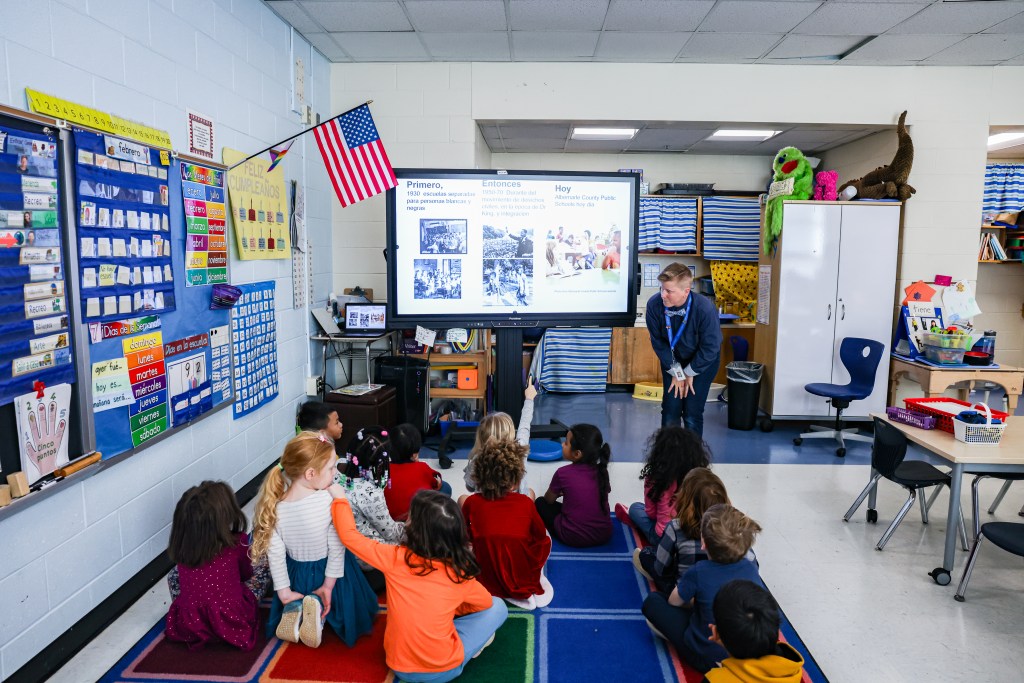
Educators in Albemarle County, such as Greenwood, are practicing a new approach to teaching social studies that requires students to think critically and understand key events from a range of perspectives, including those whose voices are often omitted from standard accounts.
In early 2019, the Albemarle County School Board adopted an anti-racism policy, which the board directed staff to develop starting in July 2018 after numerous parents and community members affiliated with the Hate-Free Schools Coalition of Albemarle County demanded a ban on Confederate imagery on school property.
The concerns were raised in the aftermath of August 2017 — when far-right and white nationalist groups marched through Charlottesville, culminating in the death of Heather Heyer and many others injured.
The school’s anti-racist policy was unusual in that it originated with students. Albemarle’s Office of Community Engagement selected a group of students who were part of the division’s summer leadership academy to help draft the policy. The division hired Kimalee Dickerson, a doctoral student at the University of Virginia’s Curry School of Education and an attorney, to facilitate the group’s work.
Some local activists thought the policy did not go far enough — for example, for not including an explicit ban on Confederate symbols as part of the school dress code — which led to protests and arrests at some school board meetings.
The policy also called for the school board to create an anti-racist curriculum for all grade levels.
In 2021, the school board unveiled a social studies curriculum designed to expand what’s covered, including how those harmed by unjust laws and policies fought back and often built thriving communities.
Nationally, the backlash to anti-racist policies and lesson plans like Albemarle’s has been fierce in recent years. Since 2020, Republican lawmakers have tried to restrict discussion of racism, gender and more in K-12 schools, and at least 18 states passed laws forbidding schools from teaching “critical race theory,” a term that has become a conservative catch-all for discussions of systemic racism and inequality.
In Virginia, Republican Glenn Youngkin rode to victory in the 2021 gubernatorial race as part of that movement, and he signed an executive order forbidding the state’s education department from promoting the teaching of “inherently divisive” ideas.
Albemarle County Public Schools has twice been a focus of that backlash. In 2021, several parents sued the school board over a curriculum piloted by one school they said was ideological. Local and state courts found in the district’s favor, but the case appears to have put the district on the Trump administration’s radar. In January, President Donald Trump signed an executive order demanding that schools end “radical indoctrination” or lose federal funding. A fact sheet accompanying the order that circulated online named Albemarle County schools and referred to one of the families who filed the 2021 lawsuit.
The order, along with a Department of Education letter demanding an end to race-conscious practices in schools and other actions, are part of a sweeping effort by the administration to redefine discrimination and reverse efforts to embrace historical perspectives beyond those of the white majority. Educators and historians worry those actions will lead to widespread self-censorship on the part of teachers who may fear blowback even about historical topics as fundamental as slavery and Jim Crow.
“If students aren’t allowed to grapple with the more complex moments in American history, they’re going to have an incomplete view of the U.S. historical narrative,” said Jessica Ellison, executive director at the National Council for History Education.
In the 2023-2024 school year, the student population in Albemarle County Public Schools was about 57% white, 17% Hispanic, 12% Black, 7% multiple races and 6% Asian, according to data from the division. About 34% of the students came from families who are economically disadvantaged.
In the same school year, Black students represented just 5% of those identified as gifted, 7% of those earning a more rigorous advanced studies diploma and 36% of out-of-school suspensions, though they made up 12% of the student body.
To create the anti-racist policy, the district set up a steering committee of administrators, school principals and others that got help from the students. It also partnered with staff of nearby Montpelier, James Madison’s home, to win a grant that would fund a rewrite of the social studies curriculum.
Starting in fall 2019, teachers from Albemarle and other districts participated in a year of professional learning about Charlottesville’s past, including its history of racial discrimination and resistance. They met with local historians and experts on Black and Indigenous history, heard from a University of Virginia child psychology expert on race and identity development, toured Confederate monuments and more. Portions of the new curricula were introduced in Albemarle classrooms beginning in 2021.
The district wanted to be transparent with parents and the community about what was coming, said Social Studies Coordinator Neeley Minton. After units for elementary school were written in summer 2022, Minton presented them to a group representing parents, students, educators and community members called Forward Albemarle. Later she and others held presentations for district parent-teacher organization presidents, parents and community members. Principals presented unit content to parents at family nights.

District officials refer to the curriculum’s approach as “whole truth history.” A unit on the American Revolution has students read both the Declaration of Independence and a letter from Seneca tribal chiefs describing how victory in the Revolutionary War let the American government seize their land.
That emphasis on multiple perspectives builds on general requirements in Virginia’s 2015 social studies standards. The state mandates, for example, that fifth graders learn about both the state’s post-Civil War economic growth and its practice of racial segregation. (The latest update to those standards, which goes into effect this fall, was the subject of a years-long battle.)
Even the youngest students are asked questions designed to make them think through all sides of historical and political debates. In a kindergarten unit on citizenship, the question is, “Does fairness mean everyone gets the same things?” Students look at primary sources to answer those questions.
More from The Hechinger Report: The college degree gap between Black and white Americans was always bad. It’s getting worse
At Journey Middle School one day in February 2025, seventh graders were in the middle of a history unit on the Harlem Renaissance, a period during the 1920s and 1930s in Harlem, New York, when African American intellectualism and culture flourished. The question here for students was, “How can art be used as a tool for resistance?”
The students studied art that had been taped to the walls: images of the Great Migration, a Langston Hughes poem, a photo of sharecroppers in the field and more. They wrote short answers on worksheets about what they saw. Who’s the artist? What’s their work trying to show?
The worksheets were a way to get them started on an essay. “When you tell a bunch of seventh graders to write an essay, they’re just going to put their heads down, and say ‘I can’t,'” said teacher Valerie Lewis. Having them combine short answers into paragraphs and those into an essay builds their confidence, she said.
Classes that focus not only on oppression but resistance and resilience force students to see those harmed in a new way, consistent with the anti-racism policy. “A lot of our approach is helping students see the assets of communities that have been historically marginalized,” said Minton. “That’s why we focus so much on agency, excellence, resistance to injustice.”

Sarah Harris, 45, has three children in district schools, including a seventh grader. Her child’s essay about the Harlem Renaissance led to a conversation at home about current art as resistance, including street art and political cartoons, she said by email. The unit took something from the past “and made it real and relevant for my 13-year-old,” she said. That contrasts with her own experience as a student in the ’90s, when social studies involved textbooks, worksheets and multiple-choice tests, she said. “We very rarely had to think critically about what we were learning.”
The Harlem Renaissance class also impressed Zoe Hamilton, one of Lewis’ students. “The art has meaning. It’s not just art for art. It has power,” she said. Seventh grader Maddox Ewing remembered stories of enslaved people drawing escape routes in the braids of their hair, which they read in another unit.
Seventh grader Finch Carlson said she likes that teachers make them give solid proof for their opinions. In a unit on New York City tenements, it wasn’t enough to say she thought conditions were hard — she had to describe what was in original photos and testimonies to prove her answer.
Lewis wants students to be listened to out in the world, not just in class. “I tell them, ‘Especially when you’re still young, if you provide your proof, people are more likely to take you seriously,'” she said. And Minton said the curriculum prepares students for membership in a multiracial democracy.
Since introducing the anti-racism policy, the district has had some limited success in reducing gaps in outcomes by race. For example, in the 2023-2024 school year, the share of Black students in gifted classes had grown slightly, to 5% from 4% the prior year, and those earning the advanced studies diploma had stayed flat at 7%. But suspensions for Black students stood at 36% of the total out-of-school suspensions that year, down slightly from 37% the prior year.
The district continues to debate and refine the curriculum. Seventh grade history teacher Dingani Mthethwa said he wished the core question in the Harlem Renaissance unit was more open-ended. “We’re asking how art can be used as a tool of resistance, but art can also be used as a form of oppression,” he said, citing post-World War I art that depicted caricatures of Black people.
Minton said by email that among much else the current version of the question gives students an opening to make reasoned arguments about how Black artists resisted oppression.
A now-abandoned school curriculum is what ensnared the district in Trump’s executive order. In December 2021, five sets of parents sued over an “advisory curriculum” piloted by one middle school that was meant to ease students’ integration into secondary-school life, in part by helping them learn more about their identities and those of other students.
It included materials the parents said “indoctrinated” their children and made them uncomfortable. For example, two slides talked about the idea of white privilege and defined anti-racism, which the families said promulgated “racial tropes” and caused one student, who is multiracial, to view his racial identity negatively.
In June 2022, a county circuit court dismissed the lawsuit, concluding in part that under the parents’ theory, the district would need to create individual education plans for every student and ensure that no student be made to feel uncomfortable. The Court of Appeals of Virginia upheld that decision, and the Virginia Supreme Court court refused to hear the case, effectively ending the lawsuit.

The district took control of writing a new curriculum, rolling out the new version at an August 2022 school board meeting, and inviting parents to review it. No one objected at that or several subsequent board meetings, and there’s no evidence there have been complaints since. The Hechinger Report contacted four of the five sets of parents who sued, but none responded to requests for comment.
The fact sheet circulated that referenced Trump’s order charged that Albemarle’s anti-racism policy is “based on critical race theory.” The order called for three federal agencies to develop a plan by the end of April to eliminate federal funding for “illegal and discriminatory treatment and indoctrination” in schools. (The White House did not respond to a request for comment regarding the fact sheet.) Then, on April 3, the Education Department sent letters to state and district leaders nationwide threatening to withhold federal funding unless they sign a certificate stating that they comply with the administration’s interpretation of civil rights laws, including that diversity, equity and inclusion activities are illegal.
Minton said by email that “there is no explicit teaching of critical race theory” in the district. But she said it’s important to define the term: a theoretical framework asserting that racism is more than just individual prejudice but rather is “baked into” larger systems and laws. Albemarle students learn about state laws once requiring Black Americans to take literacy tests and pay poll taxes, for example, which suppressed their ability to vote. “It would be very difficult to dispute that racism against Black Americans was part of the legal system at that time,” Minton said.
District Counsel Josiah Black said the district hasn’t heard anything more from the administration and that officials weren’t surprised to be named. “I don’t think anyone was shocked,” he said. “We’re in a place, Charlottesville, that for whatever reason, garners a lot of media attention.”
He declined to comment on whether the administration might try to cut district funding and how the district might respond. District communications officer Helen Dunn, in an email, said any funding loss would be “a big blow.”
Albemarle County schools did sign the certificate demanded by the Education Department, Dunn said in an email. “We have been and will continue to be compliant with Title VI,” she wrote, referring to the section of 1964 civil rights legislation that prevents discrimination on the basis of race, color or national origin.
Dunn said that Albemarle County receives about 4% of its budget from the federal government, another 28% from the Commonwealth of Virginia, and 68% from Albemarle County. “Our local government pays the lion’s share of our budget,” Dunn said in March. “But 4% is certainly a significant amount of money in a public school division’s budget.”
It’s also unclear that pulling federal funds would survive a court challenge: Two Virginia Commonwealth University education professors noted in a Feb. 11 op-ed that the order conflicts with U.S. law that forbids federal control of local schools.
“The Trump administration’s attempt to assert influence over the day-to-day operations of state and local education systems marks a troubling shift in policy — one that undermines local control and threatens to centralize power in ways that could hinder the educational autonomy of communities across the nation,” wrote Phelton Moss, an affiliate professor at VCU’s Douglas S. Wilder School of Government and Public Affairs, and Jonathan Becker, an associate professor of educational leadership at VCU. The great irony in the executive order, they said, is that it’s titled, “Ending Radical Indoctrination in K-12 Education,” while it includes “a whole section about the need to indoctrinate students in the loosely articulated framework of ‘patriotic education.'”
The Albemarle district said it won’t back down from its anti-racism policy or approach to social studies. “We’re not changing what we’re doing,” said Dunn. Black said the school board “doesn’t have a lot of appetite” for making changes to the policy. “We feel good about the steps that we’ve taken to protect kids and to foster an inclusive environment here,” he said.
But elsewhere, school administrators and teachers unsure of what’s allowed may avoid teaching certain topics. “There’s this fear that parents will take it to a school board or to the news,” said Ellison of the National Council for History Education, noting that a third grade teacher recently told her she skipped a unit on Frederick Douglass, the 19th century abolitionist, social reformer and statesman, because of a parent’s complaint.
Thinking about history as just sort of a relic of the past is irresponsible given the social issues that we all are trying to attack today.
– PRICE THOMAS, EXECUTIVE DIRECTOR OF CITY OF PROMISE
Price Thomas, executive director of City of Promise, a nonprofit focused on ending generational poverty, said it is important that students “know what this country was built on and what it’s still being built toward. And I would hope that we will continue to be brave enough to put that forward.”
Thomas, while director of marketing at the Montpelier Foundation from 2016-2019, helped create initiatives for students from Albemarle and local private schools to lead questions and discussions related to their communities, schools and race.
Although he had no role in the creation of Albemarle County Public Schools’ anti-racist policy and social studies curriculum, Thomas still recognizes its purpose.
“Thinking about history as just sort of a relic of the past is irresponsible given the social issues that we all are trying to attack today,” Thomas added. “I think that all of these things are very interconnected, and we’re smart to take a more holistic approach about how we learn from the past and how we interpret what’s going on to try and move forward.”
Meanwhile, City of Promise’s focus remains on decreasing generational poverty and academic disparities in Charlottesville City Schools by what Thomas describes as “viewing education as a social problem and implementing dual-generation strategies that target literacy and chronic absenteeism among under-resourced students and families.”
Back in Greenwood’s class, the students had been tasked with writing a position statement, three pieces of evidence for it and a conclusion — and then turning those arguments into a podcast. Not just any evidence would do: They sifted through original documents — an 1837 flier for a meeting of abolitionists, testimonies of enslaved people, a transcript of abolitionist John Brown’s address to a court after his attack on Harper’s Ferry.

After the fifth graders finished their worksheets, Greenwood had them rehearse for their podcast.
“My opinion is that violent actions were not justified because at the end, everyone involved got killed,” said one student, citing John Brown’s raid on Harper’s Ferry and a revolt by enslaved people led by Nat Turner that resulted in execution or exile for everyone involved.
By contrast, the student pointed to Henry Brown, an enslaved man who in 1849 shipped himself in a crate from North Carolina to Philadelphia and freedom. “I feel like if you resist and you get caught and killed, it’s not as effective as if you don’t and you stay alive,” the fifth grader said.
Greenwood estimated that about a third of students supported the idea that violence was justified, 10 percent thought that it wasn’t, and the rest said that both were needed.
“A 10-year-old’s world is this big,” said Greenwood, making a small square with her hands. “This is teaching students different perspectives. These were real people with hopes and dreams.”
Javeria Salman and Charlottesville Tomorrow Editor-at-Large Bonnie Newman Davis contributed reporting to this story. Charlottesville Tomorrow Managing Editor Akash Sinha contributed localized editing.