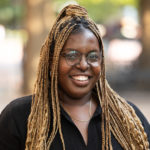

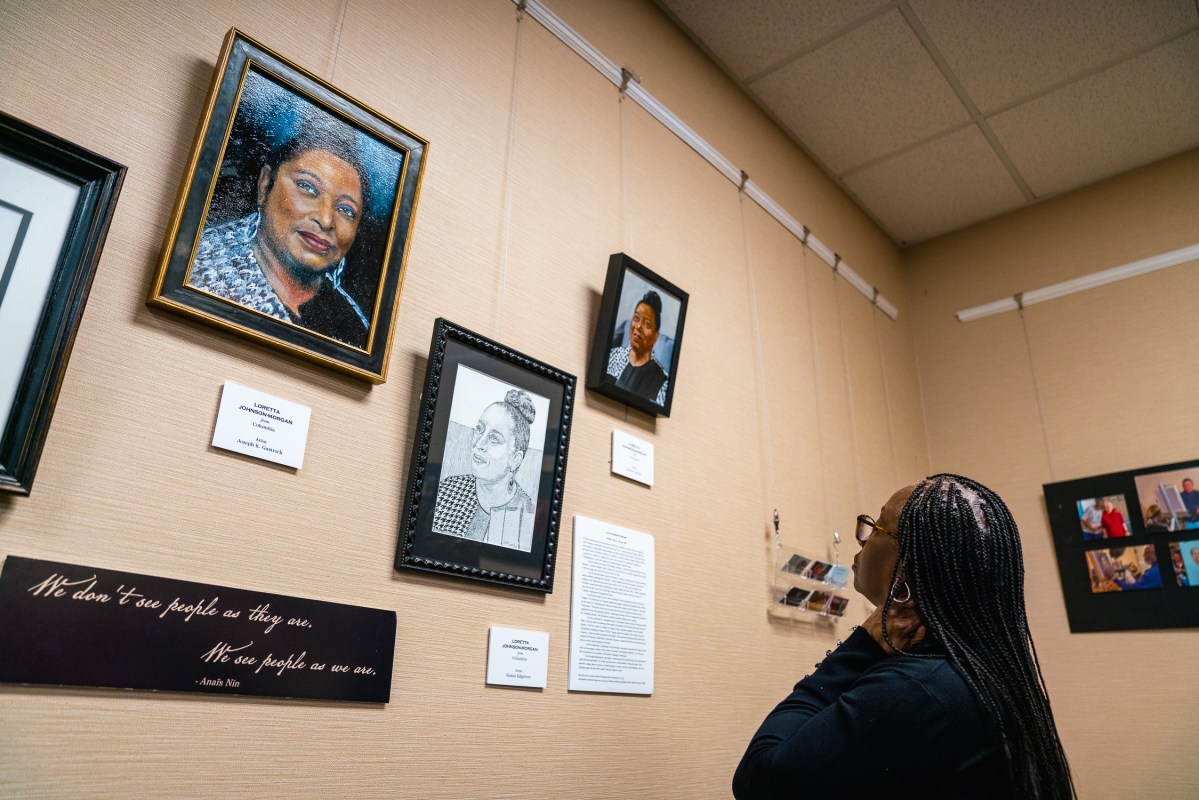
When Lorretta Johnson-Morgan was asked last June to sit for a portrait as part of an exhibit honoring Fluvanna County’s Black residents and their descendants, she thought carefully before responding.
The interpretive art project, “Looking Back, Seeing Now,” would include her and 16 others sitting for portraits and sharing their Fluvanna family histories. Johnson-Morgan, 60, who was shy as a child, worried about the attention the project might attract. She’d never cared much for recognition, she said.
She also knew little about her own ancestry and lineage at the time. Ultimately she decided that saying “yes” to the project could help document her story, some of which was lost after her family’s church, Columbia Baptist Church, lost its records in a fire in 1977, she said.
Johnson-Morgan, a retired University of Virginia employee who is also an entrepreneur and community volunteer, also believed that sharing her portrait and story in “Looking Back, Seeing Now,” currently on display at the Fluvanna Public Library until March 2, could help others learn about Fluvanna County’s rich Black history.
The idea for the project began 10 years ago with Tricia Johnson, director of the Fluvanna Historical Society. She wanted artwork for a project the organization was doing on the free people who lived in Columbia, a small village in the area, before the Civil War. As part of that project she reached out to local artists like Linda Staiger. At first, Johnson wanted the artists to create paintings from descriptions they found in old county records, but after some conversations with the artists, the idea didn’t take off.
Some time later in 2017, Staiger, a retired orthopedic surgeon, befriended Elva Key, a Black woman who lived in Fluvanna County. The women’s friendship blossomed as Key welcomed Staiger into her community and culture, said Staiger. Together they attended Evergreen Baptist Church in Palmyra, the Fluvanna County Branch NAACP meetings and several social events in the county.
Four years after they met, Key died. Staiger cherished her relationship with Key and everything that Key shared about her community.
“I miss her everyday,” Staiger, 77, said about Key. “She was incredibly supportive of me for many years.”
Staiger then had the idea of illustrating the faces of Fluvanna’s Black residents along with their family histories. She reached out to Johnson to see if the historical society could assist with her art project, and Johnson happily agreed.
It was one of the first times in Staiger’s life she felt connected to the people — many of whom were Black — around her. Throughout the years, she learned about their connections to the county, some of which led back to the antebellum period.
Staiger wanted to find a way to honor the stories she’s gathered through the relationships she’s cultivated over the last eight years, so she set out to do what she already loved doing: painting. Portraiture, specifically.
“I think portraiture, in the past, has been very elitist. It was for the people that were very wealthy and powerful, and they would have their portrait taken to show off how wonderful they were,” said Staiger. “And then I thought, imagine if we do these portraits, we’re showing how wonderful these people are, and what their ancestors might have looked like.”
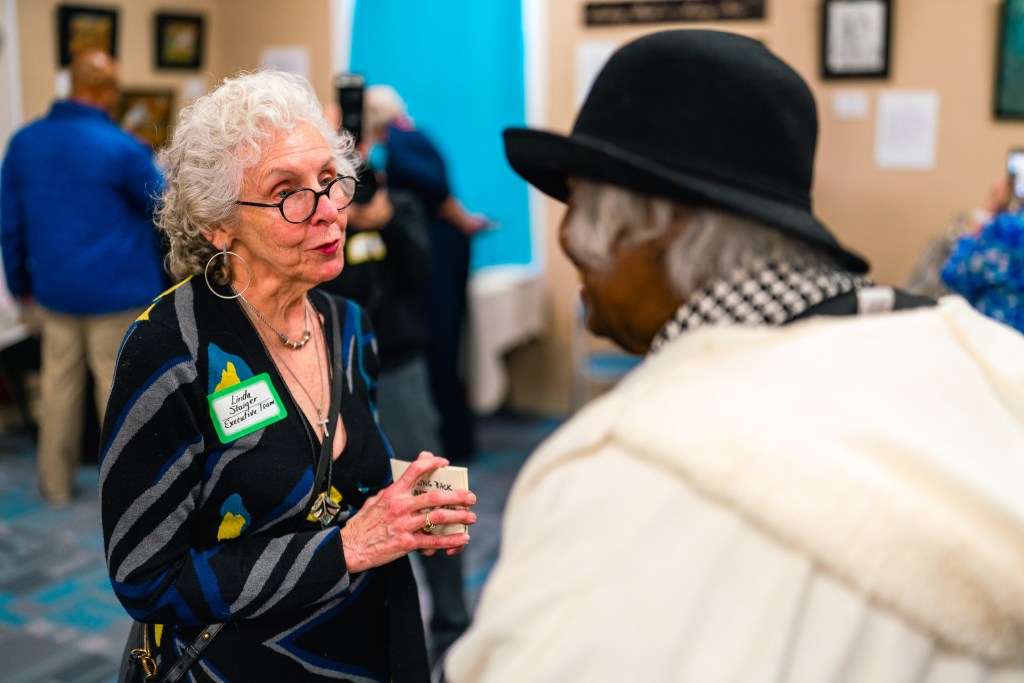
In January 2023, Staiger channeled her appreciation for her friends into “Looking Back, Seeing Now.” Staiger initially reached out to artists, such as Clinton Helms, an adjunct professor at Virginia Commonwealth University, and potential subjects throughout central Virginia. But she quickly realized she couldn’t run the project alone.
“I want to do portraits of these people that I love,” said Staiger. “I got the idea that I would start doing portraits, but then I realized if I was going to do it, I couldn’t do it by myself.”
She later recruited help from Melissa Hill, a local photographer, and Nadine Armstrong, a Fluvanna community organizer, to help find subjects for the project in March of 2023. Staiger also invited artists who worked on a number of mediums — such as oil paint, colored pencil, charcoal and poetry — to contribute to the exhibit.
“They’re not only getting their portraits painted, they also have something to think about,” said Armstrong. “When they look at themselves, they may see some of their ancestors in that portrait.”
For three hours every third Saturday of the month, 12 artist volunteers visited various locations — such as churches and schools — in Fluvanna County to create a portrait of a “sitter.”
A sitter is what Staiger named the muses for the portraits. She avoids calling them “models” as it implies that the subjects were paid to emulate a specific image.

“The people that we ask to sit for their portraits, they were told they could present themselves however they wanted, and we didn’t want to be controlling them,” she said.
In addition, the sitters were interviewed by organizers, like Armstrong, who crafted a summary of their family’s history to complement their portraits.
When searching for sitters, Staiger invited people whom she knew closely, such as Johnson-Morgan. The two had known each other for more than a decade.
“African-American history needs to be brought forward in each place,” said Johnson-Morgan, once she agreed to participate in the exhibit. “I’ve never seen anything of this magnitude done before here in Fluvanna County.”
Other participants were skeptical when approached about the project. For some of the artists and sitters, having to recall their family history would have been too traumatic, Staiger was told.
For instance, Odella Armstrong, the daughter of Nadine Armstrong, declined Staiger’s request to take part in the project in early 2023. The Armstrongs are descendants of enslaved people who were forced to labor at the Bremo Plantation, said Odella Armstrong. She said that every time she thinks about the pain her ancestors endured, she becomes angry.
“It is still mind blowing to me that people can treat another group of people like that,” said Nadine Armstrong.
But something happened that changed Odella Armstrong’s mind about participating in the project.
During a Juneteenth event she attended at Monticello that year, she left the celebration thinking how amazing it was to see African-American history on display, she said. Then her attention went back to “Looking Back, Seeing Now.” As she saw more people share their own family histories, she reconsidered Staiger’s request. Odella Armstrong called Staiger to ask if she could be a part of the project. Staiger readily agreed.
The art project has also led to further plans to honor Fluvanna’s Black history. Staiger and other organizers are working with the Fluvanna Historical Society to look into the Oak Hill Cemetery and the enslaved persons who are buried there.
Take Action
“Looking Back, Seeing Now,” an art project documenting Fluvanna County’s Black ancestry, is on display at the Fluvanna Public Library. The exhibit will travel to Sentara Martha Jefferson Hospital in Albemarle County in June, and will be at The Center at the Belvedere in Charlottesville in August.
The project is also still accepting sitters from Fluvanna County and surrounding areas, along with artists to illustrate them. People who are interested in participating in the project are asked to submit a contact form on the “Looking Back, Seeing Now” website.