

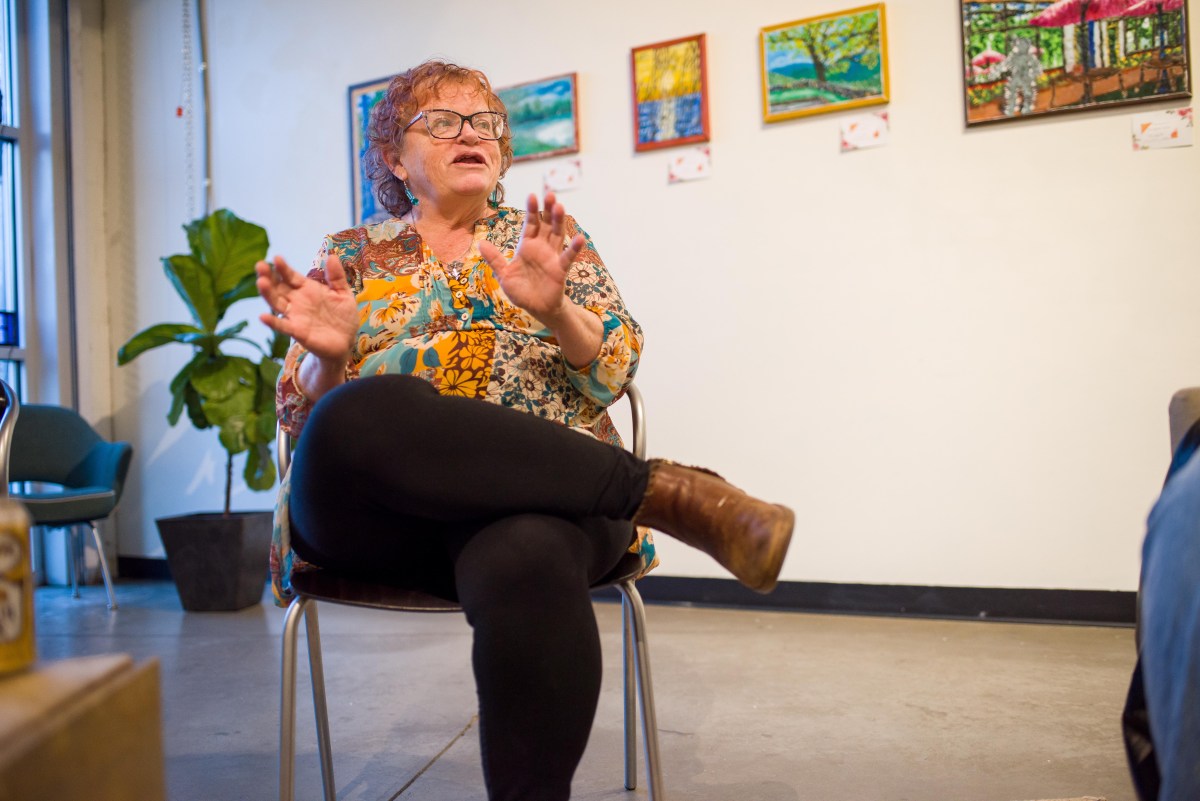
In November 2018, a piece of Colleen Rosenberry’s heart was stolen.
Her youngest son, Michael Vest, lost control of his vehicle while driving home to Nelson County on Oct. 30. In critical condition, Vest was airlifted to University of Virginia Medical Center’s intensive care unit where he was declared brain dead a few days later. He was 24.
Overcome with grief, Rosenberry, 61, was unsure how to continue her life without her son.
“It’s hard to value life when you don’t know what the focus is,” she said.
Over time, Rosenberry found that her grief became less overwhelming as she reconnected with one of her greatest passions: art. This reconnection unfolded in two distinct phases. The first phase, titled “Journey From Grief to Art,” consists of paintings that capture memories and moments shared with her late son.
The second phase, “Journey From Grief to Art to Growth,” marks a new chapter in Rosenberry’s life, where she explores ways to honor her son’s memory and legacy. It is on display at Studio IX in Charlottesville until Feb. 2.
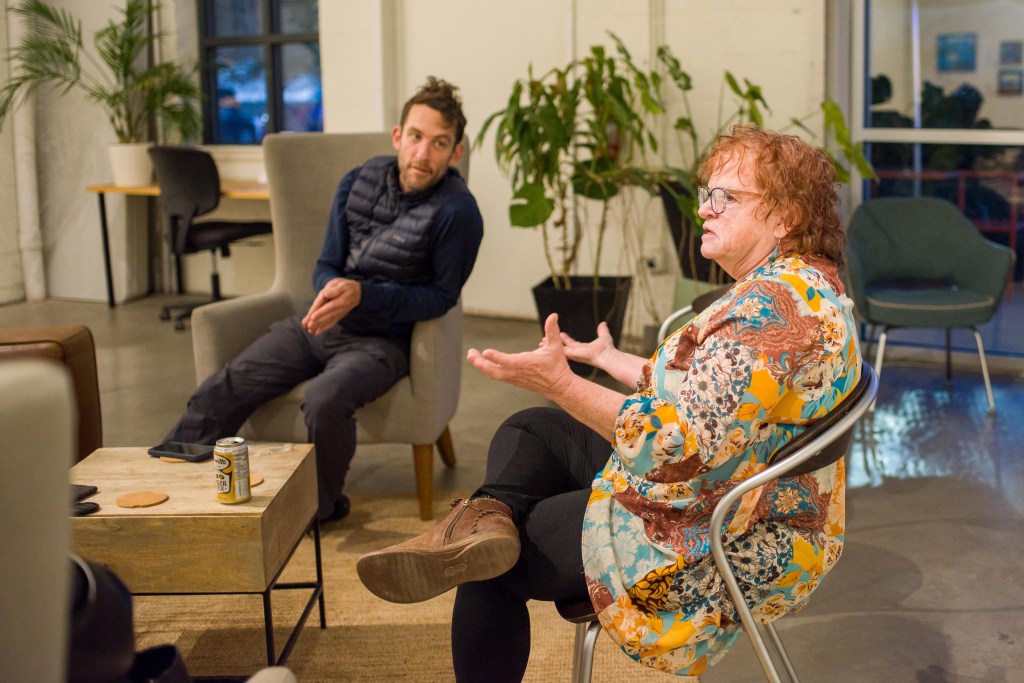
Rosenberry hadn’t touched a paint brush since high school, but losing her son caused her to dip her toes into the medium again. She gathered paint supplies from thrift stores and other artists who were giving away their unwanted inventory and set up shop in her dining room.
Rosenberry’s return to art helped her adjust — somewhat — to being home alone; her son was living with her before he died. When her dining room became too small for her to work, Vest’s room became her studio.
While Vest was more into music, he expressed his passion through scribbling doodles onto his wall, Rosenberry recalled. Once she settled into her new studio, she often played some of her son’s favorite musicians, such as Lord Huron and Ginuwine.
As Rosenberry painted more, she began to hang her paintings at the desk she rented for work at Studio IX. Her art caught the eye of Greg Kelly, a manager and curator at the studio. In 2022, Kelly asked Rosenberry to feature her art in an exhibit at the gallery.
“[An exhibit] was something that she didn’t think of in that way,” said Kelly. “I think she does her art as an extension of who she is. [But] I know she was a talented artist.”
Still, Rosenberry hesitated. Although she had not painted in several decades, she sometimes dabbled in sketching, chalk art and crafts. Eventually she accepted Kelly’s invitation to feature her work, and in June 2024, Studio IX hosted Rosenberry’s first-ever exhibit, “Journey From Grief to Art.”
Take Action
Collen Rosenberry used painting as a way to help process her grief after her son, Michael Vest, died in a car accident in 2018. Her artwork is currently on display at Studio IX’s gallery, located on 969 2nd St. SE in Charlottesville, until Feb. 2. Her work will appear again at the Crozet Artisan Depot in September. You can also check out more of her art on her Facebook page.
While her artwork features locations from Nelson County and her birthplace of Cambridge, Maryland, she gives special focus to those places significant to her son, such as their home, the Oak Ridge Farm in Nelson County, and the Natural Bridge in Rockbridge County, she said. She also captures moments that remind her of Vest.
Moments, she said, that she longs to experience with him one last time.
Clusters of white brush strokes in some of Rosenberry’s pieces in her first exhibit reflect how she sees Vest’s spirit — and the spirits of others who have passed. For example, her painting “Guide into the Blooms” depicts a lone lantern that hangs outside her house. The light is surrounded by a flurry of pink Azaleas and white spots, signaling the spirits that are always within proximity, she said.

Yet, Rosenberry said, she struggled to capture Vest in all of her pieces. In “Drinks at DBB (Devils Backbone),” she wanted to paint her son working as a bartender at Devil’s Backbone Brewing Company in Charlottesville.
The finished painting does not meet her original objective, she said. She kept trying to paint Vest into the picture, but she couldn’t get it right.
“I am still satisfied with the painting, but I don’t have that focus that I wanted with Michael,” she said. “So it was disappointing because I was really trying to get my son in there.”
While continuing to paint, Rosenberry decided to go in a different direction. She wanted to further her art as she grappled with her grief. Shortly after her exhibit ended at Studio IX last June, she began working on the second phase of her project, “Journey From Grief to Art to Growth.”
For that stage, Rosenberry explored “plein air,” French for “in the open air” and a form of landscape painting, impressionism and abstract art. She crafted the pieces with different techniques and tools, such as using palette knives to scrape over her work. She also challenged herself by incorporating oil paint into her work.
As a result, viewers see Rosenberry’s life through her eyes, with some of her pieces revealing a faint self-portrait amidst the scenery.
“Journey From Grief From Art to Growth” isn’t as complete as its predecessor, but that’s the point, said Rosenberry. While painting pieces for her second phase, Rosenberry searched for the value in life. That work follows her moving on in life, despite the loss of loved ones.

She expresses her journey in this new chapter of life in “Thoughts in the Air,“ an 8 x 10 painting with several circles of varying colors. Each bubble represents one of her children, she said, while focusing on embracing the presence of those around her. In addition to Vest, Rosenberry has a daughter, 39, who lives in Bedford, and a son, 37, who lives in Kentucky.
“I don’t want to let my son [Vest] go and fade into nothing or a memory,” she said. “No matter where I go, how do I bring my son with me?”
That question, and perhaps, part of the answer, is in “Hidden Treasure.” In the painting, Rosenberry depicts a gray stone building nestled in greenery with strokes of white. Vest, who often discussed landmarks with Rosenberry, is partly represented by the abandoned building.

These days Rosenberry’s grief comes in waves, she said. While many of her more recent paintings feature bright colors of rural and urban landscapes, others are much darker. And in some of those pieces, Rosenberry includes a self-portrait, allowing viewers to see images of her lamentations.
“The Lonesome” is Rosenberry’s most obvious self-portrait. The piece, covered with white scrapings, depicts Rosenberry in one of her most raw forms of grief. The scrapings display the mask she’s forced herself to wear since losing her son. The white marks that sit under eyes represent the tears she shed since losing her son, Rosenberry said, whereas the softer white star-like additions capture his spirit, she said.

Rosenberry is not alone in using painting as an outlet for her grief. Using art as a form of therapy for grief can be productive, according to a 2022 study by researchers at the Community Engaged Scholarship Institute. Bereaved individuals reported finding themselves and getting on with their lives after participating in art therapy programs.
Like Rosenberry, the participants in that same study said that art therapy allowed them to process “complex and overlapping emotions” during prolonged mourning.
Lisa Thomas, a licensed art therapist at Coastal Art Therapy in Norfolk, Virginia, said that painting tends to elicit stronger emotions for some bereaved individuals. It can also help those stuck in certain stages of grief to regulate, identify and process their emotions by stimulating different parts of the brain, she added.
When someone who is mourning can come to terms with their emotions, it becomes easier to create meaning and purpose in their lives, said Thomas.
“All [art mediums] evoke emotions, but paint — especially watercolor, tempera paint, acrylic painting and other different types of painting — can evoke them more easily,” said Thomas.
For Rosenberry, simply seeing someone pause to peer more closely at her paintings lifts her spirit. Which is why she wants her art to be a refuge for people who are experiencing loss, she said.
Rosenberry also hopes that her art inspires viewers to process their grief through artistic or creative expression.
“My future goal, from here on, is to get people that are grieving and help them find that one thing, one hobby, one craft, one knack, whether it’s poetry or arts or crafts,” she said.