

When Jasmine Ortiz turned to the Charlottesville Police Civilian Oversight Board after a troubling interaction with local police, she hoped to find an advocate.
In September, Ortiz had an altercation downtown with her child’s father and his companions. Charlottesville Police got involved and restrained her. While that was happening, one of the officers stood on her ankle, she said.
The next day, her ankle hurt — a lot. She later learned it was broken. Ortiz promptly filed a complaint with the Charlottesville Police Department (CPD) that launched an internal investigation and, on the advice of a local community organizer, contacted Inez Gonzalez, the Police Civilian Oversight Board’s executive director.
That Board, referred to locally as the PCOB, was created for a case like this — to be independent civilian oversight for resident complaints against police.
The problem was, even if the civilian volunteers on the PCOB wanted to investigate this case — or any case — independently, they couldn’t.
After the PCOB’s inception in 2017, its inaugural board intended it to have this power. They wanted a non-governmental body that would take complaints against police officers from Charlottesville residents and independently investigate them. And the City’s website still has the vestige of that goal.
In August 2022, the city launched an online complaint portal with a news release that explained that the “online portal will allow for community members to file complaints regarding incidents of alleged misconduct by employees of the City’s Police Department directly to the Board for investigation.”
That news release has since been removed, but the portal still exists and advertises that the Board is “processing complaints, reviewing police practices and internal investigations, issuing findings, writing public reports, and making recommendations.”
But the civilian Board’s ability to conduct independent investigations is still out of its reach.
“They are turning the PCOB into a graveyard,” said Jeff Fogel, an attorney and local activist involved in the initial push to establish the Board.

Eight years since its inception and more than a million dollars of City funding later, the PCOB is at a crossroads. While the Board has gained some tools for police oversight, it remains unclear what city leaders want it to become. And community advocates insist that anything less than the full oversight powers they fought for aren’t enough.
“We’re trying to figure out how to make it work. I don’t think anyone disagrees that there’s a place. The question is, what is that place?” City Manager Sam Sanders told Charlottesville Tomorrow.
Civilians on PCOB take a backseat on actual oversight
An important detail to understand about the PCOB as it exists today is that it has two parts: the board of civilian volunteers who apply for a seat with the City, and their full-time executive director, who is a City employee reporting to the deputy city manager and working closely with the Board. And while the executive director has some powers, including reviewing police records and observing internal CPD investigations, the civilians on the board are largely limited to advising on broader police policy.
Right now, when someone files a complaint with the PCOB through its website, it goes to the executive director; not the civilian part of the Board.

After a resident files a misconduct complaint with the PCOB, it is forwarded to the CPD for an internal investigation, Gonzalez said.
Gonzalez has the right to observe all internal CPD investigations, even those that do not have a correlating complaint filed with PCOB. She can review body camera footage, monitor live interviews of CPD personnel — which is a new right that was solidified only last year — and suggest follow-up questions. However, it’s up to the CPD investigator to decide whether to ask them.
Gonzalez can ask an interviewed officer a question herself, too, but the officers are advised at the start of every interview that they are not obliged to answer her questions. Their answers are not protected by Garrity Rights, which shield public employees from being compelled to make statements that could incriminate them.
And if an officer refuses to answer one of Gonzalez’s questions, “it is the position of the Department that they will not ask that question as they do not wish to be perceived as [being] agents of the PCOB,” Gonzalez said in an email to Charlottesville Tomorrow.
After the internal CPD investigation is complete, the Board can initiate its own hearing if the civilian who filed the complaint requests one or if the executive director finds the police investigation unsatisfactory. But, because officers are not required to answer any PCOB questions, their usefulness is limited.
The Board is also supposed to be able to launch its own investigation, either by hiring an independent investigator or by tasking Gonzalez with it. But this key function has never really come together. Why? The various documents that guide the Board’s work are ambiguous and, sometimes, contradictory, Board members say. And while the underlying causes for the issues have existed for some time, a couple of public instances have recently made them very visible.
The first time was in 2023. Charlottesville Police Chief Michael Kochis noticed that the City didn’t have any written guidelines for how or when the CPD should share information with the Board.
The city’s ordinance creating the PCOB requires that those guidelines exist and gave the city manager and the chief of police 45 days to create them after the ordinance was signed. However, it never happened. There were standard operational procedures that addressed records sharing for PCOB hearings, which was the basis for sharing before Kochis noticed the lack of more specific guidelines.
So, Kochis stopped sharing records until further clarifications were made.
As a result, in October 2023, CPD removed all its documents from the PCOB executive director’s office. For eight months, the Board was limited to reviewing policy and making recommendations, unable to oversee investigations.
Gonzalez eventually regained access to the records at the end of June 2024, after the City Manager signed new operational procedures and a memorandum of understanding.
The second time an issue came to the public’s attention was when PCOB members brought it up themselves last year. It stems from the PCOB’s operational procedures, which conflict with parts of the Charlottesville Municipal Code. The procedures grant the Board the authority to summon CPD officers for interviews, but City law prohibits the Board from compelling statements from CPD employees, explained Gonzalez.
This means that for the PCOB to conduct hearings and investigations, officers must voluntarily agree to interviews, but doing so forfeits their Garrity Rights.
“No one in their right mind would voluntarily agree to engage in that type of interview process because they have zero protection,” Gonzalez said in October.
Without officer interviews, any findings of independent investigations would be incomplete.
“How do you make a recommendation without having a full picture?” Gonzalez said. “That’s not fair to anybody.”
Lacking any real ability to launch investigations and hold hearings, the power of the PCOB is very limited.
Jeffrey Fracher, the PCOB’s former vice chair, jokingly compared the civilian part of the Board to “window dressing” in December.
So, while PCOB’s executive director’s rights grew last year, giving her the greatest access to police materials in the state, according to Gonzalez, it’s the oversight by civilians that community members who rooted for the creation of PCOB asked for.
Why the Charlottesville community pushed for a PCOB
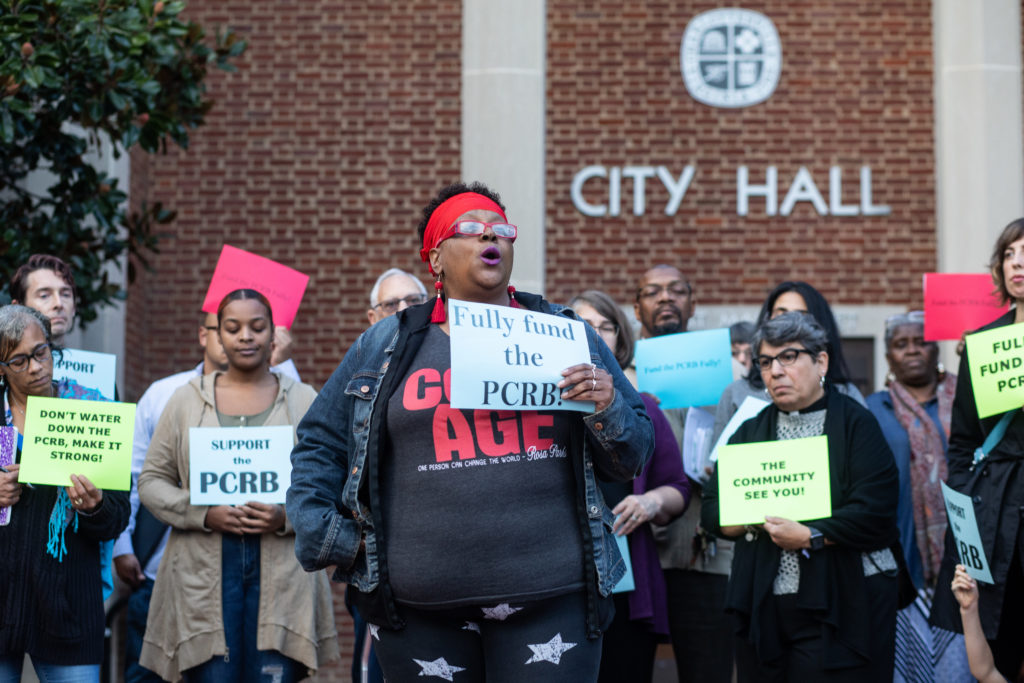
In the aftermath of the “Summer of Hate” in 2017 — when far-right and white nationalist groups marched through Charlottesville, culminating in the death of Heather Heyer and many others injured — some community members were critical of the police department’s response. Local activists pushed for the creation of a civilian board to promote police accountability and transparency.
These advocates envisioned a board with a strong civilian presence that reflected Charlottesville’s diversity, including members from historically overpoliced communities.
Rosia Parker, a community activist and member of the inaugural Board that drafted the PCOB’s current bylaws, said that it was meant to hold hearings and lead investigations to ensure fairness and oversight.
The current PCOB is not that, she said.
For example, the kind of PCOB the community hoped for, Parker said, would have taken an issue with the officers’ body cameras being off in Ortiz’s case.
Ortiz said she was pushed to the ground by the CPD officers, and one of them stood on her ankle. A bystander filmed a video that captured the incident moments later. It shows Ortiz standing and two police officers holding her by her arms.
“Y’all aren’t supposed to grab no female like that,” the bystander told the officers as Ortiz tried to get free from their hold. At that moment, the officers don’t appear to be holding her tightly.
Once the officers let Ortiz go, she launched out of the camera view toward another woman and had what appears to be a brief physical altercation. Ortiz was not charged with any crime.
The conclusion of the CPD’s internal investigation, which was provided to Charlottesville Tomorrow by Ortiz, determined that the two officers who held Ortiz didn’t turn on their body cameras. One of them and another officer mentioned in her complaint also failed to file proper detention reports.
The internal investigation concluded that the amount of force used to restrain Ortiz was justified, as she was pulling in an attempt to get to the other woman, which Ortiz did once they let her go. No footage showed an officer stepping on her foot. And she never said anything about it while they held her, the report said.
But the ankle was broken after that evening, and she lost her job because of it, Ortiz said.
While it’s unclear what recordings the CPD investigation reviewed to find Ortiz’s complaint about her ankle unfounded, Ortiz believes that the absence of the body cam footage of the officers who held her was the reason for such a conclusion.
“It’s my word against the police’s word,” she said about the lack of the footage to back up her claims.
Gonzalez, when asked about the case, said she is prohibited from commenting on any administrative investigations of personnel.
It’s unclear if this case might have unfolded differently if the PCOB had the power to involve civilians in evaluating Ortiz’s story and investigating her claims.
“It’s a failure because people want investigations,” said Harold Folley, a community organizer at the Legal Aid Justice Center who was involved in advocating for the Board in its early stages.
And without this key feature that the community wanted, “it’s not relevant,” he added.
There’s a disconnect between what the community wants the Board to do and what they can legally do, said Al Pola, PCOB’s new chair.
The frustration isn’t limited to the community members either.
“We’ve spent the last four years — five years, really — bickering over the terms of how they are going to be set up,” Lloyd Snook, Charlottesville City Councilor, said during a Nov. 18, 2024 Council meeting.
“They haven’t reviewed a single, actual controversy,” he said.
The Board did plan to hold a hearing in 2022. It was the only one the civilian part of PCOB has considered so far, and it never progressed to an official hearing. The civilian board reviewed alleged misconduct by a CPD officer during a 2020 arrest after an internal investigation into the case cleared the officer of wrongdoing. The Board held mock hearings in preparation for the case, trying out for the first time what this process would look like.
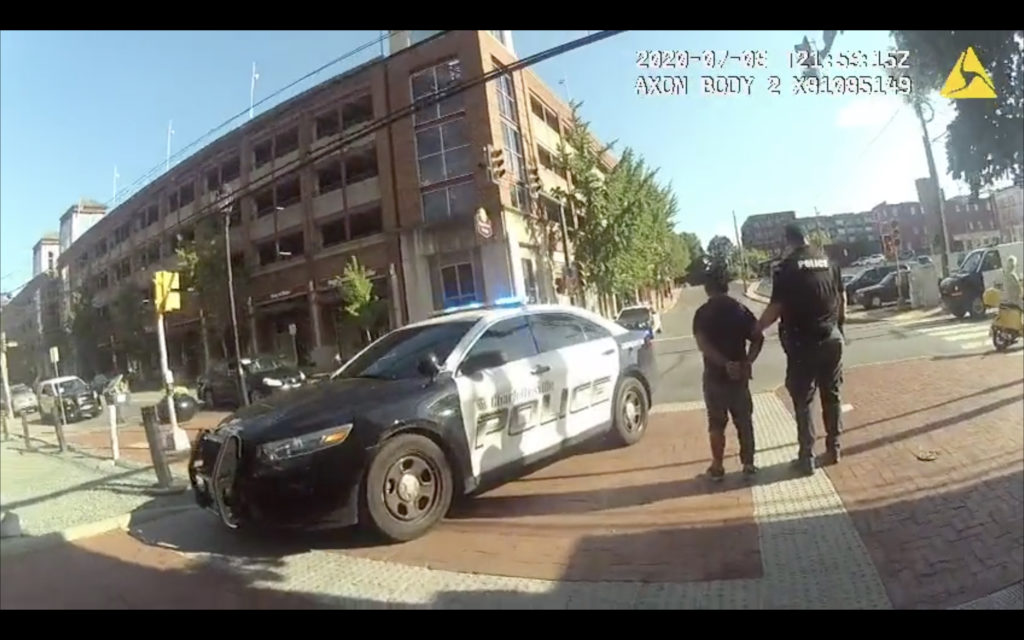
In the end, the civilian board’s hearing never happened. The police chief and the PCOB’s executive director settled the complaint with Fogel, the attorney who brought it to the PCOB. Fogel did not represent the individual who had been arrested.
But, even if the hearing took place and PCOB issued recommendations on disciplining the officers, those would not have been binding. No PCOB recommendations are binding, Gonzalez said, speaking about the PCOB generally and not about this particular case.
Few civilian oversight boards around the country can conduct independent investigations of police
Still, nationally speaking, Charlottesville’s PCOB is an example of a functioning board, said Cameron McEllhiney, executive director of the National Association for Civilian Oversight of Law Enforcement (NACOLE).
Not all police oversight boards in the country have independent investigation options, McEllhiney pointed out.
“They are still doing valuable, important work for oversight of law enforcement,” said McEllhiney, about the PCOB and its toolkit, even if it can’t conduct independent investigations.
Only 31% of tier-2 cities with civilian oversight boards have independent investigative abilities, according to a 2024 study by the University of Colorado Denver and funded by NACOLE. Charlottesville is considered a tier-2 city, in that it is regionally important but not as influential on a larger scale.
The most common function among oversight entities around the country is the review function, at 48%, according to the study. This means they review and monitor internal police investigations.
And Charlottesville’s PCOB did secure this right recently — at least for its executive director — after restoring access to police records and clarifying its executive director’s right to be present during interviews conducted as part of internal investigations.
The advisory function is the second most common, with 28% of boards practicing it, the study found. This involves making recommendations to the police on high-level policies and operational procedures. Charlottesville’s PCOB has consistently engaged in this function even when other activities were stalled.
McEllhiney acknowledged, however, that it was unusual for an oversight board to face as many challenges as Charlottesville’s PCOB.
“They had more than their fair share of roadblocks, but it’s not uncommon for a new board to face these issues,” she said.
“Charlottesville is an excellent example of the types of challenges oversight boards have to maneuver through as they try to get up and going. Some face more challenges than others.”
A lot simply comes down to how well the Board can work with the police and the government officials, she added.
Gonzalez agrees.
“It’s better than in many places in the country,” she said in a brief exchange with Charlottesville Tomorrow after the Board’s November meeting.
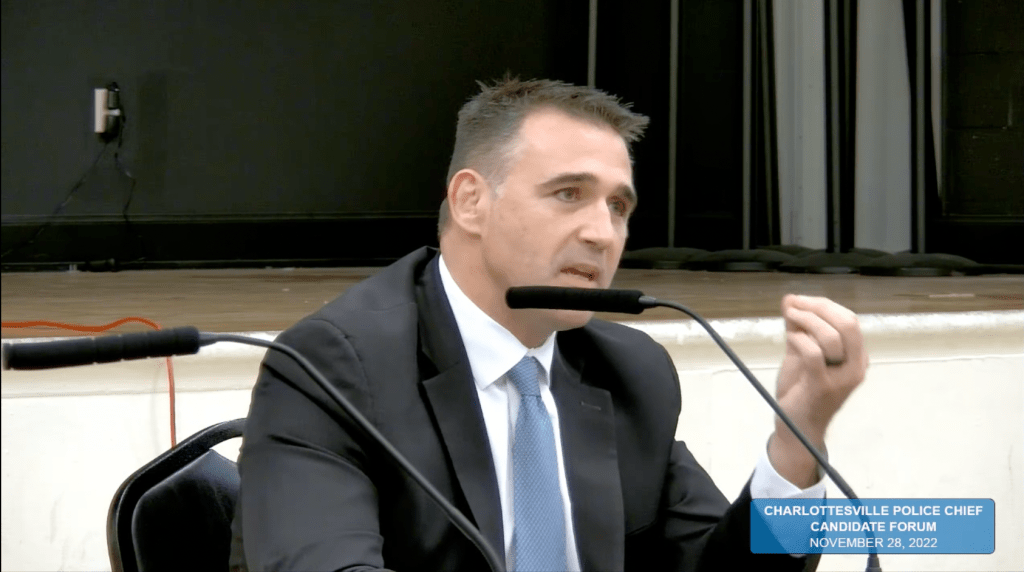
Take her working relationships with Charlottesville Police Chief Michael Kochis, she said.
“The fact that he and I can have an open dialog and communicate like two rational, reasonable human beings, without fussing and fighting — it’s extraordinary. If you talk to other people doing what I’m doing in this state and others, they don’t necessarily have those relationships with their chiefs,” she said.
“That doesn’t mean to say that the chief and I will always agree, but I think we agree more than we disagree because we both agree on one very important thing: process matters. Let’s do it right. Whatever we do, let’s do it right.”
Next, the PCOB will rewrite its city ordinance to take to City Council
Right now, the PCOB is in the process of drafting amendments to the City’s ordinance governing the Board.
The goal is to clarify the distinction between the civilian Board’s role, rights and duties and those of its executive director. They also hope to clarify access to records and address the challenge of interviewing police officers.
“We very much need to do sort of a thorough house cleaning on our ordinance,” Bill Mendez, former PCOB chair, said during a Nov. 14, 2024, PCOB meeting. “Currently, there are inconsistencies. There are some contradictions. There are provisions that make it very hard for our executive director and the Board to do our jobs.”
“I think it’s important to let the citizens know we are trying to make this work, because you wanted this,” Al Pola, PCOB’s new chair who stepped into the role in January, told Charlottesville Tomorrow in February.
“We’re trying to sit there and say, ‘Okay, how do we do the things that we need to do and accomplish what the citizens want us to do?'”
Gonzalez is assisting the civilian PCOB volunteers in their work to rewrite the city ordinance.
“It’s unfortunate that at this point we have to go backward in order to move forward,” said Pola. But taking time to make revisions now is the only way they can make sure the Board functions properly in the future, he added.
Sanders agrees that the PCOB has faced quite a few challenges in its years of existence.
“We probably didn’t invest the right amount of time early on to anticipate where there would be conflicts that could arise — the challenges of having a need for oversight that I fully appreciate and respect. But now in this seat, I see so many different things that make it hard,” Sanders told Charlottesville Tomorrow in November.
He is now taking a hands-on approach in helping the Board to rewrite the part of the ordinance related to it before they take it to the City Council.
“The main priority is just trying to get the ordinance to eliminate the conflicts that seem to prevent things from moving as smoothly as they should,” said Sanders.
Sanders estimated that the issue could be resolved sometime this spring, then it would go to the City Council.
Nonetheless, the community activists who rooted for the PCOB’s creation told Charlottesville Tomorrow that they watched the Board run into too many roadblocks to feel hopeful.
Don Gathers, the local activist and member of the inaugural board, laughed when a Charlottesville Tomorrow reporter said she wanted to talk about PCOB’s current state.
“It’s a farce,” he said. Gathers said he watches the news about police misconduct in other places around the country and feels uneasy.
“Don’t ever be comfortable thinking it couldn’t happen here.”