

The Black community’s relationship with land in Charlottesville has long been complex. While viewed as a symbol of sustenance and refuge, the relationship also has been fraught with displacement, discrimination and structural racism. One example is Vinegar Hill, once a thriving Black community of homes and businesses in downtown Charlottesville, which was destroyed during a citywide redevelopment program in 1964.
In response to a call to create new public art in Charlottesville that seeks to memorialize the city’s broken past, PUSH Studio LLC has proposed a series of towers and pillars at six public parks across Charlottesville, called “Land Forge.” The towers and pillars would be made of rammed earth, which is a building technique that compresses layers of sand and soil into different shapes. They would also incorporate community-selected narratives and images.

Meanwhile, Charlottesville’s abundance of “notable trees” is the blueprint for Hood Design Studio, which envisions “Witness Tree Rings” — stainless-steel bands encircling trees that have lived through the city’s contested past — as gathering places where memories and stories are shared, woven into a temporary public artwork, and ultimately returned to the neighborhoods from which they came.
Another tree, the baobab, which is celebrated for providing shelter and communal gatherings in countries and continents far from central Virginia, stands at the center of Dana King and MASS Design Group’s proposal to remake Charlottesville’s Market Street Park — formerly known as Lee Park — into a site of joy and collective memory.
Those proposals are just some of the ideas that the three design firms hoping to remake Charlottesville’s Robert E. Lee statue into new public art shared on March 14 during a news conference at the Jefferson School African American Heritage Center.
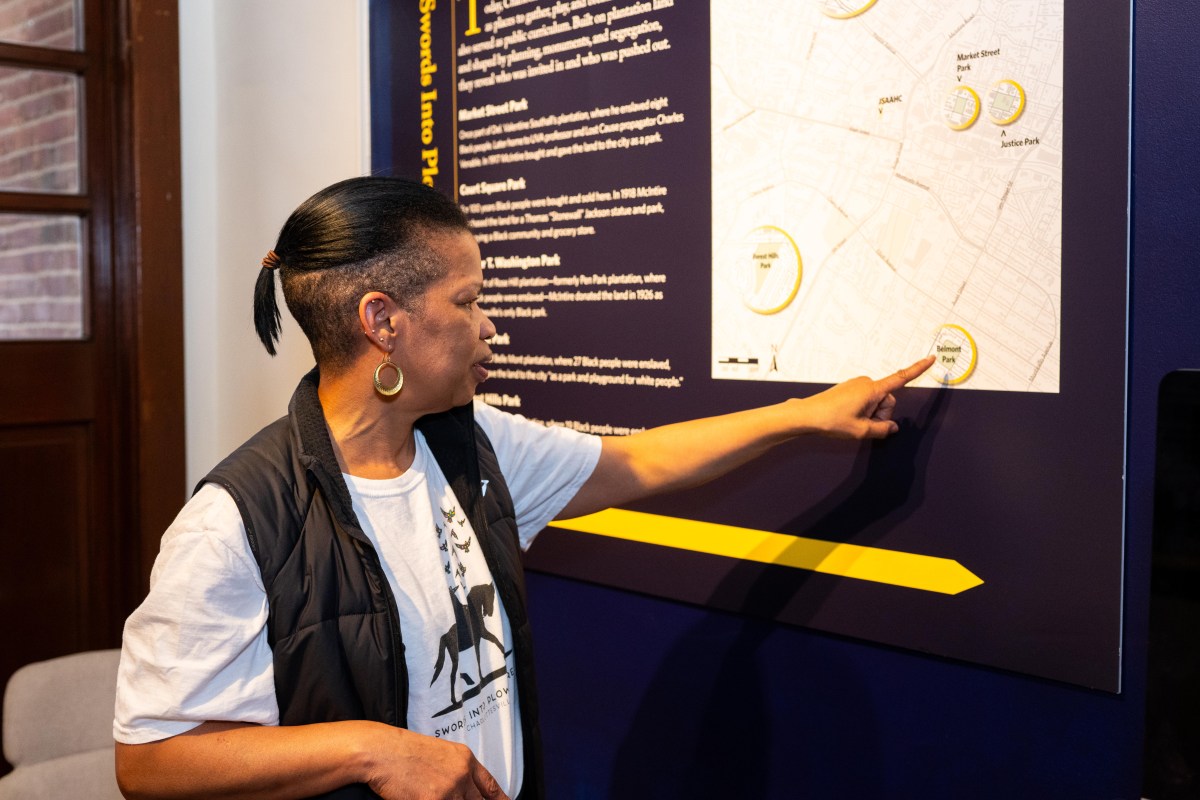
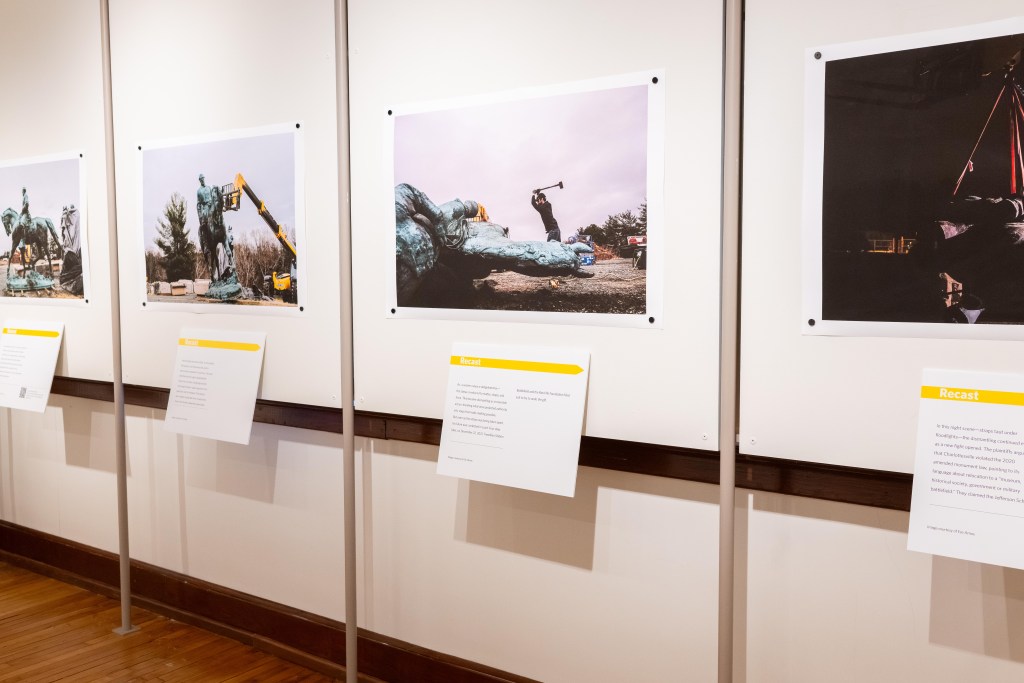
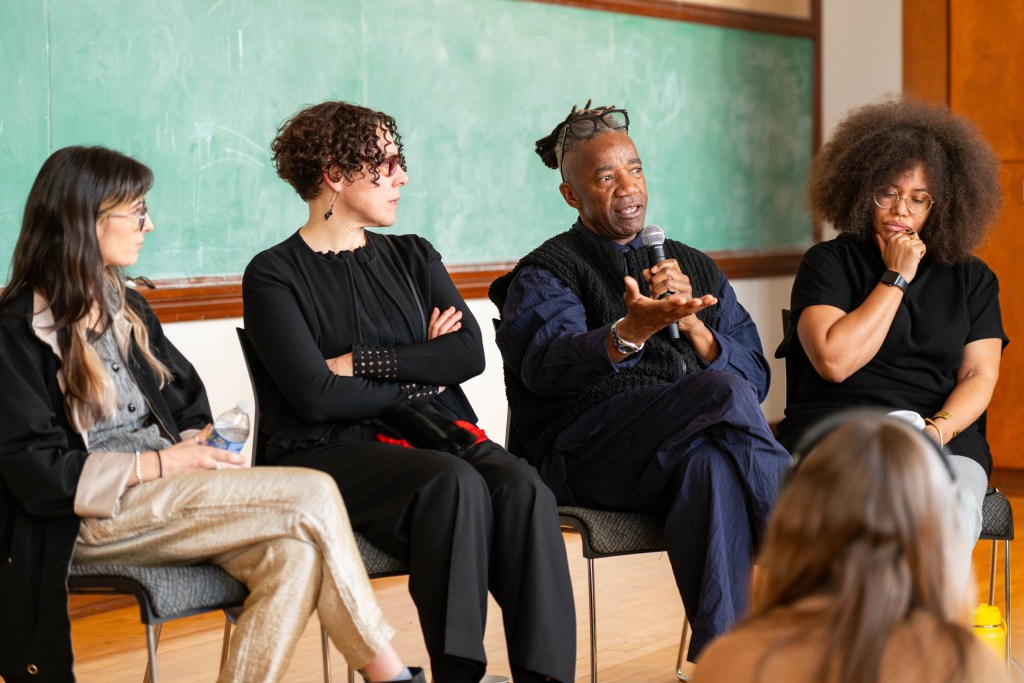
Later that evening, the design groups — three finalists among 32 applicants — presented their proposals to members of the Charlottesville community at the JSAAHC where images of the exhibit, “Recast/Reclaim,” are on display through May 30.
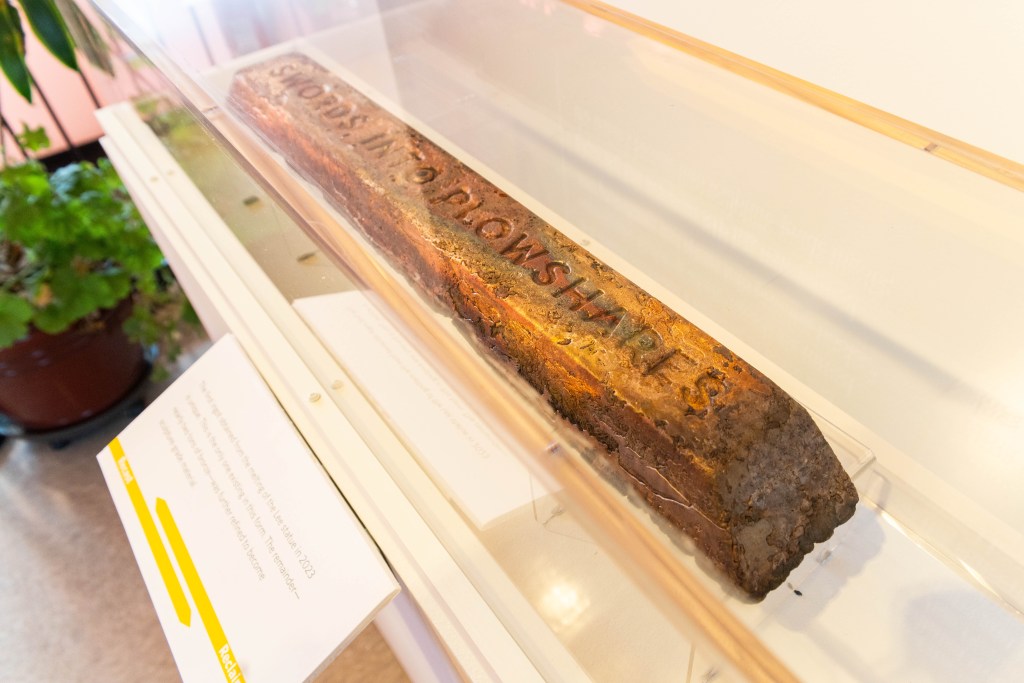
The exhibition and public artwork project are led by Swords Into Plowshares, which is stewarded by JSAAHC. The exhibition includes original, never-before-seen photographs that document the dismantling and melting of the Lee statue into bronze ingots. Those ingots travelled across the country and are currently on display in a Los Angeles museum through May 3, after which they will return to Charlottesville and be remade into public art to advance inclusiveness in public spaces.
Swords Into Plowshares, which was launched after the 2021 removal of Charlottesville’s Confederate statues, continues to host several community meetings to determine which firm will create the new work.
Take action
Provide your input on the “Recast/Reclaim” proposals
Community members can view the Recast/Reclaim exhibition and cast their vote on the proposed designs that will remake the melted Robert E. Lee statue into new public art. See the full Recast/Reclaim exhibition at the Jefferson School African American Heritage Center, 233 4th St NW, Charlottesville through May 30.
View digital proposals from the finalists here and watch their presentations here. Cast your vote in person at JSAAHC or online here.
Community voting is now open to select the final design. Scale models of the proposals are on view at JSAAHC, where visitors can cast their ballots in person or vote online through May 30. The winning design will be announced on July 10, marking the fifth anniversary of the Lee statue’s removal in Charlottesville.
Charlottesville’s role in the local exhibit and the “Monuments” exhibit on the West Coast got its legs in 2016 when then-high school student and current City School Board member Zyanhna Bryant petitioned the City Council to remove the Lee statue from Lee Park (now Market Street Park), where it had stood since 1924. Attempts to keep the statue intensified after several “Unite the Right” rallies occurred in 2017.
That year, on Aug. 12, a “Unite the Right” rally involving white supremacist and white nationalist groups drew counter protesters.
Heather Heyer was killed after James Alex Fields Jr. drove a vehicle into a group of counter-protesters. Fields, 22, was convicted of first-degree murder and other charges in 2018. Two Virginia State Police troopers also were killed when their helicopter crashed while responding to the protests, and 19 others were hospitalized, according to the Final Report of an Independent Review of the 2017 Protests prepared by Hunton and Williams law firm.
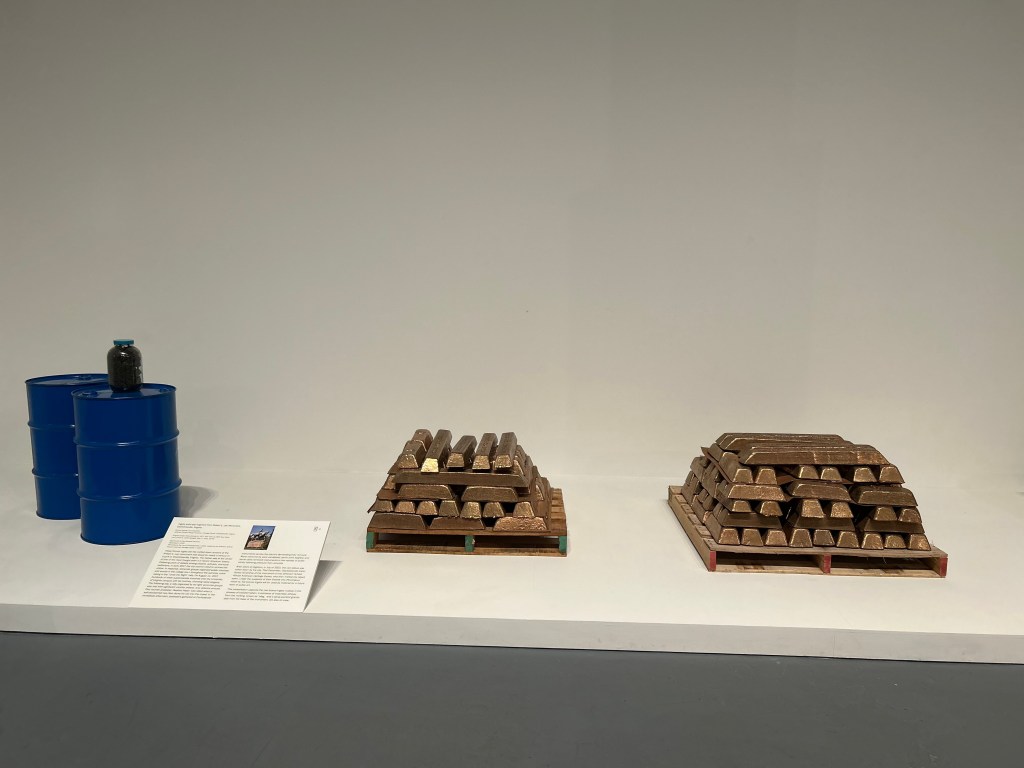
Despite the Charlottesville City Council’s vote to remove the statue, protests and a failed lawsuit delayed its removal until 2021. The statue was eventually melted into bronze ingots, which currently sit stacked on pallets as part of the massive “Monuments” exhibition at the Museum of Contemporary Art in Los Angeles.
Read a Charlottesville Tomorrow report on the West Coast “Monuments” exhibition featuring artwork created from Confederate artifacts.
When the West Coast exhibition opened, Andrea Douglas, JSAAHC’s executive director, said it also marked the start of “Recast/Reclaim,” the second phase of the Swords into Plowshares project.
“The journey to this (Los Angeles) exhibition has included a court case and moving the object more than once,” said Douglas. “Yet these challenges gave us much-needed time to plan our next steps.”
Those steps included identifying leading design firms to reimagine public spaces as places of inclusion, remembrance, and joy for communities in the city and beyond.
“These design groups are leaders in national and international conversations about race, memorialization and public space, aligned with our global aspirations for this project,” said Douglas. “Swords Into Plowshares is transformative for us here in Charlottesville and will ignite imaginative possibilities for decisive intervening in racial justice narratives in all public spaces.”
PUSH Studio’s proposal, “Land Forge: A Collective Future,” sees the story of land in Charlottesville as inseparable from the story of freedom, belonging and survival. From Vinegar Hill and its destruction to the city’s current struggles with gentrification and rising housing costs, Black Land has always meant more than property, the proposal states, adding that stability, independence, wealth and legacy is synonymous with owning land.
“Yet progress was repeatedly undermined. Racist laws, unfair taxation, and segregation eroded what Black families built,” PUSH’s proposal continues. “In 1963, ‘urban renewal’ bulldozed Vinegar Hill, destroying hundreds of Black-owned homes and businesses. Today, inequitable zoning, rising property taxes, and escalating housing costs continue to threaten homeownership and belonging for Black and Brown families.”

In response, “Land Forge” seeks to “reimagine Charlottesville’s public parks as living networks of solidarity, creativity, and healing — a new kind of Underground Railroad built not from tracks, but from relationships,” according to the proposal. “Through art, memory, and community connection, ‘Land Forge’ envisions spaces once overshadowed by monuments to white supremacy into counter-narratives of justice, dignity, and belonging.”
Hood Design Studio proposed a renewed civic ethic that asks Charlottesville to “reckon with its legacies” by creating a public landscape “rooted in truth-telling, belonging, and mutual respect.”
As such, the Oakland, California-based firm envisions the bronze remnants of a once-divisive Lee monument reshaped into a new, communal form of sculptural “Witness Tree Rings,” encircling trees that have lived through Charlottesville’s contested past.
“This transformation is both material and spiritual labor,” according to Hood’s proposal. “These works do not overwrite trauma — they create a constellation of social sculptures that invite everyday democratic engagement.”
Dana King + MASS Design Group’s proposal for Market Street Park seeks to transform the former Lee statue site into a shared civic space of justice, dignity, and belonging. Madagascar’s baobab tree, which represents wisdom, longevity and interconnection, would stand as a central symbol in a design inclusive of pavilions, paths, plazas, plantings and sculpture.
“The baobab, reimagined as an inhabitable ‘Tree of Life’ pavilion, anchors three spatial values: spatial justice, dignity, and belonging,” according to the proposal presented by the Boston-based design team. “Spatial justice redeems site and soil by turning a place of exclusion into one of acknowledgment, safety, and possibility. Dignity is seeded through accessible, parallel activations aligned with natural cycles and cultural exchange, moving beyond a merely ornamental park.”
A sense of belonging is further affirmed through the Tree of Life, West African Adinkra geometries, community handprints, and distributed baobab “fruit” sculptures, all signaling inclusion to African descendants while connecting to universal symbols of wisdom, interconnection, and shared human roots,” states the Dana King + MASS Design Group.
When the winning design team is announced on July 10, “the final phase of community engagement will begin that allows the design team to refine their concepts and come to consensus in the community that will allow us to build,” said Douglas, adding that building is planned to start in 2027.
“But what we’re trying to mark is the 10th anniversary of the Unite the Right Rally,” Douglas continued. “So our goal is to have something, whether it be a completed design that we can then move forward to building. And, coincidentally with that, we will have engaged the community in a conversation about its social values and how those social values can be iterated in a physical form. These are two things that are happening all at the same time, but I think Charlottesville has to ultimately come to terms with what happened in 2017 and this is our way of trying to help that process along.”