

Less than 24 hours after Virginia voters approved a controversial redistricting referendum, a circuit court judge ruled the referendum unlawful and ordered it stopped.
The judge ruled in favor of Republican groups that had sued the state multiple times to stop the redistricting effort.
Virginia’s Attorney General Jay Jones said he will appeal the decision. But, in the meantime, there can be no redistricting, Tazewell County Circuit Court Judge Jack Hurley Jr. said in his Wednesday, April 22 ruling. That ruling says the amendment violated state law and constitutional requirements, and relied on misleading ballot language.
I’ll break down the finer points of his ruling in a moment. But first, some quick background:
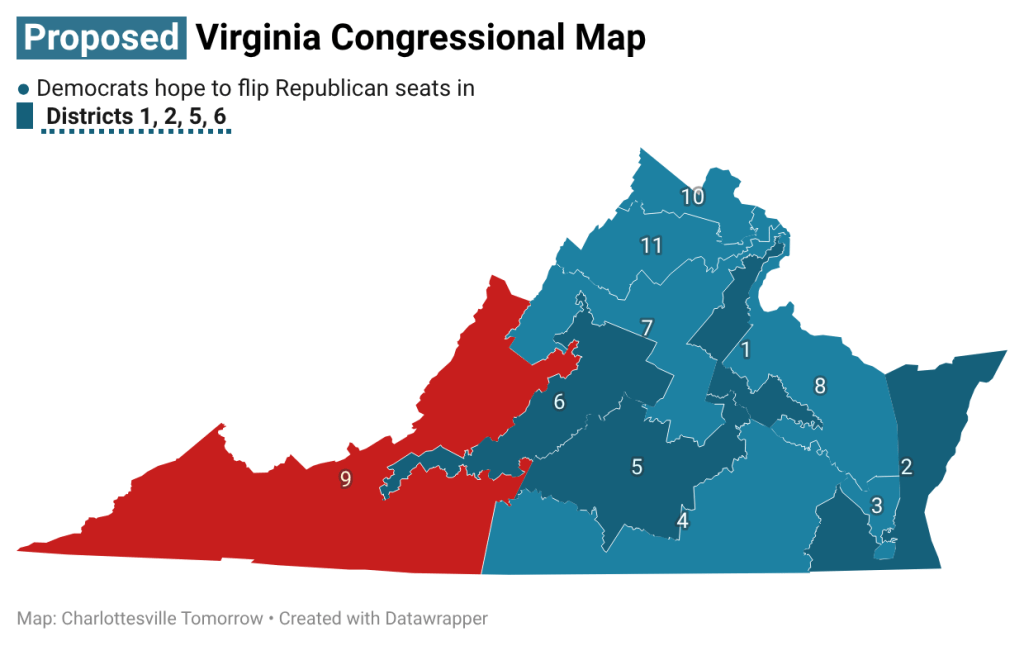
The redistricting referendum passed with about 51.4% of votes on Tuesday, April 21. You can see a breakdown of where those votes came from on our 2026 Central Virginia Voter Guide. It was a victory for Virginia Democrats, giving them the green light to redraw congressional district maps ahead of this fall’s elections in an effort to increase the number of Democratic representatives the state sends to Congress.
Virginia’s redistricting effort exists in a broader national context. Electoral maps are normally redrawn once every 10 years. But now, multiple states are redrawing them early. The current wave of mid-decade redistricting began after President Donald Trump pushed Republicans in other states to pursue redistricting so the party would have a better chance of maintaining control of the U.S. House after the upcoming elections in November. Texas was the first of several states to redraw districts to favor Republicans in 2025. That prompted Democratic-led states to pursue their own redistricting in response — turning what is typically a once-a-decade process into a more immediate, national political fight.
You can read more background on the referendum and how we got here in last week’s Central Virginia Voter Guide newsletter:
What does a ‘yes’ or ‘no’ vote actually mean in Virginia’s special election on redistricting?
(And if you’d like to receive election information like this in your email, sign up for our free Central Virginia Voter Guide newsletter here. This newsletter provides occasional emails, which will increase in frequency leading up to elections, focused on providing you information about what’s on your ballot.)
Now, the ruling.
Judge Hurley agreed on all counts with the plaintiffs who brought the case — the National Republican Committee, and a few other GOP groups.
The most sweeping finding is that the General Assembly was not authorized to introduce the amendment during the 2024 Special Session. The joint resolutions calling the special session limited the General Assembly to business concerning budget and revenue, and a few other odds and ends — not constitutional amendments. That means, the judge said, the amendment was void from the start, which in legal terms means it doesn’t exist.
There are other findings, mostly involving timing and procedural issues that the judge ruled the General Assembly violated along the path to get the referendum in front of voters.
A separate, key finding is that the wording of the ballot question itself was “a flagrantly misleading question to the voters” that “does not accurately describe the proposed amendment as it was passed by the General Assembly.” Judge Hurley did not elaborate on what was misleading in his ruling.
That question, those of you who voted might recall, was:
Should the Constitution of Virginia be amended to allow the General Assembly to temporarily adopt new congressional districts to restore fairness in the upcoming elections, while ensuring Virginia’s standard redistricting process resumes for all future redistricting after the 2030 census?
Once Attorney General Jones appeals the decision, a panel of judges on the court of appeals will review Hurley’s ruling.
Though, it might not be the only case Jones will be defending. There are a handful of other lawsuits filed in Virginia courts challenging the referendum. Read more about those suits in this article from VPM.
Meanwhile, early voting for the upcoming Aug. 4 primary election begins June 18. That gives the state less than two months to sort out which districts we will all be voting in.
We’ll keep an eye on these lawsuits and other important election news, so stay tuned for updates.
See you all in your inboxes soon!
Jessie Higgins, Democracy Editor