


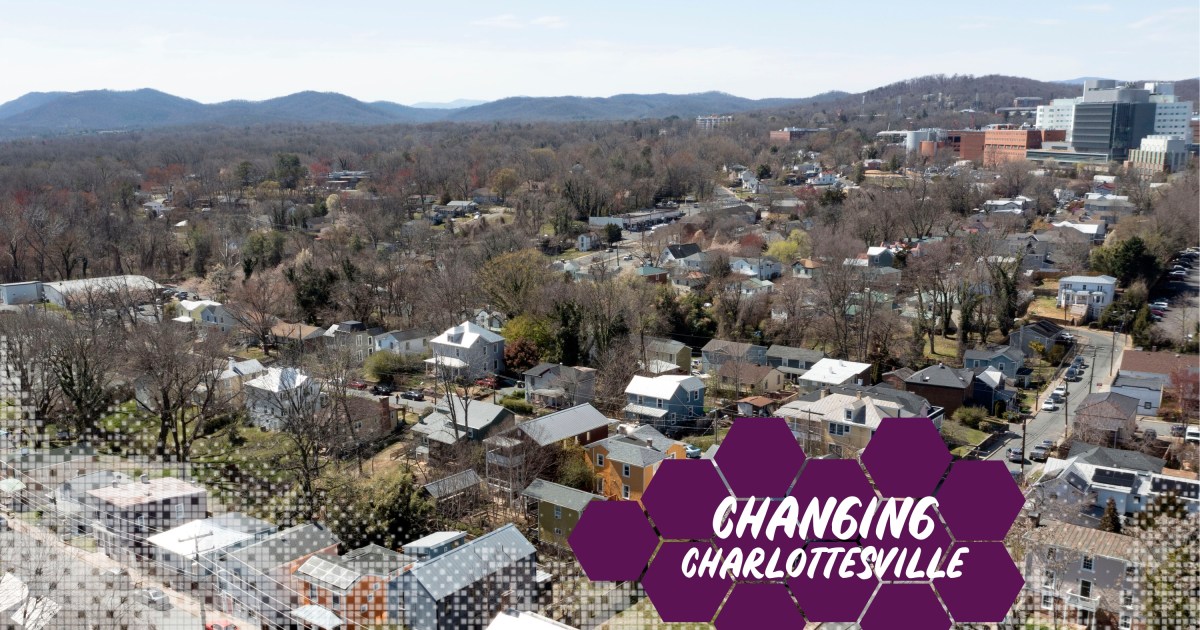
Ask longtime residents of Fifeville about their neighborhood and they’ll tell you some variation of the same thing: The neighborhood has changed.
“It has changed a lot,” said Rosa Ayers, drawing out the word “changed.” Ayers and her husband have lived in the neighborhood since the mid-1970s, when they were the first Black couple to buy a house on Forest Hills Avenue.
Fifeville is one of the city’s oldest and most dense neighborhoods. Its narrow streets — and the people who live on them — have seen a number of major changes in recent years, more than most other neighborhoods in Charlottesville.
In 1822, at the corner of what is now Cherry Avenue and Ninth Street SW, Scots-Irish builder James Dinsmore (who worked for Thomas Jefferson) built the Oak Lawn manor home for a local merchant. Smaller homes for those who worked at Oak Lawn soon popped up around it. In the 1880s, a nearby farm owned mostly by the Fife family was subdivided and sold to Black and white families, resulting in a mixed race neighborhood to the west and a working class, mostly-Black neighborhood to the east.
The area was heavily developed until the 1920s and then saw very little construction until recently. The expansion of University of Virginia, particularly of the UVA Medical Center has brought more white and higher-earning families to Fifeville.
UVA continues to expand its footprint in the neighborhood, too. It owns about a dozen properties, mostly near the hospital, on Grove Street, Estes Street, and King Street. And, in October of this year, UVA purchased the 5-acre Oak Lawn property, near Buford Middle School, for $3.5 million.
“Many residents can trace their Charlottesville roots as far back as two centuries,” said the introduction to the Fifeville chapter of From Porch Swings to Patios: An Oral History of Charlottesville’s Neighborhoods 1914-1984, published in 1990. But that might not be the case anymore.


“It has changed tremendously,” said Marcia Johnson, who bought her home off of Cherry Avenue in 1993. Families who’d been in the neighborhood for years “have died out. They sell these little homes for little or nothing, and these rich folks come in here, purchase these homes, remodel and sell them. No one, not one African American and not half of the Caucasian families, can afford these homes.”
Johnson paid $60,000 for her house in 1993. It was hard then, but it was do-able. Recently, a house near her sold for $700,000, a price she said she’d never be able to afford.
“I worked hard for my home,” Johnson said, emphasizing “hard.” She’s worried that when she and her husband retire, they won’t be able to afford their property taxes, which increase each year.
Neisha Allen, a former Fifeville resident, connects these rising home prices with the neighborhood’s location, right between UVA’s main campus and Downtown Charlottesville. Allen, at 25, just got her first apartment — in Albemarle County. She can’t afford to live in the neighborhood where she grew up.

More about Fifeville
Allen has noticed that Fifeville’s proximity to UVA, the UVA hospital, and to downtown Charlottesville, have made it increasingly attractive to higher income families and individuals looking for those amenities. And as higher earners have moved into the neighborhood, property values and rents have gone up and pushed people with lower income — like Allen herself — out.
Fifeville has a number of unique amenities, like La Flor Michoacana, a family-owned ice cream and paleta shop that’s popular citywide. The neighborhood has three city parks (Tonsler Park, Forest Hills Park, and Fifeville Park), a Salvation Army thrift store, and the city’s only mosque, the Islamic Society of Central Virginia.
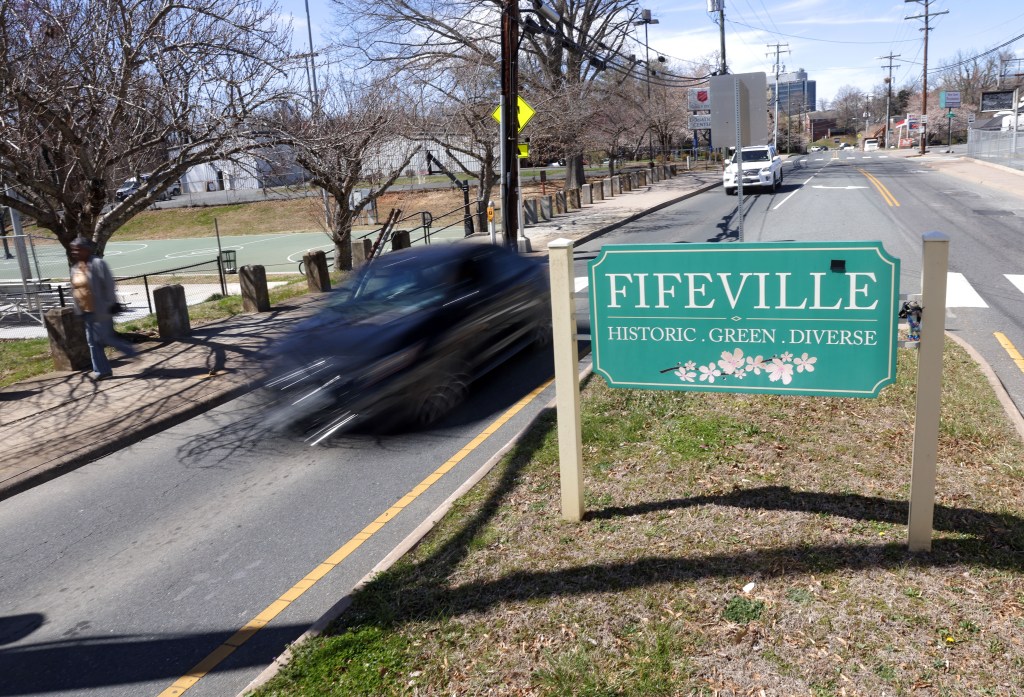
Many of the homes, especially around the Cherry Avenue area of Fifeville, date to the 1800s, according to From Porch Swings to Patios. There are pockets of housing throughout the neighborhood that were built in the middle of the 20th century, particularly close to the Forest Hills Park area, where the neighborhood borders Fry’s Spring.
Johnson is worried that what’s happening in Fifeville currently will be yet another chapter in Charlottesville’s story of displacing Black families, as well as low-income families, from their homes. Why wouldn’t it, she wonders, when it’s happened to her family twice already.
Her family lived in Vinegar Hill until the city condemned and razed it. They moved over to the Gospel Hill area in what is now Fifeville. But when UVA started expanding the hospital, they had to move again. “They were displaced, again,” said Johnson.
These changes have been going on for a while, say longtime residents. Gentrification of the neighborhood had already begun by the early 2000s, residents told C-VILLE Weekly in 2017.
Some of those seismic shifts aren’t reflected in the data analyzed for Changing Charlottesville. That’s because they started before 2013, which is the earliest year of American Communities Survey Data available on the U.S. Census website.
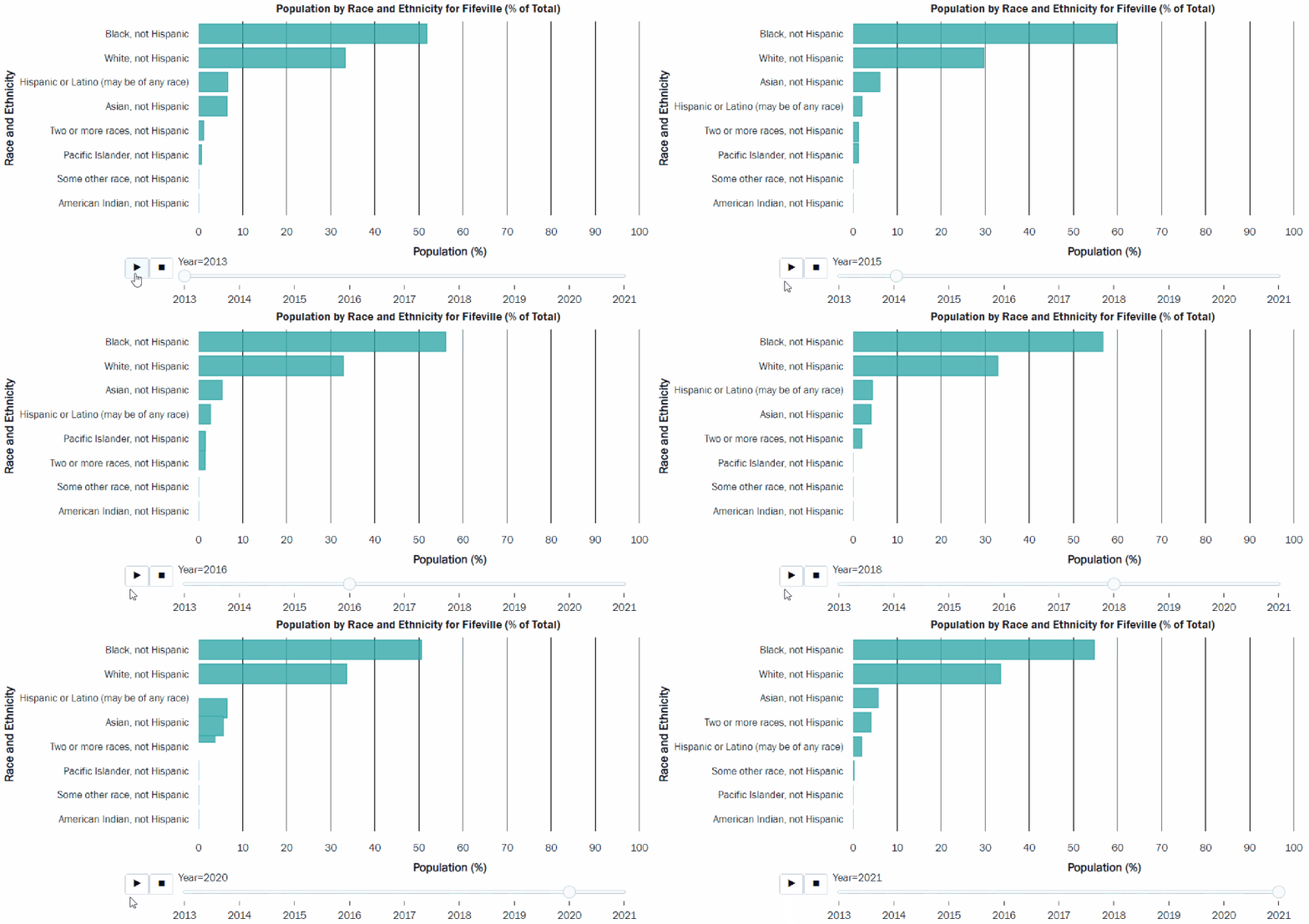
Fifeville has been, and continues to be, a majority Black neighborhood. In 2021, Black people made up slightly more of the neighborhood’s population, about 55%, than in 2013 (52%), according to the data. White (not Hispanic) people make up about a third of the population as of 2021. The percentage of people from other racial and ethnic backgrounds has fluctuated over the years.
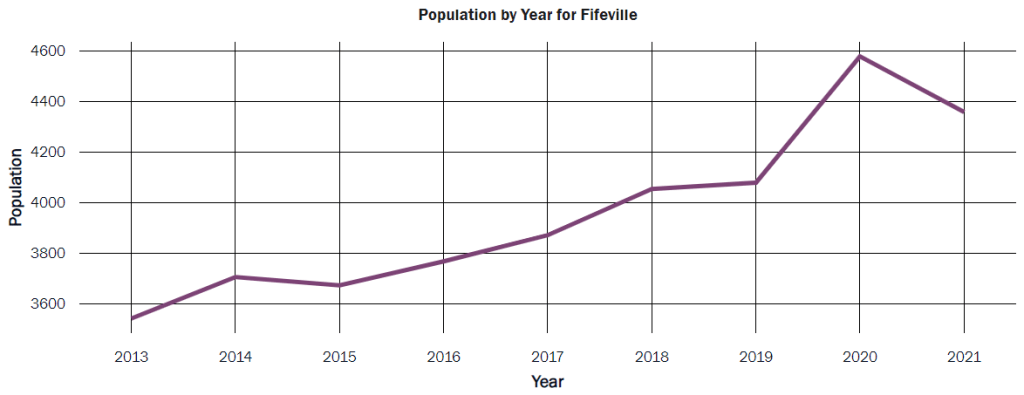
Fifeville’s overall population has grown significantly over the last decade. There are more homes in the neighborhood, and more people living in them. Between 2013 and 2021, its overall population grew by more than 800 people, from 3,541 in 2013 to 4,357 in 2021.
There are 114 more homes in the neighborhood since 2013 and the vacancy rate of those homes has dropped significantly, too. In 2013, 12.39% of the neighborhood’s households were vacant; by 2021, the vacancy rate in Fifeville was just 4.58%.
Most Fifeville residents — 60% of them — rent their homes, and have for the past decade. That’s similar to the city as a whole, however, the data shows that in the last few years, there have been small increases in the percentage of owner-occupied homes. Marcia Johnson said she’d noticed that, too.
Compared to other neighborhoods in the city, the median price of residential property in Fifeville is relatively low. Fifeville has been below median home price for the entire city for some time, and in 2021 it was more than $100,000 below. This disparity has continued even as the vacancy rate in Fifeville has dipped.

Fifeville’s median household income has increased — as it has everywhere in the city. But it has gone up rapidly in the last two years. For most of the decade, median household income hovered around $45,000 per year. But from 2019 to 2021, it jumped from $46,000 to $61,600.
The income distribution chart paints a crisp picture of how the neighborhood is changing financially. In 2013, Fifeville was economically diverse, with household incomes distributed relatively evenly across the spectrum. However, more households fell into the lowest income bracket, earning less than $20,000 per year, than any other.
But by 2021, just eight years later, more Fifeville households fell into the highest income bracket — earning $100,000 or more each year — than any other.
Explore more data about Fifeville for yourself.
Navigate the whole project

Changing Charlottesville
Charlottesville Tomorrow and 2022 graduate students in UVA’s School of Data Science teamed up to tell a story of our neighborhoods in numbers. As the city undergoes a major rezoning effort, we’ll examine how 19 neighborhoods have changed over about decade and what zoning could mean for their futures.
Introduction: A decade of data tells a story of how Charlottesville’s neighborhoods are changing
Coming soon: Interact with all the data we used in this series
The data we use in this project go back about a decade. They do not tell the longer stories of the Monacan Indian Nation, whose people have lived here long before the creation of the city of Charlottesville or the collection of this kind of data.

The Neighborhoods
Click on a purple neighborhood button to find out more. As we publish more stories, you’ll see more purple.