

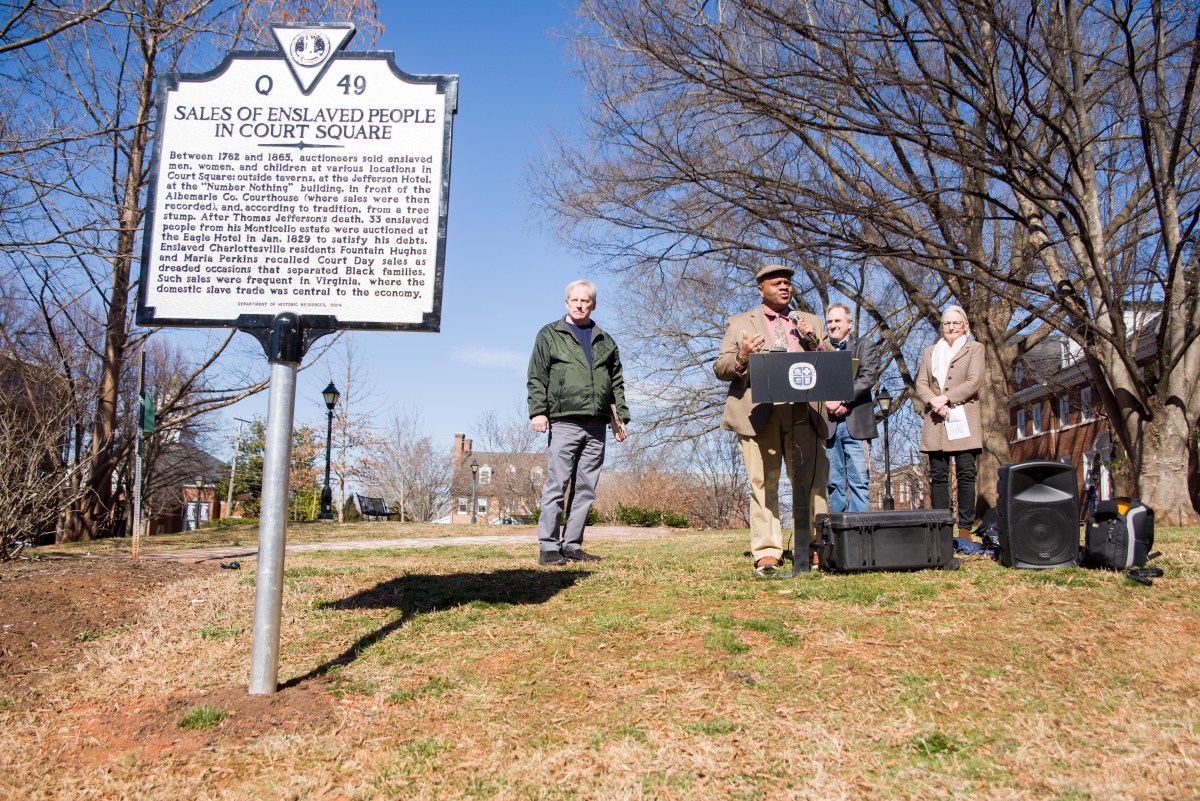
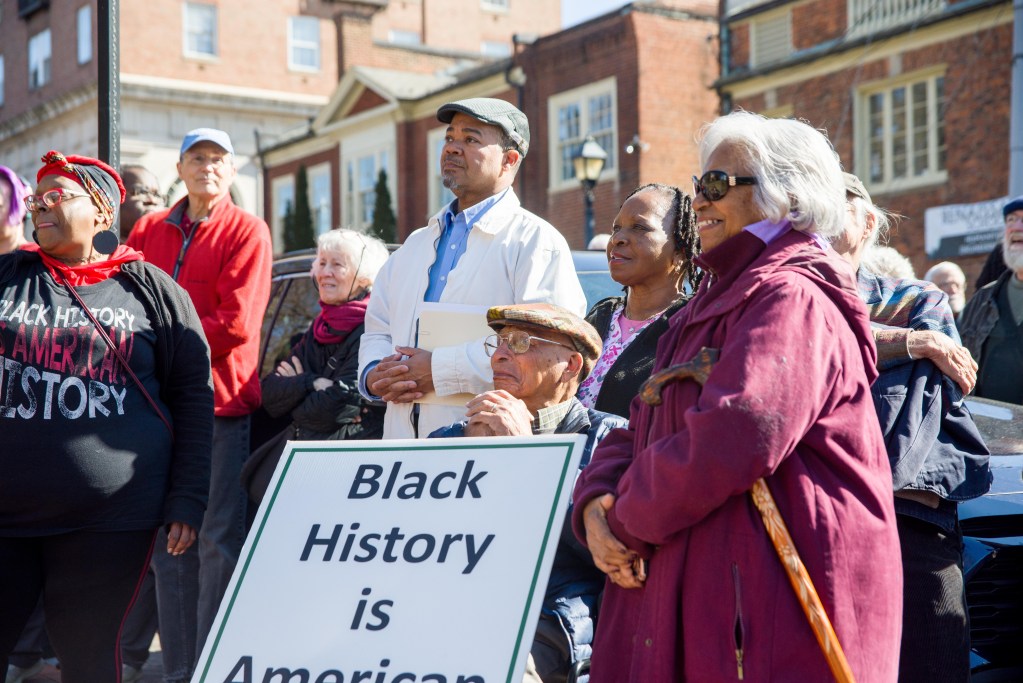
Monday afternoon, a few dozen people gathered along the brick wall at the south end of Court Square Park in downtown Charlottesville — the oldest section of the city.
Some pulled on hats and scarves as a cold wind sliced through the sunshine and kicked the smell of fresh mulch into the air.
But the wind couldn’t chill their spirits. They were there to witness the unveiling of a new state historical marker acknowledging one of the most horrific parts of Charlottesville and Albemarle County’s past: the sale of hundreds of enslaved Black men, women and children at various sites throughout Court Square between 1762 and 1865.
The marker is intended to provide a long-absent element of education about that history, Jeff Werner, historic preservation and design planner for the city, said in his welcoming remarks to the crowd on Monday, March 3.
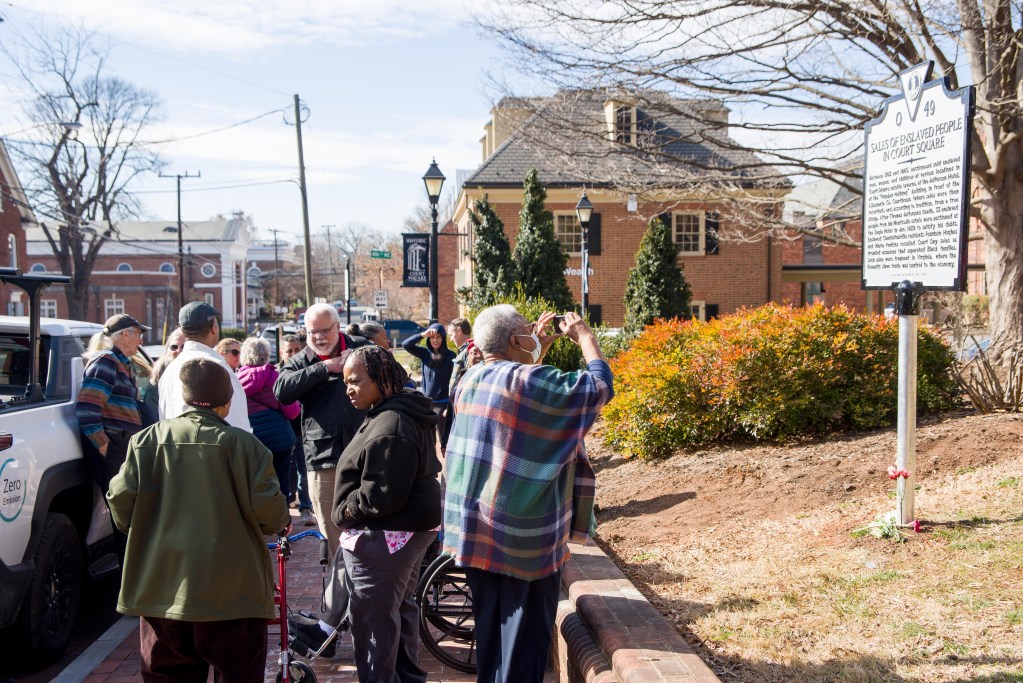
A few moments later, Werner, with help from Charlottesville Mayor Juandiego Wade and City Councilor Lloyd Snook, removed the black plastic covering from the marker to the sound of applause and the click of camera shutters.
“Thank you Jesus, hallelujah!” Charlottesville city resident Renee Bryant called out. “God is good all the time.”
“It’s been a long time we’ve been working on this,” said city resident Rosia Parker. “Had to make sure we got here.”

This photo of Number Nothing Court Square, taken in 2021, shows various community efforts to acknowledge the horrific sale of hundreds of men, women, and children throughout Court Square. A “1619” sticker is at the bottom of the lamppost, referring to the year that the first enslaved Africans arrived in the English colony of Virginia. There are other signs on the post, as well as buckets of flowers and a paper “plaque” glued to the brick sidewalk. The words “Human Trafficking Site” are written in white chalk along the ridge of the sidewalk, between the black bucket of flowers and the lamppost. Mike Kropf/Charlottesville Tomorrow Credit: Credit: Mike Kropf/Charlottesville Tomorrow 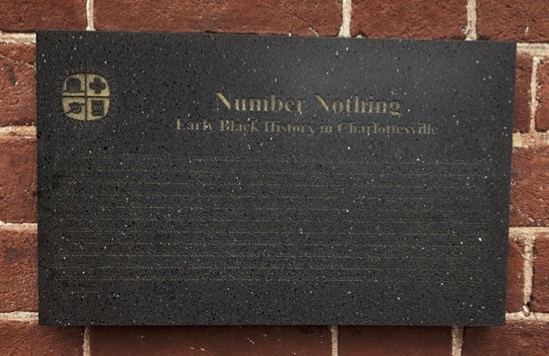
This engraved plaque acknowledging the sale of human beings at Court Square became weathered and difficult to read over the years. It was installed around 2003 and removed in 2019. Photo courtesy of Phil Varner/The Charlottesville Historic Resources Committee 
The bronze plaque embedded in the sidewalk, with one of the community’s edits. This photo was taken sometime before Feb. 6, 2020, when Richard “Freeman” Hobs Allan removed it and tossed it in the James River. Photo courtesy of Phil Varner/The Charlottesville Historic Resources Committee Credit: Photo courtesy of Phil Varner/The Charlottesville Historic Resources Committee 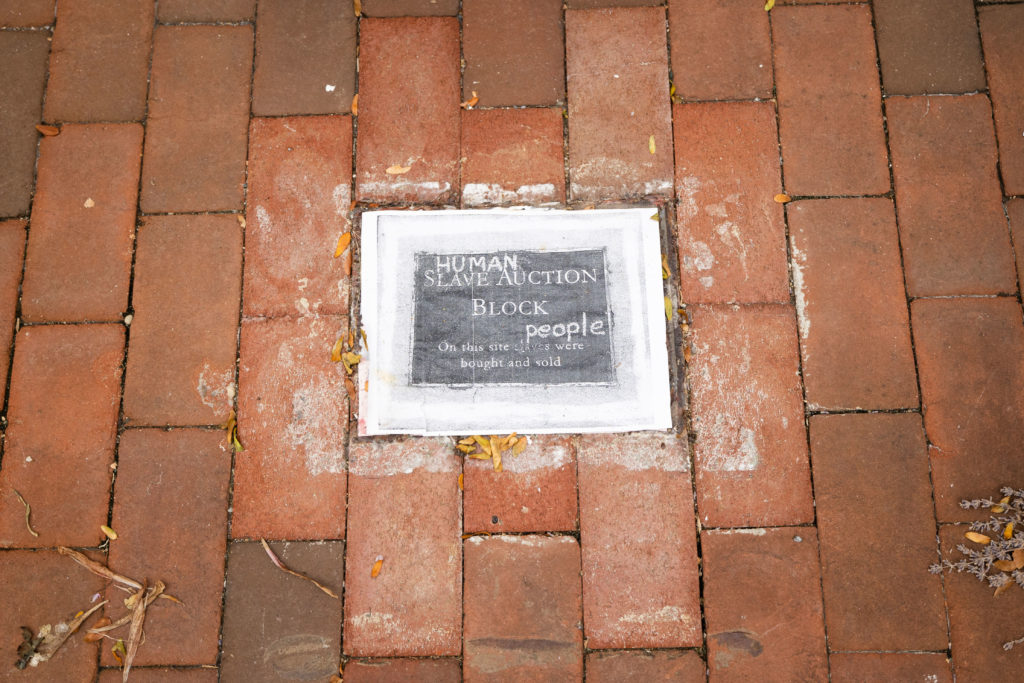
The plaque embedded in the sidewalk in front of Number Nothing read “Slave Auction Block / On this site slaves were bought and sold.” Residents used to edit the text in various ways, as shown by this printed image pasted into the sidewalk. It is unclear whether this is pasted over the plaque, or in the empty space where the plaque was. The edit reads “Human Auction Block / On this site people were bought and sold.” Mike Kropf/Charlottesville Tomorrow Credit: Credit: Mike Kropf/Charlottesville Tomorrow 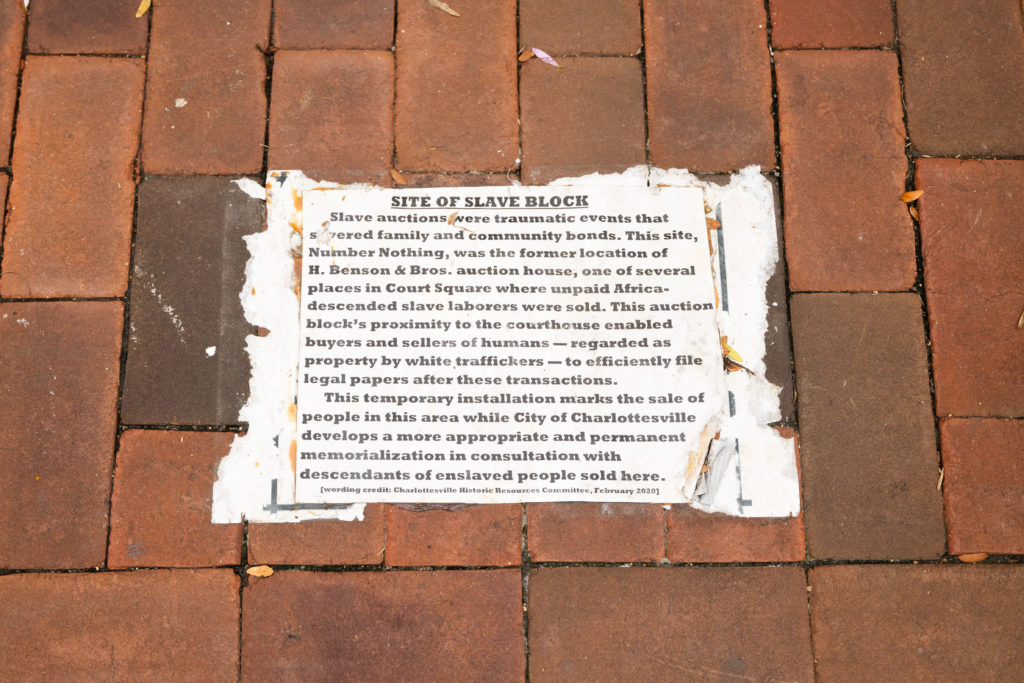
A community member in 2021 pasted a printout on the sidewalk in front of the Number Nothing building in Court Square describing the sale of enslaved men, women and children at the site. Mike Kropf/Charlottesville Tomorrow Credit: Credit: Mike Kropf/Charlottesville Tomorrow 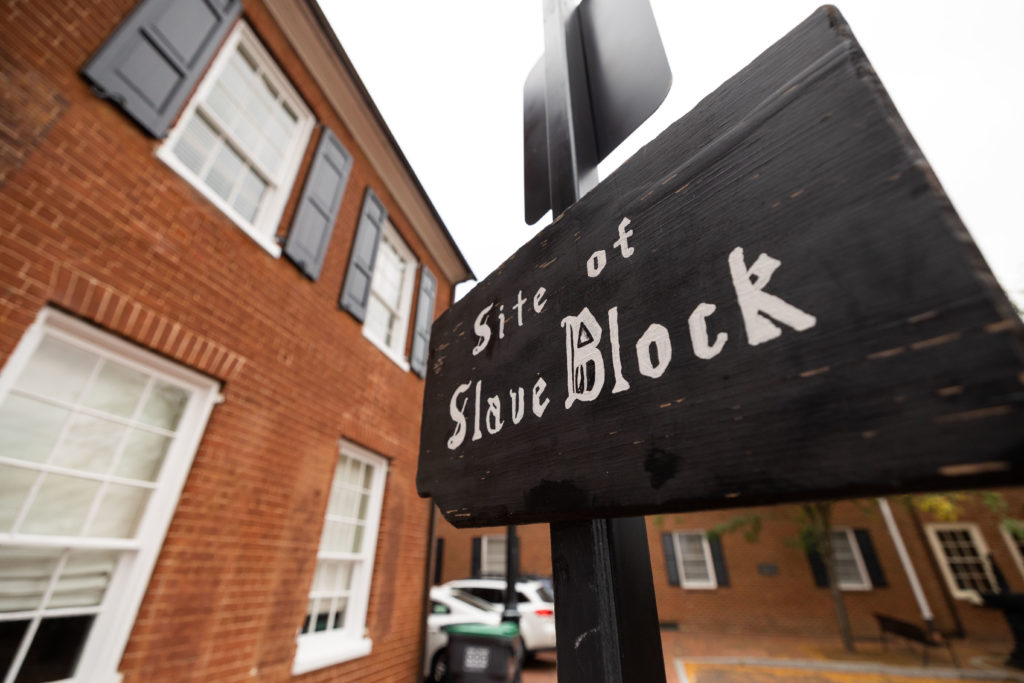
This sign, shown in 2021, was attached to a parking signpost on the side of Number Nothing Court Square, but has been removed. It appears to be a replica of the sign that Eugene Williams petitioned the City to put on the side of the building in the 1970s. After years of research, historians disagree on whether there was an auction block at Number Nothing, and if there was, where it was located. Mike Kropf/Charlottesville Tomorrow Credit: Mike Kropf/Charlottesville Tomorrow
The marker was installed after years of research — and decades of debate — about how to best memorialize the history it tells.
The effort began in earnest sometime in the 1970s, the Charlottesville Historic Resources Committee learned, when Charlottesville civil rights activist and high school teacher Eugene Williams had a slate plaque installed on the side of the brick building known as Number Nothing Court Square. “Site of slave block,” the sign read in old-fashioned white faux-script.
Number Nothing Court Square was built as a mercantile shop in the 1820s and is one of the only buildings from that time still standing in Court Square today (part of the Albemarle County courthouse is another). By 1858 and possibly earlier, Benson & Brother Auction Room was in operation and began leasing Number Nothing by 1864, according to research conducted by former Charlottesville Historic Resources Committee Chair Phil Varner. Local newspaper ads from the time show that Benson & Brother bought and sold goods — and people — from Number Nothing until at least 1865.
The mercantile’s previous location was also in, or near, Court Square, but because the current landscape is so different from what it was in the 19th century, it’s hard to pinpoint where that other location may have been, Varner told Charlottesville Tomorrow.
The slate plaque Williams fought for was removed in the 2000s during a round of sidewalk renovations and was never reinstalled. It is unclear why.
The City installed a different plaque on the front of the building around 2003, Varner’s research showed. That plaque was black marble, with carved text and gold inlay. Over time, the gold inlay faded and the marker became illegible. That plaque was removed in 2019; Varner’s research doesn’t say by whom.
Community members were upset at the removal of the slate plaque and the fading of the marble one. So, in 2011 or 2012, the city created a new bronze plaque, according to Werner’s records. It read “Slave Auction Block: On this site slaves were bought and sold,” and the city hoped to install it on the side of Number Nothing where the slate plaque had been. A company called “Serenity III,” which shared a business address with Brownfield Realty Advisors, owned the building at the time, and, according to Werner’s records, did not want the plaque on the side of the building but allowed it to be embedded in the sidewalk out front.
Community members weren’t happy with that, either. In a letter to the editor published in The Daily Progress in 2014, Williams criticized the decision to put the plaque in the ground, where people could walk over it. (Subscribers to The Daily Progress can view the letter here).
For a while, some community members took it upon themselves to create what they felt was an appropriate plaque, editing it to read “Human Auction Block: On this site humans were bought and sold.” Sometimes the editors used chalk, other times, pieces of paper or cardboard with the words written out in permanent marker.
On Feb. 6, 2020, Albemarle County resident Richard “Freeman” Hobs Allan stole the plaque and flung it in the James River. When asked why he did it, Allan cited Williams’ letter to The Daily Progress.
That plaque hasn’t been replaced, and for a while, people frequently covered the empty space in the sidewalk with a printed image of one of the community-edited inscriptions and surrounded it with buckets of fresh flowers.
Someone — it’s not clear who — put a replica of Williams’ plaque on a post on the sidewalk next to Number Nothing. It was there as recently as 2021, but has since been removed.
As of Tuesday morning, the hole in the brick sidewalk left by the removal of the bronze plaque had been filled in. The only marker remaining on the Number Nothing building is a rectangular slate plaque similar to others around Court Square that mark the first post office and the first public library, for instance. It reads “originally Number 0, Mercantile Business, early 1800s.”
So much focus has been placed on Number Nothing in part because of all of the controversy surrounding the various markers. But historians disagree on whether Number Nothing had an actual auction block, and if it did, where it might have been located.
Another reason for the focus on Number Nothing, local researchers say, is that other than a small part of the Albemarle County Courthouse, it is the only surviving building from that time where records show the sales of people took place. Auctions were held at other sites throughout Court Square — the Eagle Tavern and the Swan Tavern, to name two — but those buildings are long gone.
Because the landscape of Court Square has changed so much, other commemorations, particularly the ones held by descendants’ groups, have focused more broadly on Court Square.
Some community members can trace their lineage back to people bought and sold at Court Square, and they’ve held their own memorials there. They’ve read aloud the names of their ancestors in front of different buildings, read poetry and poured libations in their memory.
Most recently, researchers uncovered the names of more than 300 people enslaved in Albemarle County between 1830 and 1865. The researchers found the names in massive tomes of court-ordered property records tucked away on the second floor of the County courthouse — just yards away from the new marker.
Williams, Allan, and others who for years have called attention to the lack of acknowledgment of this history, beamed and cheered when the marker was revealed on Monday.
The reveal didn’t just happen on any day, Jalane Schmidt pointed out in her remarks to the crowd on March 3. It happened 160 years to the day that Union Major General Phillip Sheridan and his troops arrived in Charlottesville. Their arrival led to the liberation of more than 14,000 enslaved people, and is celebrated every year as a municipal holiday, Liberation and Freedom Day, in Charlottesville.
At the time, 52% — more than half — of Charlottesville and Albemarle County’s total population was enslaved, Schmidt reminded the crowd.
Schmidt, a religious studies professor at the University of Virginia and a member of the Historic Resource Committee, wrote the text that made it onto the marker (using every last bit of available space, Werner later noted).
In her remarks on Monday, she emphasized that the 108 words on the marker are the result of a lot of hard work by a lot of dedicated people.

All of that research had a hand in the Virginia Department of Historic Resource’s approval of the plaque in March 2024, she said.
Werner has noted how meticulously documented every word of the plaque must be for the VDHR to even consider it in the first place — the agency only considers 20 markers each year.
“We learned more about ourselves, didn’t we?” Schmidt continued. “It wasn’t always easy, but I think we’re better for it, for having had that process. This is our history. We all own it. This is part of that reckoning. This is community history, and it requires historical honesty.”
DeTeasa Brown Gathers, a lifelong Charlottesville resident and founding member of the Descendants of Enslaved Communities at UVA, gave the closing remarks.
The significance of the date — March 3, celebrated as Liberation and Freedom Day in the City of Charlottesville — wasn’t lost on her, either. The crowd was a good size, she said, but it should have been bigger.
“We need to celebrate Liberation and Freedom Day, and also be thankful for the moment of even having a marker of this substance erected,” Gathers said. “I want to mention the location of it — being upright. Let’s say ‘upright.'”
“Upright!,” some folks cheered in response.
“Things that represent our Black community mostly have been in space that you have not been able to see. Understand that it was important to put it — what?”
“Upright!” the crowd replied, with more people chiming in this time.
Gathers pointed across the courthouse lawn, to another historical marker, one that tells the story of the 1898 lynching of John Henry James, a Black ice cream seller, by an angry white mob. That marker was installed in July 2019.
“John Henry James, he’s upright. It’s time to put some things upright. I’m so grateful we are honoring this,” Gathers said, urging the crowd to research their own history.
“Research and understand more about who you are and how you fit into this narrative. This is a story of what happened in the Charlottesville area and beyond. Continue to learn about who you are,” Gathers said.
After the ceremony, some people took photos with the marker or laid flowers on the freshly dug soil at its base.
City resident Renee Bryant was smiling ear to ear as she watched the scene, standing behind Eugene Williams and holding his wheelchair steady.
“I was waiting for it,” Bryant said of the marker. “I’m 64 years old, and I have a lot of uncles, people who have passed, who used to talk about this. So I’m glad to be a part of it today.”
After taking a moment to reflect, Bryant, who is Black, had more to say:
“It makes you feel good. But it makes you sad, too, because they did this to our folks back then.”
Upon seeing the marker, Cauline Yates, a founding member of the Descendants of Enslaved Communities at UVA group, said it was “a long time coming.”
Yates has worked on other memorials, including the Memorial to Enslaved Laborers at UVA, and she knows firsthand the work that goes into the research, the writing, and the many rounds of revision that go into telling the story on the marker.
“It’s arduous,” Yates said. “You try to get the gist of it,” but there’s always more to the story.
When only a couple people remained on the sidewalk, including a man quietly playing bongos and singing in the marker’s direction, Schmidt reflected on what’s next for the community as far as commemorating its history.
“This is a long time coming, and it’s not the end of things,” she’d said in her ceremonial remarks a few minutes earlier. “The work of history doesn’t end as we learn more, as we unsurface more, as we interpret better. Our stories about ourselves hopefully become more inclusive though things like this. This isn’t the end; we’ll keep doing this.”
Schmidt looked over to the John Henry James marker before explaining what she meant: The marker is part of a much bigger conversation about how a community tells its history.
“Community members want more and better art — monumental art,” she said, fixing her gaze at the patch of grass immediately behind the marker — where a statue of Confederate general Thomas “Stonewall” Jackson stood for decades before its removal in July 2021.
“We got rid of some of these monuments that, after considerable conversation and legal wrangling, we decided we did not want, because they weren’t telling the kind of narrative, or weren’t telling it in a way that we wanted to talk about our community’s history,” Schmidt continued.
“Sometimes people complain, like, ‘oh, the landscape, it’s denuded.’ And you know what? Yeah, it’s fallow right now.”
But it’s fallow so that new seeds can be planted, and something else — of the community’s choosing — can grow in its place, Schmidt said. The Swords Into Plowshares project, led by the Jefferson School African American Heritage Center, plans to use the bronze from the melted-down Robert E. Lee statue to create a new piece of art. The organization opened its call for artists recently, on Feb. 14, Schmidt pointed out. Additionally, the City is working on a Parks & Recreation Master Plan and is looking for input from the community on what it would like to see in some city parks, including Court Square Park.
Historical markers and monuments don’t go up every day, but that doesn’t mean work isn’t happening behind the scenes, Schmidt said.
“While we reflect, we’re not doing nothing. There’s a percolating.”