
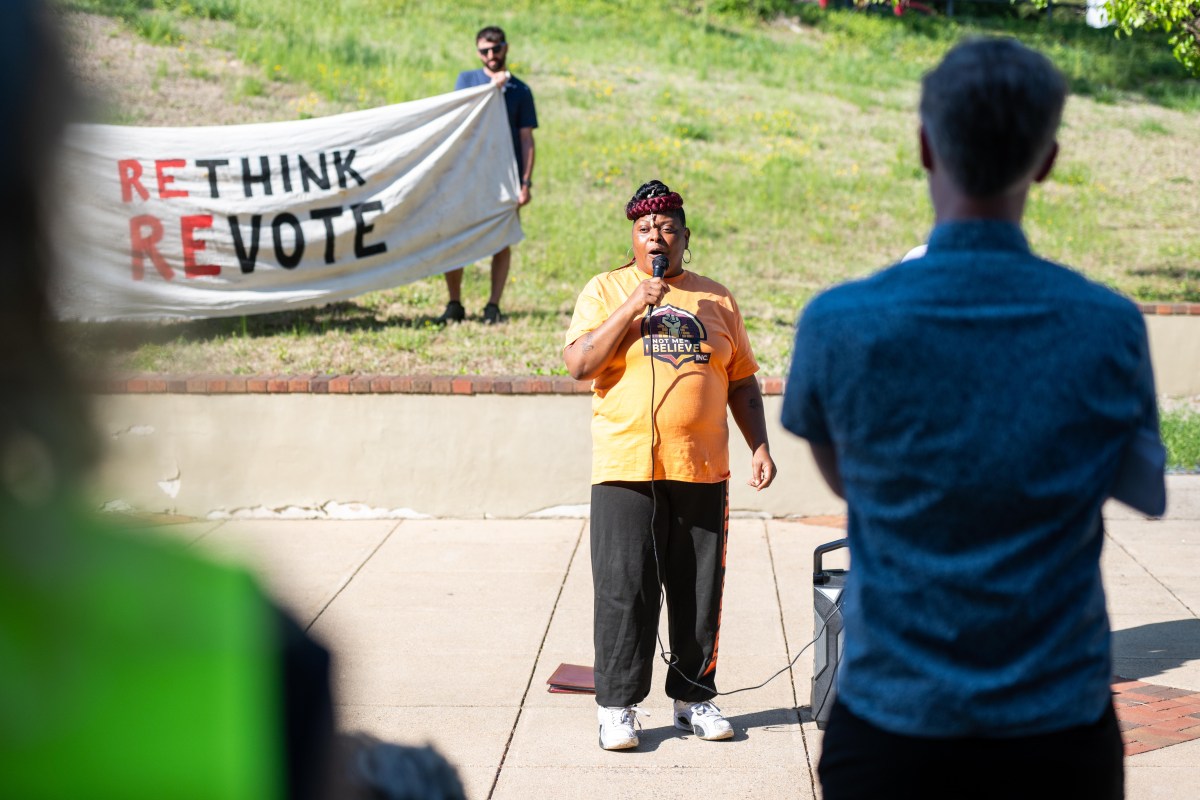
Over the past several months, parents, teachers and some local advocacy organizations have been asking the Charlottesville City School Board to reverse its 2025 decision to bring police officers back to school campuses.
And while Board member Zyahna Bryant made a motion to rescind the Board’s previous vote during a work session April 16, the motion failed.
Charlottesville has had school resource officers, or SROs, before, but the school district removed them several years ago, in part due to questions about their effectiveness. In June 2020 in the wake of the murder of George Floyd, the school district voted to remove SROs after over 40 years, saying that “data did not indicate having an SRO leads to better outcomes on day-to-day events or emergencies.” However, a string of fights and violent incidents in 2023 led to calls to bring SROs back.

The School Board then voted in March 2025 to bring back SROs starting in the 2026-2027 school year, leading to pushback from some parents and teachers who said the decision was made without enough time for community input and raised concerns about potential negative impacts on students.
Advocacy groups, including the Commonwealth Justice Coalition, the Legal Aid Justice Center and Indivisible Charlottesville, have also joined the debate and organized a petition last month asking the Board to reverse its March 2025 decision.
Since the removal of SROs in 2020, the school administration has said it has learned new information. For example, the schools “have found that having mutually selected, specially trained police who understand school routines and build relationships with the school community is better than having whichever officer is available in the moment when needed,” CCS Community Relations Coordinator Amanda Korman-Simalchik told Charlottesville Tomorrow in November 2025.
And officers have been dispatched to city schools several times in recent years. During the work session, CCS staffers showed the Board a 58-page presentation on behalf of the school division’s administration that said police officers were dispatched to city schools 295 times in 2024 and 431 times in 2023.
Some Board members pointed out that this data did not specify how many of those dispatches were “threat assessment” calls, which involve investigating and potentially intervening “with individuals whose behavior may pose a threat to the safety of the school, staff, or students,” according to statewide guidelines for public schools compiled by the Virginia Department of Criminal Justice Services.
“I’m really adamant about data because this is really important for our students,” said Bryant, adding that the data did not reflect why SROs were needed.
Bryant then made a motion to rescind the March 2025 vote to bring SROs back into City Schools.
Board member Shymora Cooper, who was not present at the March 2025 School Board meeting that reinstated the SRO program, wanted to know how interactions between SROs and students were recorded and if those records could potentially be used against those students in the future. Cooper was worried that data collected in those interactions would be used against the student in the future, she said.
Cooper also voted to rescind the 2025 vote that reinstated the SRO program.
Board member Nicole Richardson also voted to rescind the 2025 vote, saying that she did not know of anyone who was positively impacted by their interactions with police officers.
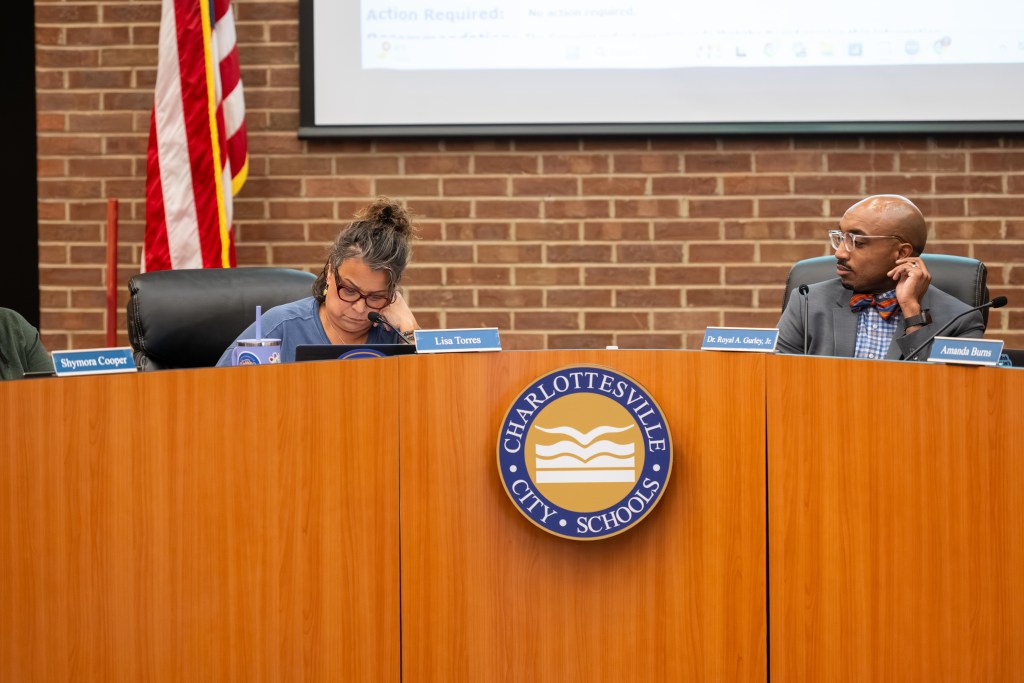
Board members Emily Dooley and Chris Meyer voted against Bryant’s motion to rescind, and before casting her vote, Board Chair Lisa Larson-Torres remained silent for a few moments before ultimately abstaining. Board member and Vice Chair Amanda Burns did not get to vote, as Larson-Torres’ abstention meant the motion failed.
According to School Board procedure, if a motion is already on the agenda, it needs a simple majority, or four votes, to pass. But because the motion was introduced during the meeting and was not on the agenda, it needed a two-thirds majority, or five votes, to pass, according to Korman-Simalchik.
“I was not in support of the vote to implement an SRO program on March 27, 2025. However, implementing the SRO program was the will of the Board, and I respected that decision even though I did not agree with it,” Larson-Torres told Charlottesville Tomorrow.
Larson-Torres and Burns joined the working group that was formed in 2025 to create a memorandum of understanding and standard operating procedures with the Charlottesville Police Department, said Larson-Torres.

“I brought all the same questions and concerns about SROs that informed my ‘no’ vote, and I brought all of the community concerns as well,” said Larson-Torres. “The committee researched, explored and ultimately finalized a MOU that included many of the perspectives/concerns that were shared in those meetings — perspectives of people like me who do not think that we should have SROs in schools.”
“I understand this particular issue is complex, difficult and hard,” said Larson-Torres. “But, as a member of the Board, and particularly as Board chair, it is important to me to show respect for the decision-making of the Board as a whole and the work of the staff that stems from it.”
The motion’s failure did not sit well with community members attending the work session. During the second public comment section of the evening, former Charlottesville City Mayor Nikuyah Walker admonished the Board for choosing the SRO program which she described as “consistently abusive towards the Black community.”
Sophia Morrero, who graduated from high school a few years ago before moving to Charlottesville, told the Board they were moving in the wrong direction with the SRO program. Speaking as a member of the community, she reflected on her experience as a student.
“Let me tell you what I was scared of when I was a kid,” said Morrero. “That someone would come into our school and kill us. And you want to add another gun to that? SROs are not the solution.”
“Ya’ll don’t care about kids,” said Tanesha Hudson, a CCS parent who joined the working session via Zoom. “Ya’ll take those numbers and make it what ya’ll want to make it.” Hudson was referring to the number of times emergency personnel were dispatched to City Schools, presented earlier in the evening.
Shannon Gillikin, the president of the Charlottesville Education Association (CEA), the union that represents teachers and support staff at City Schools, thanked Bryant, Cooper and Richardson for their questions during the working session, but took issue with board members abstaining from votes on SROs in recent months.
“If you keep abstaining your vote, you don’t belong on the Board,” said Gillikin.
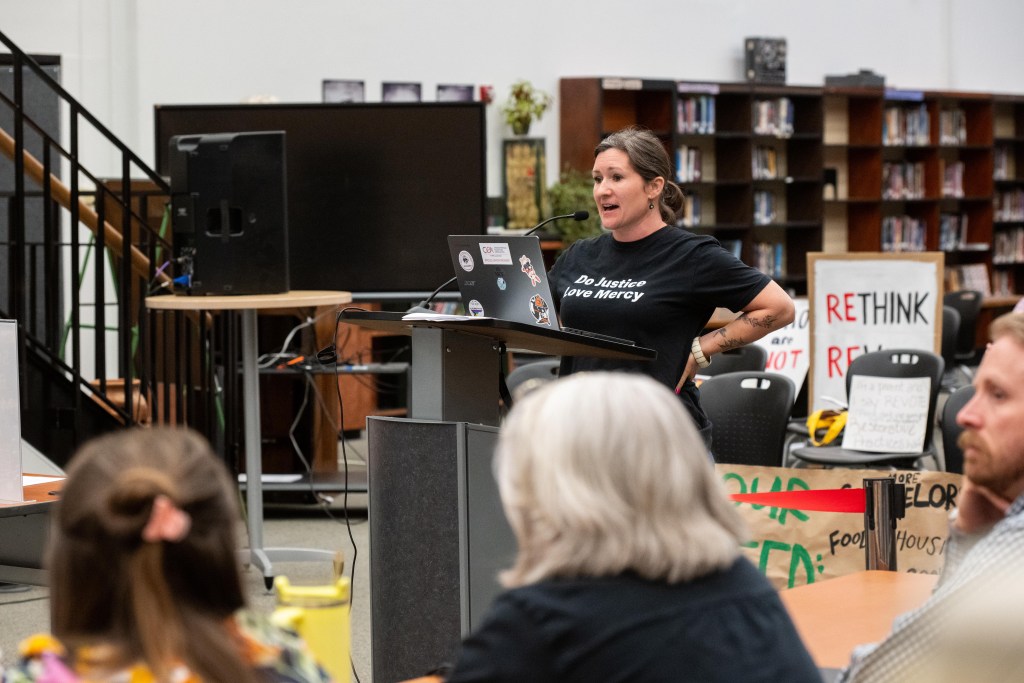
Hank Bostwick, an attorney with the Legal Aid Justice Center Youth Justice Program, attended the work session and was also disappointed with the outcome. “The Board’s actions last week were disappointing to be sure,” he said. “But we aren’t finished yet. It is clear from the Board’s discussions that the proximate placement of SROs outside of our campuses except when necessary for appropriate engagement with students and restrictions on the display of firearms are not off the table and could be added to the current MOU.”
Bostwick added that organizers are pivoting to advocate for changes to the current MOU that are responsive to community concerns. “We encourage everyone in the city with school-aged children to help us convince the Board about the wisdom of these reforms,” said Bostwick.
Editor’s note: This article was updated on April 22, 2025, to correct statements made by Hank Bostwick, an attorney with the Legal Aid Justice Center Youth Justice Program.