
The Charlottesville City School Board is facing vocal opposition from some parents and advocacy organizations who want the Board to reconsider its decision to bring police back into city schools.
In March 2025, the School Board voted 4-2 to reinstate School Resource Officers, or SROs, starting in the 2026-2027 school year. This led to pushback from parents and teachers who said the decision was rushed and failed to incorporate community feedback. The School Board has moved ahead, signing a memorandum of understanding with the Charlottesville Police Department, but some parents are still pressing the Board to reconsider.
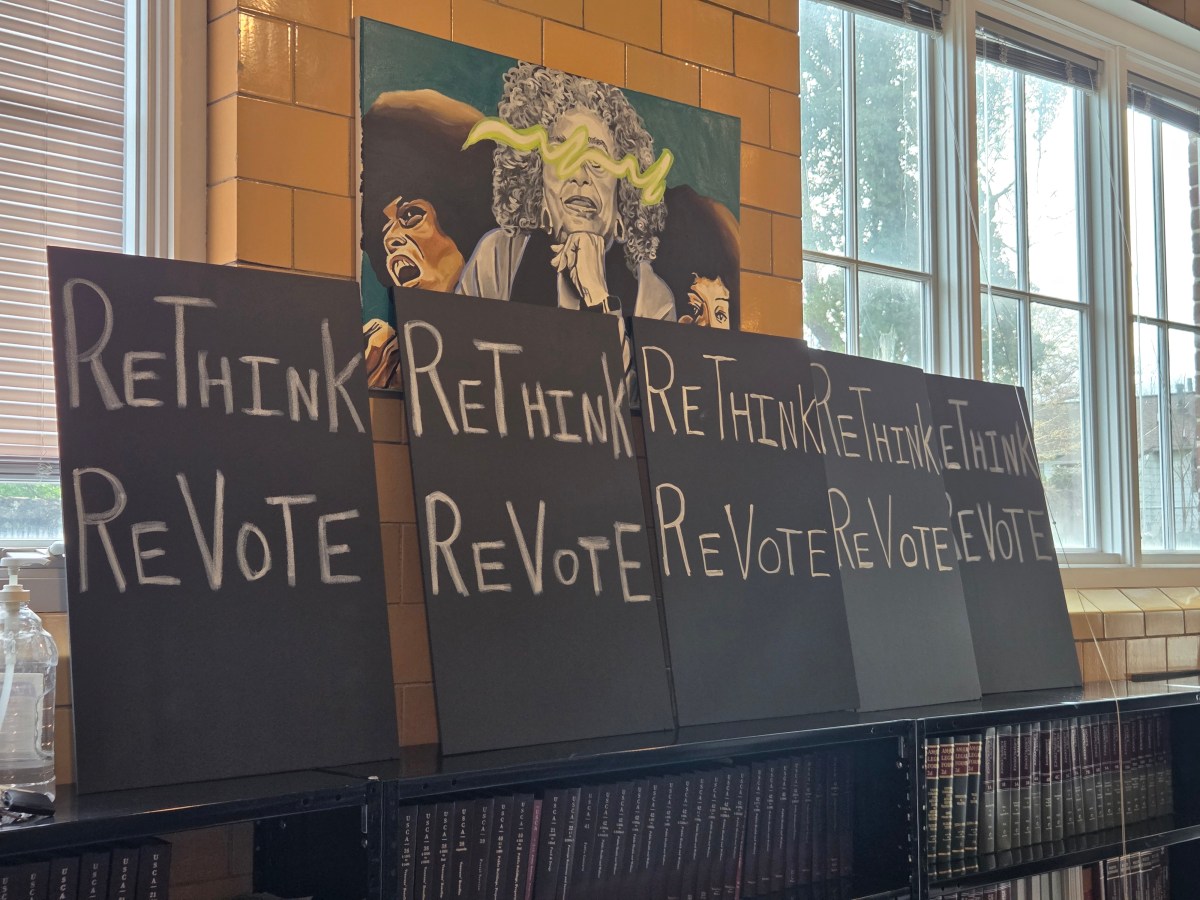
Terry Tyree, parent of a student in city schools, expressed frustration over the decision. “It was made with the lack of transparency; no public input,” Tyree told Charlottesville Tomorrow. “We are here trying to press the issue and make it public that this was made fully without our input.” Tyree was part of a small group of parents who met at the Legal Aid Justice Center on March 29 to make signs protesting the return of SROs ahead of the March 31 School Board meeting.
The Board should explore other options outside of SROs, Tyree said. “I would like to see peer advocates, maybe train and educate the current CSAs that they have, I heard some good things about them. They don’t carry guns.”
Tyree was referring to Care Safety Assistants, which are unarmed security officers that are trained in compliance with the Virginia Department of Criminal Justice Services. They are an extension of school administration and serve to provide and promote safety, security, and a positive school climate. Some parents and teachers see CSAs as a safer and better alternative to SROs.
Tyree added that she is concerned about police presence in schools and also worried about the possibility of SROs working with federal immigration agencies.
“I’m a disabled mother of three, and I had run-ins (with police) simply because I didn’t know how to respond to my own emotions,” said Tyree. “I had to sit in jail for three months with my mental health disabilities alone. I don’t want to see that for these children, the fear, the punishment, the criminalization, and then there’s the immigration thing.”
Take action
Have your say on school resource officers in Charlottesville City Schools
Community members will be able to speak during the public comment section of the Charlottesville Public Schools School Board meeting. The meeting is on March 31 at 6 p.m. at the Booker T. Reaves Media Center at Charlottesville High School, located at 1400 Melbourne Rd., Charlottesville.
To stream the meeting and participate virtually use this Zoom registration link.
Charlottesville has had SROs before, but the school district removed them several years ago, in part due to questions about their effectiveness. In June 2020, Charlottesville City Schools removed SROs and released a video stating “data did not indicate having an SRO leads to better outcomes on day-to-day events or emergencies.” However, a string of fights and violent incidents in 2023 led to calls to bring SROs back.
CCS Superintendent Dr. Royal Gurley declined to comment on the return of SROs. School Board Chair Lisa Larson-Torres said that for the Board to vote on the issue again, a Board member would need to make a motion for the issue to be put back on the agenda and get three members — for a total of four votes — supporting that motion.
And when it comes to parents’ concerns about police officers in schools Torres said that the MOU with the police department can be terminated at any point if views of the CPD and the school board do not align.
“I hear their concerns,” said Torres. “I think the Chief of Police has made it very clear that there’s no intent to collaborate with ICE in the city of Charlottesville, but [we] totally hear their concerns. The broader language in the MOU allowed us to basically dissolve that MOU at any point in time with anything that is concerning.”
Other parents have voiced their opposition during School Board meetings earlier this year.
“I’m here to ask that you vote against the harmful SRO program,” said CCS parent Nick Steiner during the March 5 school board meeting.
Steiner pointed out the current disparity in academic achievement between Black and brown students in relation to their white peers, and expressed concerns that SROs could make the situation worse.
“It’s insane for a district known for its persistent achievement gap to be putting in a program that would make that gap worse,” said Steiner.
According to data from the Virginia Department of Education, Black and Hispanic CCS students score significantly lower in core subjects than white students.
Laura Goldblatt, a CCS parent who taught at a public high school in Greenville Mississippi prior to moving to Charlottesville, told Charlottesville Tomorrow that she saw the negative impact of having SROs in schools firsthand.
Greenville Public Schools has a 97.7% Black student population, according to the U.S News & World Report.
“I was a new teacher, everything kind of felt overwhelming,” said Goldblatt. “But we did have a lot of police presence in school, and it was ineffective. It was really traumatic for my students, students who had some traumatic experience with dealing with police. I just want us to do things that are effective and that are not making the problem worse.”
Mimi Fitzpatrick, a CCS parent, said that she wants all students to feel safe in schools, and SROs would not be the way to make that happen.
“This school district gets a lot of things right, but it also has lots of room for improvement,” said Fitzpatrick. “We all want our schools to be safe spaces. Oftentimes people conflate safety and policing, but policing our kids disproportionately negatively impacts Black, brown and neurodivergent kids and enters them quickly into the school-to-prison pipeline. We owe our kids, all of Charlottesville’s kids, a better alternative to safety than exposing them to daily interactions with police officers who will be armed and capable of using lethal force.”
The Charlottesville Education Association (CEA), the union that represents CCS non-administrative staff, such as teachers and custodians, agrees that CCS should look at alternatives to bringing SROs back to city schools.
“CEA supports this effort to ask the school board to rethink and revote,” Shannon Gillikin, CEA president, told Charlottesville Tomorrow. “The majority of CEA members oppose bringing SROs back to CCS. We want the school board to truly present alternatives, to continue to support the CSA program that has been widely successful since 2020, and to revote on their decision.”
Hank Bostwick, senior supervising attorney at the Legal Aid Justice Center and one of the organizers of the sign-making event, said that he believes one of the incidents that has been cited as a reason to bring SROs back to schools could have been made worse by police presence.
“We represented one of the students who was swept up in the highly publicized fight at Charlottesville High School in December of 2023 that triggered this desire to return SROs to Charlottesville City Schools,” Bostwick told Charlottesville Tomorrow. “I’ve seen the videos, I’ve read the statements; the presence of an armed police officer on that day would have not changed the situation. In fact, it could have made it much worse.”
The Legal Aid Justice Center, along with other organizations such as Indivisible Charlottesville and the Commonwealth Justice Coalition, created an online petition asking the School Board to revote on SROs in response to some CCS parents’ concerns, according to Sam Heath of the Commonwealth Justice Coalition.
“The process that led to this decision fell far short of the transparency, community input, and protections our students and educators deserve,” read the petition.
Heath also said that the Board should look to approaches in restorative justice instead of bringing law enforcement back to city schools.
“Schools should train for, promote, and enact evidence-based restorative models,” Heath told Charlottesville Tomorrow. “What this looks like is asking, ‘What harm happened? What does repair look like?’ rather than the typical asks of, ‘What was the crime? What is the punishment?'”
In response to the petition,Torres said that the School Board “agrees the matter warrants further discussion” and scheduled a work session devoted to the topic on April 16 at Charlottesville High School.
Some parents have also said that the latest version of the MOU does not go far enough in preventing SROs from collaborating with federal immigration officers, particularly after a central Virginia SRO reported a student to ICE according to Radio IQ.
Currently, the MOU states that the school division “shall not initiate communication with any Law Enforcement Agency, including any Federal Immigration Enforcement Agency, regarding a student’s or family member’s FERPA protected or otherwise personally identifiable information. CCS and CPD shall not enter into agreements to share student information with Federal Immigration Authorities except as required by law.”
The Family Educational Rights and Privacy Act (FERPA) of 1974, protects the privacy of student educational records. These records cannot be accessed by anyone other than school officials.
While the MOU specifically addresses the school division, nothing in the MOU explicitly prevents CPD from entering into agreements or collaborating with federal immigration authorities.
CPD liaison Lt. Greg Wade said that while the current language in the MOU does not reflect it, there are no plans for CPD to work with federal immigration agencies.
“We haven’t signed any agreements, and have no plans to do so,” said Wade.
Throughout the U.S. multiple law enforcement agencies have signed 287(g) agreements under the Illegal Immigration Reform and Immigrant Responsibility Act of 1996. These agreements essentially deputize local law enforcement officers to work with and as ICE agents. But, CPD has not signed such an agreement.
Wade also said that if city schools do not agree with any action that CPD is taking, they can dissolve the MOU. And for the CPD, this means, if they feel the SRO program is not working, they can dissolve the MOU.
Efforts to keep local police officers from collaborating with federal immigration agents have reached the state capitol.
This past General Assembly, Del. Katrina Callsen introduced HB 650. The bill not only limits arrests without a warrant in places like courthouses, schools and hospitals, but also requires that school staff notify parents and guardians when ICE is on school property.
Callsen’s bill passed the House with a 63-35 vote, going on to pass the Senate with a 21-19 vote. It is up to Gov. Abigail Spangberger to either veto the bill or sign it into law.
Callsen told Charlottesville Tomorrow that the bill was in response to President Donald Trump’s January 2025 executive order that removed protections for churches and schools from immigration enforcement.
“This is all about keeping our community safe,” said Callsen, adding that she worked with the ACLU to develop the bill, which was modeled after a similar bill in New York.
“It’s a fair assessment to say that spaces that have traditionally been protected, the current administration is now going in with ICE, and so we’re being responsive and proactive in some regards and protecting those spaces,” said Callsen.
Wade said that the priority for the CPD is to build trust within the community, which includes schools.
“As local law enforcement, it’s not our job to enforce federal administrative immigration law,” said Wade. “We’re more focused on specifically in the SRO program, building trust between the city, school employees, students, everyone in that community, everyone in that ecosystem. So that’s the focus.”