Without you, local news wouldn’t exist.
It might not come as a surprise to you that our newsroom is often contacted by elected officials, public relations professionals and the communications staff of large organizations. They are used to interacting with the media, and we appreciate their updates and press releases about news that affects people in central Virginia.
But Charlottesville Tomorrow is a community-driven newsroom, so we want to hear from a variety of residents across our region. We want to hear from people who might have never spoken to a reporter for a news story before.
Listening to the central Virginia communities we serve is crucial to our work, which means it’s really important that you know what to expect when you talk with someone from our newsroom. So, we created a guide.
This guide explains our reporting process and how we talk with community members to craft thoughtful and accurate articles that we hope you can use. We created it with input from our editorial team and by drawing on excellent resources from our peers, including Outlier Media in Detroit and MLK50 in Memphis.
We are committed to being transparent about our reporting and how we encourage civic participation through high-quality, local news accessible (for free!) to all central Virginians.
So we hope you visit, share, bookmark — and feel confident when you connect with us about what’s important to you. This guide is organized in the order that we typically produce stories, from reaching out to community members, to crafting an article to hitting “send” on our newsletter to seeking your feedback, then starting all over again. (Subscribe for free!)

We’re a small newsroom, so we try to maximize our impact by focusing on voices and stories that are not getting much coverage elsewhere, and we try to avoid repeating stories covered by the many other talented local news organizations in central Virginia.
Charlottesville Tomorrow Managing Editor
Akash Sinha

Connect: Let’s get in touch
A conversation with a reporter generally begins one of two ways: you reach out to us or we reach out to you.
Any person Charlottesville Tomorrow’s reporters and editors speak with during the reporting process is a “source.” (Editors mostly edit and fact-check, but sometimes report too.)
For some people, it can be tricky to decide whether or not to talk to a reporter. We know that not everyone has had great experiences and that some people feel that news organizations have not represented them fairly. Historically and to this day, people of color, folks with lower incomes and other vulnerable communities often experience exploitative practices by the media. (If you’re interested in American media history, Media 2070 is a great place to start. If you’re ready for a book, check out News For All the People.)
If a reporter reaches out to you, from Charlottesville Tomorrow or anywhere, remember that you have the power to ask questions and decide whether the interview is right for you. You can determine how you would like to participate and tell the reporter if there is anything that would make you more comfortable. Lewis Raven Wallace wrote a guide for MLK 50, a nonprofit newsroom based in Memphis, which is a helpful resource if you are thinking about talking to a reporter.
One of MLK50’s tips is to remember that journalists are people — at Charlottesville Tomorrow, they are often your neighbors. Community members are both our “sources” and our neighbors.
“I love my community and believe that people should be heard, especially people who have been ignored, whose opinions and experiences have not been lifted up,” said Neighborhoods Reporter Erin O’Hare.
We are invested in improving life across the region and know that independent journalism can help, even when people disagree. But we also understand when people prefer not to grant an interview.
We love getting story ideas from you! Many of our articles start with community members reaching out to us. We receive hundreds of tips each month and read every tip and do our best to get back to you. Sometimes a reporter follows up for more information.
The hardest part of our job, though, is deciding what not to cover. If we don’t report on news that is important to you, it could be for a variety of reasons. We carefully consider factors like how the news fits into our reporting areas, what else our editors and reporters are already working on, and what’s already been covered by other local outlets.
The tips we are more likely to report on are about issues that directly affect you and that you are ready to speak about on the record. We prioritize reporting that is useful not just to the person who made the tip, but also to more of our central Virginia communities. We focus on specific subject areas, which you can see on our website.
“We’re a small newsroom, so we try to maximize our impact by focusing on voices and stories that are not getting much coverage elsewhere, and we try to avoid repeating stories covered by the many other talented local news organizations in central Virginia,” said Managing Editor Akash Sinha.
To share a story idea with Charlottesville Tomorrow, fill out this contact form.

Prefer to leave us a voice message or send a text?
Call (434) 218-3649 and give us as much information as you can in your message. You can also reach our newsroom on Signal at (434) 218-3649 or @cvilletomorrow.05. Signal is a chat and voice app for your smartphone that has end-to-end encryption and is run by a nonprofit organization.
Reporters might reach out to you for a variety of reasons. They could be exploring a new reporting idea. They might have a specific article with a deadline that’s coming up, or be working on a long project and researching over several months. Or, they might just need background information on their topic. They might just want to meet you to hear about what is happening in your life and what matters to you. These kinds of informal meetings with members of the community guide and inform our reporting.
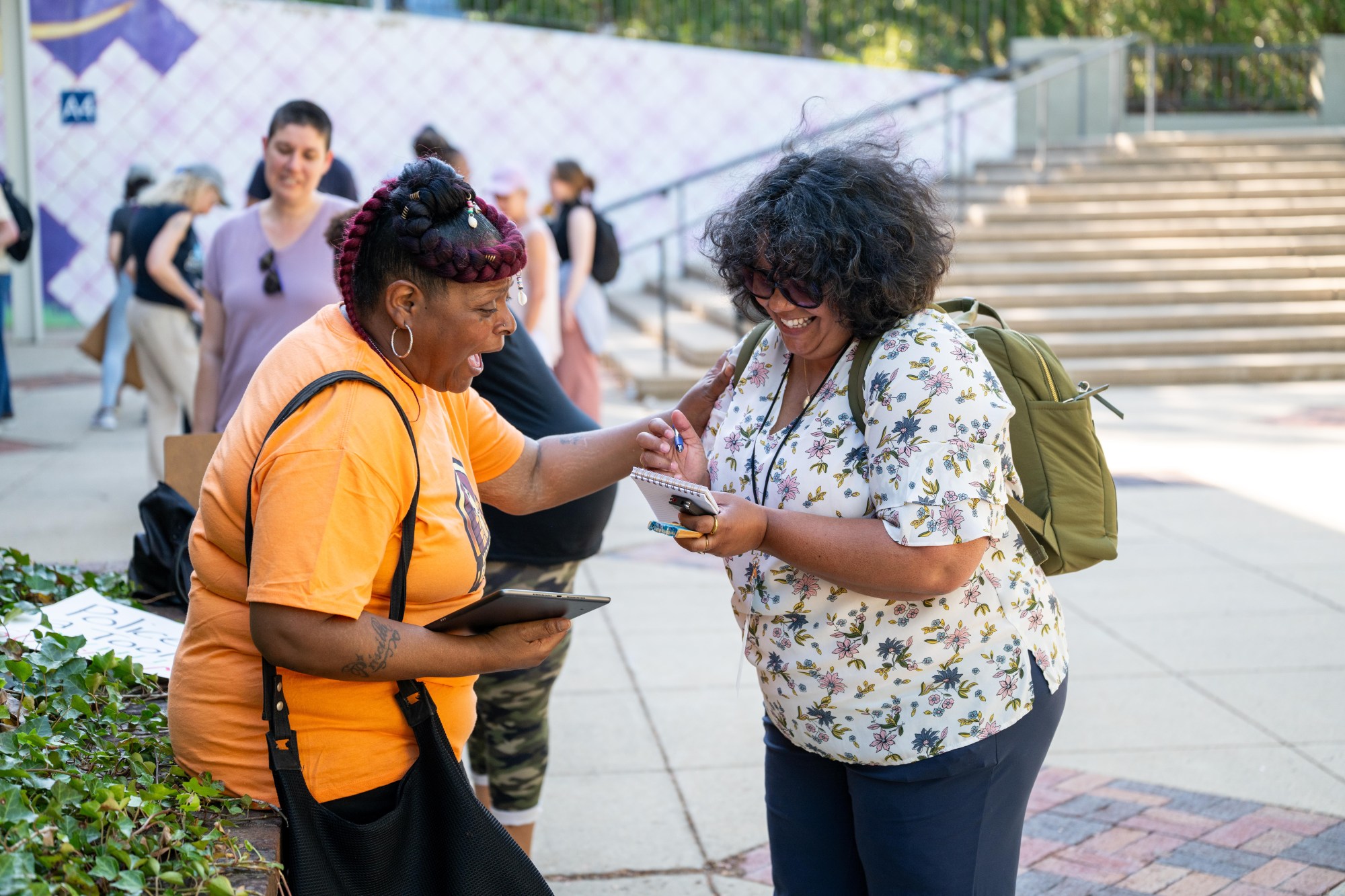
Our reporters might contact you via email, phone, through your website, on social media, or in person at events, meetings or when they bump into you in the neighborhood. We often meet potential sources at public gatherings, ask for contact information and then follow up later.
Our reporters do their best to explain why they are reaching out, whether they have questions for an article or are looking to understand a topic more broadly.
Key Takeaways

- You can submit ideas to Charlottesville Tomorrow’s newsroom via our online form or by phone at (434) 218-3649 or via Signal at the same number or @cvilletomorrow.05.
- Reporters reach out for a variety of reasons, from getting general background information to requesting in-depth interviews.
- Remember that you have the power to ask questions and decide whether the interview is right for you.
Report: You talk, we listen
“What do reporters do? Listen,” said reporter O’Hare. “It’s something that our newsroom emphasizes.”
Conversations with Charlottesville Tomorrow reporters happen via email, phone, video chat or in person. There might be a sit-down interview or a quick, back-and-forth by email or text message.

If you agree to an interview, remember that you decide what you want to say and what you are comfortable with. Charlottesville Tomorrow encourages you to let our reporters know if you feel uncomfortable or have questions during your conversation. You should feel free not to answer any question.
Charlottesville Tomorrow’s reporters might record an interview or take notes to ensure accuracy. These recordings are often only used as the reporter works on their article or, in some cases, by editors verifying the accuracy of a quote. If reporters are planning to use the recording in any other way, such as for a podcast or to share online, they will seek permission. If you feel uncomfortable with a reporter recording the interview, talk to them about your concerns.
Our reporters might repeat questions or ask for documentation, which doesn’t mean they don’t believe you. Sometimes repeating a question gives you a chance to add more details that didn’t come to mind earlier, or phrase something in a more concise way. Reporters are listening closely and are required to fact-check and to confirm information with multiple sources.
In rare cases, Charlottesville Tomorrow will consider quoting or paraphrasing a source without using their name. Our reporters and editors usually only use anonymous sources if what they are saying is the only way to report on a critical issue. The reporter might need to consult with an editor before agreeing to anonymity, and the reason for anonymity will be mentioned in the story. This high bar for anonymous sources helps our readers trust our work.
You should feel free to ask how your personal details will be shared and why specific information is important to the story.
As this useful guide from Outlier Media explains, reporters rarely share questions beforehand. This is because questions and the direction of the conversation change in the moment based on the interviewee’s answers. Often, unstructured conversations flow more naturally.
Most professional journalists do not pay people they speak with to avoid conflicts of interest. Charlottesville Tomorrow reporters are the same. However, we do have a program with our partners in Charlottesville Inclusive Media called First Person Charlottesville for community members to tell their own stories. If your piece is published through this program, you are compensated for your work. Here’s where you can share your story idea.
If you are speaking to a reporter, you should assume that you are “on the record” unless you and the reporter specifically agree otherwise. If something is “on the record,” it means the reporter may quote or paraphrase you, attributing the statement to you with your name.
Before you begin to speak to a reporter, you should tell them if you are not comfortable being on the record or quoted by name. You can ask the reporter about going “on background” for context or going “off the record,” which means they will not use the information in an article.
You should state what you want up front. Anything you say before “This is off the record” is on the record and it is up to the reporter to use the information or not. At Charlottesville Tomorrow, we generally honor requests to speak “off the record.”
Reporters most often attribute information by following a quote with “said” and then your name, plus your title, affiliation or other description. Here’s an example: “Ten percent of our members work in agriculture,” said Lena Smith, who leads a local business organization in Spring County.
If the information is a fact or statistic, the reporter will give the name of the report, study or data set where they found the information. They will also link to the source if possible. Here’s an example: Parts of central Virginia have few local journalists, but they do have community members who share local news, according to a 2026 study published by the Charlottesville Area Community Foundation and Charlottesville Inclusive Media.
Once a reporter completes several interviews and does research, they might reach back out to you for more information. Reporters will include different points of view in their work so that they can all better understand the issue. For Charlottesville Tomorrow’s longer articles, we often do extensive research, speak to many sources, and take time with the writing process to make sure we are being fair to the sources while being informative to the widest possible audience. All of that requires time, fact-checking, effort and thought — a lot of careful work. This is especially true if the article is about a sensitive topic or involves investigative reporting where we are searching for detailed information.
At some point, we might also ask to take photos, or request archival photos or documents such as family photos, maps or records. Just as when you grant an interview, you should ask any questions you have about having your picture taken or sharing this kind of material.
If you are in a public space, such as a government meeting or an event, we might also take your photo for use in an article. We understand that photographs can be very sensitive and we publish photos that align with our values, with a focus on dignity and respect.
Key Takeaways
- At Charlottesville Tomorrow, we want to hear what you think is important in central Virginia, especially if it directly affects you. We are more likely to report on an issue if you speak on the record, if it fits in our coverage areas and if it affects many people.
- Ask reporters about how the information you share will be used before you answer questions. If you are speaking to a reporter, you should assume that you are “on the record” and that you will be quoted or paraphrased with your name, unless you and the reporter agree otherwise.
- We do not grant public officials the option to be “off the record” unless they are a whistleblower.
- Reporters might repeat questions and ask for documentation; this is part of the fact-checking process.
- Reporters do not pay sources to avoid conflicts of interest.
- If you are concerned that being quoted in an article will expose you to physical, financial, legal or some other sort of risk, you can discuss being an anonymous source with a reporter.
Edit: How we make articles stronger
When a reporter writes the first version of their article, the writing process is far from over. Editors might find information gaps in the article, ask for more perspectives or additional reporting. The reporter might schedule new interviews or reach back out to sources for more information.
There are often multiple drafts of an article before it is ready to publish. Editors will also copy edit, reviewing for clarity, typos, grammar and other issues. Longer pieces are reviewed by multiple editors.
Some articles can take just a few hours to report, edit and publish, while others might take days, weeks or months. The timeline depends on the depth of the reporting, the length of the piece, available staff and resources and what other news is happening in the community. Stories may be paused or dropped due to a variety of factors. It’s not personal!
We deeply appreciate the time community members take to speak with us, but there are times you might talk with a reporter and not see your name in an article. That’s because the article may have changed focus, or we couldn’t fact-check critical information or find the sources we needed. Sometimes there is other news that we pursue first, and once in a while, the reporting process is interrupted by people needing to take time off work or staff changes.
We understand how disappointing this can be, especially when you spend time talking with us about an issue that is important to you. No matter what, each and every conversation with community members helps Charlottesville Tomorrow serve the community better.
“Public safety situations are an example of a coverage area that can evolve very quickly. We have had cases where we were about to hit publish on a story and then new information came in that completely changed the story,” said Managing Editor Sinha.
No matter the timeline, we always do as much as we can to make sure we get the facts right.
Fact-checking includes confirming information, statistics, names and locations. For example, if a local business organization leader says that 10% of their members work in agriculture, and doesn’t cite any sources, our reporter or editor will seek more sources on the labor force. If there is no source for this information, we will not include it in the report, or we will state that we could not confirm the claim or find evidence to support it.
We do not share articles with sources before publishing to protect our editorial independence. When you read an article in Charlottesville Tomorrow, it is not censored or edited by anyone other than the editorial team. This independence is critical to building and maintaining trust with our community.
That said, you should always feel empowered to ask about how you are being quoted or how information is being attributed to you. While we might not change something you’ve already said, we are always open to talking again after you’ve given an initial interview.
“We’re focused on getting it right and making sure we’re articulating sources’ perspectives accurately,” said reporter O’Hare.
And sometimes, we’ll get it wrong. We issue corrections in a timely and transparent way, and do our best to make sure our readers are alerted to significant corrections.
We believe in consistent, two-way communication with the communities we serve. We encourage community members to send us feedback and point out errors. To submit feedback to the newsroom, fill out this form.
Key Takeaways
- The editing process can be long, especially for complicated stories. Sometimes you might talk to a reporter, but not see a story on the subject for some time.
- Articles often change significantly during the reporting and editing process. Sometimes you might talk to a reporter, but ultimately an article on a subject doesn’t run. We know that can be frustrating, but please know that it’s not personal.
- A big part of editing is checking the facts — more than anything, we’re focused on getting the story right. If you see an error, please let us know!
Publish: Just the beginning
Charlottesville Tomorrow publishes our reporting on our website. We depend on the communities we serve to share this work and help us reach the people who can best use the information that is shared.
We reach thousands of your central Virginia neighbors via our email newsletters. (Subscribe for free!) Some people see articles through apps and social media, like Apple News, Google News and Newsbreak. You might also see our work in news media, through partnerships such as Charlottesville Inclusive Media. We also partner with some news organizations that share our work with people around the country.
But we know that once your story is included in a published report, that might be just the beginning. We hope you will continue to let us know how our work impacts you and what is important to you going forward.
Key Takeaways
- Charlottesville Tomorrow publishes articles on our website and shares them in many ways, such as email newsletters, social media, apps and with our partners.
- We also depend on you to help us reach the people who can most use the information we report.
Feedback: Tell us what you think
After the reporting process, we hope you — our community members — will stay in touch about what comes next. Charlottesville Tomorrow invests in following subjects and issues over time. It’s rare that we do a single story and then never return to the topic again.
We also depend on community feedback to decide what to cover and to make sure as we grow that we are covering the topics most important to central Virginians. If you have a news tip, story idea, question or would like to get in touch, contact us via our online forms. If you want to chat about what you look for in local news, schedule some time with our community editor.
Want to tell your own story? Consider submitting an idea for the First Person series, an initiative of our partners in Charlottesville Inclusive Media.
Charlottesville Tomorrow believes in local news that informs and serves everyone, puts the people most impacted at the center of our reporting, and helps to create stronger, healthier, more connected communities. Join us in supporting this vision!
Key Takeaways
- Charlottesville Tomorrow’s reporting depends on community input and feedback.
- If you have a story idea or questions for us, contact us via our online forms.
- Want to tell your own story? Consider submitting an idea to the First Person series.
Why do you ask for donations?
As an independent, nonprofit newsroom, we might operate differently from some news outlets that you’ve engaged with. We don’t have corporate owners or political agendas. Our reporting exists for one reason: to serve the people in central Virginia.
As a nonprofit newsroom, our reporting is shaped by your most pressing information needs. We invest in stories that might otherwise go uncovered, focusing on equity and working intentionally to reach those historically left out of local news.
Sometimes that means going beyond traditional reporting. For example, when we saw how difficult it was for many residents to navigate housing programs in our area, we created the Charlottesville and Albemarle County Housing Resources Guide to provide essential information in one place. This work is only possible because our mission isn’t profit-driven, it’s community-centered.
Our journalism is free for everyone. There are no paywalls or subscription fees. And, with your help, it will remain that way. So from time to time, you’ll hear from Chief Sustainability Officer Michaux Hood or another team member with a reminder that, as a nonprofit news organization, we rely on community support from subscribers like you.
When you choose to support Charlottesville Tomorrow, you aren’t “buying” news. You are investing in a newsroom that can’t be bought, because it belongs to you.
Newsroom Roles
Who is in the newsroom? Here are some people you might meet.
Our reporters follow and get to know topics, find and frame reports to dig into, interview sources, do research, write report drafts and revise with editors, check facts and meet with community members at events.
We send photojournalists to take photographs for reports, most often of the people, places and events the reports are about. Photojournalists also propose their own stories that they would like to tell visually. Sometimes reporters are also photojournalists.
Editors work with reporters on story ideas; edit drafts to make sure they have strong sources, clarity, organization, grammar and consistent style; check (and double check) facts; work on our website to design how reports and photos appear; write and send newsletters; and make corrections or clarifications. Editors sometimes report stories, too. They might have areas they focus on, like our community editor or democracy editor.
These newsroom leaders do all of the above, plus the daily work of managing reporters and their professional development, approving reporter expenses and coordinating all reporting projects with a bird’s-eye view. They work with our technology director, photographers, designers and data specialists to make sure reports are accessible and will work in all the ways people get them.
The Editor-in-Chief is in charge of editorial strategy — how we build the newsroom, recruit talented journalists and how we understand and serve communities’ needs. They are the leader of the newsroom, managing the budget and overseeing the whole team. The Editor-in-Chief also does some editing and review of reports and projects.
Journalism Glossary
What are those reporters on about? Here are some phrases you might hear.
That’s you! These are the community members, public officials, spokespeople or experts who talk to reporters for stories.
This is an idea for an article submitted by you, our community members.
In general, statements you make to a reporter are considered on the record, meaning they might share it and attribute it to you, unless you discuss otherwise with the reporter. Public officials and government employees are always on the record, with few exceptions.
Both parties agree that the source will provide background information to a reporter without attribution. These conversations give context to the reporter, informing their approach and further research.
Both parties agree that the reporter will not quote or paraphrase information or statements or identify the source of the information. These conversations might inform the reporter’s approach and further research for the article. In order to report the issue, though, reporters will need to find sources who will go on the record.
A direct quote, verbatim, in an article. These are often used to help you better understand how a source feels or express their perspective in their own voice. Quotes are often used for a short, clear statement of someone’s opinion or a short, clear statement from an expert.
Sometimes it’s more clear to summarize what someone said. Paraphrasing is often used to concisely communicate detailed and complicated information from a source.
Charlottesville Tomorrow does its best to confirm all the information, statistics, names, locations and other information it provides.