


For years now, CAT riders have complained about the bus service, specifically that it is too infrequent and unreliable. Some riders have been late for work and faced consequences for it, while others have missed important medical appointments. Others have stood outside in the heat waiting for a bus while groceries requiring refrigeration spoiled. And some passengers recall waiting in the rain for more than an hour for their bus to arrive.
That’s starting to change, incrementally, Charlottesville’s Director of Transit Garland Williams told an attentive City Council during its 4 p.m. meeting on Monday, July 21.
“We’re starting to climb out. Ridership is looking better,” Williams said. Still, he acknowledged, “we’re not where we want to be.”
Some bus riders and transit advocates who spoke before Council during the later, 6:30 p.m. meeting agreed that bus service could be better, but didn’t necessarily agree with Williams’ plan for how to get there.
Over the course of a one-and-a-half hour presentation (view the slides here) about how the agency can provide better service to riders, Williams and consultants from Nelson\Nygaard, a transportation planning firm CAT hired to help improve transit service, made one thing clear: If the city wants more reliable and more frequent bus service, it will have to pay for it.
Currently, CAT operates 13 routes, Monday through Saturday, throughout the City of Charlottesville and parts of Albemarle County. Most routes start running around 6 a.m. and end between 9 p.m. and 10 p.m., though some go until 10:30 p.m. There is no Sunday service.
In recent years, ridership has dipped — in fiscal year 2018, CAT supported 1.95 million rides. That number fell to 1.87 million in FY 2019, and to 1.3 million in FY 2020. Ridership “plummeted” in FY 2021 (which began July 1, 2020), Williams said Monday.
That was due to the COVID-19 pandemic, and CAT wasn’t the only agency affected. Public transportation ridership crashed throughout the country — people who started working from home were no longer commuting, or they drove to avoid being in close contact with strangers, Chris Van Eyken, a program manager with TransitCenter, a national nonprofit transportation advocacy organization, told Charlottesville Tomorrow in 2022.
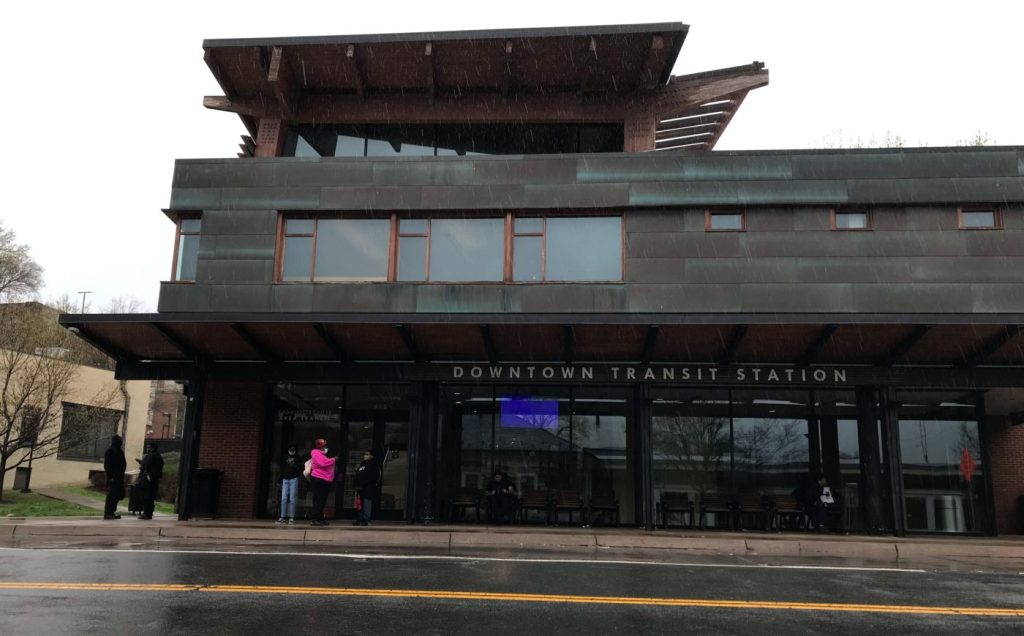
Service continued, because for some people, public transportation is their only means of transportation. Many bus agencies, including CAT, kept operating, but on reduced schedules.
The issue was compounded when some drivers left the profession at that time, saying that COVID-19 made it risky, said Van Eyken. Others retired early.
As the pandemic slowed down and agencies like CAT tried to return to a more robust schedule, there weren’t enough drivers to service the routes. That contributed to the unreliable and infrequent bus schedules that CAT riders complained about.
And drivers, who were already working overtime, were the first to hear riders’ complaints. It was draining, Matthew Ray, a longtime CAT driver, told Charlottesville Tomorrow in spring 2022.
Over the past few years, CAT workers and administration have tried to make driving a bus more appealing. CAT drivers have unionized and have successfully bargained for higher pay.
This past spring, Charlottesville City Council voted to fund 66 bus driver positions for CAT — more than the agency has ever had before.
And as of July 21, all 66 of those positions had been filled, Williams said. In fact, that same day, three new drivers had taken their Commercial Driver’s License exams.
But ridership still isn’t back to those pre-pandemic levels. CAT provided 1,353,059 rides in FY24, and relatively few more — 1,382,385 — in FY25.
Most of CAT’s 13 routes now run on 30- or 60-minute schedules. But despite the improved route frequency, CAT’s current on-time performance is around 68%, Williams said.
He called that number “abysmal.” High-quality, high-performance transit agencies have on-time performance rates of 95-98%.
The difference between the schedule and actual performance comes down to having extra drivers who can fill in when drivers call out, Williams said.
One day in June, eight bus drivers called out in one morning, Williams said. CAT only had four spare drivers — known as “extra board” — to cover for them. So the agency had to reduce service on a few routes. Riders could see the changes in real time in the CAT phone app and on the CAT website, but that didn’t make up for the inconvenience caused, Williams said.
In May 2022, CAT presented City Council with a System Optimization Plan to get seven of its 13 routes running at 30-minute intervals or better, and to restore Sunday service on five routes. The plan included improved service on Routes 5 and 7, which run between UVA Grounds and the hospital and the US 29 corridor; new crosstown service on Route 8 from the south end of Charlottesville to the US 29 corridor; and a new connection to Piedmont Virginia Community College.
That level of service would require 82 bus drivers, CAT leadership and consultants with Nelson\Nygaard told the city at the time.
But now, that number is 90.
There are a few reasons for that updated number, Jim Baker, a senior principal with Nelson\Nygaard told the Council: a change in how they estimate the number of needed operators, assuming less operator overtime and assuming more spare drivers.
More drivers requires more money.
CAT’s total budget for FY2026 is approximately $15.8 million, and comes from a few different sources. The City of Charlottesville covers the largest share, followed closely by the federal government:
- City of Charlottesville: $5.24 million
- Federal government: $5.18 million
- Albemarle County: $2.68 million
- Commonwealth of Virginia: $2.6 million
- University of Virginia: $190,000
- Advertising sales (i.e., ads on buses): $18,000
That’s with 66 drivers.
Getting to 82 would cost a total of $16.9 million. Getting to 90 will be between $2 to 3 million more, with each driver costing around $78,000, plus additional on-duty mechanics and shift management support.
But that still wouldn’t get the system to where riders want it to be.
A full system optimization plan — which means 30-minute or better frequencies on all routes during peak operating hours, Monday through Saturday, and service on five routes on Sundays — requires 108 drivers. And that would cost an estimated $22.5 million.
The plan would also require more buses, but the city wouldn’t likely be on the hook for that, said Williams. CAT can apply for fleet expansion vehicles from the state, and Williams feels confident the agency could get them that way.
During the presentation, which proposed a variety of route frequency scenarios even beyond the system optimization plan, Williams said that his preference is to start working incrementally toward getting 30-minute frequencies on most routes.
Councilor Natalie Oschrin asked if it would instead be possible to start working on 15-minute service for some of the most popular routes, to better serve the folks who rely most heavily on the bus.
A few CAT routes (like Route 7) service areas that are U.S. Office of Housing and Urban Development Qualified Census Tracts, Oschrin pointed out. That means that in those areas, at least 50% of the households are considered low-income by HUD standards, or have a poverty rate of 25% or more.
(In 2025, a family of four earning 60% of the Area Median Income in the Charlottesville area, which is considered “low-income” by HUD, earns $75,480.)
Still, Williams emphasized his preference, saying that “it’s easier to say everything is at a level point, 30 minutes, and then start talking about adding 15-minute service on select routes because it’s justifiable for additional ridership, as opposed to the opposite way, where I work high-frequency to low.”
Part of the reason for that preference, Williams said, was that CAT must follow Title VI rules in creating its routes. Title VI, which is part of the Civil Rights Act of 1964, requires U.S. transit agencies to demonstrate that their services do not discriminate against minority and low-income populations.
(CAT has to develop and submit a Title VI program every three years; the current one is set to expire and a new one will come before Council soon.)
During the public comment period during City Council’s regular business session, which began at 6:30 p.m., Planning Commissioner Rory Stolzenberg, disagreed with Williams’ reasoning.
“It’s widely acknowledged in transit planning that the 15-minute frequency interval is an important threshold in transit service,” Stolzenberg said, speaking as himself and not for the Planning Commission. (The National Association of City Transportation Officials, an intergovernmental best practices association, and TransitCenter, a national nonprofit transit advocacy organization, are among the organizations that promote the 15-minute interval.)
“It’s where the bus becomes a viable alternative to taking a car, or other means of transportation. Where you can go to a bus stop and expect a relatively short wait without having to plan your entire schedule around when the bus times and enduring long waits if you miss a bus.”
During the COVID-19 pandemic, CAT slashed service, and ridership plummeted, Stolzenberg said, echoing a chart in Williams’ presentation.
“CAT became a system of last resort that you only ride if you have no other alternative,” he continued. “Now, our consultants and our transit director would have us believe that civil rights law requires that we do not restore every route to the lowest-common denominator service that still is mediocre and does not provide a viable alternative to cars. It’s simply not true.”
The current Title VI plan is compliant, and it does not have better than 60-minute service on all lines, and getting a few routes to 15-minute frequency would still be compliant with Title VI, Stolzenberg said.
“It’s justifiable because we know that our higher frequency routes serve more disadvantaged areas in our community,” Stolzenberg continued. “And we know, based on CAT’s own ridership surveys from before the ridership plummeted, that even when ridership is higher, that riders of CAT are more disadvantaged than the population at large.”
Stolzenberg warned the Council that by going along with the 30-minute frequencies across the board plan, “we’ll make a massive investment into improving CAT frequencies on every route to merely OK, to not be a viable alternative. We won’t recover the ridership we had before.”
What’s more, he said, state funding for public transit is tied to ridership — higher ridership means more funding from the Virginia Department of Rail and Public Transportation, Stolzenberg said, adding that a recent presentation from the agency suggests that it will begin weighing ridership numbers even more heavily in its funding allocations.
Stolzenberg expressed disappointment that this wasn’t mentioned in Williams’ and the consultants’ presentation.
Stolzenberg’s point was that spending a lot of money without increasing ridership would mean CAT’s state funding would continue to decline.
“You’ll be spending more and more money over time just to keep the same mediocre services,” he said. “Whereas if you start with high ridership routes, you’ll get more money from VDRPT and you’ll be able to use that to improve other line service later.
“I urge you to send the plans, the scenarios, back to the drawing board and come up with a reasonably effective transit system.”
Later in the meeting, after almost everyone else had left, Stolzenberg spoke to the Council again.
“I feel as if I may have been a little harsh,” he said, acknowledging that the work the transit team and the consultants have done so far is “very valuable in planning.”
“That said, I believe what you guys have to ask for is a menu of different options for FY27 service, including high-frequency routes, even if a baseline of 30 minutes on every route, given the budget constraints available, is not achievable.”
Rev. Alex Joyner, pastor of Charlottesville First United Methodist Church and co-president of IMPACT, an interfaith organization that regularly advocates for better housing and transit throughout Charlottesville and Albemarle County, similarly urged the Council to consider the importance of a robust transit system.
Joyner himself is a regular rider of the 5, 7 and 11 routes, and many of his congregants are regular riders, too, so he’s learned a lot about the system, he said.
One of the things he’s learned is how important the bus system is for people of all ages, incomes and physical abilities.
“It is an investment in our common good,” he said.
“The second thing I’ve learned is, an underdeveloped, under-resourced bus system is a tragic waste of money. I get that we’re a long way from where we need to be, and we have a lot of hard choices to make as a community. But I want to urge you to continue to make transportation, and bus transit in particular, a real priority for the lives of real people.”
The Council will be weighing its options over the next few months as it begins working on the FY27 budget. It will have to decide how many drivers, and what kind of service it wants to fund — and weigh that against what it will actually be able to fund.
Council seems open to increasing its funding for CAT if possible, though Councilor Oschrin acknowledged that the city is not the agency’s only funder.
“It seems to me like we’re at a crossroads,” said Vice Mayor Brian Pinkston at the end of Williams’ and the consultants’ presentation. He pointed out that the city had planned to use some federal funding to invest in hydrogen and battery electric buses, but with the rescission of hundreds of thousands of dollars in federal grant money for various climate-related projects, that may no longer be on the table. If he had to choose between buying a few, more expensive buses, and increasing the number of drivers in order to better CAT service, he said he’d choose the latter.
“I think that lifts the whole community up in a way better than the other would, even though I think the other is important,” Pinkston said.
Pinkston won’t be voting on this, however — his term on Council ends Dec. 31, months before any official votes on the FY27 budget.
Councilor Michael Payne weighed some of the options aloud. Getting to 90 drivers would require the city to find an additional $3 million in funding. He called that “difficult, but achievable.”
Getting to the full 30-minute service, with 108 drivers, would be harder, he said. If the city were entirely responsible for that, it would be at least $8 million on top of the $5.2 million it currently provides to CAT.
“To me, the most important question is, coming into this next budget cycle, do we identify transit as one of our top three priorities?” Payne asked. “Historically, we have not done that yet. But until we do that, progress will not happen.”