
The Charlottesville Police Civilian Oversight Board has lost half of its members in recent months which has limited some of its current capabilities, and the outgoing chair pleaded with City Council to fix the board’s structural flaws.
Al Pola, who led the board from January through June, resigned last month. In a letter obtained by Charlottesville Tomorrow through a public records request, he told the City Council that flawed ordinance and other challenges have made it nearly impossible for the board to fulfill its mission. He asked the City Council for urgent intervention.
“It is clear that the board cannot achieve its intended impact without structural reforms and meaningful support,” Pola wrote. He added that he was resigning due to health concerns, but the challenges the board faces contributed to the decision.
Pola is one of four members who have resigned in the last two months, bringing the board down to just four members, one of whom is non-voting.
This means that the PCOB no longer has a quorum — the minimum number of members required for the board to vote, as per the city ordinance guiding the PCOB.
“It’s a huge issue and a huge concern,” said Charlottesville City Councilor Michael Payne.
The reasons for individual resignations are not directly connected, according to interviews with the city leaders and Pola, but there is a throughline — it all comes down to the mismatch between what the city wants the board to be and what it can be.
While city leaders focus on urgently filling vacancies to restore the board’s function, former and current leadership say the real problem runs deeper: The ordinance that governs PCOB is fundamentally flawed, they say. It blurs responsibilities between the civilian-led board and the city employee-run executive office, imposes heavy demands on volunteer members, and sets eligibility rules that make it hard to build — or keep — a sustainable volunteer board. In essence, it makes demands that are very hard to deliver.
“The PCOB’s progress has been persistently constrained by several critical limitations,” Pola wrote in the resignation letter.
“These are, in no particular order, unresolved deficiencies in the enabling ordinance which I have discussed with many of you; a lack of independent legal counsel; inadequate staffing resources; and, inconsistent support from key stakeholders. These challenges directly compromised our ability to complete investigations, conduct hearings, perform audits, and engage credibly with the community we serve, and they continue to do so.”
In other words, the PCOB needs fixing. PCOB leadership and some of the city leaders agree. Some think that the solution might be even rebuilding it from the ground up.
“It would be easier and more effective to draft a new ordinance, drawing from lessons learned, than to attempt to revise the existing patchwork of documents that currently govern the board’s operations,” said Inez Gonzalez, the PCOB’s executive director. “To try to fix it is going to be more time-consuming than to just build a model that makes sense with what everybody envisions for this board.”
“I certainly would be open to revisiting this process,” Mayor Juandiego Wade told Charlottesville Tomorrow in late June, clarifying that he was speaking on his own behalf and not on behalf of City Council. “We know a lot more now, and we’re in a different situation.”
Big goals, limited capacity
A lot was envisioned for Charlottesville’s police oversight board.
There are several different types of these boards across the country. Some are limited to reviewing police practices, while others are full oversight bodies able to conduct independent investigations into possible misconduct. It’s common for boards to have a mixture of those functions, but the latter type is more common in large cities where the board’s staff are full-time government employees.
Charlottesville doesn’t have that. Charlottesville’s PCOB is predominantly unpaid volunteers with two paid staff members.
And yet, Charlottesville’s PCOB was asked to do it all: Examine and make recommendations on the police department’s existing policies and practices, audit internal police investigations into possible police misconduct and, if they choose, conduct investigations of their own.
The latter has never fully come together. While it’s what the community members who rallied for the creation of the PCOB wanted, there are procedural challenges to conducting investigations. One of them is that the civilian volunteers are unable to compel officers to testify in front of the board, limiting their ability to be thorough in their inquiries.
The community also hoped for public hearings into alleged misconduct, but that feature, while available to the board, is limited by Virginia law that allows the chief of police discretion on what personnel information to release publicly. While it doesn’t entirely hinder oversight, it does create a tricky balance between transparency and confidentiality that may put limits on how much of the hearings are open to the public.
Yet all of these duties are still expected of unpaid part-time board volunteers, many of whom may not realize how demanding the role can be, said Gonzalez.
Take investigations, for instance. While the PCOB hasn’t taken on any independent investigations or conducted hearings, it’s safe to say that it would be time-consuming, explained Gonzalez.
“Let’s just say we had a high-profile incident — an in-custody death, or a police-involved shooting — that may take 40 hours, 80 hours, whatever it is it takes to conduct that investigation. You are limited to 75 days,” said Gonzalez, referring to the number of days the PCOB is allowed to consider a case before issuing their recommendations under the current ordinance.
“It’s about the willingness for you to come in on your own time. So would you be willing to come to work for a period of, let’s say, 40 hours a week for whatever number of weeks are necessary to conduct an investigation and not be paid?” she said. “It’s never going to work.”
“This is in addition to your regular job,” added Pola.
Even without investigations, getting board volunteers through the required training of at least 8 hours but often more; the required monthly meetings; the two required town halls a year; and community outreach obligations proved to be difficult in the past, said Gonzalez.
Sometimes it’s challenging just getting some people to answer their emails in time for the monthly board meeting so the agenda could be properly prepared, she said.
Charlottesville has “written an ordinance that essentially requires you to have a full-time board. We don’t have that. And until the City Council decides that that’s what they want, it’s always going to be the same. They’re not going to be willing to put in the hours,” said Gonzalez.
“That’s not to say that all of what they have in the ordinance is not do-able. It’s just not do-able under our current circumstances.”

Gonzalez, however, does not take a position on whether or not volunteers should be paid, she said.
“It’s about ensuring that anyone appointed to the board has a full and realistic understanding of the time commitment and complexity involved before accepting the appointment,” she said.
As civilian board stalls, oversight work continues through executive director
Everything has not come to a standstill following the resignations. While the city is rushing to fill the open seats and restore the board’s ability to vote — if not to address larger foundational issues — the PCOB’s ability to conduct some oversight as it exists today can still continue.
That’s because the PCOB has two distinct parts: There is the board of civilian volunteers and the PCOB executive director’s office, which, including Gonzalez, employs two people.
The executive director does most of the oversight and has the most rights and access to internal police resources. Gonzalez’s office receives the complaints, audits internal police investigations into cases of possible misconduct and digs into matters like the police department’s budget, line by line.
The civilian members of the board also have access to complaints filed to the PCOB, and the ability to review internal police policies and make recommendations. However, they don’t have as much access as Gonzalez, since they are not city employees, and they usually meet only once a month, so they rely on the executive director to carry on day-to-day police oversight.
And, while the civilian part of the board has been facing limitations and challenges, the office of the executive director has been gaining more oversight tools. In fact, it now has more access than most oversight boards in Virginia, Gonzalez told Charlottesville Tomorrow last fall.
So, when the board lost the ability to vote due to the resignations, the functions of Gonzalez’s office were not significantly affected.
“The bulk of the work was always being done by us anyway,” Gonzalez said. “So, we’re not crippled in our operation. People will continue to get the same level of services they were getting before.”
Still, without a quorum for votes, the board can’t make decisions as a unit and vote to initiate a formal review, conduct hearings or make recommendations based on investigations, explained Pola and Gonzalez in separate interviews in July.
For instance, the board has drafted recommendations on the use of FLOCK cameras, which are automatic license plate readers used by law enforcement agencies, in Charlottesville. But without enough members to vote, it can’t officially share the recommendations with the city manager or police chief, Gonzalez said at the PCOB’s July 10 meeting.
“It’s certainly a big deal. The board has, as one of its missions, to research, discuss, review and make recommendations to [the Charlottesville Police Department] on important issues identified by the community, CPD, or by the board itself. FLOCK is one of the issues for which many community members have expressed concern and for which we conducted the above steps,” said Pola.
“I believe those recommendations are essential not only to maintain the open lines of communication we’ve all worked hard to establish, but also to provide an independent review that CPD can use to make our community better,” said Pola.
Looking for new members — again
PCOB’s membership turnover and challenges to find new members to fill the open seats are not new — they go back to at least 2023, according to the board’s annual 2023 report.
It’s also not the only city board that has difficulties filling seats, explained Payne. The Charlottesville Affordable Housing Fund Committee, for instance, had some of the same issues in the past, including not having a quorum.
It’s not always easy to get qualified candidates in general, but boards like the PCOB and the Affordable Housing Fund Committee have very specific requirements in terms of who can serve on them, aiming to provide representation to people affected by the matters the most.
For the PCOB it means they have seats designated for residents of public housing or people from “historically disadvantaged communities that have traditionally experienced disparate policing,” according to the current job listing.
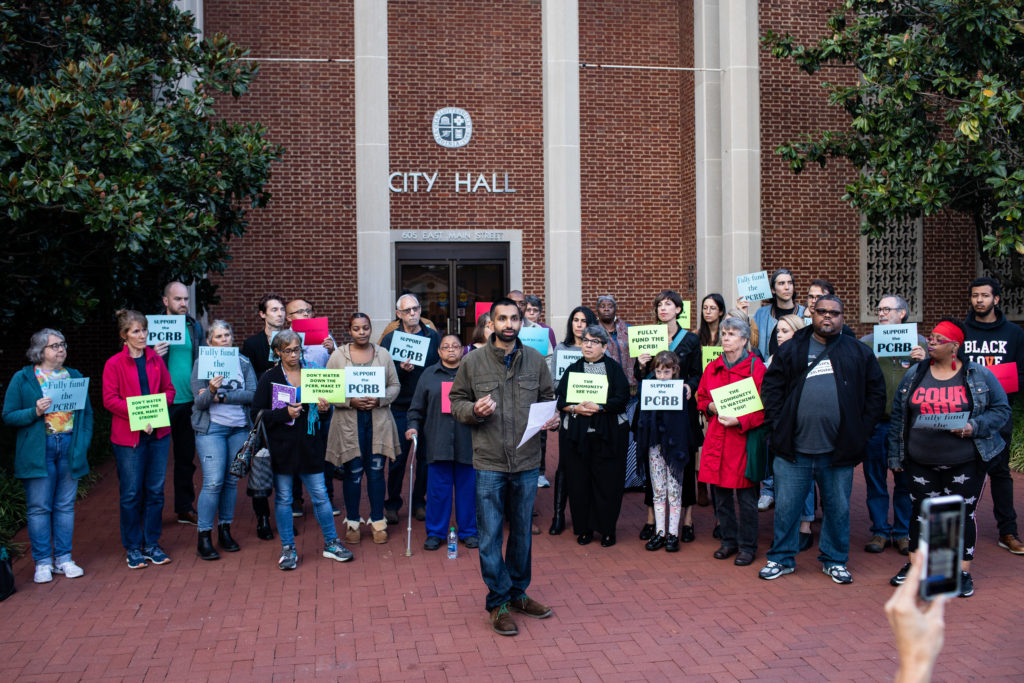
“For a while now, we have just not gotten very many applications. How do we address that issue of why people aren’t applying?” said Payne about the current vacancies as well as the past ones. It could be an issue of time commitment or a lack of trust in the board that makes a difference, he said. “That’s also been one of the challenges — it’s hard to populate the board when you just don’t get enough applications.”
To get more applicants, the City Council passed changes to the PCOB ordinance last fall, expanding the geographical scope of who can serve on the board, allowing for people with a connection to Charlottesville — instead of explicit residency to apply.
The Council appointed four new members a few months later. Two of them — Shenandoah Titus and Isaiah Alvarez — have since resigned. While Alvarez resigned for personal reasons, Titus listed concerns with “unprofessional conduct” of his former colleagues among his.
“Since joining the PCOB, in some instances I have observed conduct – which reached a new and intolerable level on May 3 during a mandatory PCOB training – on the part of our leadership that I found highly unprofessional and, in my view, did not represent the PCOB or Charlottesville (City Hall and the community) very well.”
It wasn’t an unlawful or unethical conduct, he clarified, but unprofessional in his eyes. He didn’t provide any further explanations in the letter and Charlottesville Tomorrow couldn’t reach him for comment.
The fourth person who stepped down was the representative-at-large Cameron McBride.
When Charlottesville Tomorrow reached out to her in late June, McBride said she wasn’t aware that the other three members had resigned.
“My resignation is not tied to or coordinated with that of anyone else,” she told Charlottesville Tomorrow in an email. She explained that between in-person attendance and training required by the PCOB, her full-time job and dual residency split between Virginia and Georgia, it was too much.
She didn’t completely cut ties with the PCOB, though — she resumed her status as a hearing officer for potential hearings going forward, she said.
Not everyone thinks that the resignations are a sign of a bigger issue.
“The four resignations are a problem that we will have to address, but keep in mind that it is not a system failure if someone resigns because they need to care for a sick family member, or because the member misunderstood that they would need to be present for meetings,” said Charlottesville Councilor Lloyed Snook in an email.
The city has already started searching for new members to join the board, with the deadline to apply passing on July 18.
Finding a way forward
While four board seats remain empty, Gonzalez is still working on proposed changes to the ordinance — merging the patchwork of documents that currently guide PCOB’s work into one clear proposal, aimed at fixing its limitations and clarifying the roles of the board and the executive director’s office.
Gonzalez, who is a former police officer herself, has warned that the PCOB’s ordinance overpromises what’s legally possible since she started the job in 2023. Now, she has a vision for how to fix the board at a more fundamental level.
“What the community is asking for is not unreasonable. It’s my responsibility to try to produce for them an oversight model that works for everyone, that takes everyone’s needs into consideration, everyone’s opinions into consideration, and to produce that to my bosses for their review,” said Gonzalez.
She believes that the easiest way to give everyone what they want and avoid the limitations on the investigations and hearings is to limit the civilian volunteers’ job to auditing the results of investigations instead of conducting their own. In this model, the executive director’s office can still choose to conduct an investigation if they don’t agree with the way the police’s internal inquiry was handled. Volunteers will then review that investigation as well and make recommendations on reprimand, if they find it fitting, and policy recommendations to improve police operations, if needed.
“What I’m proposing is that what we’ve been doing in practice, we just put on paper, and that’s pretty much it,” she said. “We’re not trying to eliminate anybody’s powers, because I think that that would disappoint the community.”
Such changes to the original vision will require a lot of community involvement and listening, said Councilor Payne. He emphasized that the investigative model versus the audit model was a part of the original debate around the PCOB ’s creation and, ultimately, the community chose the investigatory one because “it provided the highest possible level of oversight.”
“The audit model is a viable oversight model other localities have implemented,” he wrote in a message to Charlottesville Tomorrow.
“But my concern would be, would that be counter to the original intent the community had for what they wanted from the PCOB? How do we ensure the original intent is still being followed through on and oversight is as strong as possible? If a switch to that model is discussed, I think it needs to be carefully evaluated and discussed in detail at City Council work sessions with staff and we need to ensure there’s robust opportunities for public feedback to see how the community feels about that change.”
For now, Payne is thinking about how to help the board as much as possible with the model they have.
“We have to figure out how to go to them and actively recruit people to apply, as well as figure out, for the people who maybe are interested in serving, but decide not to apply, what are the barriers holding them back?”
And maybe it’s time for the City Council to sit down with the PCOB staff and volunteers, both current and former, and discuss what issues they faced and how to resolve them, Payne added.
Payne called Pola’s resignation letter, and his reference to the PCOB’s 2024 annual report’s section on challenges and potential fixes, a helpful starting point.
Gonzalez, when she heard about Payne’s comment about a possible discussion, was interested.
“That would be phenomenal. I agree with him 100% — that would be great.”
“It’s just a matter of someone, somewhere, prioritizing, even for just a moment, the PCOB, and saying, ‘Okay, maybe we should consider these recommendations,” she said.
Since that conversation in early July, the PCOB has presented the Annual 2024 report to the City Council during the meeting on June 21. Payne requested that PCOB staff, board members and the City Council have a full work session to discuss the issues and recommendations for fixing them brought up in the report in depth.
“I couldn’t say I agree with every single recommendation, but I do agree with many of them. At an absolute minimum, every recommendation should be seriously discussed and considered by City Council,” he said in a message to Charlottesville Tomorrow.