


Charlottesville City Council is funding 66 full-time bus drivers for the local public transit authority — more than ever before.
But community groups are advocating for more. They’d hoped the Council would put up the money for at least 82 drivers to get Charlottesville Area Transit bus wait times to 30 minutes or less.
On April 14, the Council adopted a $265.2 million budget for the 2026 fiscal year. It’s about $600,000 more than the budget City Manager Sam Sanders proposed in March — largely because the Council opted at the last minute to give more money to Charlottesville Area Transit (CAT).
The $5.2 million the city is giving to CAT for fiscal year 2026 is the most it has ever given the agency. It’s $778,000 more than fiscal year 2025, and about $2.5 million more than in fiscal year 2024.
The increased funding is intended to improve the fixed-route service on 13 different lines throughout the city of Charlottesville and parts of Albemarle County.
For years, riders have complained about CAT service, namely that it is too infrequent and unreliable, causing them to be late for work or miss important events like doctor’s appointments.
Part of the problem was a driver shortage, CAT drivers and transportation experts told Charlottesville Tomorrow in April 2022.
The city hadn’t made driving a bus a particularly attractive job, driver Matthew Ray said at the time. The hours were long, the pay was short, and the job was increasingly stressful as frustrated riders lashed out at drivers for late and missed buses. The drivers the agency did have were working extra shifts to try to keep the buses running — and they were exhausted.
Since then, the city approved a collective bargaining ordinance, which allowed bus drivers to unionize. It has increased drivers’ wages and added benefits. Those things have helped, a few drivers recently told C-VILLE Weekly, but the agency still has a long way to go to serve both drivers and riders alike, they said.
Hiring more full-time drivers and shortening wait times for passengers should help with reliability of the service and passenger-driver relationships, they said.
The city is working on that — as of April 15, the agency had hired 64 of the 66 funded positions, said City Councilor Michael Payne.
The agency also rolled out a new schedule last fall, increasing bus frequency on some, but not all routes. Those service changes are part of CAT’s strategic plan, which the agency finalized in June 2024, to improve bus service over the next 10 years.
It’s progress, but leaders with IMPACT Cville, an interfaith group of more than 25 local congregations of various faiths, said they want to see wait times come down more and want reliability to improve.
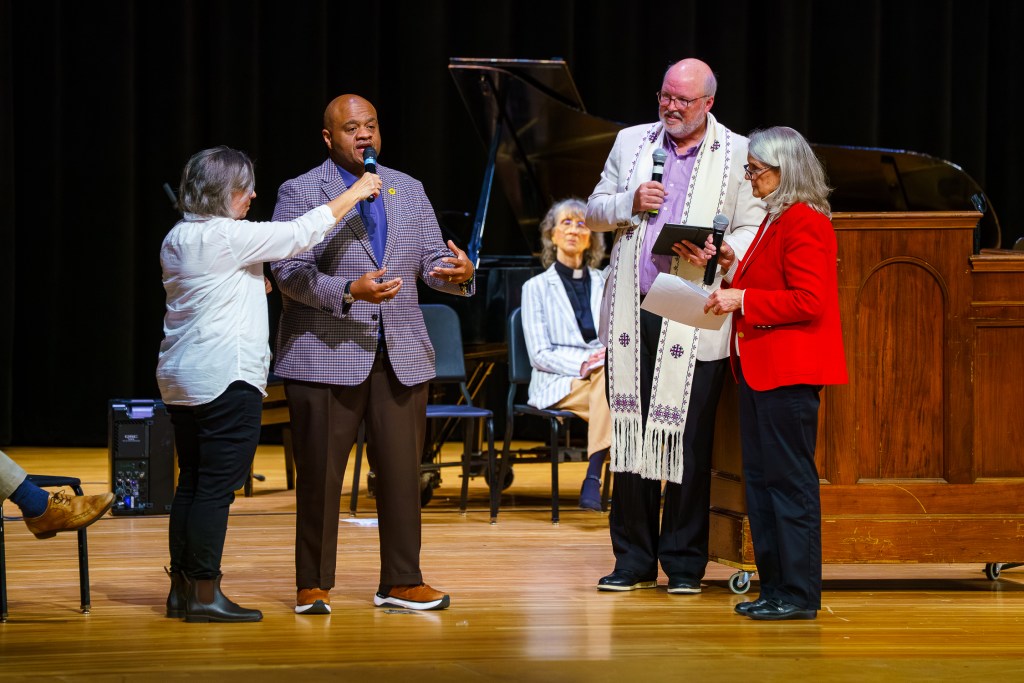
Every year, IMPACT hosts a rally, called the Nehemiah Action, supporting social justice causes.
More than 1,100 people attended this year’s event, which was held Tuesday, April 8, at Charlottesville High School’s Martin Luther King Jr. Performing Arts Center. This year, the group focused its attention on affordable housing in Albemarle County and public transit in Charlottesville.
IMPACT organizers invited all five City Councilors to attend, but only two did — Mayor Juandiego Wade and Vice Mayor Brian Pinkston.
The other three councilors — Natalie Oschrin, Michael Payne, and Lloyd Snook — did not attend for a very specific reason, Payne and Snook told Charlottesville Tomorrow in separate emails a few days after the event: When three or more City Councilors are present in a room and discuss city business, it constitutes a quorum. When there is a quorum present, it counts as an official public meeting, and by law, official public meetings must be advertised.
Most Councilors weren’t comfortable with that, Payne wrote.
There are potentially ways to get around the situation, such as having no more than two councilors in the room at once, then having one leave so that another can come in, and so on.
But most councilors weren’t comfortable with that, either, Payne added.
During the rally, community members and faith leaders alike spoke about how CAT had let them, or their congregants, down.
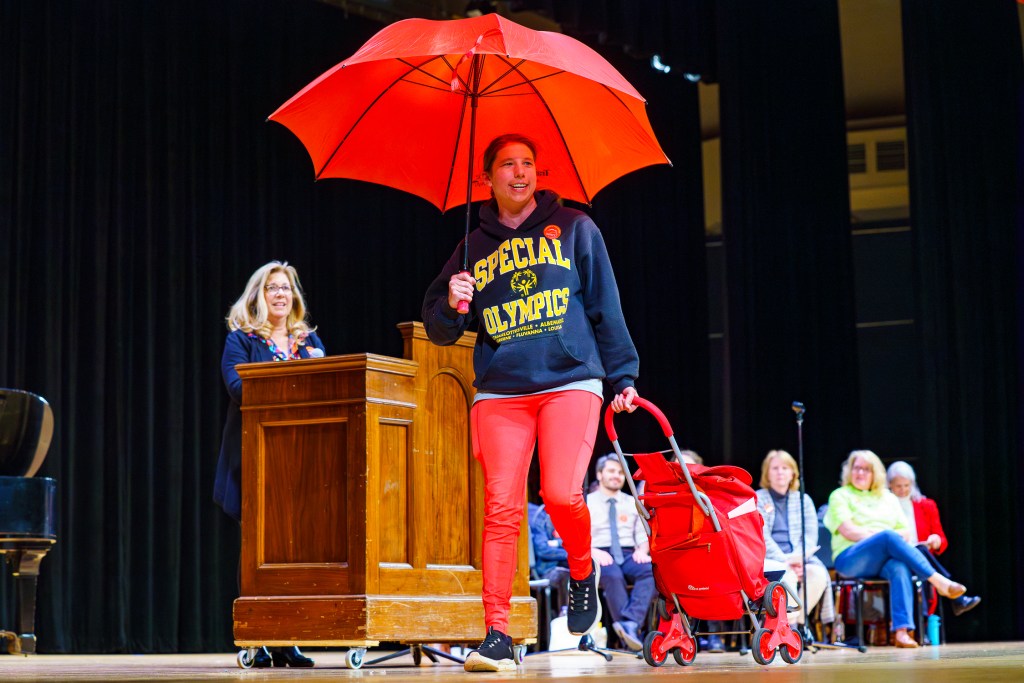
Shannon Flanagan, a regular CAT rider, walked on stage to deliver her testimony with a bright red umbrella in her hand, pulling a wheeled backpack behind her. She acted out a skit about what it was like to wait for the bus.
Shannon’s mother, Heidi Flanagan, explained that Shannon moved from the family’s home in Crozet into a Charlottesville group home for adults with special needs. Shannon doesn’t drive, so she relies on the bus. Heidi said that Shannon regularly called her for company while she waited for the bus in all kinds of weather — rain, snow and heat.
“It was about safety, and it was a lot of uncomfortableness,” Heidi said.
“We love the bus. The bus is great,” she added, imploring the Councilors to fund more bus drivers — 82 drivers, to be exact.
Having 82 drivers would allow CAT to get to 30-minute wait times for weekday service on Routes 2, 3, 5, 8, 10 and the Free Trolley, CAT Director of Transit Garland Williams told Charlottesville Tomorrow in an email.
That number came from a May 2022 system optimization proposal provided to CAT by Nelson\Nygaard, a Boston-based consulting firm.
“Presently, we’re revising that proposal with Nelson\Nygaard to confirm the number of operators needed,” Williams wrote, “because the May 2022 proposal also highlighted that more frequent service was needed on Route 6, and that Routes 2 and 3 needed to be split in order to provide better coverage.”
Achieving 30-minute service on all of CAT’s 14 routes would require approximately 101 bus operators, the proposal said.
IMPACT leaders said they hope the city will get there soon.
A lot of folks in Charlottesville can’t afford to own a car, or cannot drive, and “have no choice to rely on the unreliable,” said Colleen Swingle-Titus, pastor of Park Street Christian Church. She knows people who schedule their entire days — work, doctor’s appointments, grocery shopping and other errands — around the bus schedule. A late bus, or a missing bus, can mean losing wages or having to reschedule an important and long-awaited appointment, she said.
“Public transit matters. It matters to your neighbor,” Swingle-Titus said before tying the importance of better public transit to taking better care of the environment and to building more affordable housing.
“We hear from City Councilors that transit is a priority,” but neglecting to fund the additional driver positions says otherwise, said Mer McLernon with Grace Episcopal Church Red Hill.
“We’ve heard them say the right things,” McLernon added. “It’s time to make it happen, because we can’t wait for the bus.”
IMPACT leaders asked Wade and Pinkston to commit to three things: filling all budgeted CAT driver positions by the end of 2025; meeting with IMPACT leadership in July to give an update on the progress toward filling those positions; and funding 82 (instead of 66) full-time CAT driver positions in fiscal year 2026.
Both Wade and Pinkston agreed to the first two, pointing out that the city was already very close to hiring all of the budgeted positions.
They were also supportive of getting to 82 drivers, but said the timing wasn’t right. The Council was set to vote on a final budget just six days later — the city was too far along in its budgeting process to add an additional 16 drivers to the budget at the time, they said.
At $78,000 per driver, which includes wages and benefits, that would require finding an additional $1.25 million in the budget, which would mean cutting that amount from other programs throughout the city.
But both Wade and Pinkston said they would support a budget amendment to get the number of CAT drivers from 66 to 82 during the 2026 fiscal year.
“What I will support is using the surplus funds that we have from this year’s budget toward those 82 drivers,” Wade said. “Once we understand what happens with the federal fallout, we’ll understand where we can put the surplus funds.”
Payne, who did not attend the event, told Charlottesville Tomorrow in an email that he is “committed to doing everything we can to get to 82 drivers so that we can reach 30-minute routes,” meaning wait times of 30 minutes or less. It might be challenging, he said, but “being serious about finding a way to fund the new driver positions is the only way to accomplish our stated transit goals.”
Snook supports getting there”as soon as we can,” he told Charlottesville Tomorrow in an email. But it’s not as simple as a budget amendment.
“That will require not only drivers but buses that we do not now have,” Snook said, explaining why that complicates things. “Buses cost about $1 million apiece, and the only way to buy them is to use federal and state funds, and to go by the requirements of their funding programs. And if we were to say today that we wanted to buy, say, 10 more buses, they wouldn’t be here for about 2 years.”
Councilor Oschrin, who did not attend the meeting, did not reply to Charlottesville Tomorrow’s request for comment.
IMPACT made its asks to City Council because, while CAT covers the city as well as parts of Albemarle County, the management, operation, and maintenance of the system falls under the auspices of Charlottesville City government.
And while the City runs the system, it is not the only source of funds. CAT is funded almost entirely by taxpayer money — local, state, and federal — in some form.
The agency’s total budget for the upcoming fiscal year (2026) is $15,879,891. The City of Charlottesville covers the largest share of CAT’s budget, followed closely by the federal government:
- City of Charlottesville: $5,235,892
- Federal government: $5,178,187
- Albemarle County: $2,656,559*
- Commonwealth of Virginia: $2,600,883
- University of Virginia: $190,070
- Advertising sales (i.e., ads on buses): $18,300
(*Pending approval — the Board of Supervisors is expected to take a final vote on its fiscal year 2026 budget, including its allocation to CAT, on May 7, according to the Albemarle County budget calendar.)
As the city works to fill all 66 of its operator positions, and as City Council works to figure out how to fund more of them, CAT is working on a new proposal, Williams said.
The agency is working with Nelson\Nygaard to develop a service proposal that would bring 30-minute frequency on all weekday routes until midnight, with 15-minute weekday service on Routes 5, 6, 7, and the Free Trolley — some of its most popular routes — Williams said.
That proposal, dubbed the “30 Minute Service Proposal,” will be completed by June 15, Williams said.