

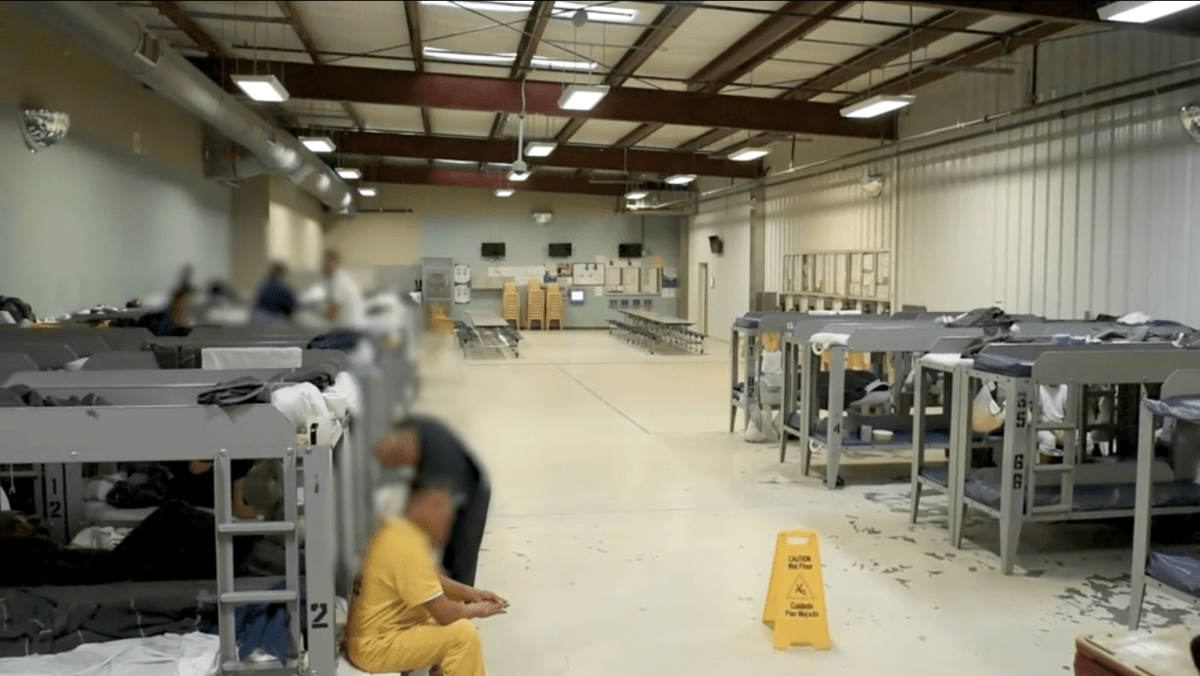
Inside the living quarters at the Immigration Centers of America facility in Farmville, Ahmed felt his mental health begin to unravel.
There was little to do and nowhere to be alone. He shared one open room with dozens of other men. They slept in rows of bunks in one half of the room and ate at dining tables that butted up against a row of fully exposed toilets in the other — close enough that the sight and smell of them were part of every meal.
Outdoor recreation was rare. Long days stretched out before him, followed by even longer nights, filled with the quiet sounds of men sobbing.
“I mentally broke,” Ahmed said.
Ahmed is not his real name. He is an asylum seeker currently living in Charlottesville, who spoke with Charlottesville Tomorrow over a Zoom call with his attorney, and asked to not use his real name for his safety.
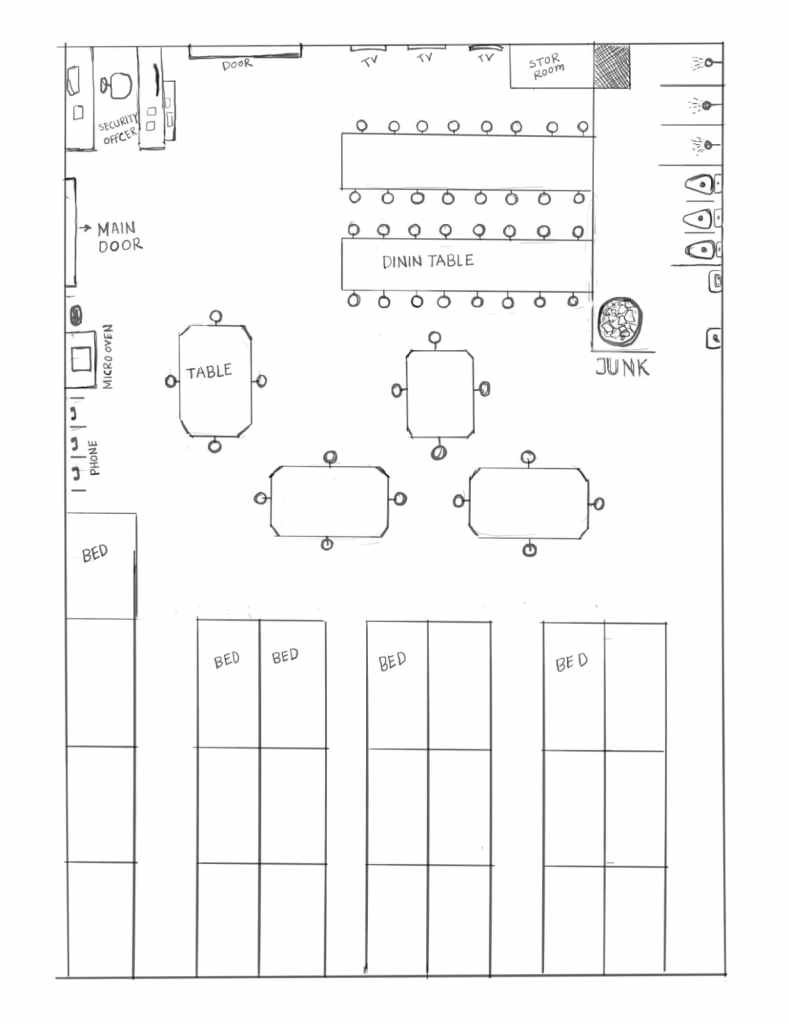
“I didn’t have any idea how to live in the jail, I didn’t know how to handle this circumstance,” Ahmed said.
That despair deepened when, like a growing number of immigrants detained recently in the United States, Ahmed was granted bond by an immigration court judge, meaning the judge granted his release until his court date. But the Department of Homeland Security refused to release him.
The decision stunned Ahmed and his attorney.
“The Department of Homeland Security filed what’s called an auto stay provision,” said Elizabeth Schmelzel, Ahmed’s attorney through the Legal Aid Justice Center. “This is authority that they have from a regulation just after Sept. 11, which allows them to refuse to release someone from immigration detention, even when they have been granted bond.”
DHS did not respond to Charlottesville Tomorrow’s request for comment.
The regulation she referred to is 8 C.F.R. § 1003.19(i)(2), which says that DHS can “stay… any order of the immigration judge authorizing release” while the agency appeals the decision to the Board of Immigration Appeals, the highest administrative body for federal immigration laws.
“I have seen it used once in my career,” Schmelzel said. “It is usually used when the department has a very serious security concern. It is now being used blanketly.”
Across the country, immigration attorneys report that DHS is blocking bond releases more often than ever using this broad regulation, which does not require DHS to give a reason for keeping a person in detention. An Aug. 30 report in The Guardian highlighted several cases where immigrants won bond but were still kept in detention. An anonymous DHS official told the news outlet that government lawyers were instructed to put all bond rulings on hold — though DHS publicly denied that claim.
Faced with this incredible circumstance, immigrants and their attorneys are turning to the federal court system. There they file petitions of habeas corpus, a procedure that lets a judge decide whether someone’s detention is lawful. Filing this kind of petition is a drastic step, one that essentially argues that the government is holding someone illegally — in violation of its own Constitution.
And federal court judges are approving these petitions at a striking rate, according to Schmelzel and other immigration attorneys who have spoken publicly.
This was the case with Ahmed.
In a 27-page decision issued Sept. 19 and reviewed by Charlottesville Tomorrow, U.S. District Court Judge Leonic Brinkema tore apart the DHS case for detaining Ahmed.
“[Ahmed] prevailed before the [immigration court judge],” the ruling reads. But under the current rules, government attorneys can still step in and block the judge’s decision on their own. The court blasted this as “patently unfair,” noting that it hands power to prosecutors who already lost their argument in front of a judge.
“The automatic stay imposed in immigration cases constitutes an unequivocal violation of due process. It is, in effect, no process at all,” Brinkema wrote.
Ahmed was released from the Farmville detention center that very day.
“My release is maybe a miracle,” Ahmed said, with a small smile. But the damage, he added, had already been done.
“I’m mentally still in detention,” he said, shifting uneasily as he spoke. “I can’t go out. If I go outside and see people — or police — I feel like they’re coming to arrest me.”
The number of people detained in the Farmville detention center in Prince Edward County has increased rapidly, from about 240 people per day in Sept. 2024, to about 590 in Sept. 2025.
government data compiled by the Transactional Records Access Clearinghouse At Syracuse University
This was not the first time Ahmed has lived in fear, he said.
Ahmed is one of hundreds of thousands of people who seek asylum in the U.S. each year, saying they would face persecution if forced to return home: prison, torture, even death.
He shared with Charlottesville Tomorrow the story of his long journey and what brought him here. Many of the details could not be independently verified, a common challenge in reporting on people fleeing conflict, persecution or unstable governments. What follows is his personal account.
Violence forced Ahmed to flee his home country
Ahmed’s path to the U.S. began with a seemingly small decision. But one that he said set him apart in his home country of Bangladesh.
He wanted to be an artist.
“In my country, some people believe that drawing pictures is a religious sin,” Ahmed said, speaking through an interpreter. “For that reason, since I was a child, I have faced many problems from fundamentalists and extremists.”
He recalls one day, when he was in the seventh grade at an Islamic Study Center, he sketched a human figure on the blackboard.
“Seeing that, the instructor beat me with a long stick,” Ahmed said. “And once the stick was broken, he beat me with his hands and legs. These types of fundamentalists exist in our country.”
But Ahmed wanted to be an artist. And despite resistance from some in his community who he said believed his art was anti-Islamic, he became one. He earned a master’s degree in India, returned to Bangladesh, and soon was selling art and exhibiting in museums across Europe and Asia.

But his artwork made him a target, he said. And, in 2022, Ahmed displayed some artwork near his neighborhood. Soon after, a group of masked individuals surrounded him in the street and beat him. Badly.
“People in my area knew I was doing this kind of work — that I draw pictures and make sculptures,” he said. “That’s why they attacked me.”
By 2024, the situation had worsened.
That summer, the government re-instated a quota system for civil service jobs, which reserved about one-third of all government jobs for family members of people who had fought in the 1971 war for independence from Pakistan, Reuters reported. Students in the country protested, saying the quota favored the political party that was in power, the Awami League. Those protests exploded into a nationwide movement.
Authorities responded with force, imposing curfews, deploying security forces to universities, and cutting internet access as street clashes intensified. Weeks of violent clashes left more than 1,000 people dead. By Aug. 5, 2024, Prime Minister Sheikh Hasina had resigned and fled the country.
Since her ouster, the activities of her political party, the Awami League, have been banned by Bangladesh’s interim government and the party is being investigated for various abuses of power, according to reporting from DW, an international news network based in Germany.
Critics accuse the Awami League of steadily dismantling democratic checks in Bangladesh. Elections were boycotted or tightly controlled. Opposition figures were jailed. Laws limited what people could say online. The U.N. High Commissioner for Human Rights Volker Turk has said that Hasina’s government, along with some Awami League members, committed serious human rights violations. (You can read more from the U.N. and reporting from Reuters.)
But supporters say that same iron grip kept fundamentalist groups at bay. The party took a secular stance and cracked down on Islamist movements. To many Bangladeshis, the Awami League was both a threat to democratic freedoms — and the force keeping extremists from gaining power.
A few days after Hasina’s government fell, a group of men approached him on the street preparing to attack him, Ahmed said. This time, he ran.
“I ran far,” Ahmed said. “Like, 13 kilometers.”
While he was running, some of his attackers went to his family’s home looking for him. Others began sending him threatening text messages, he said.
So Ahmed fled.
“It’s not just me in Bangladesh — lots of actors, artists, writers, models have been forced to flee the country,” he said. “And you will see the houses of many singers and painters have been burned down.”
News outlets, including The Daily Star, the largest English-language newspaper in Bangladesh, are reporting stories of widespread destruction of art, particularly sculptures, in Bangladesh. But groups are also targeting singers and other artists, according to France 24, a Paris-based international news network.
‘I had no option to return back to anywhere’
Ahmed managed to get a Visa to Mexico, his attorney said.
But Mexico did not offer him the safety he sought. The day he arrived in the winter of 2024, he was violently mugged, he said.
He soon connected with a small community of Indian immigrants who told him that people of Indian or Pakistani descent were often targeted, and as a single man alone he was especially vulnerable to being kidnapped for extortion.
So, Ahmed began looking for a way to get to the United States.
His first attempt to simply approach a main border checkpoint on foot failed.
“I tried to talk to a U.S. border guard who could tell me whether I would be allowed to enter because I am going through these circumstances,” he said.
Video of the Immigration Centers of America facility in Farmville recorded in December 2019. Ahmed, an asylum seeker residing in Charlottesville, was held in the detention center despite being granted bond by an immigration court judge. U.S. Immigration and Customs Enforcement
But people on the Mexican side of the gate prevented him from reaching a guard. So, Ahmed said he hired a taxi to drive him back to that same gate.
Instead, that taxi driver took him to a group of smugglers.
Ahmed didn’t know who these people were, but he said they took his money, all his possessions — including his few remaining paintings — and his passport.
The men then dropped him at the border.
“I had no option to return back to anywhere,” he said.
So he said that he simply waited for U.S. Immigration and Customs Enforcement to find him.
Once arrested and in ICE custody, Ahmed asked for asylum. It took DHS two days to process Ahmed’s request, set a date for him to appear for his asylum petition and release him on his own recognizance.
Ahmed said he had a friend who lived in Charlottesville, so in January 2025 he made his way here.
A routine ICE check-in resulted in Ahmed’s detention
For the next few months, Ahmed felt himself begin to relax. He made some friends who were studying at the University of Virginia and started looking for local artists to connect with.
“Every weekend, I visited a different type of art gallery to search for some artists. But I just saw some paintings, never the artists. My bad luck,” he said, with a chuckle.
Still, life was finally somewhat stable.
But this peace wouldn’t last.
At his first mandatory ICE check-in in July in Richmond, an official told him he must wear an ankle monitor. They placed it on his left leg, which has some nerve damage, he said. The device, which is large and frequently hot, caused excruciating pain.

He returned to his next ICE check-in with a doctor’s note in hand and asked that it be removed. The official he met with this time would not remove the monitor, but offered to put it on his other leg.
This is where Ahmed’s account diverges from what DHS presented in court.
According to DHS’ court filings, Ahmed “was unwilling to cooperate” and “it was determined that he would remain in custody pending his immigration proceedings.”
Ahmed said he had agreed to ICE’s offer, and while he was waiting for the official to move the monitor to his right leg, three ICE officers entered his room and forcefully arrested him.
“I was not trying to resist them or force them to do anything,” Ahmed said. “I was just asking that they install the ankle monitor on my right leg and let me go. But [the officer] tells me, ‘Your time is up. We gave you a chance and you did not take it.'”
From there, they took Ahmed to a waiting car and shoved him inside, he said.
At the detention center in Farmville, Ahmed’s mental health declined. He found himself experiencing symptoms of intense anxiety and depression. He asked to speak to a mental health counselor. Instead, he said he was sent to a man who instructed him to strategize for what to do once he was deported.
The Farmville Town Council ended their contract with ICE in March 2024. At that point, Prince Edward County took over the contract.
Farmville Herald, June 2025
To cope, Ahmed returned to his one true passion in life: art.
He began drawing portraits of his fellow detainees.
“I probably did 100 portraits in two months,” he said. “Every day, I did one, two, three, four portraits.”
The other detainees were thrilled with the gifts, and gave him candies and snacks from the detention center’s commissary.
It’s the only artwork he’s really done since fleeing Bangladesh.
“I had just started my international career,” Ahmed said. “I want to try to build up my career internationally. But, right now, everything is stopped.”
Ahmed is still waiting for the U.S. Immigration Court to hear his asylum case, which is a long and complex legal proceeding.
“When I met [Ahmed], he wasn’t detained, so we were just kind of moving through his trial preparation,” Schmelzel, his attorney, said. “I handle a lot of cases, and my concern now is, because of so many changes in policy, any of my clients could be detained. And if that happens, we will have to stop and do the same thing.”
It took Schmelzel, her team at Legal Aid Justice Center and attorneys from the Amica Center for Immigrant Rights two months of writing motions, petitions and attending court hearings to secure Ahmed’s release.
That’s time she would have liked to have spent preparing for the asylum trial, she said.
“We decided to authorize this body, the Department of Homeland Security, to be prosecutor, jailer and judge with that regulation,” Schmelzel said. “Think about what that really means. It is pretty shocking that the department can just ignore a judge’s order.”