

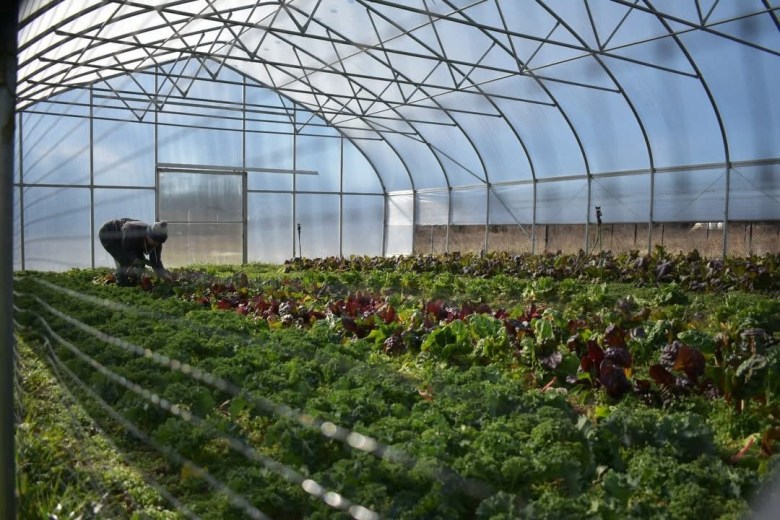
In the summer of 2024, Charlottesville’s Bellair Farm — a historic local farm with a focus on sustainable agriculture and community connection — was approved for a $100,000 grant from the U.S. Department of Agriculture (USDA).
In anticipation of the grant, the farm’s owners increased worker wages and expanded benefits like overtime pay and sick leave, Farm Manager Michelle McKenzie told Charlottesville Tomorrow.
But months later, a federal funding change upended those plans, leaving the farm uncertain whether the money would materialize.
The historic 900-acre farm, around 10 miles south of downtown Charlottesville, was one of five recipients in Virginia and 141 across the country to get this grant through a Biden-era USDA program called the Farm Labor Stabilization and Protection Pilot Program (FLSP).
The goal of the pilot program, launched in late 2023, was to shore up the country’s strained agricultural supply chains by tackling critical farmworker shortages. It also aimed to “reduce irregular migration from Northern Central America through the expansion of regular pathways.” It did that by offering grants to farms that commit to a set of worker protections and labor standards for both American and non-citizen workers, with the goal of attracting more seasonal workers from northern Central America on temporary H-2A visas.
The broader backdrop for the program is a looming crisis in the nation’s food supply, driven largely by a persistent farmworker shortage, UVA Professor Jennifer Bair told Charlottesville Tomorrow in July 2025. While experts told The Guardian that the labor shortages alone could be enough to collapse the U.S. food industry, other factors like extreme weather events, dwindling water supplies, aging supply chains and cuts to key nutrition and farming programs are also contributing.
Bair and her team at UVA had been in the early stages of USDA-funded research into the Farm Labor Stabilization pilot program — namely whether it could help address farmworker shortages by offering solutions to issues within H-2A recruitment pathways — when their funding was unexpectedly cut by the Trump administration in April.
While the Farm Labor Stabilization program itself was not cancelled, the sudden cancellation of the research component will make it difficult to measure whether — and to what extent — the program is actually a viable tool to help solve these labor shortages, professors involved in the research told Charlottesville Tomorrow in July 2025.
“We’re confused as to why you would potentially go forward with an expensive program, but not fund the very small piece of it looking at the actual effectiveness of the program,” Bair told Charlottesville Tomorrow in July 2025. “We’re losing an opportunity to study an issue that is of tremendous importance to agricultural employers across the country who are trying to figure out a way to address this problem of persistent unmet labor demand.”
The cancellation has also left those running Bellair, which agreed to take part in the research as a condition of receiving the grant, in limbo, still waiting to learn whether they’ll receive the full amount they were promised despite the research getting cut.
Local farms play a vital role in food access
Small farms like Bellair operate within an already challenging agricultural landscape — one that directly affects the region’s food supply.
Agricultural census data shows that the number of farms in Albemarle County is steadily declining.
“Supporting local farms is a critical way to address food insecurity,” Aleen Carey, the co-executive director of food justice nonprofit Cultivate Charlottesville, told Charlottesville Tomorrow. “The more small farmers you have around, the more they can grow, the more they can make available to people.”
(Disclosure: Aleen Carey serves as a member of Charlottesville Tomorrow’s Board of Directors. Our board does not have a say in our editorial decisions or directly supervise anyone who produced this report. Here is our editorial independence policy.)
In 2023, 15% of Charlottesville’s residents struggled with food insecurity according to Map the Meal Gap, a project of nonprofit Feeding America, a nationwide network of food banks and pantries.
Bolstering local farms also strengthens the region’s food security by providing alternative food sources during times of natural disasters or other crises, when regular supermarket supply chains can become disrupted, Carey said.
“It’s important to know that you have access to food in a crisis situation — which could be a pandemic or a natural disaster — that you’re not going to be without food, and knowing that you can get that food that’s grown close, that you don’t have to get from out of state or out of the country, that means everything,” she said. “Not everything that we needed was available in the stores many times during COVID.”
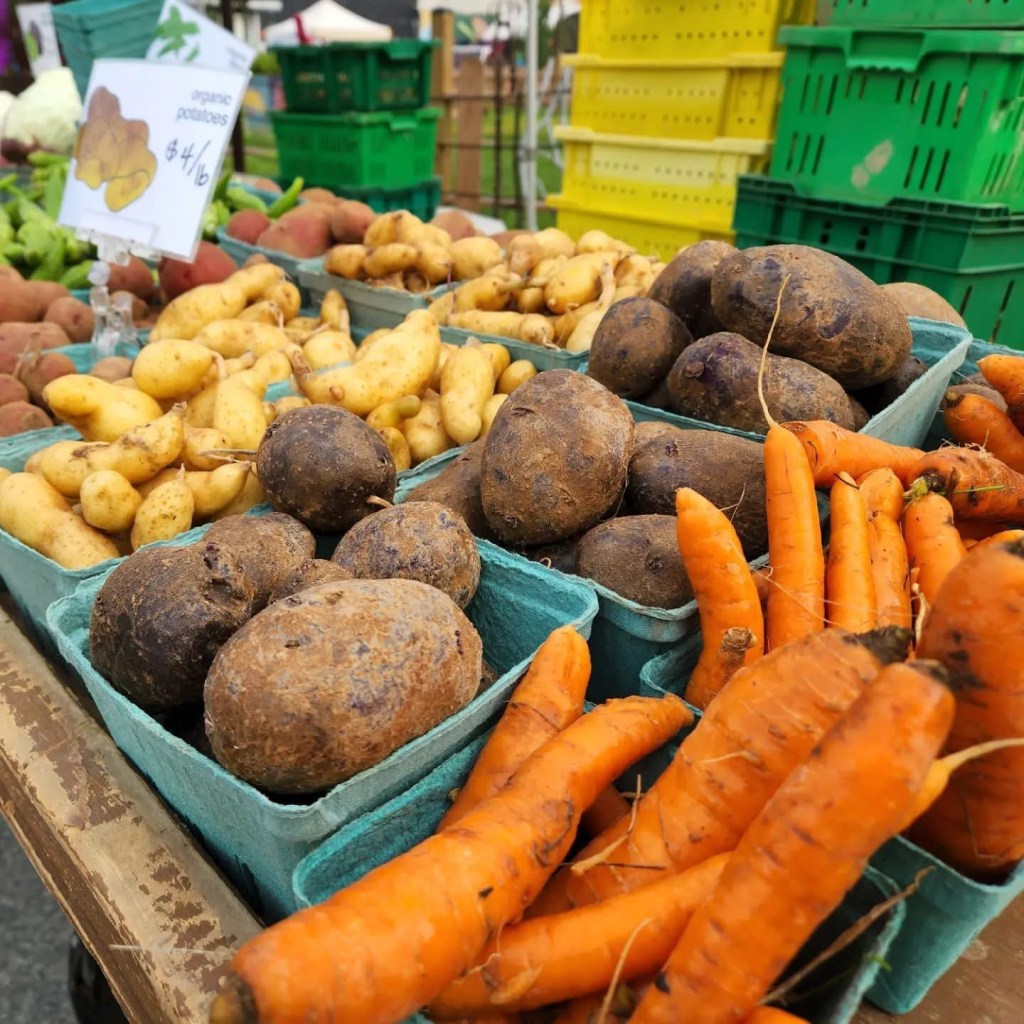
Cultivate regularly gives out free produce grown in the organization’s community gardens to community members in need. When there isn’t enough produce grown in the community markets due to bad weather, pests or other issues, the nonprofit will buy extra from Bellair or other local growers. Bellair also regularly donates produce to the nonprofit.
“They are unbelievably generous with their time and with their produce,” said Carey. “If they have extra, they donate to us, or they donate to one of the food banks or food pantries immediately, all the time.”
Generally, the more financially secure Bellair is, “the easier it is to chip in for the community”, McKenzie explained.
“It’s exponential, the impact that a partnership like that can have, and that a farm that is run in that way and is very community-centered can have,” Carey added.
Farms say persistent worker shortage is raising costs
But keeping farms going is becoming more of a challenge.
Farmers across the nation have persistently reported seasonal and year-round labor shortages over the past two decades that are squeezing operations and raising costs, according to the USDA. The rural labor supply around Charlottesville and Albemarle County faces similar challenges.
And while Albemarle County has a growing workforce overall, the farms in it are struggling with low labor force participation and worker retention, in part due to gaps in infrastructure like affordable housing, McKenzie said.
In Charlottesville and Albemarle County, housing costs are quickly outpacing what many locals can reliably afford. Nearly half of all renters in the region are “cost burdened,” meaning they spend 30% or more of their income on housing, according to the Central Virginia Regional Housing Dashboard, maintained by the Thomas Jefferson Planning District Commission.
This is the case for most farmworkers, McKenzie said.
The median pay for agricultural workers in the country as of 2024, the most recently available data, was $17.30 per hour, or $35,980 annually, according to the U.S. Bureau of Labor Statistics.
“People cannot afford to live in these areas very easily on the wages that employers are able to offer,” she said. “So people are looking at either longer commutes, or they might have partners that have higher incomes, or they might just be really lucky and have one of the few places that is affordable. Most of our workers are in one of those three categories.”
The seasonal nature of farmwork also makes it difficult for farms to retain American workers — who would need to find employment elsewhere once seasonal work is over — making H-2A workers all the more critical to the American food system.
“It’s just not reasonable to ask a local worker to get laid off every winter, and it’s not reasonable to ask us to pay someone full time in the winter when there’s no work, we can’t afford it,” she said. “And our customers wouldn’t be able to afford the product if that were to happen, the whole entire thing falls apart.”

There is also limited domestic interest in agricultural work, McKenzie added, and many Americans lack the skills, training or knowledge needed for farmwork.
“My H-2A guys, when they come to the farm, on day one can drive manual transmission, can start small engines, have operated a large array of equipment, including tractors of the size and beyond the size of what we own,” McKenzie explained. “Whereas a local worker comes in and they literally don’t know how to drive stick, they can’t start a small engine, they don’t know what two-stroke versus four-stroke is, they don’t know which cars are diesel and which aren’t. They literally don’t know what is a pitch fork and what is a digging fork, and they don’t know how to sweep a floor properly, honest to God.
“I don’t say that to be discouraging to these people, it doesn’t mean that they’re not trying,” she continued. “It just means that they’ve been brought up in a culture that doesn’t value those skills, and they’re expecting me to teach them. And I wouldn’t even mind teaching them, but I can’t afford to, because they can’t provide the level of labor that I would need to get a return on that investment. Because when fall comes, the same person is going to go get another job. As soon as they’re useful, they’re going to be gone.”
H-2A workers fill a critical labor gap, but the program is ‘a bandaid on a broken system’
The shrinking pool of American farm labor is where H-2A farmworkers come into play, McKenzie said.
The H-2A visa program allows farmers to fill seasonal agricultural jobs with foreign workers after proving they are unable to find domestic workers. Most H-2A jobs last around 6 months, and most H-2A laborers work on crop farms picking fruits and vegetables, according to the USDA.
Because many crops — especially fresh produce — require large crews during peak harvest seasons, U.S. farmers have come to rely heavily on seasonal H-2A workers. It’s the fastest growing U.S. work visa program, nearly tripling over the past decade, according to the Economic Policy Institute, a nonprofit think tank based in D.C. that researches domestic economic trends.
Without H-2A workers, the American food system would undoubtedly collapse, Mckenzie told Charlottesville Tomorrow, which is why H-2A workers are often described by agricultural organizations as lifelines for American farmers.
“Nationally, when it comes to produce, everything is hand-picked, and it’s picked by a migrant person, whether documented or undocumented,” she said. “Even with Bellair, if the H-2A program was cancelled, I would probably start to immediately think about scaling down, switching business models or getting out. Because it’s not sustainable.
“I see the H-2A program as a bandaid on a broken system,” Mckenzie added. “There’s multiple ways to fix problems, and H-2A has been a highly effective temporary solution. And if it was revoked we would have to bear the full brunt of what we’ve designed here in this country, which is an economy that exports our problems.”
Locally, H-2A workers are especially critical to orchards and vineyards, which make up a major and growing part of Albemarle County’s agricultural industry.
Nearly a quarter of all grapes harvested for wine production in Virginia come from Albemarle County, according to agricultural data collected by the Piedmont Environmental Council. Almost one third of vineyards and wineries in the state are located in the wine region that encompasses Albemarle, Culpeper, Fauquier, Fluvanna, Greene, Louisa, Madison, Nelson, Orange and Rappahannock counties, according to a 2024 wine industry report by a Virginia consulting group funded by GO Virginia, an state-run economic development initiative.
The same report estimates that as of 2023, employment in the region’s wineries and vineyards generated over $338 million in gross domestic product for the region. The region is also home to dozens of wineries and orchards that attract tourists for wine‑tastings, vineyard tours, seasonal events and other offerings.
Barboursville Vineyards, for example — located around 17 miles north of downtown Charlottesville — has relied on H-2A workers for over two decades, according to reporting from CBS news affiliate WCAV.
“It would be hard to function if the program was not existing,” the farm’s general manager, Luca Paschina, told WCAV in 2018.
But while H-2A visas help keep farms running, the visa program also has serious, well-documented issues that leave foreign farmworkers vulnerable to exploitation.
Although H-2A law requires employers to pay workers a minimum wage, provide housing and transportation and protect worker rights, investigations by outlets like ProPublica have found widespread violations.
Common abuses include wage theft, substandard or unsafe housing, extreme isolation, confiscation of identification documents, threats, intimidation and more — all while the structure of the program itself makes it very difficult for workers to report abuses or leave. In some of the most extreme cases, H-2A workers have been subjected to forced labor and human trafficking, ProPublica reported.
USDA cancelled UVA’s research ‘for DEI reasons’
The Farm Labor Stabilization grant aimed to address some of these exploitative practices, with the goal of strengthening recipient farms — and the domestic agricultural supply chain — through a more stable, reliable labor pool, according to the USDA.
Among other requirements, farms that received the grant had to commit to baseline standards for all their workers, including responsible recruitment practices, providing all workers with know-your-rights resources and guaranteeing that worker protections and benefits are applied to all agricultural workers on the farm, whether foreign or domestic. They also agreed to participate in studies by researchers selected by the USDA.
The USDA, then under the Biden administration, had originally approached Bair and her team about potentially conducting their research, Bair said — not the other way around. The research would have explored whether programs like the Farm Labor Stabilization program can effectively reduce exploitation in the H-2A program and help address persistent farmworker shortages by encouraging growers to adopt better labor practices.
While Bellair Farm had always aimed to increase worker pay and benefits, the Farm Labor Stabilization pilot program grant helped turn that goal into reality, McKenzie told Charlottesville Tomorrow.
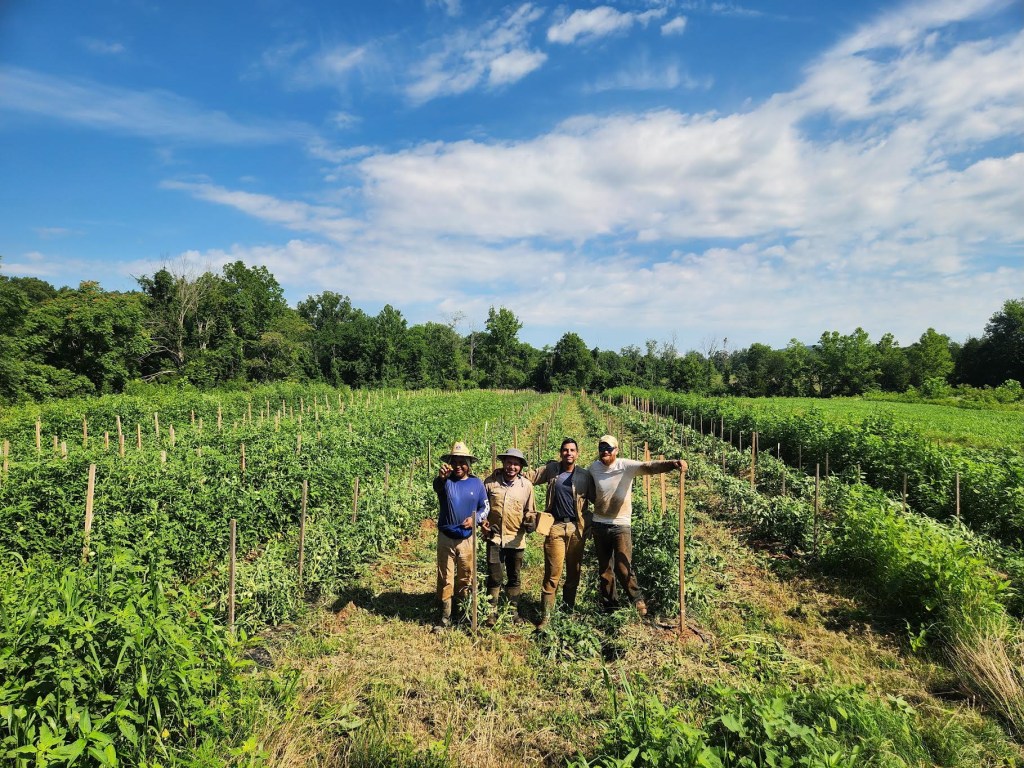
Bellair has employed four H-2A workers during the last few years, although it’s planning to increase that number to five this upcoming season. In anticipation of the grant, the farm was able to increase their pay from around $14.50 an hour to $16.50 an hour at the start of the 2024 growing season. The state’s minimum wage at the time, which is also the minimum for the H-2A program, was $12 an hour.
The grant also freed up funds in the farm’s budget to purchase new equipment to make the workers’ jobs easier, McKenzie added.
“If this grant program continued at this level of funding, it would be a game changer for Bellair, it would be incredible” McKenzie told Charlottesville Tomorrow. Bellair was awarded $100,000.
“I would also love for the USDA to understand the very nuanced details of it and what works and what doesn’t. Where are the weak points where maybe bad-faith employers can take advantage of that program?” she asked. “How do good-faith employers operate and what does that look like?”
Research into the program, McKenzie added, would have been an invaluable step toward answering these questions.
When the grant was cancelled, Bair’s team was told that the cancellation was due to “DEI reasons,” without receiving further explanation.
A USDA spokesperson confirmed to Charlottesville Tomorrow this was the reason for cancelling the grant.
“All Department contracts, grants, and cooperative agreements were subject to review for alignment with USDA policies and priorities,” A USDA spokesperson told Charlottesville Tomorrow. “The agreement to complete the research project, FLSP Research Understanding the Impact of Farm Labor Practices, was determined to be out of alignment with priorities regarding diversity, equity, and inclusion programs and activities.”
Bair’s best guess for why this is the case, she said, was because their research involved foreign-born workers.
The Trump administration takes a different approach to shoring up farms’ access to foreign workers
While the Biden administration instituted the Farm Labor Stabilization program to help farmers by addressing labor shortages, the Trump administration has taken a different approach toward the same goal.
In October 2025, the Department of Homeland Security implemented changes to streamline H-2A petitions to make the process easier and faster for domestic farmers. The same month, the Department of Labor also issued a ruling to reduce costs for farmers by effectively reducing the wages of most H-2A workers — the opposite approach the Farm Labor Stabilization program was exploring.
The administration did so by changing the methodology for calculating the minimum hourly wage that U.S. employers must pay H-2A and domestic workers in the same jobs, also known as the Adverse Effect Wage Rate.
The change introduced a two-tier “skill level” system that divided H-2A agricultural jobs into two wage categories, “entry-level” and “experienced,” when setting the Adverse Effect Wage Rate. Entry-level positions, which include most general farm labor such as planting, harvesting and packing, were assigned a lower wage rate, while higher rates now apply only to jobs that meet specific criteria for skills, training or specialized duties.
Because most H-2A work falls into the entry-level category — the Department of Labor has estimated that 92% of H-2A workers will be classified as entry-level — the new system has resulted in lower wages for the vast majority of H-2A farmworkers.
This will result in a wage transfer from the average H-2A worker to their farmer employers of $5,513 per year, according to estimates from the Department of Labor.
In Virginia, the 2025 Adverse Effect Wage Rate was $16.15 per hour. Under the new two-tier system, the rate for tier-1 entry-level H-2A workers has fallen to $11.82 an hour, while tier-2 experienced H-2A workers will be earning a minimum of $16.32 an hour, McKenzie told Charlottesville Tomorrow.
While Bellair’s H-2A workers all classify as tier-1 entry-level workers under the new system, McKenzie said, Bellair doesn’t plan to decrease their wages from their current pay of around $16.50 an hour.
Farms that were promised federal funds are left with uncertainty
In the meantime, the USDA continues to fund the $50 million Farm Labor Stabilization pilot program. But with the research now cancelled, McKenzie also fears that the continuation of the program is now less likely.
“It (the Farm Labor Stabilization grant) would be such a benefit for us if it were to continue, but with the research component canceled, I’m not sure of the likelihood of that,” she said. “It seems just as likely that they would just fulfill their obligations, pay out everything they already have to pay out and stop.”
So far, Bellair Farm has received $50,000, or half of their total $100,000 grant.
But it wasn’t an easy road to get there. There were many times when McKenzie wasn’t sure if Bellair would ever receive the funding they had been promised.
Starting in January 2025, expected payments through the Farm Labor Stabilization program were frozen or significantly delayed, causing severe financial distress for some farmers, according to the National Council of Agricultural Employers.

The delays were caused by a federal funding freeze and an administrative review of the USDA initiated by the Trump administration at the beginning of his term, according to reporting by The Washington Post and other outlets. The aim was to ensure that existing programs were in line with his administration’s priorities. The administrative review unfolded amid large-scale staffing losses and agency reorganization, severely limiting the USDA’s operational capacity and its ability to process or distribute grant reimbursements.
“It was frozen, and then it was unfrozen, but then it took a very long time for things to start moving again,” Mckenzie told Charlottesville Tomorrow. “And there have been very low points where you’re sending an email into the ether, and nothing’s happening and you submitted everything and followed every webinar to the tee, and you’re so careful, and you have all your forms in order and it’s just, you know, pending, pending, pending for weeks and months on end.”
While McKenzie had initially been expecting the first $50,000 payment from the USDA in
2024 and — after delays — in May 2025, the farm only recently received it in early October 2025.
And the uncertainty isn’t over yet, she told Charlottesville Tomorrow.
The grant payments are distributed to each farm in three payments, the first payment making up 50% of the grant and the next two making up 25% of the grant each, once the farms reach certain milestones.
Participating in the research was a milestone required to receive the second payment, she said. Now that the research has been cancelled, she’s not sure whether Bellair Farm will get the final two $25,000 payments from the USDA.
“We are willing and waiting to participate in any research that does occur,” she said. “It’s a required thing that I’m missing, but there’s no way to get it. So we’re back in limbo land, this time for 25% more of our award.”