

“It’s not typical for a small town to have a 10-acre park system right off Main Street,” said Gordonsville resident Peter Hujik.
But the Town of Gordonsville is in the midst of a multiyear, multimillion dollar project to build just that.
The project takes place in Verling Park, which is just a block from downtown and home to Orange County’s only public swimming pool, Dix Memorial.
But until recently, the future of the pool — and the park — was uncertain. The pool was crumbling and outdated, but fixing it would be a dauntingly expensive task for the town of 1,400 people. However, the community took on the challenge. A grassroots campaign followed, raising millions and turning a decaying facility into the centerpiece of the expanded park. Along the way, the project pushed Gordonsville to reckon with the pool’s segregated past — and gave the town a chance to rebuild something more inclusive in its place.
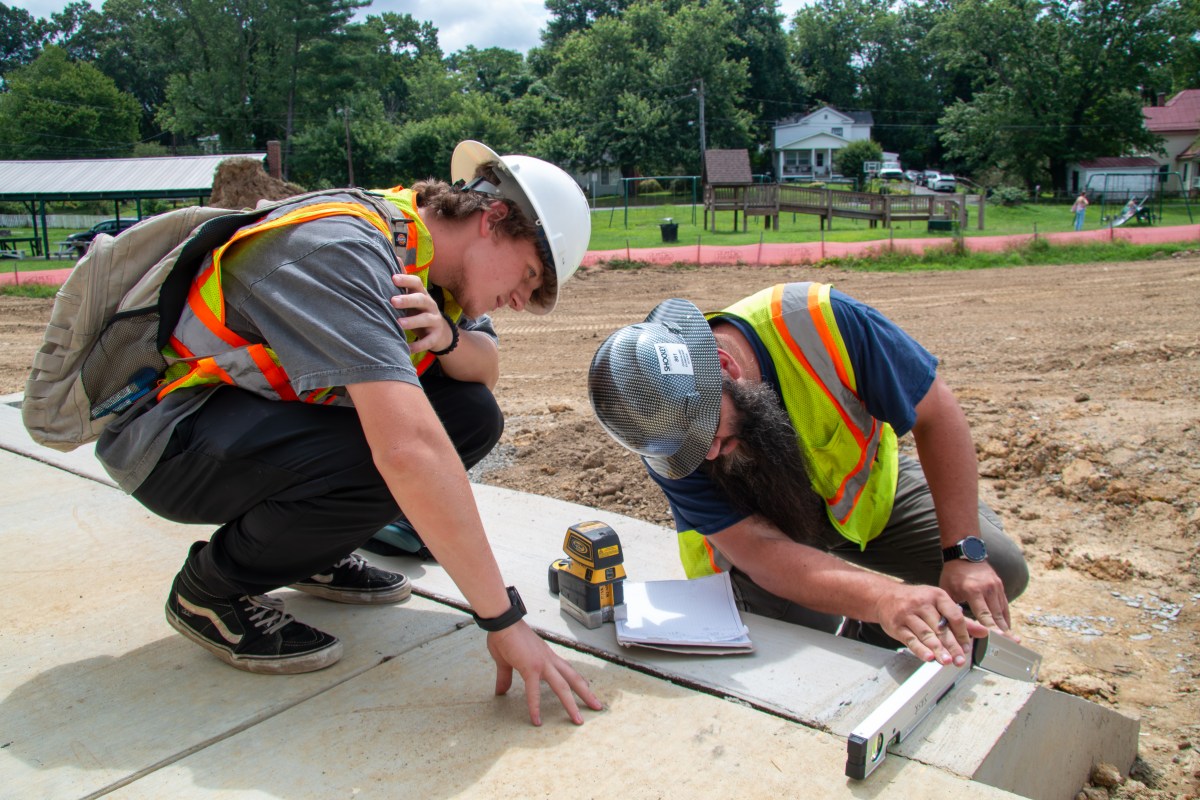
Phase one of the project, the complete pool renovation, wrapped up over the summer. The town has since embarked on phase two, which includes a new event pavilion, playground and winding walking paths that connect Verling Park with Gordonsville’s other green space, Fireman’s Fairgrounds. That brings the park footprint from less than a block to almost 10 acres.
The whole project is estimated to cost $6.5 million, for a town with an annual budget of $7.7 million. The pool alone cost $3.9 million.

“It’s a hard balance, being a small town taking on big expenses,” Gordonsville Mayor Ron Brooks admitted. But he believes the town has struck that balance pretty well. The town government “has not had to spend a dollar,” because Gordonsville has significant grassroots support, he said.
“The project wouldn’t get done without a group of persistent citizens,” agreed Hujik, an early advocate for the project.
Original funding for the project traces back to the early twenty-teens, when swim team parents hosted bake sales to raise money for a new pool.
By then, Dix Memorial was beginning to languish.
Originally built in 1956, the pool was “a cinderblock, four-lane rectangle,” according to Town Clerk Janet Jones. At almost 70 years old, it was leaking, inefficient and expensive to maintain. The swim team eventually left because it was not regulation size.
Mason Brooking, who started lifeguarding as a teenager in 2022, remembers lifeguards had to check the pool’s chlorine levels every hour, sometimes closing it entirely due to unbalanced chemicals.
“The water would get so cloudy, you couldn’t see people when they went under,” Brooking said.
But because Dix Memorial is the only public pool in Orange County, families didn’t have many options on the days it closed. Some opted for the Orange Country Town Pool, where a family membership costs $525 per year. Others drove half an hour to Charlottesville’s public pools.
Community donations to fix the pool trickled in over the years. By 2017, the town held around $70,000 in escrow for a potential pool project.
But the catalyst for the project was the creation of Town to Trail. Founded by Gordonsville residents in 2017, Town to Trail was originally a working group under the Piedmont Environmental Council before becoming its own nonprofit in 2022.
Throughout 2017, Town to Trail hosted community feedback meetings to hear what residents wanted, before petitioning the town to get the park project on the docket.
“The whole town came together to figure out a vision for the park,” said Liz Samra, who was one of Town to Trail’s original members. Again and again, residents emphasized renovating the pool.

It would be a big lift, but it wouldn’t be the first time Gordonsville residents have pulled something like this off. Decades ago, residents ran and maintained an all-volunteer swimming pool, without any government funding. Though, the circumstances then were a little different.
When Dix Memorial opened in 1956, Black residents could not swim there.
Instead, Black residents went to a pool on Charles Street, on land donated by the Calvary Seventh Day Adventist Church. The pool went by many names. Originally called the Gordonsville Community Swimming Pool when it opened in 1959, it was later renamed the Charles Street Recreation Center. Vice-Mayor Emily Winkey grew up calling it the Neale Pool.
Funding for the pool came from Charles Neale, who had opened Dix Memorial three years earlier.
Opinions on why Neale funded a second pool are mixed, depending on who you ask. Bob Coiner, former mayor of Gordonsville, sees Neale as a misguided man of his time. Coiner speculated that Neale may not have been aware that Black families could not swim at Dix. Once Neale realized that, he opened a second pool so that everyone could have a chance to swim.
Others see it differently. Local historian Gloria Gilmore passed away earlier this year, but in a 2024 presentation she said: “This is in the fifties. Separate But Equal is why there were two pools. When the segregation law was outlawed, money came in to build another pool in the Black community.”
Winkey agrees. “Neale financed the second pool to keep us separate,” she said. “That was the purpose of the two pools.”
Desegregation in the United States began in 1954 with the Supreme Court’s Brown vs. Board of Education ruling. However, it took more than a decade for most communities to desegregate. Orange County Public Schools fully integrated by 1969, but Winkey remembers the pool communities stayed separate.
“Dix Memorial did not integrate until the pool on Charles Street closed down [in the 1980s],” she said. “I did not swim in Dix Memorial pool, but spent all my summers in the Neale Pool.”
For Winkey, the Charles Street Recreation Center provided early examples of civic engagement.
“It was a community effort to ensure that children had a place to play and learn to swim,” she said.
Besides the lifeguards, the Charles Street Recreation Center was run entirely by volunteers and sponsored by three local churches. The pool hosted Mermaid Princess pageants to raise funds, with other support coming from a local community service group called The Brotherhood Club.
Neale financed the second pool to keep us separate. That was the purpose of the two pools.
Gordonsville Vice-Mayor Emily Winkey
“When my siblings and I were coming up, The Brotherhood Club had dances year round, and that money rolled over so that we could maintain the pool,” said Winkey. “The men worked with that, and the ladies of the community always volunteered at the pool to run the concessions stand and ensure the children were safe and well behaved.”
Winkey contributed her own part as a child: She was one of the mermaid princesses in the pageant.
“Can you imagine?” she laughed. “We were all so skinny back then! I was probably 5″2′! When we raised $500, we thought that was a whole lot of money.”
As a private pool without town support, funding didn’t always come easily. The pool on Charles St. closed for needed repairs in the early 1970s and almost closed for good a few years later, until The Brotherhood Club spearheaded a monumental effort to keep it open.
First, members of The Brotherhood Club went to Gordonsville Town Council for the money, but the town declined. An Orange County Review article from the time reported that the Council “took no action” on the club’s request, with one councilor positing it was not legal “for a tax-supported governing body such as town council to contribute to a privately owned project.”
So club members did it themselves.
A 1977 Orange County Review article illustrates the undertaking: “After appealing to local businesses and residents for supplemental financial aid and materials, members of the club donated their own time to supply all labor for the project. The amount of labor required was substantial. The pool, concession stands and dressing rooms were cleaned and repainted, new topsoil was spread and re-seeded, the perimeter fence was torn down and rebuilt, and the toilets and plumbing, which had been broken by winter freezing, were replaced.”
Thanks to those efforts, the pool reopened in 1977 and stayed open for almost a decade longer. However, it ultimately closed in the mid 1980s, due to lack of funds, changes in church leadership and aging volunteers.
With that, Dix Memorial became the only pool in Gordonsville — and the only public pool in Orange County. And traces of its segregated past still linger.
“The built environment reflected the history of segregation,” Hujik said.
During Town to Trail’s community feedback meetings, Hujik learned that the park signage faces away from Gordonsville’s historically Black neighborhood. The pool was also blocked from view by an abandoned house surrounded by a chain link fence at the corner of Piedmont Street and Linney Street.
“People who live in the historically Black neighborhood usually come down Linney Street [to get to the park],” said Hujik. “That’s where the house and chain link fence was. It was a visual barrier. We saw from an integration perspective it was important to have that point of entry welcoming.”
New signage has not yet been added. However, within the first year of its creation, Town to Trail raised $30,000 from private contributions that helped the town purchase the abandoned house and demolish it.
In the following years, thanks to community donations and a $100,000 grant from the Virginia Outdoors Foundation, Town to Trail bought two other properties that connected Verling Park to Fireman’s Fairgrounds. It donated them to the town in 2022 under an open access easement, ensuring they stay open to public use.
That same year, the town applied for a grant from the Land and Water Conservation Fund, awarded through the Virginia Department of Conservation and Recreation on behalf of the National Park Service.

Even more community donations, combined with a $1 million donation from the Manning Foundation, meant the town had $1.4 million to put toward the project when it applied. Gordonsville became one of six Virginia recreation projects to get the grant, ultimately receiving $3 million in matching funds from the federal government.
“It was a compelling story because we already had the matching funds and the footprint,” Samra said. “It was shovel-ready, not just a vision.”
The grant also had the support of then-U.S. Rep. Abigail Spanberger (now governor-elect), who wrote to the NPS Agency Director Chuck Sams requesting he “provide full and fair consideration of the application submitted by the Town of Gordonsville.”
But Samra also credits the community support.
“The generosity of people was overwhelming,” she said.
According to Mayor Ron Brooks, the town and Town to Trail had received more than 150 community donations of $10 or more.
The pool is renovated, but the fundraising continues. In September, Town to Trail donated $70,000 to the town for the renovation of the event pavilion. According to Brooks, $35,000 had been private donations, which were then matched by a grant from the Perry Foundation. Once the money was donated to the town, it doubled again, to $70,000, thanks to the NPS grant.
It’s a lot of time and effort, but those involved say it’s a worthy cause.
“This is a public pool, and that’s important,” said Samra. “You should be able to learn to swim, to have recreation spaces, no matter what your economic status is.”
“It builds so much character for a small town to see what we can do when everybody pitches in,” said Vice-Mayor Winkey. “The journey took a long time, but it was a complete community effort.”




.jpg)