

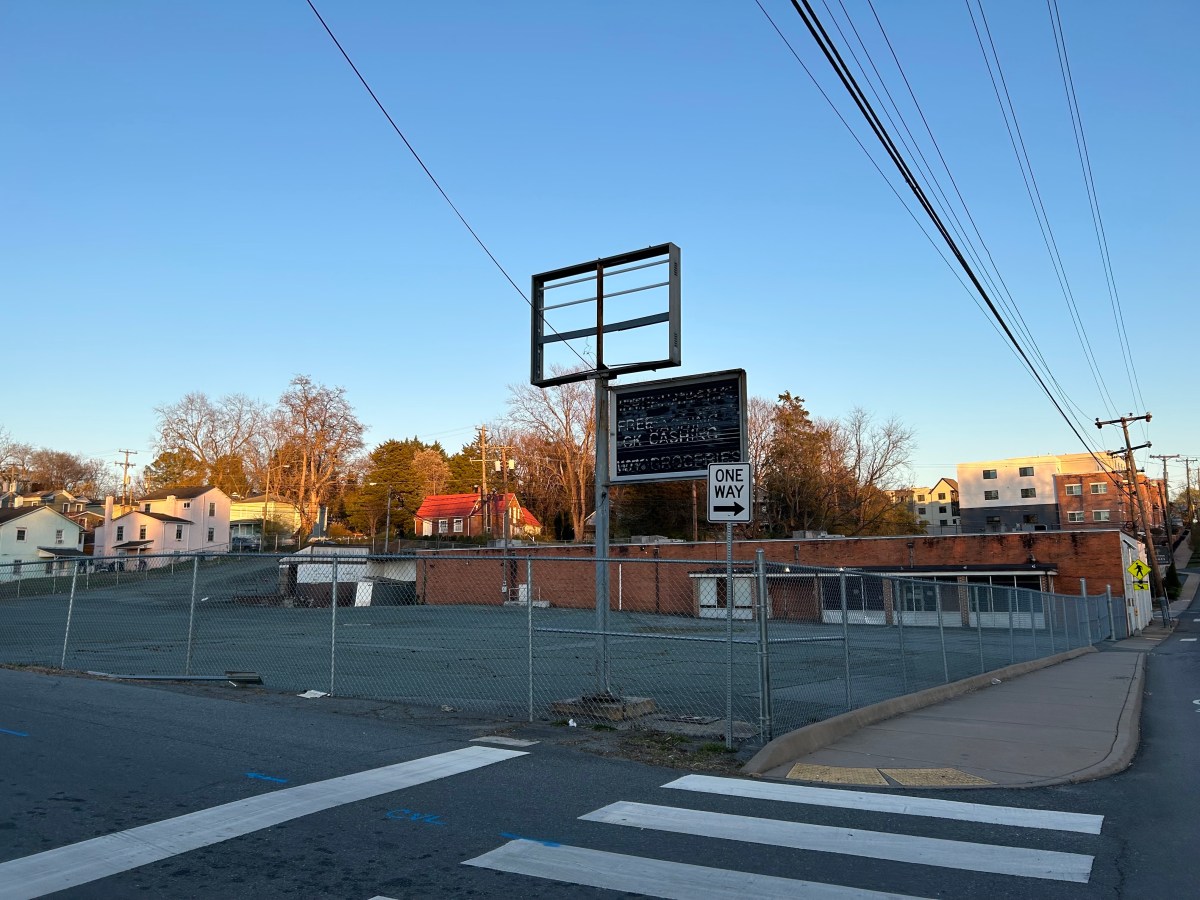
Carmelita Wood shopped at Estes IGA grocery on Cherry Ave. every Saturday morning for years. The parking lot was always packed with Fifeville residents doing their shopping and catching up on the latest neighborhood news. People chatted while waiting in line at the hot dog stand. They bought desserts from the women who held bake sales in the parking lot.
“Some of those baked goods were very good,” said Wood, smiling wide as she recalled the memory. “Very good.”
When Estes closed in 2002, another market, Kim’s, moved in for a while. But it wasn’t the same, residents have said. The neighborhood lost one of its main gathering places. Some folks lost their jobs, and many lost convenient access to fresh, healthy and affordable food.
“Having to worry about how to get their groceries was a really big thing,” said Wood, a longtime Fifeville resident and president of the Fifeville Neighborhood Association. More than two decades after Estes closed, that hasn’t really changed.
But it could.
The Charlottesville Food Co-Op wants to bring a community-owned grocery to the old Estes site at 501 Cherry Ave. — and they’re doing it because the neighborhood wants them to.
That is, if they can get the money for it. They’re asking the City of Charlottesville for help, and the city’s decision could make or break an unprecedented development project.
Fifeville community’s plan for the future includes a local grocery store
About a decade ago, Fifeville, a historically Black, low-wealth neighborhood, was changing, quickly — the nearby University of Virginia kept expanding and altered the makeup of the neighborhood in the process.
In August 2022, local developer Anthony Woodard, CEO of Woodard Properties, paid $3.5 million for two adjacent parcels of land on Cherry Ave., including the one with the old, sagging Estes building.
He envisioned a new home for the Music Resource Center, and something else — apartments, most likely. He asked the Fifeville Neighborhood Association what they thought.
The neighborhood association in turn asked for a say in what went on the site. In an unprecedented move by a local for-profit developer, Woodard agreed.
Residents wanted all of the apartments to be low-cost. And they wanted a grocery store.
The neighborhood association, Woodard Properties, and local nonprofit housing developer Piedmont Housing Alliance committed to trying their best to make that happen.

Another survey, this one conducted in fall 2024, affirmed how important a grocery store is to the neighborhood — and told the project partners a little more about what the neighborhood envisioned for it. More than 500 people filled out that survey, and the results showed that people wanted easy access to fresh, healthy food at a low cost. And, they wanted the store to be led by a person or a group with deep ties to the neighborhood or the Charlottesville community.
The grocery store has been the hardest component to figure out, the project partners say. They had to find a grocer that could deliver on what the neighborhood wants, while also being able to afford to pay the roughly $3 million in construction costs. Outfitting the store with shelves, displays, coolers, freezers, registers and other necessities will cost millions more.
Grocery stores have very low profit margins, typically between 1% and 3%, according to the National Grocers Association, and the projected size of the store at 501 Cherry Ave. would make it an even bigger challenge, various companies told the project partners.
At around 7,000 square feet, the space is relatively small for a grocery store, about twice the size of Market Street Market. In order for the grocery store to work financially, the construction would need to be subsidized, Piedmont Housing Alliance executive director Sunshine Mathon told the neighborhood last year.
By fall 2024, the partners had struck out with most of the grocers they spoke with, including the owners of Reid Super-Save Market, which closed just a few months later. It looked bleak.
“My hope is that we are able to give the community what they ask for. My fear is that we will fail,” Wood said during a community meeting.
By December 2024, four groups were interested in running the grocery store. By February, it was down to just two: Good Foods Grocery, a natural foods store in Richmond that opened in 1985 and runs a workforce training program for adults with autism, or the newly-formed Charlottesville Food Co-Op, which would be a community-owned and run grocery store.
Good Foods had 40 years of experience. The Co-Op offered strong local ties.
Over the past year, both had to come up with a business plan and financial projections for the project partners. An independent grocery industry expert reviewed them and determined that both were feasible options, Woodard said.

Though the decision took months, the choice — the Co-Op — was obvious, Wood said.
“What made it come together was the similarities between the values of the neighborhood and what the Co-Op has to offer: community engagement, community ownership, community wealth-building,” Wood said. “These are core values that other potential operators did not offer.”
Co-Op brings opportunities for community wealth-building, improved health
Community members planted the seeds for the Charlottesville Food Co-Op a few years ago, but it didn’t bloom until the 501 Cherry Ave. opportunity came up, said Deanna McDonald, a health education coach and consultant who partnered with the Fifeville Neighborhood Association on the 501 Cherry Ave. community engagement efforts. She is also on the Co-Op steering committee.
“This would be the ideal spot,” she said. She knows the Co-Op can’t recreate Estes, but hopes it can create a new hub with that same community feel.
Like Wood, McDonald has fond memories of Estes. McDonald’s aunt lived on 7 ½ St., and when McDonald and her cousins got to walk to Estes, McDonald felt more independent.
“Estes was freedom,” she said.
She thinks the co-op could be, too.
Co-op grocery stores (“co-op” is short for “cooperative”) are community-owned stores. Anyone can shop at a co-op, but only co-op members are involved with decision-making for the store.
Currently, the Co-Op is made up of a steering committee of 15 members who come from Fifeville and other parts of the city. It’s a multi-generational, multi-racial group that meets twice a month, sometimes more. But eventually, they won’t be the only ones making decisions.
Anyone who buys a membership to the co-op gets a say on how the store is run and what’s on its shelves. If the store starts to turn a profit, that profit will be returned to members as dividends, or in the form of credit for groceries.
But McDonald said they’ll also listen to customers on what to stock.
The Charlottesville Food Co-Op will carry what is known as a “conventional mix,” McDonald said, everything from Cheetos to carrots. Keeping costs low for items like frozen peas might mean stocking some higher-price items like bottles of wine. A bottle of wine has a higher profit margin than frozen peas, and can subsidize the cost of frozen peas, she explained.
The Co-Op is also forming relationships with local farmers to see how much of the store’s food can be local.
Being able to shop for groceries close to home isn’t just about convenience. It’s about health.
Not having access to fresh and healthy food over time can cause a plethora of health problems, including cardiovascular disease, diabetes and certain types of cancer. The problem is particularly acute in neighborhoods without grocery stores, in historically marginalized, historically low-wealth neighborhoods — like Fifeville. Opening more community-based grocery stores like the one the Co-Op envisions, could help improve health outcomes, according to a 2023 report from the American Journal of Clinical Nutrition.
It’s also about self-empowerment and community wealth-building.
Part of that will be making membership possible for everyone in the community, no matter their income, said steering committee chair Alysse Dowdy. One of the ways to do this is by having income-based membership tiers. Another is to set up a membership fund, where community members can donate money toward someone else’s membership. Dowdy, McDonald and other steering committee members have been exploring options by talking to other co-ops throughout the country to see how they’ve been able to do it.
For instance, the Gem City Market co-op in Dayton, Ohio, offers $10 memberships for people who qualify for government assistance or who self-identify as low income.
The Co-Op intends to accept Supplemental Nutrition Assistance Program (SNAP) and Women, Infants and Children (WIC) — also known as food stamps — dollars, Dowdy said. It also wants to be a Virginia Fresh Match store, which would mean that SNAP and WIC dollars would go twice as far when spent on fruits and vegetables.
But before any of this can happen, the grocery store needs money.
The entire 501 Cherry Ave. project — the Music Resource Center, the 71 apartments, and the grocery store — is expected to cost between $45 and $50 million, said Alicia Garcia, Piedmont Housing Alliance’s director of real estate development.
The cost to build out the bare space for the grocery store — just the box where the grocery store will go — is about $2.5 million, said Piedmont Housing Alliance’s Mathon. That’s down from the initial $3 million projection. Still, it’s a lot of money.
Last summer, the project received a $250,000 food access grant from the U.S. Department of Agriculture’s Healthy Food Financing Initiative program, which is meant to address issues of food insecurity in low-income areas or areas that do not have easy access to grocery stores.

PHA will also use grant money that it received from the U.S. Department of the Treasury Community Development Financial Institutions Fund’s Capital Magnet Fund for the store. The grant money is intended for projects related to affordable housing and community revitalization efforts that benefit low-income communities.
That leaves about $1.7 million, and they’ve asked the City of Charlottesville for it.
City Council will officially hear the request during its Dec. 15 meeting, city spokesperson Afton Schneider told Charlottesville Tomorrow.
(So far, the city has allocated $3.1 million to the housing component of the project.)
City Council’s decision could determine the fate of the project. Without the funding for the grocery store, the entire project won’t be able to move forward, Mathon said. PHA needs to start the loan process with its lender in January in order for construction to begin in April. If construction begins in April, the project should be done in October 2027 — when the Music Resource Center will need to move out of its current space and into the new one.
And even if City Council comes through with the money for construction to begin, the Co-Op still has a lot of work ahead. It will cost an additional $4 million to get the store outfitted, stocked and staffed.
The steering committee — which is made up entirely of volunteers — is working on forming an advisory board and seeking out donors. They’ve already found some local support in the form of a $5,000 grant from the Community Investment Collaborative, which the Co-Op won in April at the Tom Tom Foundation’s Pitch Night. Next year, they’ll start selling memberships. They realize it might be difficult to sell people something that they cannot yet see, touch, smell, or taste — a co-op membership — but they say that getting people involved is crucial to getting the Co-Op up and running.
Their goal is to start with at least 300 members.

“It’s happening, and we’re at a point where we can say that,” said Dowdy. Still, she’s careful to say it’s not a done deal. “It’s going to require a whole heck of a lot more people and resources to even get us to the next milestone.”
But the promise of opening the grocery store Fifeville residents have wanted for years keeps them going.
Wood thinks about it every day, she said, especially when she worries that the project won’t all come together. But there have been various points where it seemed they might not clear the hurdle right in front of them, and yet, they did.
“When people come together, we can accomplish anything,” she said. “If we don’t accomplish this now, then we’ll continue to try to accomplish this somewhere else in the city. But I really would like to see it happen here. It would give the city, the developers, the neighborhood, so much pride to say, ‘look what Charlottesville has done.'”
Editor’s note: This story was updated on Dec. 9, 2025 to correct a reference to the money the City of Charlottesville has allocated to the 501 Cherry Ave. project.