

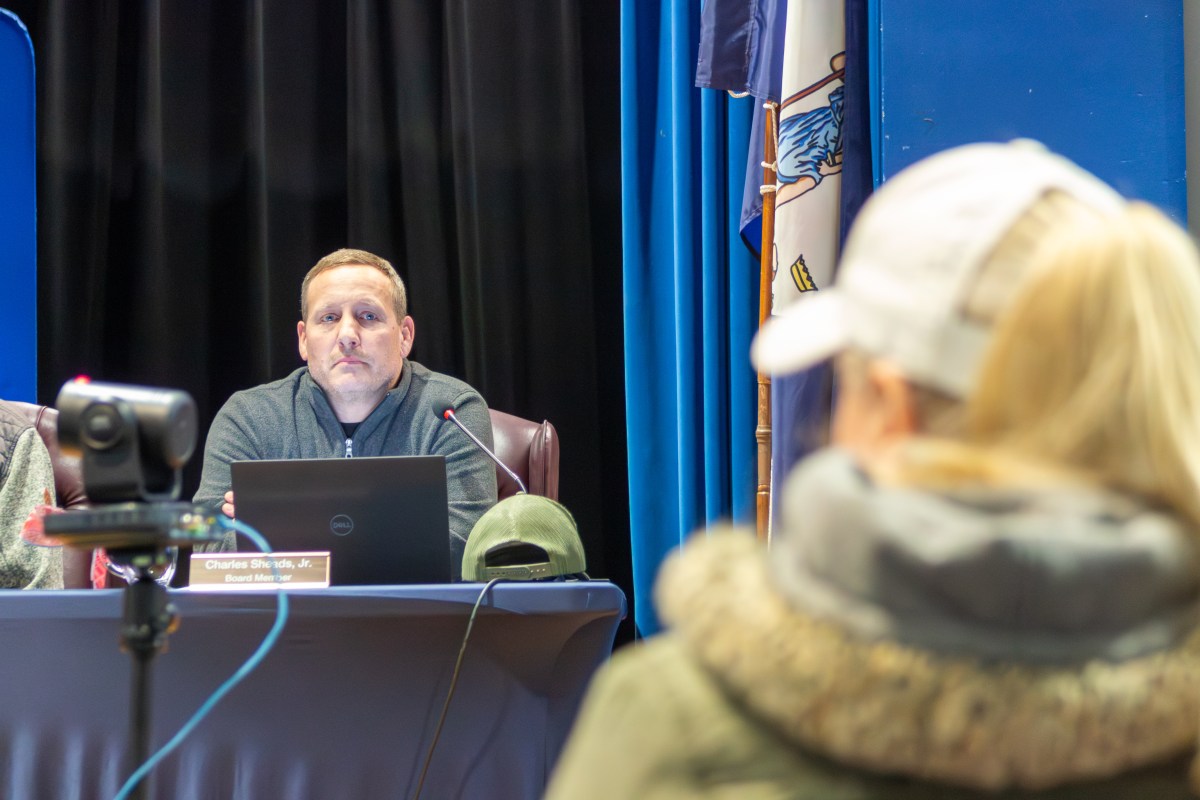
Despite a month of public outcry over disparaging comments Madison County Public School Board member Charlie Sheads made about Muslims and initiatives to improve equity for Black people, his fellow School Board members remained silent as Sheads doubled down during their final meeting of the year on Monday, Dec. 8.
“I can assure you there is one religion that chants ‘death to America’ and that’s the Muslim religion,” Sheads said, speaking during the meeting. “It’s not a color. It’s not racist. It’s religion, and they do not like us.”
The current outcry against Sheads began on Nov. 5, when he published a post to the “Madison Bulletin” (now “Madison Bulletin Untamed”) community page on Facebook. In it, Sheads disparaged Americans who voted for New York City Mayor-elect Zohran Mamdani and Virginia Lt. Gov.-elect Ghazala Hashmi, both of whom are Muslim, and likened the politicians to the perpetrators of the Sept. 11 attacks.
“On 9/11/01, muslims hijacked jets, murdered nearly 3,000 Americans,” Sheads wrote. “NY voted in a muslim mayor & Va voted in a muslim Lt. Governor. WTF is wrong with you people?”
After receiving criticism from some commenters, Sheads went further, writing that “muslims hate America, they hate Christians and will kill us if and when given the opportunity,” and that “infidels are their enemy and they celebrate when they kill infidels.”
At times, Sheads personally attacked those who disagreed with him, calling one commenter “exactly the stupid type of individual that a Muslim would support…. until they didn’t need you anymore and you’d be discarded,” and told another, “Your opinion of anything is worth less to me than a pile of worm s—.”
Sheads did not limit his remarks to Muslims, at one point claiming that members of the political left “have to give everything to blacks because they can’t achieve it themselves.”
Sheads did not respond to Charlottesville Tomorrow’s email requests to be interviewed and declined to comment in person following Monday’s meeting.
The community members speak out

Over the following week, Sheads’ post gained the attention of community members. On Nov. 11, NAACP Culpeper Branch 7058 issued a news release calling Sheads’ remarks “the type of rhetoric that we’ve repeatedly seen fuel hostility, vandalism and violence against our brothers and sisters in the African American and Muslim communities,” and calling into question his ability to fairly represent the interests of Madison County students.
Roughly 7% of Madison County Public Schools students are Black, and 9.5% identify as multi-racial, according to the latest Virginia School Quality Profile published by the Virginia Department of Education. Around 75% of the division’s students are white. The state does not track students’ religious affiliations.
“Accordingly, we are calling on the Board of Supervisors to immediately censure Charlie Sheads and for the School Board to strongly consider additional appropriate action warranted under the School Board’s Code of Conduct,” the statement reads.
The next day, during the county Board of Supervisor’s Nov. 12 meeting, community members joined the call for Supervisors to censure Sheads.
Under Virginia law, there is no direct mechanism for a school board member to be removed by their fellow board members or another governing body, like the board of supervisors. Removal must be initiated via citizen petition with the local circuit court. However, Sheads chose not to seek re-election this year. His term ends Dec. 31, meaning a petition would be unlikely to move through the court system in the brief window of time that Sheads will remain in office.
While those in leadership in Virginia can’t force a school board member to resign, pressure from public officials has occasionally led to a member willingly stepping down. Notably, this was the case in September when Gov. Glenn Youngkin called on Chesterfield County School Board chair Dot Heffron to resign after she posted on Instagram about assassinated conservative activist Charlie Kirk.
Charlottesville Tomorrow reached out to Gov. Youngkin’s office for comment but did not receive a response.
Several community members who spoke at the Madison County Board of Supervisors’ meeting hoped that public pressure could come from officials at the local level.

Cindy Taylor said that the lack of recourse for citizens made it even more important for other elected leaders, like the county supervisors, to rebuke Sheads.
“I know it’d be easy to say, ‘He’s out of office at the end of the year. Let it go or just don’t amplify it; let it go.’ Or, ‘This is the School Board’s problem. This is not for the Board of Supervisors. They need to deal with it,'” said Taylor. “No. It’s time finally for every elected official in this county to stand up and say, ‘I do not support this.'”
Patricia Frye, a pediatrician who has worked with refugee children from Afghanistan, told the Supervisors that she was troubled by the harmful generalizations made by Sheads.
“You may not like Muslims, you may not know any Muslims, but you cannot stand up as an official — and especially as a School Board official who’s responsible for helping to mold these children — and say blanketly that a whole community of people is evil and that they are dangerous,” Frye said.
Frye, who is Black, also expressed personal concerns about living in a community where a public official holds Sheads’ views.
“As a minority in this community, this incendiary and inflammatory language is making us more and more uncomfortable,” she said.
Another fear that came up repeatedly was that failing to make Madison County and its school system a welcoming place could result in economic decline, discourage people from moving to Madison and cause current residents to leave.
“You and all of the supervisors are constantly talking about economic development and the future of our county and the need to expand our tax base,” Taylor said in a comment directed at Madison County Supervisor James Jewett. “We are not going to get families to move in here and businesses to locate here when someone can say — an elected official can say such toxic things — hateful, dangerous things — and we say nothing.”
The Rev. Frank Lewis, pastor at Antioch Baptist Church, agreed.
“We’re all the taxpayers in this county, and we all want the best for our children and our grandchildren as they grow up, so they won’t have to worry about getting out of the county and running because of what they think they’re going to face in their county,” Lewis said.

The lone resident to express support for Sheads at the meeting, Leigh Purdum, said: “This cancel culture has to stop. We know his stance. He has the right to his opinion. I don’t know what the problem with that is.”
Two of the five county supervisors — Clay Jackson and Carty Yowell — chose to respond to public comment. Both said that while they personally disagreed with Sheads’ comments, it was ultimately a free speech issue.
Jackson currently serves as the chair of the Board of Supervisors until his term expires Dec. 31 after two recent electoral losses, first in the House of Delegates District 62 Republican primary against Karen Hamilton, followed by a failed write-in campaign to retain his supervisor seat. In his remarks, Jackson discouraged those in the audience from giving Sheads further attention.
“It bothers me that we are giving publicity in this venue where we have such a good community — such a good community — to publicize something on a Facebook page. This looks to me like responding to a bully. We’re all better than this,” Jackson said.
In a follow-up interview, Jackson clarified that he did not intend to chastise community members for speaking up, but instead was disappointed in Sheads for bringing negative attention to the county.
“This is a very minor thing and definitely does not reflect on the community of Madison in any way,” Jackson said. “Everybody gets a fair shake in Madison County.”

A day later, on Nov. 13, the Madison County Public School Board issued an unsigned statement, writing that Sheads’ posts and comments which “broadly disparage a religious group and others are those of the individual member and are not the comments or views of the School Board,” and that the School Board is committed to creating “a welcoming and respectful environment for all members of our school community.”
The Culpeper NAACP responded quickly on Facebook, calling the response from the Board of Supervisors “underwhelming” but crediting community members for putting enough pressure on local officials to result in a statement from the school division.
Family describes pattern of inaction in the school division
For some, the recent controversy surrounding Sheads — and the silence from other local officials — is just the latest example of what they describe as a broader, ongoing issue of discrimination within MCPS.
Devlyn D’Alfonzo, formerly of Radiant, Virginia, said that when she and her family moved to their house in Madison County 12 years ago, it was meant to be their “forever home.” However, years of troubling interactions with the Madison County school system would ultimately lead D’Alfonzo and her husband to make a difficult decision.
“We absolutely intended to be there the rest of our lives,” D’Alfonzo reflected. “But with two girls, we started to see that their future in that county was going to be very narrow, and that in order to have a nourishing, safe environment where they could explore and figure out who they were, and focus on learning and growing and becoming whatever adult they’re going to be, Madison was going to make them fight for that.”
D’Alfonzo said that while she had “zero problems with teachers,” those teachers received little support from the school administration when dealing with issues among the students.
“There were kids in one of [D’Alfonzo’s daughter’s] classes who were making comments about how Hitler was right and Nazis were great, and that they had great ideas, and antisemitic comments,” she said. “And the teacher, she would try to go to admin, but nothing really got done about it. She would just be told, ‘Oh, you need to deal with it in your own classroom.’ And that was pretty much the response to everything.”
I remember girls with blonde hair and blue eyes telling me that I couldn’t play with them because I didn’t have blonde hair and blue eyes. I remember being called the N-word by other kids in fifth grade, about 10 years old.
Willa Lewis, 2025 graduate of Madison County High School
MCPS Superintendent Anna Graham said that while she couldn’t comment on specifics for privacy reasons, MCPS takes all instances of bullying and discrimination seriously.
“We follow our established bullying policy and the disciplinary procedures outlined in our Parent-Student Handbook,” she wrote in an email to Charlottesville Tomorrow. “In addition, all of our schools implement the Positivity Project as part of our division-wide character education efforts to reinforce respect, empathy, and positive relationships among students.”
Ultimately, D’Alfonzo said, after several unsuccessful attempts at getting the School Board to address her concerns at meetings and in writing, she and her husband decided to move out of Madison County for the sake of their daughters’ education. They briefly considered sending their children to Charlottesville City Schools before eventually finding a new home out of state. She said that even with Sheads on the Board, she may have made a different decision if she felt other School Board members were adequately pushing back against the normalization of discrimination and bullying.
“I think if you had one kook on the Board and everyone else had sense and spoke against it and kind of checked him in real time, that would’ve been different,” D’Alfonzo said.
“No meaningful action was ever taken”
On several occasions, the Culpeper NAACP has made similar complaints about comments and actions taken by Sheads, who has served on the Board since January 2022, and the School Board in general. In August 2021, while Sheads was running for office, he made what some believe was a white supremacist hand gesture during a School Board meeting that was captured on video by the MadRapp Recorder (now called the Piedmont Journal Recorder.)

“Since 2017, the okay hand gesture has been used by individuals who are members of far-right groups, such as the Proud Boys, Neo-Nazis, and the Three Percenters,” the Culpeper NAACP said in a statement on Sept. 16, 2021.
Sheads has disputed the NAACP’s interpretation, saying that he was scratching his finger.
On July 6, 2022, the Culpeper NAACP issued a broad statement on its concerns with the Madison County School Board. Areas of concern included achievement gaps among Black students, “numerous incidences of students using racist language and engaging in racially motivated incidents on school buses, in classrooms, and on sports fields,” and “proposed extremist policy revisions designed to prevent students in need of affirmation and support, including LGBTQ students and those with abusive or dysfunctional family situations, from receiving counseling and resources.”
The organization also condemned the School Board for its stance on book banning:
“In June, despite protests from educators, parents, and community members, the school board voted to ban several texts from the high school curriculum, including a speech on the Vietnam War by Dr. Martin Luther King, Jr. and an acclaimed letter written by James Baldwin.”
In January 2023, the School Board went on to garner national attention for banning 21 books due to what it deemed “sexually explicit material,” including works by Toni Morrison and “The Handmaid’s Tale” by Margaret Atwood.
The statement also objected to several comments by Board members, including a claim by Wingate that diversifying the schools’ workforce should not hinder the system’s “pursuit of excellence,” and a statement by Sheads that “the mission of Black Lives Matter is to destroy the nuclear family.”
(Assertions that Black Lives Matter aims to “destroy the nuclear family” are based on a paraphrased selection from a since-deleted page of the BLM website. Those claims have been challenged by fact-checkers across the political spectrum, from the Poynter Institute to the Independent Women’s Forum, as being taken out of context.)
“Complaints have been made about this particular Board member [Sheads] dating back to his candidacy, yet no meaningful action was ever taken and he was able to serve his full term without any reprimand or any form of accountability,” Culpeper NAACP publicity committee member Andrew Taylor wrote in an email in response to questions from Charlottesville Tomorrow.
“While we fully support freedom of speech, there is a clear difference between expression and comments that are prejudicial or derogatory toward marginalized groups,” he continued. “Any individual who repeatedly makes these types of statements, especially in full view of parents, students, and teachers and staff, cannot be trusted with creating that welcome environment or be relied upon to affect policy or curriculum without those beliefs informing his decisions.”
Civil rights group says Sheads comments echo national rise in anti-Muslim sentiment
Ismail Allison, spokesperson for the Council on American-Islamic Relations (CAIR), the largest Muslim civil rights organization in the U.S., told Charlottesville Tomorrow that Sheads’ comments reflect a broader uptick in Islamophobic and anti-Arab sentiment.
“Mr. Sheads was expressing pretty commonly perpetuated anti-Muslim tropes and conspiracies linking American Muslims to terrorism,” Allison said. “This is something we’ve seen a lot of, especially in the past few months.”
In March, CAIR released a report stating that complaints of Islamophobic incidents had increased by 7.4% in 2024 to 8,658 — the highest number since the organization started collecting data in 1996.
“More and more, it seems that anti-Muslim bigotry is tolerated and has become quite mainstream, and has been for many decades,” he said. “It’s something that’s parroted oftentimes from the government and from a lot of media outlets. I think that’s why it sometimes can be more difficult to fight, just because it’s so sort of socially ingrained.”
Muslims hate America, they hate Christians and will kill us if and when given the opportunity. Infidels are their enemy and they celebrate when they kill infidels.
Charlie Sheads, Madison County Public School Board member
Allison also said it wasn’t surprising that some of Sheads’ comments went beyond Islamophobia to attack other marginalized groups.
“If you’re able to be hateful and bigoted towards one group, it’s, you know, not a big stretch to extend those same kinds of views towards other groups,” Allison said. “We’ve seen that both groups and individuals that tend towards this sort of anti-Muslim bigotry also tend to be racist, oftentimes anti-Jewish, anti-immigrant. That’s a pretty common feature.”
As a first step toward helping Madison County residents feel more safe, Allison suggested that, with the encouragement of the rest of the School Board, Sheads could meet with members of communities he has targeted, including Muslims.
“I think the best way to dispel that is to meet with the Muslim community, so that he can learn more about us, and learn more about Islam, and see that the kinds of things he’s perhaps picked up from online or from the media are not true.”
In a follow-up interview on Nov. 25 with Charlottesville Tomorrow, Madison County Supervisor Carty Yowell said her ideas about moving forward focused on the “fresh start” the schools will have with the incoming School Board in January. Three new members, Lauran Gordon, M. Graham Davidson and Mitch Dickey, will join current members Sue Wood and Greg Martz.

Yowell reiterated that he found Sheads’ behavior inappropriate for a public official and hoped the Board would do more to address the situation at its Dec. 8 meeting. Speaking about the School Board’s official statement, Yowell said, “That was underwhelming.”
Yowell said it didn’t make sense to state that Sheads “doesn’t reflect the attitude of the School Board. Well, he’s on the School Board, so come on.”
Yowell added that in his experience as one of the Board of Supervisors’ two liaisons to the school system, he’s never seen evidence of discriminatory beliefs from School Board members “trickling down” to teachers or administration.
“I know most of the administration, and I don’t believe their views are anywhere like Mr. Sheads,” he said.
Regarding the claims of discriminatory bullying, Yowell said he believes the incidents are more likely a result of a general lack of civility in contemporary culture.
“I think the things that are going on in the school system are quite possibly a reflection of what those kids are seeing on the outside from the rest of society, and it is really unfortunate,” Yowell said.
‘I remember being called the N-word’
Former MCPS student Willa Lewis shared a different perspective.
A 2025 graduate of Madison County High School and the granddaughter of the Rev. Frank Lewis, Willa Lewis currently attends Virginia Commonwealth University and works part-time at a hair salon. She said that starting in elementary school, she was exposed to racial slurs and harassment from classmates.
“I remember girls with blonde hair and blue eyes telling me that I couldn’t play with them because I didn’t have blonde hair and blue eyes. I remember being called the N-word by other kids in fifth grade, about 10 years old,” she said.
Lewis said that as she continued her education in Madison County, many of her fellow students gave up on trying to report instances of intolerance.
“It’s become so normalized that I used to see it all the time — kids would just literally just take it,” Lewis said. “They wouldn’t say anything because it was just like, what are they going to do about it? There were never any changes being made, so I think kids just stopped trying to talk to someone about it.”
As for Sheads, Lewis said that while the statement released by the School Board is a step in the right direction, the situation never should have gotten to this point.
“He’s been known for making comments for years, so I feel like if they really wanted to find a solution, they would’ve solved it a long time ago and not waited until his term was almost over,” Lewis said.
Although Lewis wasn’t optimistic about finding a resolution for the types of incidents she described, she encouraged her younger classmates still enrolled in Madison County schools to do their best to focus on their long-term goals, even if faced with discrimination.
“You’re there for a reason, to get your education,” Lewis said. “No matter what you choose to do in life, no one can take that away from you.”
School Board members remain silent

Ultimately, those who had hoped for a more assertive response from the School Board during their December meeting were met with disappointment. Outgoing members of the Board, including Sheads, were presented with plaques for their service during a meeting that almost entirely ignored community concerns over discrimination.
Sheads was the notable exception. The first to speak following public comment on Monday, Sheads reiterated many of the same comments from his social media posts, lashing out at Muslims before repeating his claims that the Black Lives Matter movement’s “goal was to break up the nuclear family.”
At one point, Sheads derided a high school senior, Gabriel Moeller of Brightwood, who had spoken during public comment about Sheads’ social media comments. Sheads quipped that “reading comprehension is important,” then told Moeller that “certain people like to take words and twist them around so that it fits their agenda. I would appreciate that you didn’t do that in the future.”
Moeller’s remarks had consisted of near-verbatim quotes of Sheads’ social media comments, along with an observation that Sheads’ “kind of rhetoric is pretty harmful” and hopes that the “new School Board will set a better example” for students.

Comments from the remaining members of the Board touched on a number of topics, from math education to tearful declarations of Board members’ personal religious beliefs, but were devoid of any reference to Sheads’ conduct at the meeting, his social media posts, or the many concerns that community members and the Culpeper NAACP had brought up over the previous month.
The majority of the Board declined the opportunity to comment to Charlottesville Tomorrow after the meeting adjourned. Sue Woods, one of the two members who will remain on the School Board next year, stated: “He has the right to say what he wants to say, and that’s all I’m going to say about it.”
In a conversation following the meeting, Superintendent Graham took a more student-centered approach. Graham reiterated the school’s nondiscrimination policy and encouraged students who have concerns or feel unsafe to report how they are feeling to their teachers during homeroom, which also serves as a “character education” period in Madison schools, in order to be connected with a school counselor.
“We have a motto,” Graham said. “Every student matters; every moment counts.”
(Note: Charlottesville Tomorrow reached out to members of the Madison County School Board several times over the course of reporting on this story. School Board chair Nita Collier and vice-chair Christopher Wingate sent copies of the official School Board statement but did not respond to further inquiries.)