
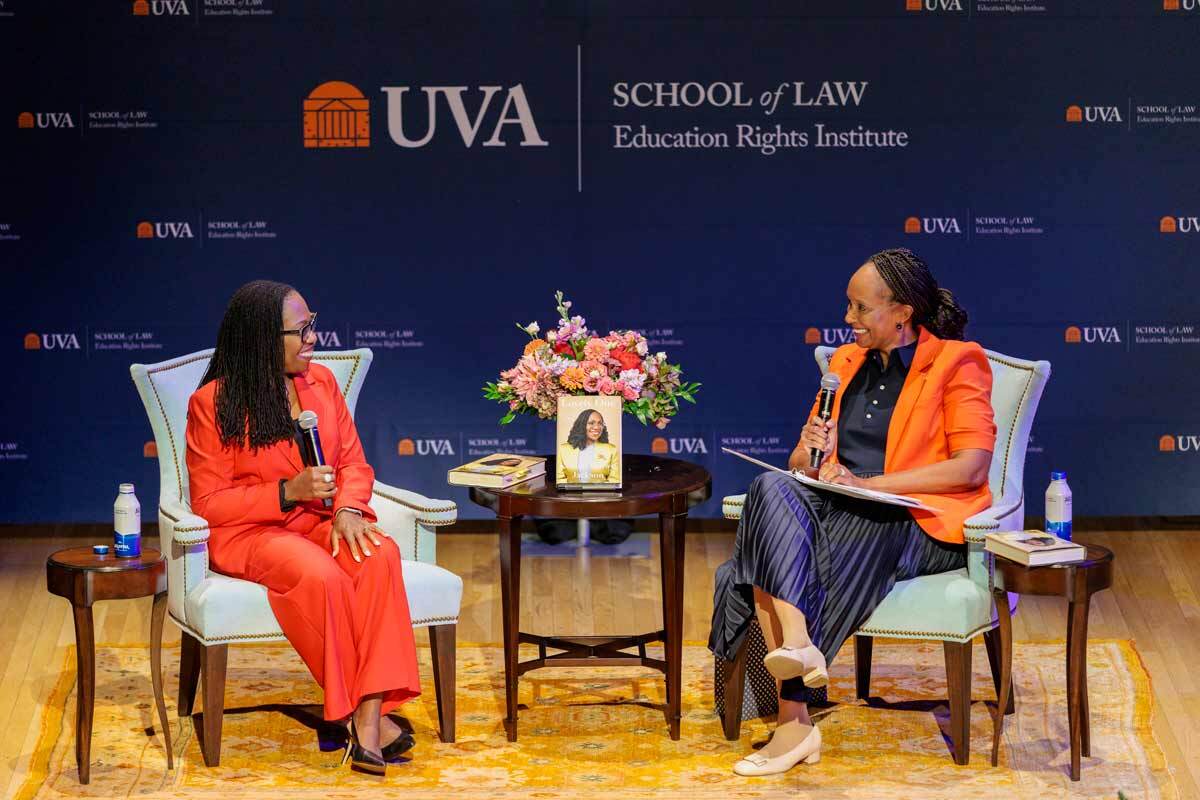
When Supreme Court Justice Ketanji Onyika Brown Jackson, the first Black woman to serve on the nation’s highest court, stepped onstage at the University of Virginia’s Old Cabell Hall last Thursday, loud applause and cheers erupted. Some, overcome with joy, covered their mouths with their hands. Others’ eyes filled with tears.
The justice, wearing a red pantsuit and an equally brilliant smile, waved to the crowd and, along with her close friend and law school classmate Kimberly Jenkins Robinson, graciously posed for photographs. Jackson then got down to business by animatedly discussing her New York Times best-selling memoir, “Lovely One,” that was released one year ago and almost three years after her appointment to the high court.
I sat in awe while watching and listening to Jackson. I was inspired by her every move, her every word and her supreme level of comfort as she described her upbringing. She explained how her family and a fierce work ethic equipped her to handle numerous headwinds before and after she graduated from Harvard Law School in 1996.
I started listening to Jackson’s audiobook last December while driving to Charlottesville from my home in Richmond to attend a Kwanzaa celebration at the Jefferson School African American Heritage Center. Rolling down I-64 West, I learned about Jackson’s early life and how her parents, Johnny and Ellery Brown, instilled in her the importance of education by listening, watching, thinking and doing.
Last week at UVA she recounted their stories.
“Both of my parents were public school teachers, and my mother really saw this as an opportunity to ensure that her daughter was fully and properly educated,” Jackson said. “She labeled everything in my room with the name of it, and would take me around the room pointing out the words.”
Her mother’s tactic worked. Jackson, 55, learned to read as a toddler, attended science camps for kids and participated in other activities that promoted early learning, she told the audience.
“And as a result, I think I really always valued education, and public education,” said Jackson.
Jackson’s words led me to think about the history of segregation and education in this country where Black and other marginalized people were denied equal access and opportunity for quality education. I also thought about Brown v. Board of Education and courageous men and women such as Thurgood Marshall, the lead litigator in the landmark ruling that led to segregated schools being declared unconstitutional. Marshall became the first Black person to become a U.S. Supreme Court Justice in 1967.
Jackson, one of the Supreme Court’s three liberal justices, avoided mentioning much of America’s current political climate or the spate of anti-DEI actions that have pummeled UVA and other colleges and universities in recent months. Jackson herself has been the target of venomous speech.
It was interesting to learn that, when introducing himself at Thursday’s program, UVA’s Interim President Paul Mahoney said he’d once clerked for the late Justice Thurgood Marshall.
Mahoney assumed his new role when UVA’s former president, Jim Ryan, resigned in June under pressure from the U.S. Department of Justice, which alleged the school had failed to fully dismantle its diversity, equity and inclusion programs, according to several news sources.
In July, Allie Pitchon, Charlottesville Tomorrow’s public institutions reporter, detailed how the federal government’s $64 million in grant cuts at UVA will impact Charlottesville and surrounding communities.
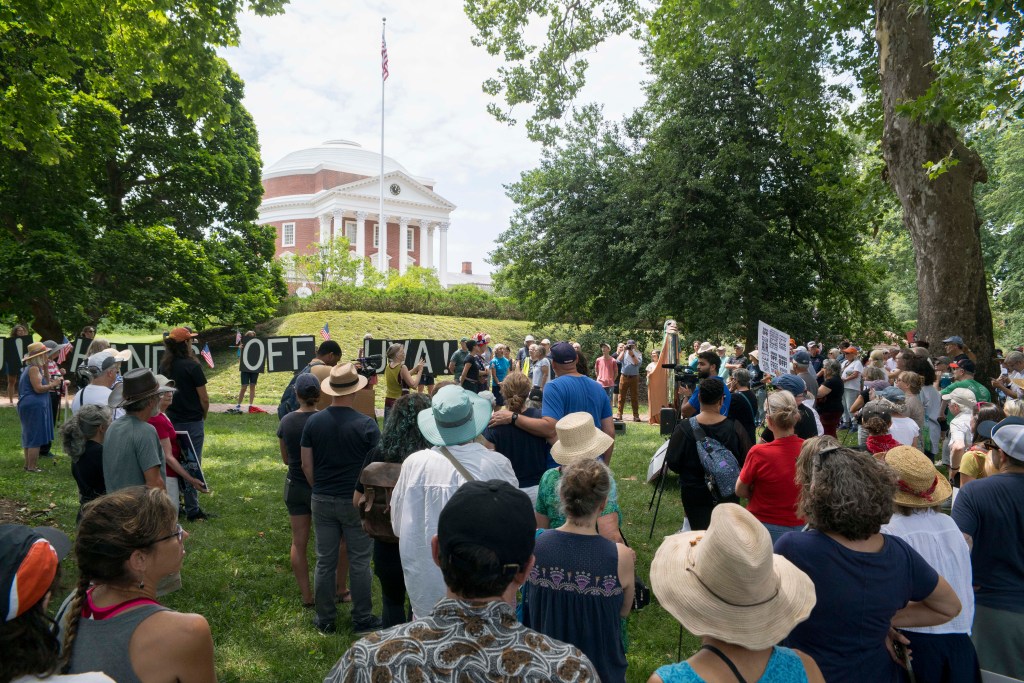
From July: The federal government cut $64 million in grants at UVA. Here’s what it means for the community
The cuts “disproportionately targeted grants tied to diversity, equity, inclusion, climate change and other topics deemed inconsistent with the Trump administration’s priorities. They would have supported local industry, farms, arts and more, leaving a gap that, according to some experts, could take years to repair,” Allie wrote.
UVA also recently discontinued Uplift@UVa, formerly known as Upward Bound, which helps high school students from families with lower incomes, and first-generation college students, prepare for their entry into higher education.
From August: Vinegar Hill: After nearly 60 years, UVA shutters college prep program for first-generation college students in Charlottesville
All of this left me wondering: How would Thurgood Marshall advise his former law clerk and the woman who now sits on the same court that he once occupied?
Interim President Mahoney provided a possible answer when remembering Marshall as his “personal hero” who had a gift for “teaching profound lessons in a homespun way.”
When discussing cases, Marshall would let his clerks debate issues without revealing his stance, Mahoney said. Once he decided, he’d signal the end of the debate. Occasionally, a clerk would persist, prompting Marshall to point to his commission on his wall, the document investing in him part of the judicial power of the United States.
“It eventually dawned on me that this was a deep lesson about our constitutional design to the lay person,” Mahoney said. “The constitution is about rights, freedom of speech, freedom from unreasonable searches and seizures and so on. But the Constitution also establishes a system of government, and in that system, the Supreme Court has the final say, not because the justices are smarter and wiser than the rest of us, although they are very smart and very wise, but because the Constitution assigns that role to them.
“I have no doubt that Justice Jackson has inspired her law clerks in similar ways, both personally and professionally,” Mahoney said.
I concur.
Thanks for reading,
Bonnie Newman Davis, Editor-at-Large

Event sponsored by