


Starting Monday, Aug. 11, the University of Virginia has a new interim president, but some students and faculty say the selection process was not inclusive enough.
UVA’s Board of Visitors (BOV) announced on Aug. 4 that it had selected Paul Mahoney to serve as the university’s interim president following Jim Ryan’s ouster under pressure from the Trump administration in late June and Jennifer “J.J.” Wagner Davis’s month-long stint as acting president.
Leaders from across UVA — including representatives from the American Association of University Professors and United Campus Workers union as well as members of Student Council and Jewish faculty — held a “Hands off Our University” press conference on Aug. 6 to protest the closed-door appointment of the new interim president and demand transparency in the search for UVA’s 10th president (video below).
“This appointment was not an example of shared governance, but the result of a closed and exclusionary process masquerading as inclusion,” UVA professor and United Campus Workers member Ian Mullins told attendees. “It was designed to pre-screen participants, silent dissent, and provide the appearance — not the reality — of democratic input.”
Mahoney — a current professor and former dean at UVA’s School of Law — will “have the full authority of the presidency” as interim president, according to an Aug. 4 UVA news release announcing his selection, and “will focus on keeping the university running smoothly while the search for a permanent president is underway.”
Decisions made at UVA often have significant ripple effects throughout the region because UVA is Charlottesville’s largest employer, according to the Virginia Department of Workforce Development and Advancement. It is also a significant healthcare provider in central Virginia through the UVA Health system, serving over 1 million patients each year. UVA is a major landowner and owns or occupies over 7,000 acres in Charlottesville and Albemarle County, according to the Scholar’s Lab at UVA. The university also operates a variety of community partnerships. Changes in UVA’s leadership — even temporary ones — can thus influence local nonprofits, schools and businesses, employment, construction projects, healthcare and more.
Jim Ryan resigned as University of Virginia president on June 27 after the Trump administration — which had criticized his support for diversity, equity and inclusion programs — threatened to withhold hundreds of millions in federal funding and continue investigating the school’s diversity initiatives if he did not step down, according to The New York Times. The move was widely condemned by Virginia lawmakers, UVA faculty and community members as unprecedented political interference in higher education and a threat to academic freedom.
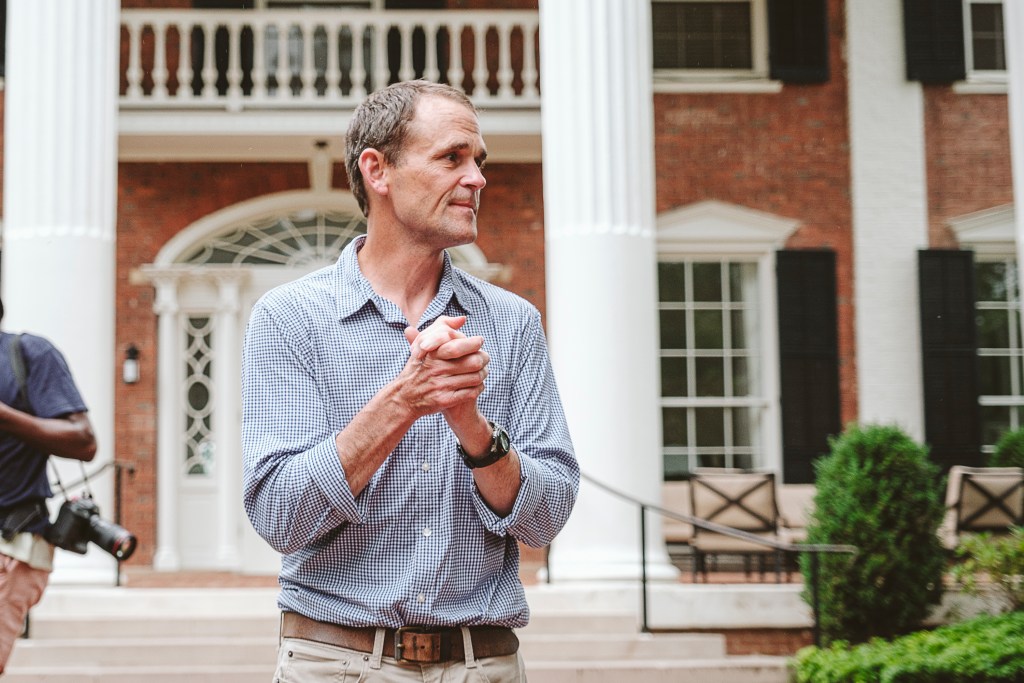
Mahoney has worked at UVA’s law school since 1990 and has held several chair and administrative positions at the university, according to the Aug. 4 release.
Before joining UVA, Mahoney worked at New York-based law firm Sullivan & Cromwell. He is a member of the American Academy of Arts and Sciences and the Council on Foreign Relations — an American think tank focused on international relations and U.S. foreign policy — and has previously been a member of the U.S. Securities and Exchange Commission’s Investor Advisory Committee.
Mahoney is married to Julia Delong Mahoney, who also is a UVA law professor.
“I thank the board for the trust they have placed in me, and for arriving at this decision in a manner consistent with the University’s core values of shared governance, academic freedom and student self-governance. As a longtime member of this community, I care deeply about UVA’s education, research and patient-care mission and look forward to continuing that important work together,” Mahoney said in UVA’s news release.

“We are confident that Paul’s longstanding connection to the university as a faculty member and dean of the law school, as well as his extensive achievements as a lawyer, professor and public servant, make him the right leader to guide this institution as the search for a 10th UVA president gets underway,” Board Rector Rachel Sheridan added in the same news release.
But UVA’s AAUP chapter expressed concern about the process for appointing Mahoney, which they say lacked sufficient transparency and faculty involvement.
“The AAUP has time-honored standards for the selection of presidents. It requires inclusion of elected faculty members in the process,” UVA professor and AAUP-UVA member Walt Heinecke told Charlottesville Tomorrow.
“There were no faculty involved in decision-making about this appointment,” he said. “Shared governance demands faculty involvement not only by way of input and listening sessions but also by way of participation in decision-making. The single Faculty Senate representative to the BOV is not a voting member.”
Heinecke added that only 13 faculty members were invited to a listening session during the search process. It is unclear who those faculty members are, he said, but they “were chosen by the search firm and were not necessarily elected by faculty and did not necessarily hold any leadership positions.” In other words, he said, “the search committee may have chosen the faculty they were willing to listen to.”
Heinecke added that the lack of public discussion from potential candidates also leaves faculty members unclear on Mahoney’s position on important ongoing issues within UVA, including his stance on “the implications of academic freedom in relation to the issues of the [U.S. Department of Justice] investigation into UVA and its settlement.”
Mahoney’s political affiliations
Mahoney has clerked for Judge Ralph K. Winter Jr. of the U.S. Court of Appeals for the Second Circuit — widely recognized as a top conservative judicial mind, according to The New York Times — as well as Justice Thurgood Marshall of the U.S. Supreme Court, a staunch liberal.
Since 2009, Mahoney has contributed at least $15,375 in political donations, all of them to the Republican party, according to data from the Virginia Public Access Project.
His contributions include $5,000 to John Adams’ 2017 campaign for attorney general of Virginia; $5,000 to Ed Gillespie’s 2017 bid for governor; $2,500 to a political action committee affiliated with Gillespie in 2016; several donations to Republican politician Rob Bell amounting to $2,625; and a $250 donation to Bryce Reeve’s 2019 campaign for the Virginia Senate.
The selection process
“In selecting the interim president, the board sought input from across the UVA community by establishing a website for nominations and hosting listening sessions with faculty, students, alumni and more,” UVA’s news release states. “Several themes emerged from these meetings, including the importance of identifying an interim president with an established track record as a leader or former leader within UVA, strong academic credentials, and the ability to forge connections and build trust across a wide array of stakeholders.”
The BOV convened for a closed session on Aug. 4 to approve Mahoney’s appointment. Before moving into closed session, the BOV held an open session meeting to explain their selection process to attendees.
The Board told meeting attendees that it had received nearly 600 nominations for 143 individuals for interim president, and held seven listening session groups from July 17 through July 23. These included sessions with UVA Health leaders, university vice presidents and the vice chancellor, staff leaders, academic deans, undergraduate student leaders, graduate student leaders and other faculty leaders.
Moving forward, members of the BOV said during Monday’s meeting that they hope to select a new permanent president for the university within the next four to six months.
A 28-person committee will lead the search, which will begin when they meet for the first time later this month or in early September, BOV members said during the meeting. They added that the committee is in the process of hiring an external firm to help with the search.
UVA spokesperson Bethanie Glover told Charlottesville Tomorrow that UVA plans to offer “numerous avenues” for community members to provide input to the search committee, including town halls and listening sessions with students, faculty, staff and other interested parties. These events will be scheduled at a future date.
The search committee also plans to launch a website at an undisclosed future date “to provide updates on the process and to solicit input on potential candidates and selection criteria from the entire UVA community,” she added.
Editor’s note: This article was updated on Aug. 20, 2025, to clarify the identity of the speakers at the Aug. 6 press conference at UVA.