

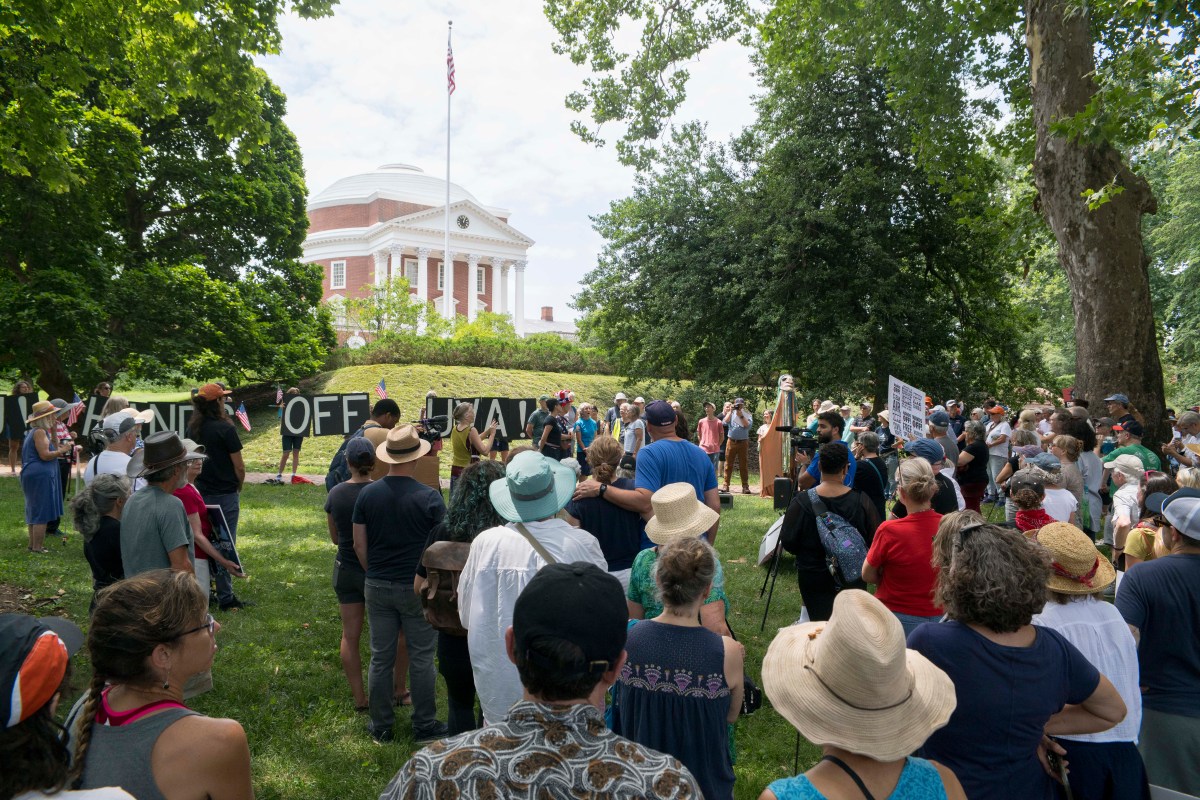
A list of terminated federal grants shared with Charlottesville Tomorrow through a public records request shows that the University of Virginia lost nearly $64 million across 45 previously approved projects.
The list also reveals that the cuts, made by the Trump administration, disproportionately targeted grants tied to diversity, equity, inclusion, climate change and other topics deemed inconsistent with the Trump administration’s priorities. They would have supported local industry, farms, arts and more, leaving a gap that, according to some experts, could take years to repair.
One grant that was cut — nearly $2.9 million from the U.S. Department of Agriculture — would have supported UVA research into a USDA initiative providing grants to farms that commit to implementing robust labor standards for both U.S.-based as well as foreign-born workers hired under H2A visas. Five Virginia farms, including Bellair Farm in Charlottesville, were recipients of these grants.
The goal of the research was to ensure a stable labor supply to American farms to the benefit of both farmers and the workers they hire, UVA Professor and Senior Associate Dean for Academic Affairs Jennifer Bair told Charlottesville Tomorrow.
More broadly, the aim was to strengthen local and national agricultural supply chains to help prevent a looming crisis in the nation’s food supply spurred by labor shortages and other factors (including extreme weather events, dwindling water supplies, aging supply chains and policy-driven cuts to key nutrition programs). As the Trump administration imposes sweeping tariffs on agricultural imports, experts warn that the labor shortages on their own – which are largely due to restrictive immigration policies – could be enough to collapse the US food industry, according to The Guardian.
The USDA — then under the Biden administration — had approached Bair and her team about submitting a proposal to conduct the study after being impressed by their previous research mapping where migrant workers are coming from, where they’re being employed and the impact they have on local labor markets, she said. But when the grant was cancelled, they were told it was due to “DEI” reasons, Bair added.
The only reason her team could imagine for the “DEI” label, she said, was that the program they were asked to research involved both American and foreign workers — despite the USDA initiative itself not being cancelled.
But the issue of persistent unmet labor demand for domestic farmers remains, weakening national food supply chains.
“Farmworkers are vital partners in efforts to strengthen the sustainability of domestic food supply chains, and many farms are worried about recruiting and retaining the workers they need,” Bair said. “Cancelling our research on the Farm Labor Stabilization Program means that we’re losing an opportunity to study an issue that is of great importance to many agricultural employers across the country.”
Another cut grant — $20 million from the Environmental Protection Agency — would have supported workforce development, environmental resilience and clean energy efforts in Southwest Virginia, while also investing in Charlottesville’s increasingly lucrative clean energy industry.
A portion of the grant would have supported local research into renewable energy and energy storage, helping “develop a pipeline of professionals” from local universities and colleges, including UVA, into the industry, UVA Professor of Public Policy and Politics Christine Mahoney said. It also would have funded local renewable energy workforce development through James Madison University’s Center for the Advancement of Sustainable Energy, she added.
Charlottesville is home to a growing cluster of clean energy companies – the highest per-capita concentration in the region. They include 16 companies that currently make up the Charlottesville Renewable Energy Alliance (CvilleREA), employing more than 500 people. Together, they have around $20 billion worth of clean energy projects in operation and development, board chair Chris Meyer told Charlottesville Tomorrow.
But recent sweeping federal cuts to renewable energy tax incentives through President Donald Trump’s so-called “Big Beautiful” tax bill have thrown a wrench into the local industry’s growth.
“Rather than growing 20% a year, we’re going to be growing at 5% a year,” Meyer said. “And there’s still executive orders coming out making things more difficult.”
Combined with these federal cuts, the UVA grant termination is “bad for the renewable energy sector, which is bad for high-paying jobs in our region,” Mahoney said. “There’s these layers of bad impact, and then they’re magnified by other administration policies.”

Funds have also recently been withdrawn from local projects that support shifts to renewable energy, including the Charlottesville Office of Sustainability’s Climate Adaptation and Resiliency Planning Project and an environmental justice government-to-government grant with Albemarle County. Trump’s tax bill also eliminates residential solar tax credits after 2025, which will devastate local solar companies, Meyer added, particularly local residential commercial installers that will likely see their sales halved once the tax credit is eliminated.
“There’s, across the board, attempts to defund climate work at every level, whether it was research focused on clean energy technology, whether it was supporting individual households and businesses and their efforts to reduce their own greenhouse gas emissions, or whether it was grants to cities like Charlottesville or Albemarle County that were working to solve real problems in our community while advancing climate work simultaneously,” Susan Kruse, executive director of climate, energy and environmental justice nonprofit Community Climate Collaborative (C3), told Charlottesville Tomorrow.
“All of these things have been on the chopping block one after another since the Trump administration took office,” she said. “It’s really disheartening to a lot of the community to see these things going in the wrong direction when we felt like we were just just really starting to move the needle on climate work right here in Charlottesville.”
“It’s a loss of immediate dollars, of advancing job preparedness programs and workforce development in renewable energy,” Mahoney added, while also being “really damaging to an industry that was really growing and thriving in our area.”
Beyond local industry: other impacts of lost funding
Beyond long-term impacts on local industry, immediate effects of the funding cuts are also being felt deeply by the Charlottesville community. Two of the funding cuts, for instance, include financing for Charlottesville’s annual film festival and Virginia Humanities’ Virginia Folklife Program.

The local program aims to keep important cultural traditions alive by funding yearlong apprenticeships under master practitioners of a cultural trade.
“The people, the community, the interactions — all create the tradition of expression that we work to preserve,” Lamont Pearley, an applied folklorist and founder of The African American Folklorist magazine, told Charlottesville Tomorrow. “To eliminate it, it’ll be a huge loss of tremendous proportions.”
Pearley participated in the apprenticeship program for a year starting in 2023. He studied the fundamentals of Piedmont-style blues under Corey Harris, a celebrated local musician, MacArthur Fellowship (also known as a “genius grant”) awardee and current PhD candidate at UVA’s music department.
“There are significant things that he and I may not have been afforded or able to do if we were not part of the program,” Pearley said.
This year, Virginia Humanities was able to spend part of the grant for the apprenticeship program before it was cut and pay for the rest with private financing, Director Matthew Gibson told Charlottesville Tomorrow.
“However, if these types of grants are terminated in the future, then that is really where the pain will be felt because this will be a huge hit to supporting the preservation of people’s stories and artistic traditions here in Virginia,” he added.
Earlier this year Virginia Humanities was impacted by other federal cuts at the National Endowment for the Humanities which caused Virginia Humanities to reduce its workforce, move its offices to a new location and award fewer fellowships and grants to community scholars.
Another cut grant at UVA gave undergraduate students access to academic and professional development opportunities they might not have otherwise had — while encouraging them to engage with and give back to the Charlottesville community.
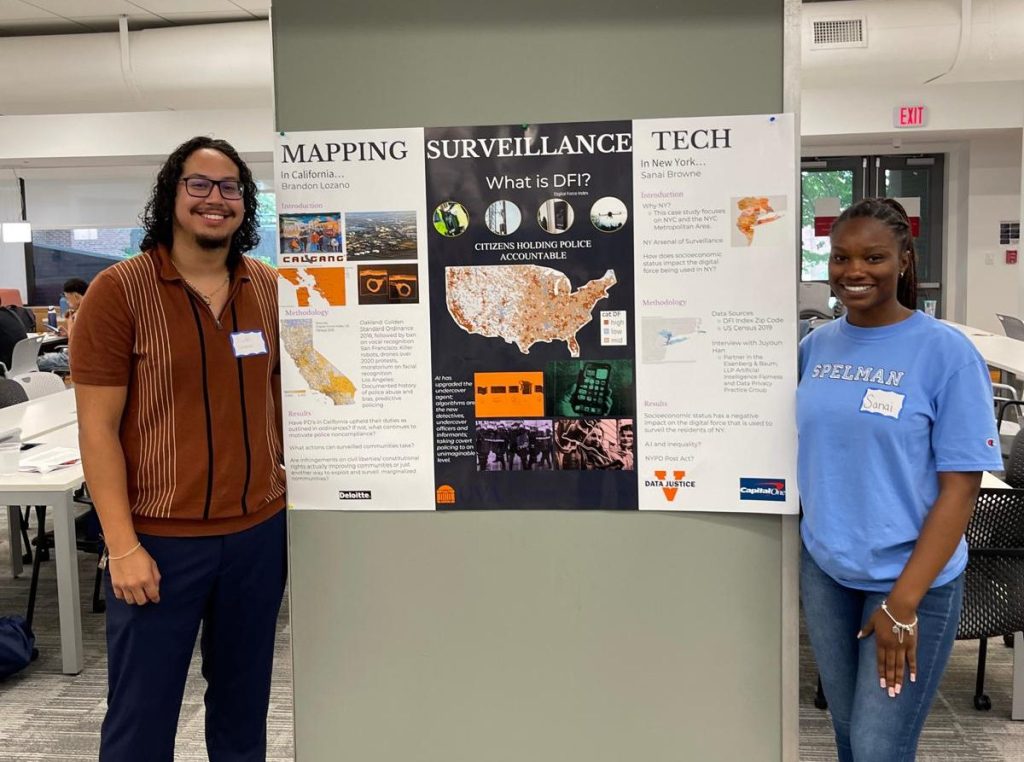
It funded the Research Experience in Data Science (REDS) program, a 10-week residential summer initiative at UVA for undergraduate students from across the country. Previously known as the Data Justice Academy, the program offered students from historically under-represented backgrounds a chance to build data science skills through mentored research.
“I credit it a lot for my confidence in myself, for not having impostor syndrome and learning how to seek out opportunities that – if I hadn’t been in the program – I wouldn’t have ever known to even look for,” said Brandon Lozano, who participated in the program in 2023.
Cole Whittington, who participated in 2022 and 2023, agreed. He credits the program entirely for his decision to major in data science and pursue a master’s degree in the field at UVA this fall.
Students researched racial and socioeconomic biases in AI police surveillance, systemic racial health disparities, privacy concerns within AI and more. They also engaged directly with the Charlottesville community, Srimann Ramachandruni, a 2023 participant, said.
He and others taught data science to local youth through Star Hill Pathways, a free college and career pipeline program that encourages underrepresented students in Charlottesville and Albemarle County public schools to pursue STEM and data science careers. Siri Russell, UVA’s associate dean for community and government partnerships, credited Data Justice Academy participants with helping make the program a success in an August 2023 UVA news release.
“It really was more than just a research experience, but an experience to engage with and give back to the Charlottesville community,” Ramachandruni told Charlottesville Tomorrow.
The academy’s name and scope were changed before the 2025 application cycle to comply with new policies targeting DEI efforts at UVA and other universities. But its funding was still cut shortly before acceptance letters for the 2025 program were set to go out to students in May.
Cutting funding that makes academia more accessible “interrupts the production of early career scientists from underrepresented groups” — including those who could return to Charlottesville and re-invest in the community as professors — a UVA professor whose grant was recently cut said. They spoke on condition of anonymity, citing fears of career reprisal.
But the cuts also legitimize “the rhetoric that assumes that people of color and women in higher education are now undeserving of some of the positions they hold or some of the grants and accolades they get, and that does impact the community,” they said.
“Already, students of color just walking around the streets are being harassed and being doxxed online,” they added, noting one of their Black students was recently harassed downtown with the word ‘DEI.’ “DEI is now being not only used to dismantle our university, in my opinion, but it’s also being used as a coded slur.”
“I worry for Black students and Black community members in general,” they added. “…trying to erase black history, trying to erase the long-term social movement to desegregate male-dominated fields — all that’s affecting the community. Culturally, this will have an impact.”
Leela Prasad contributed the data visualization in this article.