

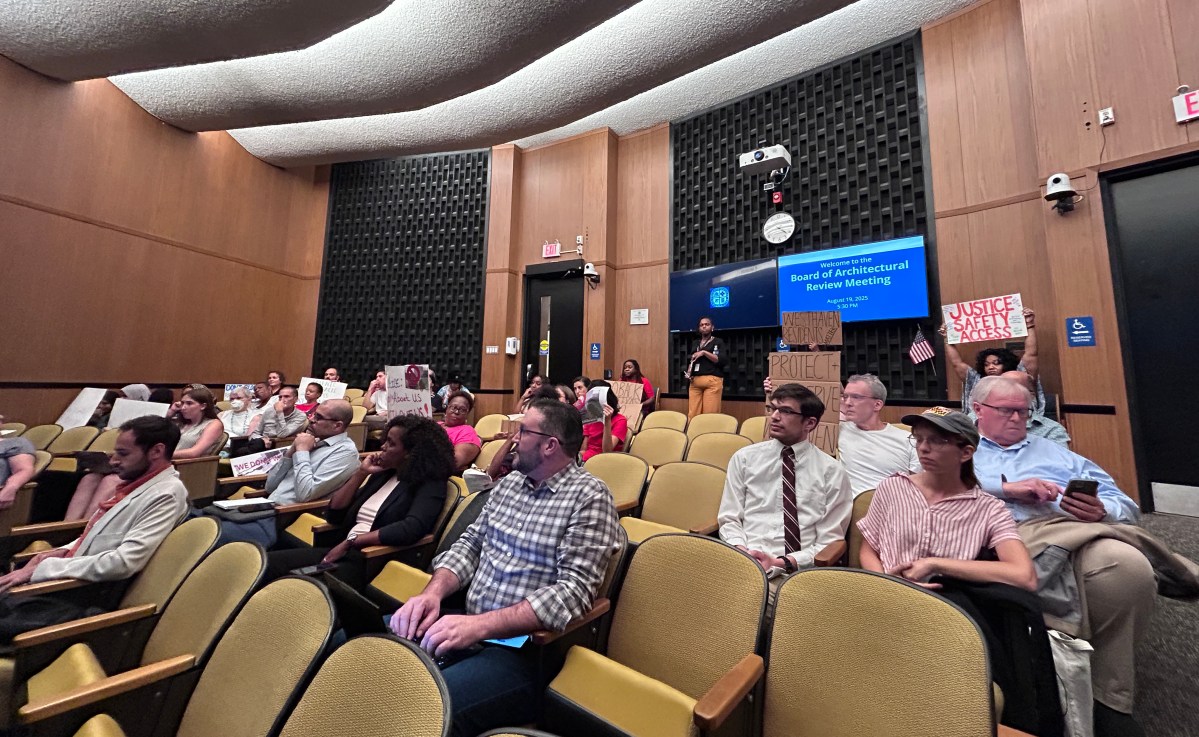
Members of Charlottesville’s Board of Architectural Review remarked how they could hardly believe how many people sat in the City Council chambers Tuesday evening, waiting for their meeting to begin.
About 40 people had taken a seat, some holding handmade signs that said “Go Back to Texas,” “Don’t Block Us In — No Prison Walls,” “Justice, No Crumbs” and “Nothing About Us, Without Us.” “Protect and Preserve Westhaven,” said another. One woman held up a sign with an image of a project the BAR was set to discuss — an 11-story luxury student housing building — with a bold red “no” symbol over it.
A Texas developer specializing in student housing, has proposed the project for 835, 843 and 847 West Main St., three adjacent parcels of land currently occupied by a parking lot and a small building that most recently held a cupcake shop. The company’s presentation to the BAR touted its $6 billion in assets across 11 states (the presentation begins on page 196 of the meeting agenda packet).
Its building would tower over Westhaven, Charlottesville’s oldest and largest public housing community, located in the historically Black 10th and Page neighborhood. Over the past week, Westhaven and 10th and Page residents — and hundreds of community members who signed a petition supporting them — have made it clear that they oppose the project for a variety of reasons.
They say the building, which is intended for UVA students, is too big, that it will block sunlight from the community, and that it will cut their community off from the rest of Charlottesville.
More than anything, they say the project ignores historical context and is disrespectful to the Westhaven residents who have long shouldered the devastation wrought by the city’s “urban renewal” efforts in the 1960s, and who, for the past three years, have been leading the redevelopment of their own community.
“Families were uprooted, culture was erased, and communities were left carrying the wounds for generations. The proposal before you is not just about design. It is about whether the city repeats the mistakes of the past, or chooses a different path.” Latricia Giles told the BAR Tuesday night. Giles is executive director of the Public Housing Association of Residents (PHAR), a nonprofit group that advocates for residents of Charlottesville’s public housing communities.
Beyond this specific development, the situation has also sparked fervent conversation among community members and city officials about who gets to design a community’s future — and some consequences of the city’s new zoning code.
Residents and advocates warn against repeating mistakes of the past
Westhaven residents had just finished their own site plan when LV Collective shared its plans for the building.
During two different public comment periods Tuesday, Aug. 19, 24 community members stood up to voice their opposition to the project, to demand that the developer listen to the community, and to encourage the BAR to use its power to keep the building from literally overshadowing Westhaven and the broader 10th and Page community it is part of. Others held up their signs to show support.
“I don’t know that we’ve had 24 people come and talk to us” in an entire year, remarked Jeff Werner, the city’s historic preservation and design planner and staff liaison to the BAR. He called it “refreshing.”
Near the end of the meeting, BAR member Dave Timmerman asked Andreé Sahakian, a senior development manager with LV Collective who gave the firm’s presentation that night, if he’d ever encountered this level of community feedback in any of the other cities LV has built in — Tempe, Arizona; Ann Arbor, Michigan; Austin, Texas.
Sahakian said he hadn’t.
“We’re proud of that,” Timmerman replied.
So many people showed up in part because the meeting might have been their only chance to voice their opinions on the proposed project in an official city forum. Under the current zoning ordinance, LV Collective can build the project “by right,” which means once it has a certificate of appropriateness from the BAR — an approval that the city requires when exterior changes are made to buildings in locally designated historic districts — it can proceed. By-right development projects abide by the parameters laid out in the zoning ordinance and do not require special permission from the Planning Commission, or City Council, to be built. That is, unless the BAR’s decision is appealed to City Council.
The thing about architecture is that you can’t divorce it from the legacies of enslavement, Jim Crow, urban renewal and gentrification.
—Wendy Gao, community organizer with the Public Housing Association of Residents
Throughout the evening, Westhaven and 10th and Page residents and their supporters — included among them Planning Commissioner Betsy Roettger and City Councilor Michael Payne, both speaking for themselves and not as city representatives — urged the BAR and LV Collective to consider not just the proposed building design in front of them, but history.
“The thing about architecture is that you can’t divorce it from the legacies of enslavement, Jim Crow, urban renewal and gentrification,” said Wendy Gao, a community organizer with the Public Housing Association of Residents (PHAR).
Westhaven is Charlottesville’s oldest public housing community, built in 1964 — the same year white city leaders razed Vinegar Hill. Vinegar Hill was a thriving majority-Black community located at the west end of the present-day Downtown Mall. It covered an area that stretched roughly from Bodo’s on Preston Avenue to the Staples Parking Lot near West Main St., from the Jefferson School City Center on 4th St. NW to Mudhouse on the Downtown Mall.

The city razed all of the homes and businesses in that district in the name of “urban renewal.” Many of the families whose homes were destroyed were sent to live at Westhaven, carved out of a hill below West Main St., in the majority-Black 10th and Page neighborhood.
For generations, its residents have endured such injustices as having their children zoned to a school three miles away, instead of the one in their own neighborhood, and living in homes that haven’t been updated in decades.
“Charlottesville already scarred Westhaven once when it destroyed Vinegar Hill in the name of progress,” Giles told the BAR Tuesday night.
About a decade ago, the Charlottesville Redevelopment and Housing Authority — the quasi-governmental body that was responsible for the razing of Vinegar Hill in the 1960s and that currently owns and manages all of the city’s public housing communities — started seriously looking at redeveloping its oldest communities. PHAR insisted not just on having a say, but that residents lead the process.
“We, the residents, are very interested because we stand to gain or lose the most in this process,” they wrote in a 2016 document called the “Resident Directed Positive Vision for Redevelopment.”
The city and CRHA agreed, and residents got to work.
“We’ve been attempting to show that we honor families,” former Mayor Nikuyah Walker said at the groundbreaking ceremony for South First St. redevelopment in March 2021. “No matter how little money you make, no matter if you live in these spaces for generations, we are saying that we understand that there’s an obligation to you.”
Despite being the oldest CRHA community, Westhaven wasn’t first on the list for redevelopment. Its residents waited patiently as residents of Crescent Halls, South First Street, and Sixth Street communities chose every detail from how many units their community would have to the materials used to build it.
When Westhaven residents got the green light to start their planning, about three years ago, they started meeting twice a month, two hours at a time, to envision their community’s future.
Their plan includes three different recreation areas, one for younger kids, one for older kids, and one for everyone; a picnic pavilion; a dog park; an accessible walking loop; and a new road named after Holly Edwards, who worked at the Westhaven Nursing Clinic and advocated on the behalf of public housing residents, including during her time on City Council, before she passed away in 2017.
It also includes 250 units, 100 more than Westhaven currently has. Westhaven residents finished their site plan in March 2025.
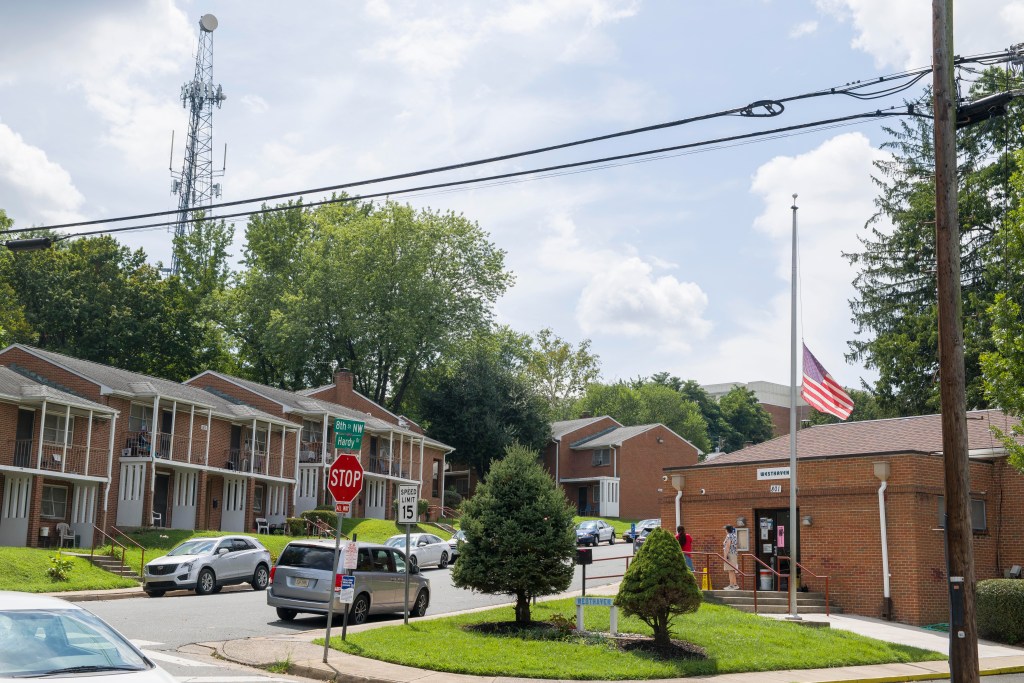
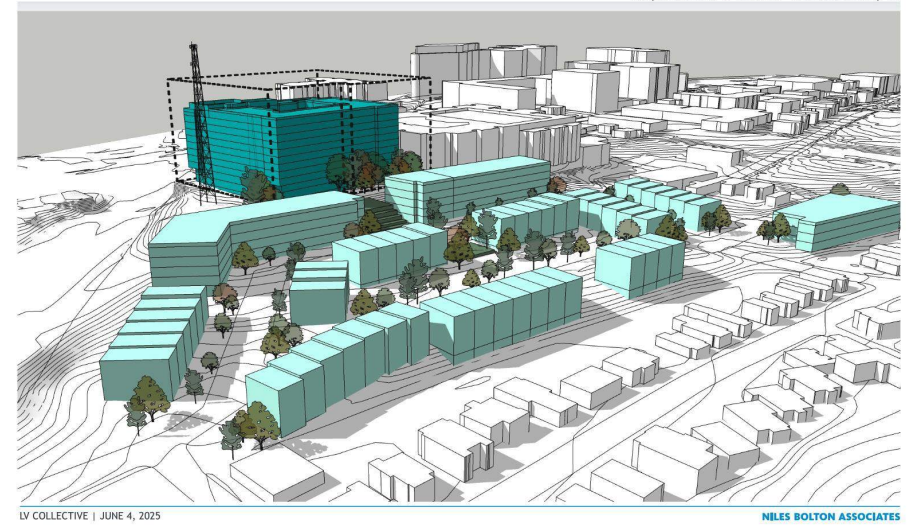
Later in the spring, they heard about LV Collective’s preliminary plan for the 11-story building on West Main. The lot backs up onto Westhaven, but sits about two stories above it. That means it would feel taller than 11 stories, some city residents attending the BAR meeting pointed out.
Tuesday night, LV Collective’s Sahakian talked about the community engagement the company was encouraged to do when they first met with city staff in March.
He said that after initial meetings with city staff, they met with CRHA in May, with neighborhood representatives in June, and then held a community meeting at the Jefferson School African American Heritage Center in July.
Residents said LV Collective did reach out to them, but they weren’t happy with how.
“This is very disrespectful, the way it went down,” Joy Johnson, PHAR co-founder and chair who has lived in Westhaven since 1983 and who has received national recognition for her advocacy, told the BAR Tuesday night.
“Our residents worked very hard to come up with a design of what their neighborhood could look like. And once we presented it, to come to a meeting and [hear from the developer] ‘this is what we’re going to put up,’ is very, very disrespectful.”
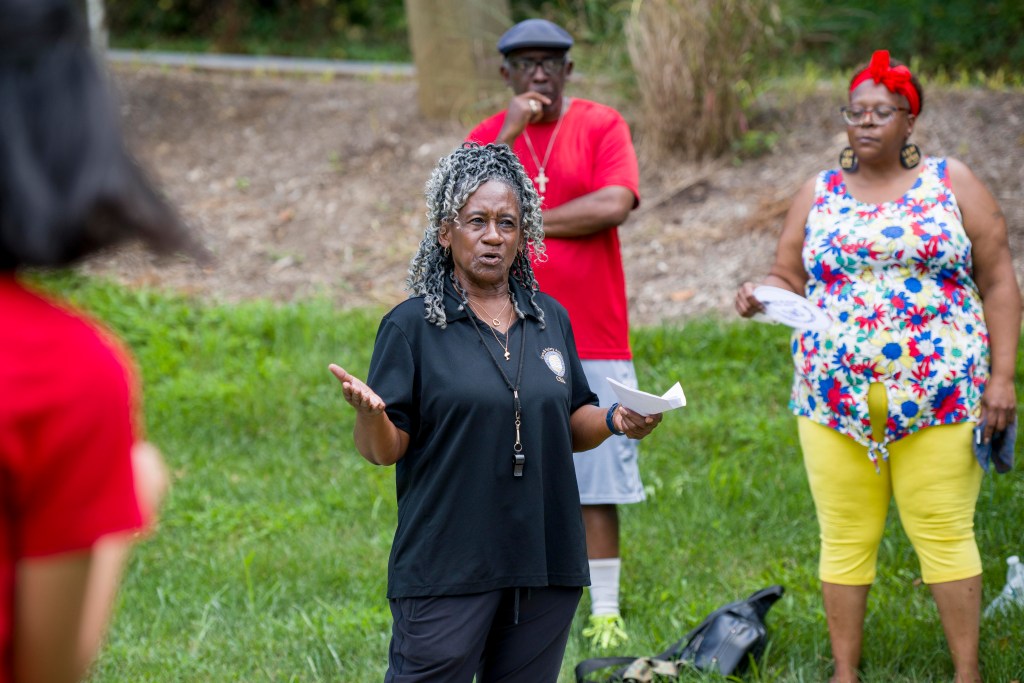
Johnson and Vizena Howard, president of the 10th and Page Neighborhood Association and a City Schools crossing guard, said during an August 13 press conference at Jenkins Park that the July community meeting only happened because neighborhood leaders insisted.
“It was very disrespectful when they called me to schedule a meeting with just me and my assistant, versus trying to have a meeting with everybody together,” Howard said.
During Tuesday’s BAR meeting, Sahakian said that city staff suggested LV Collective reach out to certain individuals, so that’s what they did.
Residents also raised several issues with the building’s exterior design — which is the only thing the BAR has authority over.
For one, they say, the building is too tall. Eleven stories is even taller than another nearby luxury student housing building that residents detest.
“It’s bad enough that we have The Standard,” said Westhaven resident Ivana Key. The Standard is six stories high; at 11, the proposed building would be nearly double that.
“I don’t approve of this building,” Earl Hicks, a lifelong Charlottesville resident and longtime Westhaven resident, told the BAR. “I look up and imagine an 11-story building standing in our backyard, depriving us not only of sunshine, but locking us in.”
“It blocks everything,” said Janet Nordenson, who has lived at Westhaven for 31 years. “I just don’t like it, and I think it’s ugly, to tell you the truth.” She called the building “a big distraction from what the residents want.”
Westhaven residents would have a view of the proposed building’s backside — the HVAC equipment, delivery service, garage doors, and the parking deck. PHAR executive director Giles and Roettger both pointed this out.
Giles called it “the backside of someone else’s convenience pushed into our front yards.”
“This is not repair,” she continued. “This is not healing. This is exclusion dressed as development.”
Knowing that the BAR can only ask for changes regarding the building’s exterior and can’t outright block the build’s construction, Westhaven and 10th and Page residents and their supporters asked for things the BAR can control, such as a reduction in height and more setbacks to make the proposed building feel less imposing for Westhaven and 10th and Page.
Westhaven residents are particularly concerned about their access to West Main St., and the memory walk they’ve planned for it.
Currently, Westhaven residents do not have direct access to West Main St., despite being so close to it. They have to walk over to 10th St., or go around 8th St. and under the railroad trestle, to get to it.
So, Westhaven residents have planned for a walkway that would give them access to West Main. Along it would be interpretive historical signage telling the story of Westhaven — and Vinegar Hill.
Residents want the walkway to be wide and well-lit in order to be safe, welcoming and practical. That’s not what they say they see on the narrow access path included in LV Collective’s site plan.
“Young people from Westhaven feel very unwelcome in that corridor,” said Zyahna Bryant, a lifelong Charlottesville resident who grew up in the 10th and Page neighborhood. And that’s not a new issue, she said.
Bryant mentioned a 1975 riot that occurred at the Safeway grocery store on West Main St. when a white security officer followed a group of Black youth from Westhaven around the store, suspecting them of shoplifting. Black folks from the neighborhood said that kind of harassment had become a regular occurrence, according to a Charlottesville-Albemarle Tribune article about the incident. Fed up, 200 people showed up at the store to voice their displeasure, and some threw bottles, bricks and stones at the police officers on the scene, smashing windows of the store.
“It’s a prime example of what neighbors are fearing,” Bryant told the BAR. “I think it’s important to think about how space will be navigated. What it means, what it looks like, when students who have wealth, access, privilege, are put into a neighborhood where folks do not have as much wealth, access, and privilege.”
Her concerns about security were echoed by Eugene Ryang, a landscape architect who has been consulting with both Westhaven residents and with LV Collective.
“Security for white students, for white people, usually means violence for Black, brown and low-income people,” he said.
Ryang also commented on how difficult it has been to work on the memory walk.
“We joined this project to be an advocate for Westhaven,” said Ryang, principal with local environmental design firm Waterstreet Studio. “We really haven’t had the position to be an advocate, because we were basically given the path on the edges of the building and told to — and I risk saying this, we’re probably going to lose our job with LV Collective — just put the green lipstick on the pig, so to speak. We haven’t been able to work on a promenade or a connection. We were just given a space to plant.”
Later in the meeting, Sahakian said Ryang’s summary of what the landscape architects were told to do was “a bit mischaracterized.”
City Councilor Michael Payne joined the chorus of voices cautioning the city against repeating history.
“We all know the history of urban renewal,” Payne said to the BAR during the public comment period. “There’s a lot of lessons to take from it. One of the lessons I take is the importance of humility in city decision-makers and the danger of arrogance for decision-makers who will never have to live with the consequences of the decisions they’ve made.”
He lamented the fact that West Main St. is no longer a place where a historic Black community, working-class white residents, and UVA students interact, but is instead “a quarter of, by and for UVA students.”
“What if the city had been as intentional about creating a Black business district as we were in creating the Downtown Mall? What if we thought beyond either/or decision-making, and beyond the free market, delivering what is going to create historic justice?” he continued.
“Are we really confident that we’re not able to repeat the mistakes of urban renewal? Is this time different? Is this time the decision-makers who didn’t grow up in Westhaven, don’t live in Westhaven, don’t socialize in Westhaven — do they know better this time?”
Proposed development illustrates challenges with new — and legally contested — zoning ordinance
After every community member who wanted to speak gave their comments, it was the BAR’s turn.
In general, the BAR echoed community members’ requests for a reduction in height, so that the building would better suit the neighborhood. They also asked for more setbacks and for a more attractive design, one with materials that won’t degrade.
“If there’s going to have to be a building here, make it pretty. Make it an attractive building,” said BAR member James Zehmer.
“We’re committed to it,” Sahakian said, insisting that so far, the designs are mostly just conceptual.
The BAR went a step further, though, and implored the company to listen to Westhaven and 10th and Page residents. By law, they can’t require it, but they strongly encouraged it.
“An olive branch would be to adjust your design to try to hear them and address their concerns,” said Zehmer.
“Listen to these people,” said BAR member Timmerman. “They’re here telling you a real thing about a place where they live. Listen to these people. Respond. We would like to see a response that is aligned with what our people are telling you.”
In a statement emailed to Charlottesville Tomorrow Friday afternoon, Sahakian said LV Collective is listening.
“Following feedback from the Board of Architectural Review and Westhaven residents, we are evaluating building height, setbacks and materials,” he wrote. “We are also actively reaching out to Westhaven stakeholders to meet so we can thoughtfully design the memory walk and promenade. Our goal is to foster an open, ongoing dialogue and ensure this development reflects both the needs of the market and the priorities of the neighborhood.”
The fact that LV Collective’s proposal meets the requirements laid out in the city’s zoning code and can therefore be constructed by-right is at the root of the issue, some city officials said during the meeting.
Planning Commissioner Roettger was the first to acknowledge that the city is responsible for putting Westhaven residents in this position in the first place.
“Some of my issue with this whole thing is really the city’s fault,” she said during the public comment period. She believes the site “should have been looked at more sensitively” when the city was developing its new zoning ordinance. City Council adopted the ordinance unanimously in December 2023, and it went into effect in February 2024.
The overall goal of the ordinance was to address the city’s affordable housing crisis by “upzoning” the entire city, meaning, making it easier to build more housing throughout the city. City staff worked on it for seven years, and hired an outside consultant to help not just with writing code itself, but with the community engagement efforts to get more community members involved.
The ordinance was controversial, but ultimately, the Planning Commission recommended that City Council adopt it. And the night City Council voted on it, more community members voiced support for it, than opposition to it.
But the situation that was before the BAR on Tuesday reveals how parts of that ordinance are proving problematic, officials said Tuesday night.

“When we developed the zoning, there was a strong push to maintain special use permits around 10th and Page, Fifeville, Rose Hill, Kindlewood, Westhaven, and other public housing sites,” Payne said Tuesday, speaking as himself and not for the Council. These are all traditionally neighborhoods with families with lower incomes that have been particularly vulnerable to the pressures of gentrification.
That happened for some areas of the city, including parts of 10th and Page and Rose Hill, along Preston Ave., and Fifeville, along Cherry Ave. In those areas, developers who want to construct a building over three (but no more than seven) stories tall must apply for a Special Exemption Permit (SEP) from City Council.
The intention wasn’t to prevent tall buildings entirely, Payne said Tuesday, but “to give residents a voice” in what’s built in their neighborhood. (Read more about Core Neighborhood Corridors on page 103 of the ordinance.) If a developer applied for an SEP, City Council could require the developer to involve the neighborhood in its plans by way of a community benefits agreement, Payne said. A community benefits agreement is a contract signed by a community and a developer who agree to work together on a development project. So far, there is one example in Charlottesville, the 501 Cherry Ave. project in Fifeville, though it was developed under the old zoning code.
But, only two places in the city received that Core Neighborhood Corridor designation on the zoning map. Most of 10th and Page, including Westhaven, was left out. That’s how Westhaven ended up next to some of the highest density allowed in the city.
That decision, Payne said Tuesday, was made “by planners who thought they knew better.” He recalled a meeting with said planners, remembering that “the exact words in one of the meetings was, ‘this area of West Main is an area where large student apartments want to go.'”
BAR member Cheri Lewis also expressed regret that the ordinance had been passed without more consideration for how it might affect Westhaven and 10th and Page.
This is not the first time the ordinance has been questioned.
A few residents who own property in some of the city’s neighborhoods with the highest property values, sued the city in January 2024 in an attempt to stop the implementation of the code. They allege that the city broke the law when it submitted just the transportation chapter, instead of its entire comprehensive plan, to the Virginia Department of Transportation. Therefore, the comprehensive plan is invalid, they argue, and if the comprehensive plan is invalid, so is the zoning ordinance based on it.
The city argues that it did not break the law, and that the ordinance is valid.
The suit is ongoing, and a Charlottesville Circuit Court judge is expected to issue an opinion in the case on Friday, Aug. 22.
Already, Charlottesville City Council has sent the ordinance back to the Planning Commission for re-adoption, in case the judge sides with the plaintiffs.
In any case, Payne and Lewis urged everyone who wants to avoid this kind of situation in the future to write to the Planning Commission and to City Council, to show up to their meetings and ask them to change the zoning ordinance.
“This zoning is not appropriate next to Westhaven,” Lewis suggested residents tell them.
“Consider it done,” said Gloria Beard, a longtime 10th and Page resident, called out from the back of the room.
“When we go to Council, will you stand with us?” Joy Johnson asked Lewis.
“Yes,” Lewis replied without hesitation.
As of Friday afternoon, city staff had not received a request from the Planning Commission or City Council to look into any changes to the zoning ordinance prompted by Tuesday night’s BAR meeting, city spokesperson Afton Schneider said in an email to Charlottesville Tomorrow.
And if they do, a change wouldn’t be immediate.
Any proposed amendments to the ordinance would first need to be analyzed by city staff, recommended to the Planning Commission, and then brought to City Council for a final decision. There would be multiple opportunities for public comment along the way, Schneider said.
LV Collective will have the chance to present a revised plan to the BAR at a later date. At that time, the BAR could choose to issue the certificate of appropriateness that LV Collective needs to move on to the construction and building permitting phase. If the BAR chooses not to award a certificate of appropriateness, LV Collective could appeal the decision, and that appeal would go to City Council.
If the BAR does issue the certificate, Westhaven residents could appeal.
Editor’s note: Article updated on Sept. 2, 2025, to clarify that the proposed student housing building has not yet been named by the developer.