


Thursday evening, about 30 people gathered in a meeting room at the Tonsler Park Recreation Center for the monthly Fifeville Neighborhood Association meeting.
As people settled into the folding chairs set up around the room, they greeted their neighbors, trading stories and sympathetic looks as they discussed the ongoing flu season — how it’s hit their families, their workplaces, their schools. A few marveled at how they’ve been able to avoid it so far.
Their conversations waned as the meeting began — they didn’t want to miss the news they’d gathered to hear.
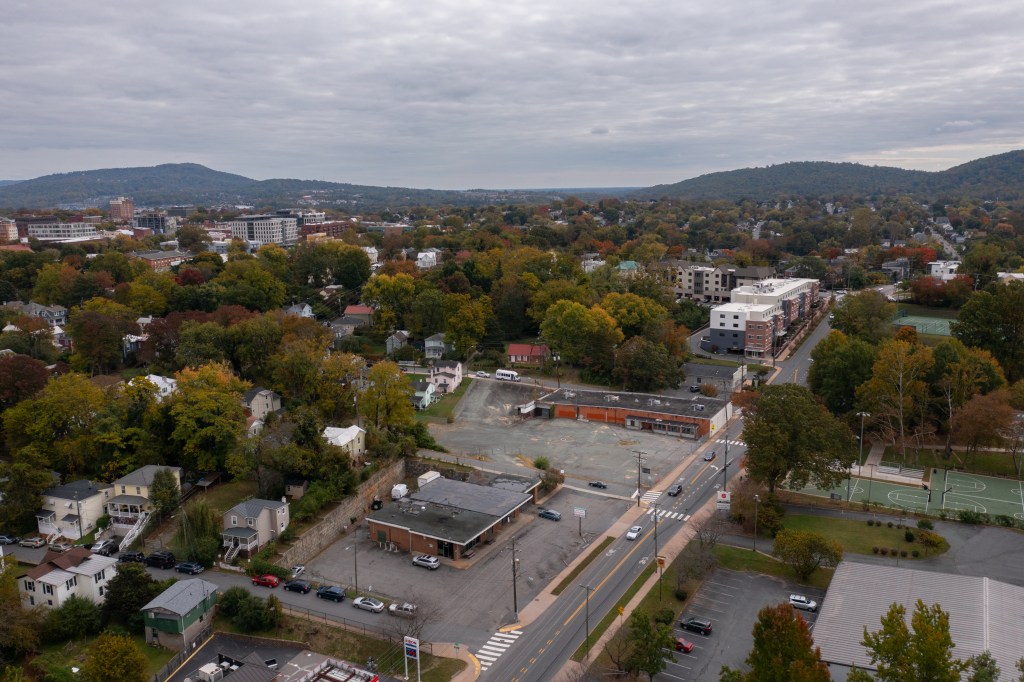
For the past couple of years, the Fifeville Neighborhood Association has been involved in an unusual endeavor: working with a local real estate developer on a project they hope will bring a youth-centered nonprofit, more low-cost housing and a grocery store to the neighborhood. The neighborhood association has been involved in everything from building design to helping select the materials the buildings would be made out of. It would be located at 501 Cherry Avenue in Fifeville, the former site of Estes IGA and Kim’s Market, across the street from Tonsler Park.
The overall estimated cost for the project is between $45 million and $50 million.
There was some uncertainty about the project last fall. Several key steps, such as some funding and a grocery store operator, were needed for the project to move forward. At the time, the project’s developers, Woodard Properties and Piedmont Housing Alliance (PHA), explained the difficult situation: The longer it takes to find the funding, the more likely it is that construction costs go up, increasing the overall cost of the project. Sunshine Mathon, executive director of PHA, described it as a “chicken and egg” situation.
And while there are now two potential grocery store operators, uncertainty remains: The grocery store — and possibly the entire project — can’t happen until the developers and its community partner figure out a $3 million funding shortfall.
The neighborhood association plans on asking Charlottesville City Council, which has already allocated $3.1 million for the housing component of the project, for $1.5 million to help make the grocery store a reality. It hopes to apply for grant money for and fundraise the other half.
It wasn’t what the neighborhood wanted to hear, or what the developers wanted to tell them.
Finding ‘the most natural and strong fit for the community’
The disappointing news was tempered with a more exciting announcement: The neighborhood association officially recommended that Woodard Properties and PHA consider a newly formed local food co-op to operate the grocery store.
The neighborhood association’s recommendation is based on a community survey the group conducted in the fall. The purpose of the survey was to understand what the broader community, but particularly Fifeville residents, would want from a grocery store if one were to open on Cherry Ave. The response was clear: Residents want a grocery store with healthy, affordable options, and they want the person or entity operating it to have deep roots in the community.
That’s exactly what a locally-run co-op grocery wants to bring to the table, co-op steering committee member Kisha Bwenge told attendees at the Feb. 13 meeting.
Co-op grocery stores — “co-op” is short for “cooperative” — are community-owned stores. Anyone can shop there, but only member-owners of the store are involved in the decision making and receive a cut of the store’s profits.
Reading from a prepared statement on her phone, Bwenge told the audience what the steering committee envisions.
The multiracial, multigenerational steering committee of about 25 people formed specifically to explore the possibility of operating a grocery store at 501 Cherry Ave. It had its first meeting just one month ago, in January 2025.
The group wants to bring healthy, affordable food to their community while also supporting local farmers, Bwenge said. It would hire local people to work at the store and partner with local farmers to stock its meat and produce sections. It would join the National Co+Op Grocers organization, which would essentially give the co-op the purchasing power of a chain, therefore enabling the group to stock familiar products.
Bwenge talked about how the group hopes to leverage government-subsidized programs for low-income families such as the Supplemental Nutrition Assistance Program (SNAP) and the Special Supplemental Nutrition Program for Women, Infants, and Children (WIC) by working with Virginia FreshMatch, a program that doubles the value of every dollar SNAP and WIC recipients use to buy fresh and frozen produce.
She spoke excitedly about the discount vegetable table at the Friendly City Co-Op in Harrisonburg, about an hour west of Charlottesville. When the audience chuckled warmly at her excitement, she explained: It helps farmers sell excess in-season produce while offering it to the community for 99 cents per pound.
The steering committee hopes it could bring something like that to Fifeville.
If it seems like things are moving fast, that’s because they are, Bwenge said. “It has been a busy month as we’re turning this aspiration into action.”
The group is already working with the Food Co-Op Initiative, a national nonprofit that guides people all across the country through the co-op startup process. It is also working with the Central Virginia Small Business Development Center on its financial projections and business plan.
This process usually takes months, if not years, Bwenge said.
So why is the co-op steering committee moving so quickly?
Woodard Properties has requested an official business plan by Friday, Feb. 28 — just two weeks away.
The co-op’s business plan and financial model goes in for review with the Small Business Development Center this week, Bwenge said. After that, the group can submit it to the neighborhood association and the developers.
When Bwenge finished her presentation, everyone in the room clapped.
“Well done. Well done,” someone said as the room buzzed with excitement.
While the Fifeville Neighborhood Association has recommended the local co-op as the operator for the potential grocery store on Cherry Ave., it’s not a foregone conclusion.
The developers have to consider the recommendation per a memorandum of understanding (MOU) that they signed with the neighborhood association in 2023, but the developers are not required to accept the recommendation.
The neighborhood association believes that “a locally based co-op is the most natural and strong fit for the community,” Sarah Malpass, vice president of the Fifeville Neighborhood Association, told the audience Thursday evening.
But, given the project’s uncertainties and various moving parts, the neighborhood association has another recommendation — Good Foods Grocery, a natural foods store in Richmond that is looking to expand.
“We also feel that it’s going to be important to maintain the ability to pivot; to see how all these factors work together,” Malpass said. “So, we think it’s possible for Good Foods to be a good community fit, too.”
Good Foods Grocery opened in 1985, and since 2023, it has been owned by Commonwealth Autism, a nonprofit autism advocacy organization that also runs a workforce training program for adults with autism at the store.
Tyler Hart, President and CEO of Commonwealth Autism and Good Foods Grocery, attended the January Fifeville Neighborhood Association meeting to give his pitch. He talked about the store’s training program for adults with autism and explained a bit more about how the store operates, stocking foods from many Richmond-area producers. Hart said a new store in Charlottesville would probably be similar to Rebecca’s Natural Foods, but with a much smaller supplements section, and possibly a kitchen. (Rebecca’s Natural Foods, which was located in the Barracks Road Shopping Center, closed in September 2023.)
The local co-op steering committee and Good Foods are two of four organizations the neighborhood association was considering for the possible grocery store.
A big part of what the project partners will be looking for in the business plans submitted on the 28th is feasibility — will the co-op, or Good Foods, be able to make it work in that space?
The project partners are going into these conversations knowing that even with solid business plans, they’ll need a subsidy to make it work.
That wasn’t news to most people in the room. Back in September, Mathon told residents that the grocery store probably wouldn’t happen without it.
The current estimated cost of the grocery store space is $3 million for a “white box,” Chris Virgilio, director of real estate development for Woodard Properties, explained at the meeting Thursday evening. That cost includes the exterior walls and infrastructure such as electrical, sewer, and plumbing. It does not include interior fixtures or operating costs, which the grocery store operator will have to cover upon moving in.
That’s a lot of money for these potential operators, Malpass said.
That’s why the neighborhood association is asking the City of Charlottesville for help.
The Fifeville Neighborhood Association plans to send a letter to Charlottesville City Council asking for $1.5 million — half of the estimated grocery store’s $3 million construction cost.
The group is applying for grants and considering a capital campaign for the rest, Malpass said on Thursday. That way, any potential operator can focus on its own fundraising efforts for operating costs.
“With all the uncertainty at the federal level, cities are going to have to think very judiciously about where they put their funding,” Malpass said.
Still, the neighborhood association is hopeful. “We’ve done our research, and we believe in the ask,” Malpass said. “But it’s going to take community voices to get it through.”
The City has been supportive of the project so far, in part because of its commitment to trying to bring a grocery store back to Fifeville. The Cherry Avenue Small Area Plan, an official city plan for the neighborhood’s future adopted in 2021, outlined how important this is to the neighborhood.
When the 501 Cherry Ave. plan was up before the Planning Commission, then-chair Lyle Solla-Yates said the neighborhood’s desire for the grocery store was something that really stuck out to him about the Cherry Avenue Small Area Plan.
The Planning Commission reviewed the plan, urging for more affordable housing in addition to the grocery and the nonprofit spaces, before recommending it to City Council in August 2023.
“We’ve got to find a way to make it happen,” then-Mayor Lloyd Snook said of the project at the time.
City Council unanimously approved the project plan in September 2023, and later committed $3.1 million to the affordable housing component of the development.
Multiple City Councilors and City Manager Sam Sanders have since praised the project, particularly the agreement Woodard Properties, PHA and the Fifeville Neighborhood Association signed promising to work together.
When the City approved the plan, it also signed a proffer agreement with Woodard Properties. That contract says of the grocery store space, “The space will be reserved exclusively for a grocery store until the issuance of any certificate of occupancy for the Project.”
And that’s where things are getting tricky. The developers can’t get the certificate of occupancy without the money to build the grocery store first.
Finding the funds
Disappointment lingered in the air during Thursday’s meeting when the conversation turned to the funding gap.
The meeting attendees murmured sounds of approval and seemed ready to email the City Council and encourage their neighbors to do the same.
But they had questions.
Folks in the room were confused why the entire project — which is expected to cost between $45 and $50 million — seemed to be stalled out on the $3 million needed for the grocery store.
“If we don’t have somebody in place to take financial responsibility for the grocery store space before we break ground, we can’t break ground because we don’t have the funding in place to pay for the construction, essentially,” said Woodard Properties’ Virgilio.
“But that’s such a small portion of the entire project,” said Lisa Draine, who is involved with the co-op steering committee.
“I don’t know what to say,” Virgilio said. “You can’t build a house unless you have money to put down,” he said. “You need to have money to put down at the bank in order to finance the construction.”

The Music Resource Center (MRC), which plans to occupy some of the commercial space in the project, has the funding for its piece, and PHA has most of its funding, Virgilio said. The grocery store is the last remaining piece, and he assured the room that Woodard Properties, PHA, and the Fifeville Neighborhood Association were actively looking for subsidies for it.
The conversation went on for a few more minutes until Malpass suggested that the neighborhood association revisit the text of the MOU with Woodard Properties and PHA to clarify this for themselves before presenting it to the neighborhood again.
The confusion wasn’t resolved in the meeting, but Virgilio explained the predicament in an email to Charlottesville Tomorrow Friday afternoon.
When Woodard Properties and PHA reduced the project’s scale to address the neighborhood’s concerns about building size, those modifications, coupled with construction costs, drove the price of the commercial spaces — including the one for the grocery store — beyond market-rate rent, he said.
When a developer proposes to build something, whether it’s homes or commercial space, the firm usually applies for a bank loan. That loan creates debt for the developer, who then pays back that loan by selling or renting those spaces.
High construction costs translate to a larger loan, which in turn translates to more debt and higher rents (or sale prices).
Therefore, the only way to reduce the cost of the $3 million build-out of the commercial grocery space and lease it at or below the market rate, is through subsidy, Virgilio wrote.
The MOU team, particularly PHA, is “actively pursuing” subsidy options, he added.
But the mixed-use design that the developers committed to in both the MOU and its contract with the City, requires the grocery space to be built alongside the MRC and affordable housing, Virgilio said. That’s why “securing funding for it is essential before construction can begin.”
That’s the part that’s hard for residents, who seem to have grown more passionate about the possibility of a grocery store as the conversations around it have progressed, to hear.
“We’re working with the neighborhood to make the grocery selection as soon as practical, so that we don’t delay bringing the other needed community benefits to fruition,” Virgilio wrote.
That’s why the developers are requesting business plans and financial models from both the co-op steering committee and Good Foods Grocery so quickly.
“Any organization providing financial support — whether through a bank loan, philanthropy, or government subsidy — will need to review the grocery store operator’s business plan and financial model to ensure its viability,” Virgilio wrote.
“Additionally, recent changes at the federal level have introduced some funding uncertainty, and we are actively assessing any potential impacts on the project.”
Finding a way forward
Community members are still wondering: What if it doesn’t work out?
Following the submission of business plans from the co-op steering committee and Good Foods Grocery, Woodard Properties, PHA, and the Fifeville Neighborhood Association will have a conversion, Malpass said on Thursday.
The project partners did not say whether they had chosen a deadline for their decision, or what comes next if neither business plan seems viable.
When a community member asked about a contingency plan during a September meeting, Woodard Properties CEO Anthony Woodard said at that time there was no contingency plan. It is unclear if that is still the case.
If Woodard chooses either the co-op or Good Foods for the space, the neighborhood association will work on raising the $3 million for construction, and the selected organization will focus on raising money for fixtures, furnishings, stock, and operating costs.
No matter what, the co-op steering committee plans to forge ahead. If it doesn’t work out at 501 Cherry Ave., the group will look into other options, said Deanna McDonald, a health education coach and consultant who has partnered with the Fifeville Neighborhood Association on the project’s various community engagement efforts and is now assisting the co-op steering committee.
The closing of Reid Super-Save Mart at 600 Preston Ave. earlier this year brings new urgency to the project, McDonald said near the end of the meeting Thursday evening. Many folks in Fifeville, as well as surrounding neighborhoods such as 10th and Page, Rose Hill and Ridge Street, are now without a nearby grocery store, McDonald pointed out.
“It has essentially become a food desert.”
“This is a community problem,” she said. “So we’ll be looking for everyone to come support the co-op.”
Editor’s note: This story was updated on Dec. 9, 2025 to correct a reference to the money the City of Charlottesville has allocated to the 501 Cherry Ave. project.