

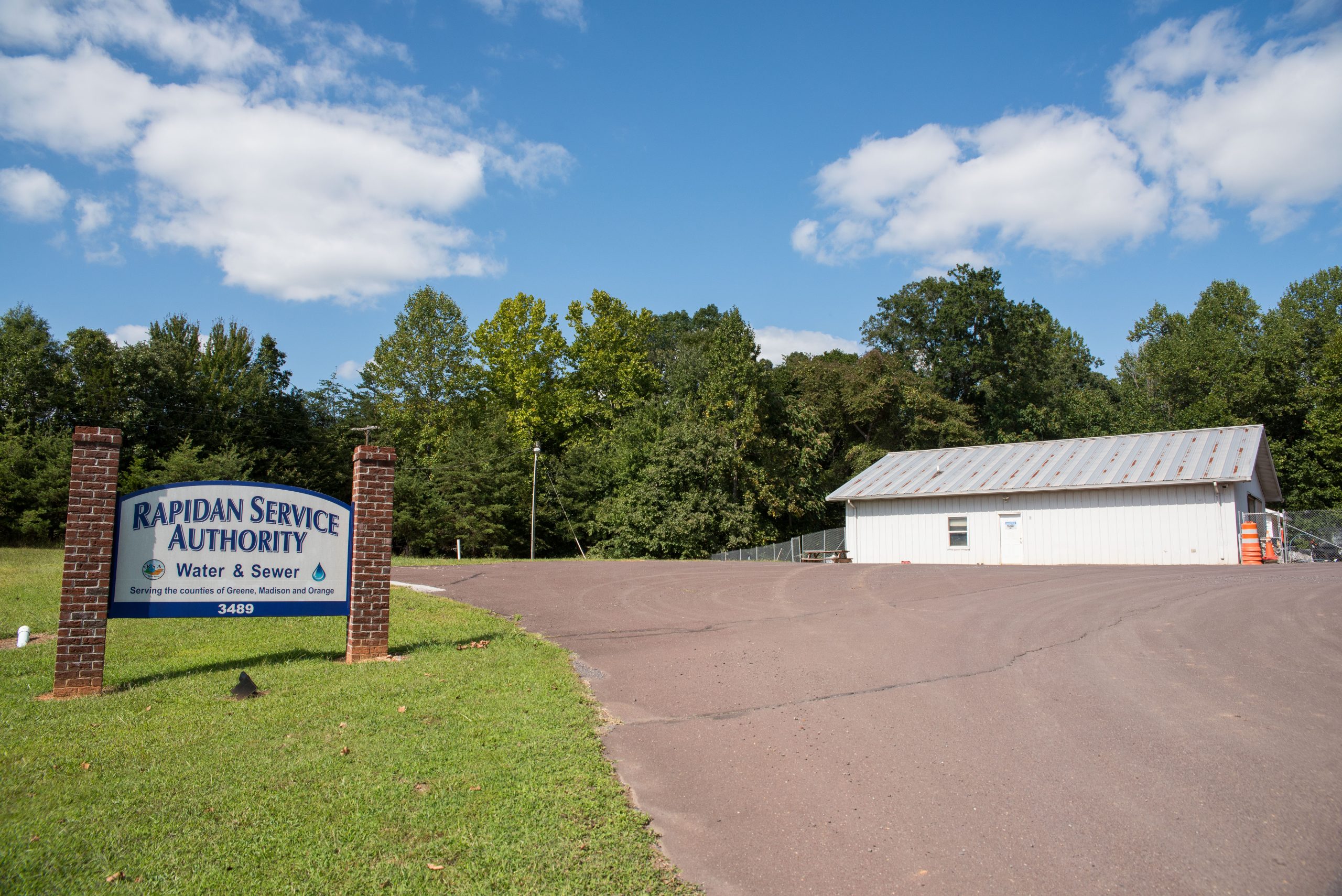
Following the August crisis in eastern Orange County that left residents without water for a week, a Rapidan Service Authority board member said that changes could be coming to the local treatment plant.
It’s not clear yet what those changes will be or when they will happen, but they will likely cost residents an increase in their water bills.
“The technologies are not inexpensive, and so rates probably need to move in order to accomplish some of these things,” said RSA Board Member Ted Voorhees during a call with Charlottesville Tomorrow in early October. Voorhees is also the Orange County administrator.
Before rates can be increased, RSA board members must finish reviewing the Virginia Department of Health’s 60-page investigative report, released Sept. 25, which says the contamination was caused by a “catastrophic” failure of three water pumps at the authority’s water treatment plant. The health department (VDH) also issued a separate notice of violations accusing RSA of failing to recognize and investigate the pump failure as soon as it started receiving complaints of strange odors in the water.
Tim Clemons, RSA’s general manager, did not respond to Charlottesville Tomorrow’s did not respond to Charlottesville Tomorrow’s request for comment on the VDH investigation and alleged violations.
The water crisis started Aug. 20 when one of the treatment plant’s three water pumps failed. The next day, RSA started receiving reports of a petroleum-like odor in the water from customers. The authority issued a “do-not-use” water advisory, and told customers not to interact with the water except to flush toilets.
The advisory was changed to “do-not-drink” on Aug. 24, the same day two more water pumps (generally used as backups) failed. Roughly 13,000 RSA customers could not use their water for several days. On Aug. 27, after tests showed the water met federal and state standards, the water authority lifted the advisory.
There’s already a phased design in place for expanding that plant capacity. Should some of those features have already been in place, then this incident probably would not have happened, as they would have had the capability of addressing the issue more quickly or differently than they did with the limited capabilities of the plant they have.
— Mark Johnson, chair of the Rapidan Service Authority Board and an Orange County Supervisor
According to the VDH investigation findings, the failed pumps burned mineral oil that leaked into the water, creating the odor and strange taste for some of RSA’s customers.
Along with releasing the findings of its investigation, VDH issued a notice accusing RSA of several violations, including failing to alert its administrators about the pump failures. While RSA knew about the failure of the first pump on Aug. 20, the authority did not inform VDH until Sept. 4.
“The idea that the RSA staff kept something from the state… it’s convenient, after the fact, to point at that,” said Voorhees.
It’s true that RSA didn’t immediately inform VDH when the pump failed, but it wasn’t because they were hiding it, Voorhees said. It was because the pumps fail relatively often, he said, but never caused the kind of odor, color and taste issues seen in August.
“It’s just not something you would necessarily assume, that it’s had this catastrophic failure,” he said. “It’s something that no one had ever seen, so it didn’t cross anyone’s mind.”
Usually, when a pump fails, the staff only gets a notification that it stopped working, not the reason or the overall state of the pump. When that happens, a backup pump typically is turned on and the broken ones are sent to a repair shop, Voorhees said.
RSA called VDH after they heard back from the repair shop on Sept. 4. That was the first time they realized the pumps could have been an issue, Voorhees said.
“They knew that they had recently performed electrical work, so they knew something was going on, but they didn’t link that to a catastrophic pump failure. They just thought, well, these things just aren’t working, not that they’ve blown up and leaked oil,” he told Charlottesville Tomorrow.
RSA has 60 days to come up with a plan to address the concerns outlined in VDH’s notice. It is expected to include plans to address not only the factors that led to the water crisis and improve water monitoring, but also an ongoing issue with excessive disinfectant by-products in their water — an issue that the Wilderness Water Treatment Plant has had since early 2023, according to publicly available data of water-related violations compiled by VDH.
“The RSA Board is currently reviewing the VDH report and allowing our attorney and staff time to digest it and prepare a response,” Mark Johnson, chair of the RSA Board and an Orange County Supervisor, said in an email to Charlottesville Tomorrow.
Johnson said there is no set date for when the Board and its attorney will reach some kind of decision about how to address the violations the state alleged took place.
“The RSA Board will meet on the 16th, and it’s likely I will know more after that meeting,” he said.
The discussions about upgrading the Wilderness Water Treatment Plant predate the August crisis. The plant became active in 1997, according to VDH data. Since then, the area’s population has had significant growth. The facility was also designed when there were fewer regulatory requirements.
However, considering the plant’s tight footprint, RSA needs to buy more land to make improvements and additions to the treatment process, said Voorhees.
“There’s already a phased design in place for expanding that plant capacity,” he said. “Should some of those features have already been in place, then this incident probably would not have happened, as they would have had the capability of addressing the issue more quickly or differently than they did with the limited capabilities of the plant they have.”
Tim Clemons, RSA’s general manager, told Charlottesville Tomorrow in September that the plant was considering adding a granular activated carbon treatment process to its toolkit. This treatment is supposed to help with any future odor or taste outbreaks, as well as the issue of having too much disinfectant byproduct in the water.
Some officials believe that the solution is to build a new water treatment plant altogether.
“Long term, we need a new and better and improved plant,” Supervisor Crystal Hale said at the Orange County Board meeting on Sept. 10.
Hale did not respond to Charlottesville Tomorrow’s requests for more details about the ideas she presented at the board meeting.
Rapidan Service Authority canceled its regularly scheduled October meeting. The next scheduled public meeting is Nov. 21, in Orange, Virginia. As of publishing, the location has not been announced on its website.