

After reading Charlottesville Tomorrow’s August report about the sale of Cavalier Crossing and eventual displacement of the hundreds of residents there, Albemarle County Supervisor Mike Pruitt said he felt “hot under the collar.”
Pruitt represents the Scottsville Magisterial District of Albemarle County, where Cavalier Crossing is located. He was angry that hundreds of his constituents would not have their leases renewed to make way for renovations, and that the report was the first he heard about it.
“This one slipped through my radar, which is deeply upsetting to me,” Pruitt told Charlottesville Tomorrow.
He wanted to help. So, about a month after the Charlottesville Tomorrow article ran, the Board of Supervisors is taking action. Supervisors are poised to allocate $170,000 in unused American Rescue Plan Act funds, which is taxpayer money, to the Albemarle County Emergency Relief Program (ACERP) to help displaced residents. This is on top of the $260,000 the county had already allocated to ACERP for the 2024-25 fiscal year.
The plan is for about $100,000 of that to be earmarked for security deposit assistance, marking a change in the program’s parameters. Previously, ACERP could be used only to help people catch up on rent and utility bills.
Pruitt isn’t sure when the funding will be available, but he hopes it will be soon.
“I realize that’s frustrating, but we’re working fast,” he said. “This is the fastest I’ve ever seen a government move on a thing.”
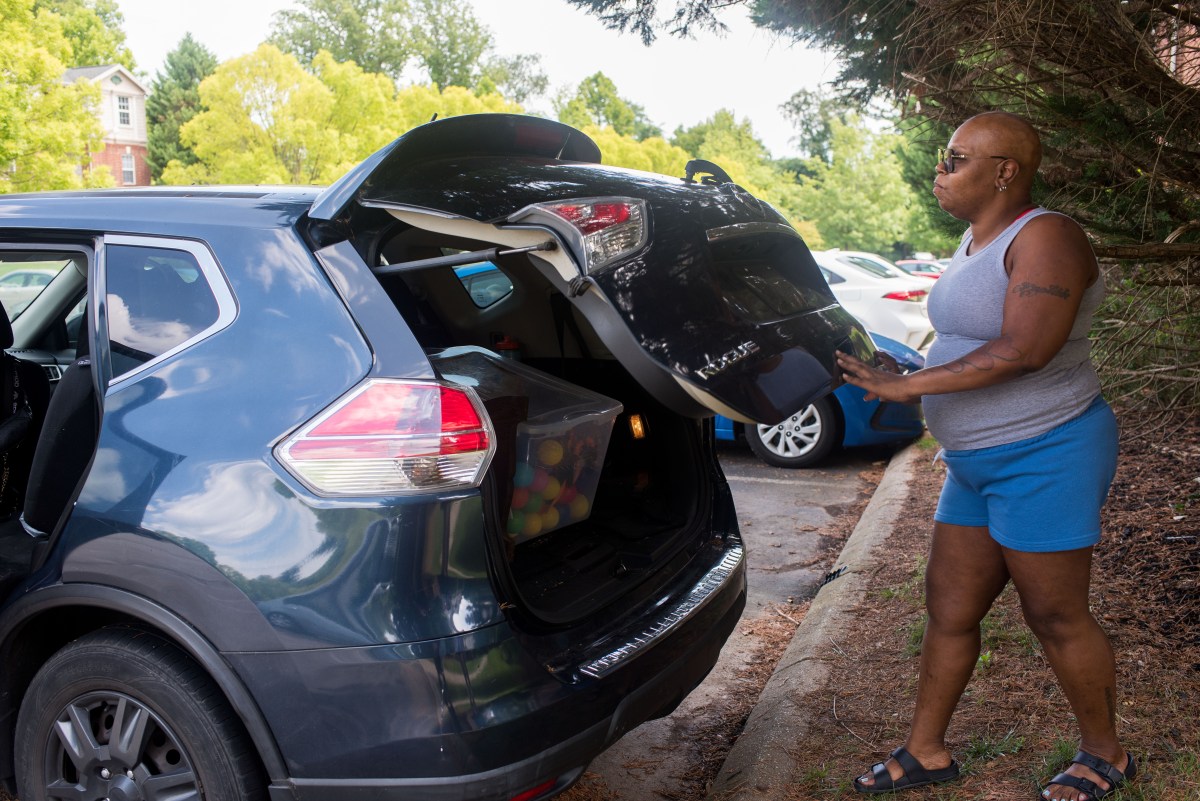
It wasn’t fast enough for all residents — some already had to move over the summer. For instance, Takiesha Stewart, a mother of nine, left her apartment at Cavalier Crossing when her lease ended in July. She was undergoing chemotherapy for breast cancer at the time, she said.
She couldn’t find a place big enough for her family that she could afford by July, she said.
“Where else are you going to find a place?” she asked the last week of July. “It’s just so unfair. They don’t see us as people.”
Stewart moved in with her oldest daughter for a few months before eventually finding a new place.
Stewart was one of more than a dozen Cavalier Crossing residents who spoke with Charlottesville Tomorrow this summer upon hearing the complex had been sold and that they’d have to move out in the coming year. Many expressed anxiety over finding new housing.
The county is doing its damned best to build more units — public perception to the contrary, I’m sure.
—Albemarle County Supervisor Mike Pruitt
Local reaction pushes developer to offer more support
Dwight Dunton, founder and CEO of Bonaventure Multifamily Income Trust , the company that now owns Cavalier Crossing, said he understands that the renovations are displacing residents. But the company has no choice.
Currently, residents of Cavalier Crossing pay about $560 per month, including utilities, to rent a single room and private bathroom in the complex (a four-bedroom apartment is about $2,300). It’s one of the only places in Charlottesville and Albemarle County where someone could rent a single room, and at that price.
After renovations, single room rentals will no longer be an option, Dunton said.

“We bought the property with the intention of converting it to a market property rather than a by-the-bedroom, failed student housing, as a way to make sure this property continued to serve this community for many years to come,” Dunton said. “Albeit, serve potentially different residents than some of the residents that are currently living there. But if this were to continue under the current approach, the property would not be habitable, because it is not economically sustainable.”
Bonaventure notified residents that their leases would not be renewed over the summer. For some residents, that meant they had to be out as early as July 31; the remaining leases will continue expiring until July 31, 2025.
Residents who spoke with Charlottesville Tomorrow over the summer said that they did not receive any sort of relocation assistance or guidance from property management or ownership.
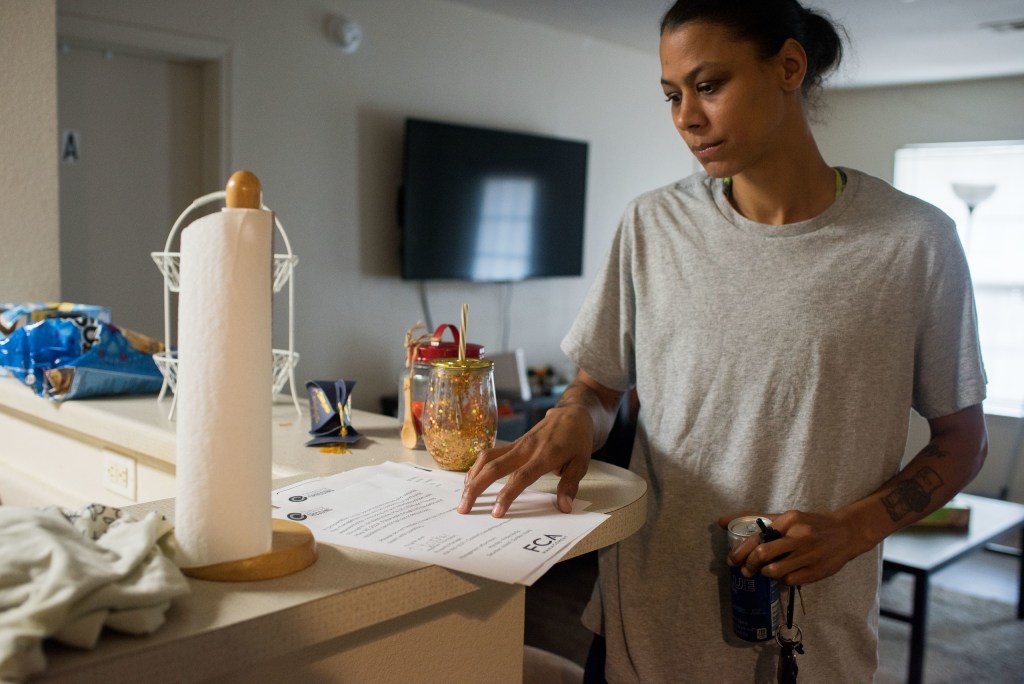
After meeting with Supervisor Pruitt in September, the company changed its approach. It put together an overview of the renovation plans and distributed a list of resources to the remaining residents on Oct. 3.
The Oct. 3 letter clarified that the terms of all current residents’ leases will be honored, and that tenants will not be asked to leave Cavalier Crossing before their lease ends. It also outlined the current renovation plan, which is already underway, and includes:
- relocating remaining residents whose buildings are slated to undergo construction soon, from their unit into another empty one in the complex;
- offering moving help to those residents;
- and offering relocation assistance and a resources packet to residents moving out of the complex.
The letter concluded with contact information for two apartment complexes that it suggests residents check out — Spark Charlottesville and Cobalt Ridge — and a list of seven housing-related resources, including homeless shelters, provided by Charlottesville and Albemarle County and local nonprofits.
If this were to continue under the current approach, the property would not be habitable, because it is not economically sustainable.
—Dwight Dunton, founder and CEO of Bonaventure Multifamily Income Trust
“This is a letter we should have gotten a year ago,” said a Cavalier Crossing resident who spoke with Charlottesville Tomorrow by phone on Wednesday. She asked to speak anonymously out of fear of retaliation.
“I’m on a very fixed income. I’ve lived here for seven years. This is unnerving,” she said.
Samantha Tricoli, director of asset management for Bonaventure, said that the company should have been “more proactive” in communicating with residents about the changes at Cavalier Crossing.
“I think there was a lot of confusion in our messaging that maybe wasn’t clear enough in the beginning as to what our full renovation plan was for the property,” she said.
The company’s initial release said it would convert Cavalier Crossing into “luxury 2- & 3- bedroom units.”
But Tricoli doesn’t want people to think that “luxury” means unattainable.
“We are not trying to achieve rent that is at the top of the market,” Tricoli said.
Bonaventure has not yet decided how much it will charge for rent for the newly-renovated apartments.
“While our rent will be slightly higher for the new apartments, we believe that it will be a suitable option for individuals and families with incomes around 60% to 80% Area Median Income for Charlottesville,” Tricoli said.
In 2024, 60% of the Area Median Income for a family of four is $73,260 a year, and 80% AMI for a family of four is $97,650.
Bonaventure is considering applying for a rezoning of the property to increase the total number of units available in the complex, Tricoli added.
If Bonaventure were to apply for a rezoning and the Board of Supervisors were to grant it, Bonaventure would need to abide by the County’s recently adopted Housing Albemarle plan, and make 20% of those units available to residents earning 60% AMI or lower.
“That would be a tremendous amount of actually affordable housing,” said Supervisor Pruitt. “That will be helpful for our community in the long run, recognizing that that doesn’t help the people on the ground.”
Albemarle County steps in with financial assistance for residents
For those residents who will not be able to stay, Supervisor Pruitt’s pushed the Board of Supervisors to help.
Pruitt organized a meeting with tenant’s rights and affordable housing advocates concerned about Cavalier Crossing residents.
What Pruitt heard was that people need help moving. Specifically, they need security deposits and first month’s rent assistance.
Pruitt thought the County could help with that.
Albemarle County has a program for emergency housing assistance, called the Albemarle County Emergency Relief Fund (ACERP). For the current fiscal year (2024-25), the county allocated $260,000 to the fund. Human Services, the department that manages the fund, controls disbursements across the calendar year to prevent the fund from being maxed out in the first few months.
Previously, ACERP was used for helping people catch up on rent in order to prevent eviction, and to prevent utility shutoffs — not for security deposits.
“We weren’t using it for security deposit assistance, because I don’t think it occurred to us to do that,” he said.
In order to expand the program’s parameters, he had to find additional money for it.
Staff did, in an underutilized septic to sewer conversion program.
“Manna from heaven, the septic to sewer program hasn’t had the response we were expecting,” Pruitt said. The county had allocated $1 million in American Rescue Plan Act (ARPA) funding for a program to help people convert their septic systems to the County sewer system. But since fewer people applied for the program than the county expected, there was still a chunk of money left in the pot.
Staff brought a request to reallocate $170,000 of that ARPA funding to ACERP as soon as possible, with $100,000 of that earmarked specifically for security deposit assistance.
If the Board approves that request, security deposit assistance could be a new facet of the ACERP funding and “might be a core part of the program going forward,” Pruitt said.
County staff is also discussing raising the maximum amount each person can receive from the fund. Currently, it’s $800 — not enough to cover most security deposits.
The Cavalier Crossing resident who spoke anonymously with Charlottesville Tomorrow said she was glad to hear Albemarle County was working to provide this funding.
“I really appreciate what he’s doing,” she said of Supervisor Pruitt. “I think it’s great.”
But still, she’s concerned. She knows a lot of people need assistance, and that the money for it can run out fast. She worries that the ACERP pool will be dry when her lease is up, in July 2025, and she needs to move.

Tenant advocates say security deposit help is a good start
Tenant advocates are happy that the County took such a direct action, quickly. But they view it as a first step on what they say should be a longer journey toward protecting affordable housing and helping the residents who need it.
“I’m grateful for Supervisor Mike Pruitt’s efforts to bring this before the Board of Supervisors and bring about real change,” said Elizabeth Stark, a tenant advocate with the Charlottesville Chapter of the Democratic Socialists of America, who met with Pruitt and other advocates to discuss ways to help Cavalier Crossing residents.
“It is my hope that county residents and the Board of Supervisors will see Cavalier Crossing as a learning experience about how important it is to protect affordable housing units and to be proactive about affordable housing in general,” she said.
Stark hopes the Board will continue to increase its funding of housing and rental assistance initiatives in future budget cycles.
“What an amazing response from the County,” said Heather Kellams, women’s case manager at People and Congregations Engaged in Ministry (PACEM), one of the area’s homelessness providers. She also attended Pruitt’s meeting.
“Talk about the importance of making a step to voice some opinions and get some change.”
Kellams has two clients currently living at Cavalier Crossing, and both are worried about becoming homeless again when their leases run out, she said. One of her clients has been especially worried about being able to pay for a security deposit and first month’s rent on a new apartment. She’s been able to put some money in her savings recently, but not enough to pay for such a significant moving expense.
Hearing that she will likely be eligible for deposit assistance from the county has been a relief, said Kellams. But, her client still has to find a place, and she can’t afford more than $600 per month on her full-time job at a local dry cleaner.
“Although I feel like the assistance with the ACERP funds for security deposits and first month’s rent is awesome and will be very helpful, I continue to see a real shortage, as everyone is saying, in actual units that are available,” especially at the $500-700 price range, Kellams said. She wants to see the county do more to create those types of units, whether they’re apartment complexes or cottages.
Albemarle County considers more long term goals to safeguard affordable housing
Pruitt said the County is trying.
“The county is doing its damned best to build more units — public perception to the contrary, I’m sure,” said Pruitt.
The Board is also revising the County’s zoning ordinance as part of its comprehensive plan process to allow for the construction of more housing in general, he added.
On a broader scale, Pruitt is trying to push for additional tenant protections on the state level. He wants to see Virginia implement rent stabilization measures, which protects tenants from exorbitant rent hikes by capping the amount a landlord can raise the rent each year. He also wants localities to have first right of refusal on properties that go up for sale, similar to the Manufactured Home Lot Rental Act, where mobile home park tenants (or groups representing those tenants) have 60 days to make an offer on their park, and the seller must consider that offer before selling it to another buyer.
For now, adding money to ACERP and broadening the program’s parameters is a solution, albeit a small and temporary one, Pruitt says.
These changes are intended to help Cavalier Crossing residents with relocation expenses, but anyone who lives in Albemarle County and needs assistance can apply for it, too.
Before people can apply for the expanded assistance, County staff has to set up the program. And before that can happen, the Board needs to take an official vote on appropriating the funds.
It is unclear when the Board of Supervisors will vote on the ACERP allocation. The next Board meeting is Wednesday, Oct. 16 at 1 p.m., and it is not on the agenda. (View all upcoming meetings and agendas here.)