

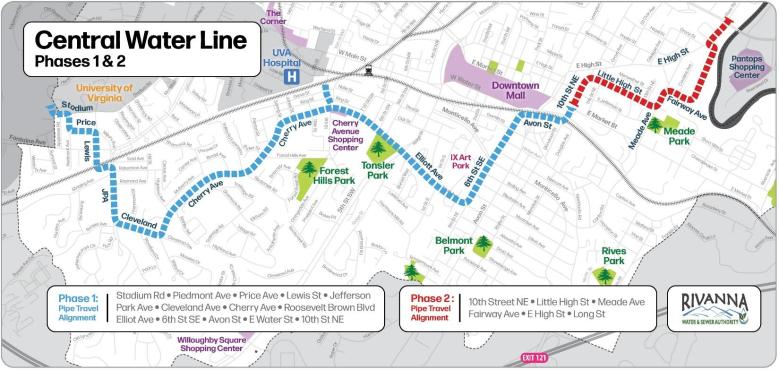
Charlottesville and parts of Albemarle County are getting a new water main.
In October of this year, the Rivanna Water and Sewer Authority (RWSA) will begin a four-year-long project constructing five miles of water transmission pipe through the City of Charlottesville.
The work, which is to be completed in two phases, will stretch across the entire city, from Stadium Rd. near the University of Virginia to Fairway Ave. in the Woolen Mills neighborhood.
Take action
Stay up-to-date on the new water main project for Charlottesville and part of Albemarle County
In October of this year, the Rivanna Water and Sewer Authority (RWSA) will begin a four-year-long project constructing five miles of water transmission pipe through the City of Charlottesville.
Sign up to receive a newsletter with project updates on the RWSA website.
Learn more about the central water line project from this fact sheet from RWSA. RWSA will also hold a community meeting in September — the date, time and location for that meeting has not yet been announced.
Currently, the entire City of Charlottesville and parts of Albemarle County’s “urban ring” — a more densely developed area of the county surrounding the city — are served by six small water mains that flow from three water treatment plants: the North Rivanna Water Treatment Plant by the Camelot subdivision; the South Rivanna Water Treatment Plant near Walmart on Route 29; and one on UVA Grounds at Observatory Hill.
Those plants, and the six water mains, are owned and managed by the RWSA.
RWSA is an independent public agency responsible for collecting, treating, storing, and distributing water, as well as treating waste water, for residents of Albemarle County and Charlottesville. RWSA sells water wholesale to the city and county utility offices, who then sell and distribute it to customers. Its operations are funded mostly by those water sales and in small part by local and state allocations, which are taxpayer money.
Water from those six existing RWSA-managed mains flows into smaller, city- and county-owned pipes that distribute water to neighborhoods, and then to even smaller pipes that bring water to individual homes and buildings.
When the project is complete, the area will be served by one large main in addition to the six smaller ones. Having both will add a layer of redundancy to the system so that if any of the treatment plants or mains need work, water flow shouldn’t be interrupted, RWSA Communications and Outreach Coordinator Westley Kern told Charlottesville Tomorrow.
Kern said people could think of it like a tub drain. When a tub drain pipe gets clogged, it’s because there are only small channels for the water to flow through — sort of like having smaller water mains. But when there’s a larger pipe opening, more water can flow through, faster.
So, adding a larger pipe to the system of smaller ones contributes to the flow, and means that there’s a system to fall back on when one needs work or encounters a problem.
The goal, Kern said, is to ensure that the area has safe drinking water for many years to come.
But to get there, a few city streets will be dug up over the next few years, with construction expected to begin later this year and wrap up in 2029.
The new water main will be “huge,” Kern said — the pipe opening will be 24 inches or 30 inches wide, depending on the location — and placed several feet underground, under city streets. The pipe will be placed deep enough that it shouldn’t interfere with any existing utilities, meaning that residents shouldn’t experience any sort of utility disruptions, said Kern.
That also means that if the city needs to go in and work on any of its utilities, such as the sewer main, the water main is unlikely to be affected because it’ll be a few feet deeper underground, Kern said.
Most of the work will be done during waking hours Monday through Friday, with some night work at the busier streets and intersections along the route, such as Fontaine Avenue and Roosevelt Brown Blvd. near UVA Health University Medical Center, Kern said.
Right now, RWSA isn’t anticipating any road closures for the project, but traffic will probably be slower wherever the work is being done. It’s likely that traffic will be flagged, so cars can still pass through in one direction at a time, said Kern, but this could change if necessary.
Connecting the treatment plants together on a single main should make water transmission more efficient throughout the area, said Kern.
It will also allow RWSA more flexibility in the event of an emergency or if any repairs need to be done, Kern added.
The project, which has been planned for a few years now, comes at a time when many Virginians have had to worry about whether or not their drinking water is safe to consume.
In August 2024, a catastrophic pump failure contaminated the water supply in Orange County, leaving residents afraid to use their tap water for weeks. A few months later, in April of this year, the Rapidan Service Authority, which serves both Orange and Madison counties, voted to increase customers’ water and sewer rates in order to pay for infrastructure upgrades.
Earlier this year, in January, a water treatment plant servicing the City of Richmond failed, leaving residents and businesses without clean drinking water for days. A subsequent Virginia Department of Health report about the incident “found a long chain of preventable failures at the city’s 100-year-old water treatment plant,” the Virginia Mercury reported in April.
With that in mind, RWSA is taking “a very proactive approach,” Kern told Charlottesville Tomorrow. Currently, the South Rivanna treatment plant supplies the vast majority — about 80% — of the water used in the city and the urban ring. The Observatory treatment plant provides the most water after the South Rivanna plant, and the North Rivanna plant supplies the least. Eventually RWSA will phase out the North Rivanna plant, Kern said.
By having a central water main in addition to the smaller ones, RWSA can increase the amount of water treated at and sent out by the Observatory plant. That helps split the responsibility more evenly between the Observatory and South Rivanna plants, so that the entire network isn’t relying so heavily on just one plant for its supply. So, if something went wrong at the South Rivanna treatment plant, the Observatory plant could then pick up the slack, likely with minimal disruption to the area’s water supply.
In addition, the water mains are connected to various RWSA-managed drinking water storage tanks throughout the area, including on Pantops, off of Avon Street, near UVA, and north of the city, that would also help ensure people have clean drinking water in the event of an emergency.
The two-phase water main project is estimated to cost $79 million, according to a project fact sheet. Sagres Construction Corporation from Arlington, Virginia, has been hired for the first phase, which is estimated to cost $47.45 million.
The Albemarle County Service Authority is paying 52% of the cost, while Charlottesville Utilities is paying 48%, and the funding has already been approved.
Water and sewer rates for the Albemarle County Service Authority increased this year in part to pay for the project, according to the county’s FY2026 rate sheet. The county said it is using some of its financial reserves to lower the impact on customers, and the average water and sewer rate increase is 8.9%, or $6.19 per month, which took effect July 1 of this year.
Charlottesville’s water and sewer rates have also increased as of July 1. Water rates went up by more than 17%, and sewer rates by 8%, which equates to about $6.55 and $3.60, respectively, for the average user, according to the latest Charlottesville Utilities rate report.
These increases “are largely due to the increases in the RWSA cost,” said Charlottesville Director of Utilities Lauren Hildebrand in an email Tuesday afternoon. “This includes paying for RWSA’s operating cost and capital improvement program, which include the water main project and other water supply infrastructure projects.”
“These projects are required for the community’s long-term needs,” Hildebrand added.
There’s help available for city and county residents who need help with their water and sewer bills. Charlottesville residents can call 434-970-3211, or go to the city’s water and sewer assistance program website, to see if they qualify. Albemarle County residents can call the Albemarle County Emergency Relief Program (ACERP) at 434-972-4010 ext. 6, or email acerp@albemarle.org, to see if they qualify. Albemarle County also accepts applications in person at its Department of Social Services, located at 1600 5th St. Information on these programs and other housing resources is also available in Charlottesville Tomorrow’s Housing Resources Guide.
Editor’s note: This article was updated on July 23, 2025, to clarify how the Rivanna Water and Sewer Authority is funded.