


When Charlottesville Mayor Juandiego Wade checked his email Tuesday morning, he saw one from Cultivate Charlottesville, a nonprofit food justice organization that provides fresh, organic produce to hundreds of local families each year.
“I thought it was a typical request for donations,” he said. During this time of year, his inbox — like everyone else’s — is full of fundraising emails. But when he read further, he saw that Cultivate’s email wasn’t typical at all.
“Unless we can reach our fundraising goal of $500,000, Cultivate Charlottesville will face the heartbreaking reality of closing its doors in the spring,” the email said.
If Cultivate were to close, it would mean the organization would stop providing free, fresh produce to some of the city’s poorest families.
“I am very concerned, because the impact this organization has on this community is tremendous in the area of food equity,” said Wade, who previously served on the organization’s Board. “I really believe that we need them.”
The nonprofit organization, which is funded through philanthropic donations, grants, and some City taxpayer funds, did not get four major federal and local grants that it applied for this year, said Aleen Carey, Cultivate’s co-executive director.
(Disclosure: Aleen Carey serves as Charlottesville Tomorrow’s board chair. Charlottesville Tomorrow is a nonprofit news organization locally governed by community leaders and residents, so there are times when the editorial team reports on people, organizations and companies in which board members have direct interests. However, neither the chair nor board have a say in our editorial decisions or directly supervise anyone who produced this report. Here is our editorial independence policy.)
Cultivate’s budget is now short $500,000, Carey said.
The organization’s expenses were $1.4 million in 2023, according to its most recent tax filing. This year its projected expenses are around $860,000, Carey said.
Carey would not say which local grant the group applied for but didn’t receive.
“I won’t say, because the hope is that we will be able to get into their funding this year,” she said.
She did say that one was “hyper local” and the other was statewide.
In addition there were two federal grants the organization was expecting to receive, but did not. Both were from the U.S. Department of Agriculture. The largest was for $300,000.
Cultivate currently employs 13 people, down from around 30 last year when Carey said the organization was fully staffed.
During the COVID-19 pandemic, the organization grew, but that’s because there was more demand for its services, as well as pandemic relief funding to keep those services going, said Carey. Staff knew that as pandemic relief funding dried up, the organization might have to shrink a bit.
But the organization did not anticipate such a massive funding gap. Cultivate currently has enough money to continue paying its existing staff until April 1, Carey said.
“If we don’t raise another dollar between now and April, we will close April 1,” she said.
Carey said she dreaded telling the public, and the Cultivate staff.
“I almost felt bad putting [it] out there,” she said. “But we ultimately decided to be up front with people, that this is not like every time we’ve sent an appeal at the end of the year. This isn’t a drill. This is for real.”
Carey knows that $500,000 is a lot to fundraise.
Cultivate’s absence would be felt deeply throughout the city, according to local city and nonprofit leaders who spoke with Charlottesville Tomorrow.
“I think the community would look and feel, and be a lot different without Cultivate Charlottesville,” said Mayor Wade, citing the organization’s food equity and food justice work.
Statistics suggest the same.
One in seven people in the City of Charlottesville experienced something called food insecurity in 2022, according to Map the Meal Gap, an annual survey conducted by Feeding America, a nonprofit network of more than 200 food banks in the United States. The USDA defines food insecurity as “the lack of access, at times, to enough food for an active, healthy life.”
That rate is higher among children, at 17.3%, according to the report.
There are food banks and soup kitchens throughout the city, but Cultivate does something else entirely. The organization gives away thousands of pounds of fresh produce each year, and teaches people how to grow their own food.
Cultivate does this through three different programs: City Schoolyard Garden, the Urban Agriculture Collective of Charlottesville and the Food Justice Network. They were all nonprofits in their own right before combining in 2018 into one nonprofit to streamline their efforts and share resources, said Carey.
The City Schoolyard Garden program, which maintains gardens at almost every city school, teaches children how to work in the garden and how to prepare the food they grow.
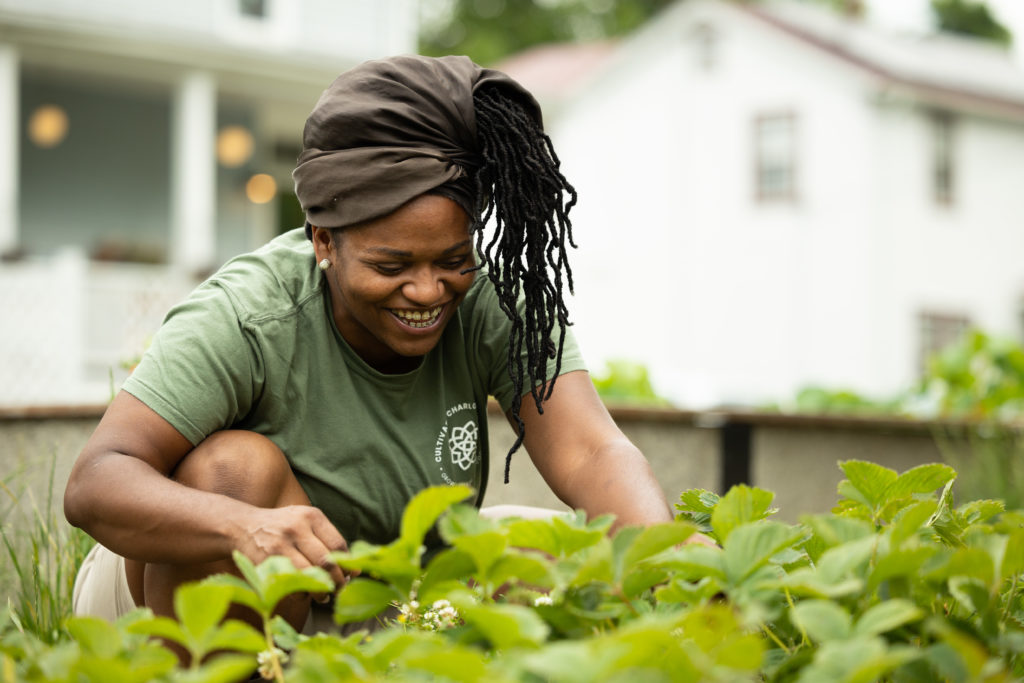
The Urban Agriculture Collective grows and gives away for free to residents of public and subsidized housing. In 2021, Cultivate’s then-co-executive director Richard Morris told Charlottesville Tomorrow that the urban farms grew about 10,000 pounds of food and regularly provided about 350 families with fresh produce every year, from June to October.
The Food Justice Network is an effort to bring together multiple civic groups and individuals to work on projects. That includes work like helping the Fifeville Neighborhood Association advocate for a grocery store on Cherry Avenue, and getting the Charlottesville City Market and the Farmer’s Market at IX to accept SNAP benefits.
But Cultivate Charlottesville has faced some challenges in recent years.
Much of its urban farm land has been lost to redevelopment, though Cultivate has been able to establish a new, large garden at the Charlottesville Area Technical Education Center (CATEC).
Cultivate was hoping to sow another, huge community garden at Booker T. Washington Park — it’s something residents said they were interested in, and City Council supported the idea. But any decisions about that garden are on hold. Not long after Cultivate presented the idea to the Council, City Parks & Recreation said it would be creating a master plan for all city parks, and any decisions about Washington park would come after that process.
“Cultivate’s City Schoolyard Gardens and Urban Agriculture programs are both well-respected and have done a lot to raise awareness of growing and enjoying your own food,” Jane Colony Mills, executive director of the Loaves & Fishes Food Pantry, wrote in an email to Charlottesville Tomorrow. “The Food Justice Network has bolstered other area food access organizations like Loaves & Fishes in our food equity and access efforts. It would be a shame for this organization and their important work to be lost.”
The city has already lost at least one food access program this year.
Over the summer, the Local Food Hub ended its Fresh Farmacy Program, C-VILLE Weekly reported. People with low incomes who were also at risk for diet-related health problems could get a “prescription” to participate in the program, which was started in 2015 by the Local Food Hub and the Blue Ridge Area Health District. The Local Food Hub will close its doors by the end of this year.
“This is a rubber meets the road moment,” said Price Thomas, executive director of City of Promise, an organization that seeks to make a positive impact on generational poverty through dual generation, full family initiatives supporting access to education and opportunity.
“Nearly 60% of students in Charlottesville City Schools are eligible for free and reduced lunch,” Thomas pointed out in an email to Charlottesville Tomorrow. “How do we expect these students to learn and excel in schools if they aren’t well fed? How can we honestly say they have the same opportunities as their peers if they don’t have consistent access to high quality, healthy food?”
Since reaching out to the community for help, the local Anne and Gene Worrell Foundation has promised to donate $100,000 to Cultivate this year, and another $100,000 next year, Carey said.
Mayor Wade has also said he plans to speak to city staff to see what the city can do to help.
“I think that we as a community, not just the city government, we all need to rally around and support the organization,” he said.
The outpouring of support from the community has been heartening, said Carey. By Tuesday afternoon, just hours after the email went out, Cultivate had received a few other donations and Carey’s phone had been ringing off the hook.
“We’re so hopeful that we’re going to be able to do this,” she said.