


The Justice Department’s Oct. 22 deal with the University of Virginia — which temporarily pauses five federal investigations into the university in exchange for UVA adhering to the Trump administration’s stricter interpretation of race-based admissions, among other concessions — has ignited fierce backlash across the university and in the state’s Capitol. Critics warn that the agreement hands sweeping control to the Trump administration and undermines hard-won protections for students and faculty of color.
To understand what the agreement really means, Charlottesville Tomorrow spoke with legal experts and faculty who caution that its reach extends far beyond UVA — setting a precedent that could reshape how public universities nationwide interpret civil rights law and respond to federal pressure.
UVA is the first public university to sign a deal with the Trump administration
“We had five open investigations…and the DOJ is pausing those investigations,” Interim Executive Vice President and Provost Brie Gertler said during a Faculty Senate meeting on Oct. 24. “They have agreed to do that, and we have agreed to continue doing what we have been doing, which is to continue reviewing our policies and practices to ensure that they are in line with civil rights law.”
This guidance is largely the same as UVA’s existing internal guidance developed and distributed by senior leadership and university counsel in May — a month before former President Jim Ryan’s ouster from his position at UVA — Gertler said during the meeting.
The one exception, she specified, is that the DOJ’s guidance states that the sexes must be defined by biological sex, that people of a biological sex must have access to intimate spaces that are restricted to people of their biological sex and that athletic competitions must be defined by biological sex.
“The agreement that we signed says that we will follow the July 29 guidance subject to relevant judicial decisions,” Gertler added. “And there are two relevant judicial decisions here from the Fourth Circuit, which say that, in fact, Title IX requires that people are able to access intimate spaces that correspond to their gender identity and to participate in athletic competitions corresponding to their gender identity.”
The deal with the DOJ announced Wednesday marks the first time a public university has signed such an agreement with the Trump administration, according to reporting from The New York Times (subscription required). It comes after months of pressure on UVA and other universities to fall in line with the administration’s political agenda — in particular its rejection of diversity, equity and inclusion.
UVA is the fourth university to reach such an arrangement. Similar deals have been made with Brown University, Columbia University and the University of Pennsylvania, while Harvard remains in negotiations.
The deal was announced only a few days after the university rejected the Trump administration’s Compact for Excellence in Higher Education on Friday, Oct. 17. The rejection came just hours after more than a thousand people — including students, faculty, staff, alumni and members of the Charlottesville community — rallied on UVA’s lawn to demand that university leadership turn down the offer. The compact urged universities to agree to a list of requests in exchange for priority access to federal research funds. It would have created sweeping changes to universities’ hiring and admissions practices, foreign student enrollment and culture so that they aligned with President Trump’s political agenda.
“I think everyone was stunned that we had just gone through this whole compact process where we had a protest and the Faculty Senate issued a resolution against it, and then all of a sudden just a few days later, Mahoney, through secret negotiations, basically signed a deal with the devil,” Walt Heinecke, UVA professor and immediate past president of the university’s chapter of the American Association for University Professors (AAUP-UVA), told Charlottesville Tomorrow.

UVA defends deal, critics call it federal overreach
UVA’s administration has praised the deal for preserving academic freedom, preventing external monitoring, avoiding fines and pausing expensive investigations.
Interim President Paul Mahoney described the agreement as the “best available path forward” in an Oct. 22 message to the UVA community. Mahoney added that “some work remains to be done to satisfy fully the terms of this agreement,” but he is optimistic that the UVA community “will be able to pursue that work in a manner consistent with the values and principles that are at the heart of everything we do.”
But Virginia State Senator Scott Surovell criticized the deal as “a surrender” that undermines the university’s independence. State Senators L. Louise Lucas and Creigh Deeds also criticized the agreement, as has State Delegate Katrina Callsen. In a recent letter to UVA’s leadership, Callsen and Deeds asked them to reverse the agreement, arguing that it subjects UVA to unprecedented federal control, according to reporting from The Cavalier Daily.
State Sen. and Lieutenant Gov.-elect Ghazala Hashmi, too, criticized the Trump administration’s efforts to interfere in the state’s institutions of higher education during an Oct. 27 visit to UVA, where she listened to concerns that faculty, students and other members of UVA’s community laid out about the deal.
“The federal actions are such and to such a degree of severity that they are posing fundamental threats to our institutions, not the least of which is the threat to full funding,” she said, further criticizing the Trump administration’s efforts to dismantle diversity, equity and inclusion at UVA and beyond.

The University’s chapter of the American Association of University Professors (AAUP-UVA) also opposed the agreement. The faculty organization — which aims to defend academic freedom, shared governance and professional standards in higher education — first sent a letter to the university’s Board of Visitors back in August expressing concern about the university’s ongoing negotiations with the DOJ and warning against allowing outside authorities to infringe on university autonomy.
One of its main critiques of the agreement is that Interim President Mahoney acted unilaterally to sign the deal with no warning, transparency or opportunity for the university’s constituency to voice their opinions or oppose its signing.
“There was absolutely no faculty consultation on signing this agreement,” Heinecke said. “And the faculty senate leadership was cut out of this, so that agreement that he signed has no legitimacy with the faculty.”
UVA professor Lisa Peterson, a current member of the university’s Faculty Senate, expressed similar sentiments during the Oct. 24 senate meeting.
“I just I think it’s disingenuous at best or duplicitous at worst, that we saw interim president Mahoney on Friday afternoon and he said some things to us, and then in less than a week, he unilaterally went and signed an agreement on behalf of the entire university after having been interim president for not even three full months, with limited trust,” she said. “It concerns me that he has so little respect for what he must know our position to be.”
Former Chief Deputy Attorney General of Virginia Claire Gastañaga agreed that it was hard to fathom that an interim president would sign a years-long deal unilaterally on behalf of the university’s constituents and future leadership. During her eight years in the Attorney General’s Office, Gastañaga was responsible for giving legal advice to universities and colleges in the state.
“I think it’s remarkable that Mahoney, as an interim appointee — unless he’s been given some signal that he’s going to be the permanent president — would sign something that commits the president personally to guarantee quarterly reports for a period that could extend well beyond his presidency, until 2028,” she said.
At the same time, she said, Mahoney’s own appointment remains arguably legally murky given that he was selected by a Board of Visitors that does not currently meet official membership guidelines required by Virginia law and is therefore not a legally constituted body.
“The reality is that one has to ask the question of whether an interim president picked by a board that isn’t legally constituted should feel that they have the authority to sign a multi-year agreement in a situation like this,” Gastañaga added.
DOJ deal binds UVA to ideology, not law
Heinecke, Legal Defense Fund Senior Counsel Antonio Ingram and Chris Ford, a contracts lawyer and UVA alumnus, also said that the deal is not a good one for the university because it commits UVA to abide by an ideological interpretation of the law and not the law itself.
Under the deal, UVA agreed to comply with the Trump administration’s July 29, 2025 guidance for recipients of federal funding, which is “much more restrictive than the law requires,” Ford told Charlottesville Tomorrow.

“For the university, if your yardstick is financial burden, then it’s a win,” Ford said, referring to the fact that the agreement did not involve steep fines for UVA. “If your yardstick is that there is now the obligation to comply with guidelines that are not in strict compliance with the requirements of the law, then I think this is problematic.”
Among other stipulations, the guidelines abide by the Trump administration’s interpretation of the Supreme Court’s 2023 decision ending race-based admissions.
While the Supreme Court’s 2023 ruling effectively barred considering race as a specific factor in college admissions, it still allowed applicants to discuss how race had shaped their life experiences in personal statements. The Trump administration’s interpretation extends beyond what the 2023 ruling requires, adopting a more restrictive stance that bars any consideration of race in admissions — even as legal experts maintain that a holistic review process can still take race into account.
“This guidance is not grounded in what is the law currently, it is grounded in an ideological interpretation of the law,” Ingram told Charlottesville Tomorrow.
“So the fact that now we have a university adopting a legal interpretation that no court has ever endorsed because of the settlement agreement — I think that’s quite troubling,” he said. “And it just shows the power of the executive branch to weaponize the Department of Justice to expand precedent beyond the bounds of what courts have ruled just because of the power of intimidation and coercion.”
Critics fear DOJ guidance will harm students of color, reduce their attendance at UVA
Rather than leading to “race-neutral” admissions, Ingram added, the adoption of these guidelines — which also ban the targeted recruitments of racial minorities — will ultimately culminate in even fewer students from underrepresented backgrounds gaining access to UVA, a university where white students vastly outnumber every other ethnic group on grounds.
Ford agreed. The deal, he said, is being weaponized by the federal government as a tool to halt progress at the university, where groups of people that had been historically kept out of the elite institution finally have voices.
“The underlying theme of what’s happening is that they’re trying to exclude voices and ideas,” he said.
“I think we need to remember why we need diversity statements, why we need the targeted recruitment of underrepresented minorities, because these demographics did not become underrepresented because they were less qualified, because they did not work hard enough,” Ingram told Charlottesville Tomorrow back in August while discussing the dangers of a potential agreement with the DOJ. “They were underrepresented because they were the victims of state-sanctioned exclusion for centuries, and these tools were meant to remediate this exclusion.”
Just as concerning, Ingram added, is the fact that the July 29 guidelines ban race-based scholarships and programs for minorities that have historically been excluded from higher education — despite the fact that the 2023 Supreme Court decision banning affirmative action in no way prohibited these.
“If people want to bring a lawsuit so the Supreme Court can potentially rule that race-based scholarships are illegal, they can do that,” he said. “But what they can’t do is take an opinion that was about race-conscious admissions and then expand that to the sort of world they want to live in. That’s just not how the law works.”
Gastañaga agreed, adding that both Title IX and Title VI allow gender- or race-based scholarships at a university as long as its financial aid program, as a whole, affords students substantially equal opportunities.
In other words, under current regulations, a university may offer certain scholarships that are limited to women or targeted to students of specific racial or ethnic backgrounds, as long as those scholarships don’t result in unequal overall opportunities for other students to receive financial aid.
The July 29 guidelines also prohibit the “segregation” of facilities and resources, including designating specific facilities like lounges or study spaces for certain racial or ethnic groups because these could “foster a hostile environment”, even if access is technically open to everyone.
“Which is wild, because to now say that a Black Student Union at UVA that is open to all students — because its name has the word Black in it — could create a racially hostile environment?” Ingram asked. “For who? The white students who have the majority of the campus that reflects their culture and their values?”
“And would these guidelines on segregated spaces apply to the predominantly white fraternities and sororities or honor societies who use school facilities?” Ingram added. “Because those may be technically open to all, but I would say they have an even worse history of segregation and exclusion than a center that was probably made in 2020 just to uplift the Black communities that have been suppressed for centuries on that campus.”
While UVA does not have a Black Student Union, the primary meeting and gathering space for Black students at the university is the Luther Porter Jackson (LPJ) Black Cultural Center. It offers study and meeting rooms, cultural resources and hosts weekly community gatherings so that Black students can connect with peers who share similar backgrounds and experiences at a university where the majority of students don’t look like them.
UVA spokesperson Bethanie Glover told Charlottesville Tomorrow that current “policies and training are consistent with Department of Justice guidance,” but did not clarify whether the LPJ Black Cultural Center will remain open when asked.
“No spaces at UVA are exclusively reserved for certain races or groups, and we have provided University staff and student groups resources to help them maintain an open and welcoming posture,” she said.
The fact that the Trump administration has largely tried to force elite, primarily white institutions into deals targeting diversity, equity and inclusion is also not an accident, Ingram added.
“When we have a multiracial elite institution where you have the future Tim Scotts and Cory Bookers attending class next to students who don’t look like those backgrounds – there’s something that’s really threatening to the administration to see the next generation of Black and brown leaders who have access to elite credentials and networks,” Ingram told Charlottesville Tomorrow. “And they’re making sure that those pipelines are narrowed before that can become the future of our country.”
DOJ-UVA deal skips standard legal procedures, Trump administration ‘blackmailed’ UVA, lawyers say
The deal, lawyers told Charlottesville Tomorrow, is also legally backward when compared to how settlements between the DOJ and universities typically work.
Usually, the DOJ would present evidence of a university having violated the law before suing the university and eventually coming to a settlement. But in this case, a preemptive settlement occurred without any evidence of wrongdoing, Gastañaga told Charlottesville Tomorrow.
“So it is absolutely irresponsible, in my view, for any president — much less a lawyer President — to sign an agreement in the absence of any evidence that the university had violated the law, and particularly irresponsible to do so in a manner that theoretically binds a future president who hasn’t even been selected yet,” she said.

“It’s a complex legal situation, but it boils down to a couple of very simple principles, one of which is that you don’t punish people without evidence and due process,” she added. “But at this stage, we have a situation in which — under an executive order which has no force of law, zero force of law — the federal administration blackmailed the university into signing an agreement.”
Ford shared similar sentiments with Charlottesville Tomorrow.
“Ultimately, what should be shocking to everyone ought to be the lack of transparency, the lack of due process and, when it comes down to it, the ability by the federal government to essentially extort a result,” he said. “It is mafia tactics to force compliance. And not only to force compliance by the immediate target, but also to intimidate potential targets into complying without even being asked to do so.”
“When you enter into a contract, typically there’s offer, acceptance, and consideration, consideration being the value of the contract,” Ingram agreed. “I’m just not seeing the value here, aside from not being sued by the Department of Justice under this administration, which is weird and unprecedented — to enter into a settlement to avoid litigation that doesn’t have precedential support by the current state of the law.”
The DOJ is a very powerful institution, Ingram added. Forcing UVA into an agreement like this one with no legal support is not only the DOJ wielding its power, but also “implementing ideology in a way that’s going to have long-lasting impacts” on UVA and beyond.
Deal favors the DOJ, critics say
The agreement, Ford told Charlottesville Tomorrow, also heavily favors the DOJ in its terms and conditions.
For instance, it grants the DOJ sole discretion to determine that UVA “is making insufficient progress toward compliance” at any time, and only grants it 15 days to “make appropriate progress” before potentially resuming investigations, fines or funding cuts.
“I am a contracts lawyer. And if I’m representing my client and in a contract I say something to the effect of, ‘at my client’s sole discretion,’ and I get away with it, then I won a huge victory, because that means that, essentially, I am the last word on that,” Ford said. “If the DOJ gets to determine whether we are in compliance, pretty much at its sole discretion, and it doesn’t give us a lot of time to even explain or make a justification as to why, that’s problematic.”
The deal, Ford added, also favors the DOJ because — by allowing the DOJ to be the final arbiter on the university’s compliance with its guidance — it doesn’t give UVA the ability to defend itself from allegations of wrongdoing.
“There’s an agreement that’s in place, but what does that agreement mean if you don’t have the ability to defend yourself against enforcement?” he said. “And therein lies, ultimately, the big problem.”
In fact, the backwards legal process that led to this deal, Ford added, resulted from the university’s inability to defend itself.
“The university’s legal defense is subject to the Attorney General, but the Attorney General is politically inclined in the same way that the Department of Justice is, right? And so accordingly, they weren’t going to fight it,” Ford said. “And so at least from my perspective, the whole thing was rigged from the beginning to have this outcome, from the forced ouster of President Ryan, to what has happened with this agreement, it was bound to happen because there was no resistance that was put up.”
“The Department of Justice determines everything, fact and interpretation,” Heinecke agreed. “This leaves open all UVA pending investigations — there’s no actual resolution. They can come back on a whim and open up any of those investigations and then threaten us with monetary penalties at the drop of a hat.”
Gastañaga added that, instead of a true settlement, the agreement was more of a truce, because none of the investigations into the university were actually resolved.
“This is basically the terms of a ceasefire with no guarantee that the other side isn’t going to begin firing immediately upon any kind of theoretical violation of the truce,” she said. “If I were subject to the terms of a ceasefire like this, I would not necessarily feel safe in my home.”
Deal threatens UVA’s institutional independence, lawyers, faculty warn
The agreement, Heinecke told Charlottesville Tomorrow, also robs UVA of its institutional independence, despite claims to the contrary.
While the deal explicitly states that there won’t be external monitoring by the federal government, it also requires that UVA’s president provide the DOJ with quarterly compliance reports through 2028, under penalty of perjury.
“Anybody who says that this is not an agreement for monitoring is just simply wrong,” Gastañaga told Charlottesville Tomorrow. “Being required to report quarterly on a set of key performance indicators, if you will, is monitoring and subjecting the university to monitoring.”
“Despite the rhetoric that this is the best way forward — that it could have been worse — it’s a total appeasement and surrender to federal oversight going forward, and it’s absolutely a horrible precedent for other public universities around the country.” Heinecke said. “Ultimately, in signing this agreement, the university has sacrificed its independence.”
I think this is essentially an agreement to capitulate to an administration whose currency is intimidation.
—Walt Heinecke, UVA professor
The point of the long-term monitoring and short 15-day period to respond to allegations of wrongdoing and change course, Ingram told Charlottesville Tomorrow, is to encourage fear and preemptive overcompliance by the university.
“I think this is essentially an agreement to capitulate to an administration whose currency is intimidation,” he said. “Having a short compliance window to address any issues, I think, is purposeful. It’s to encourage UVA to over-comply and over-correct.”
“And I think that’s the point,” Ingram added. “To create a nebulous, moving target that you’re unsure of how to comply with, and so you just do things that just hurt people of color and queer people in order to keep your DOJ officials satiated in their quest to roll back civil rights protections.”
Critics fear what deal means for academic freedom at UVA
The loss of institutional independence threatens academic freedom at UVA, Heinecke told Charlottesville Tomorrow.
“The three-month reporting requirements are going to impact academic freedom. They’re going to instill fear amongst faculty and shut down academic freedom,” he told Charlottesville Tomorrow. “What they’re calling federal cooperation — it’s really political compliance.”
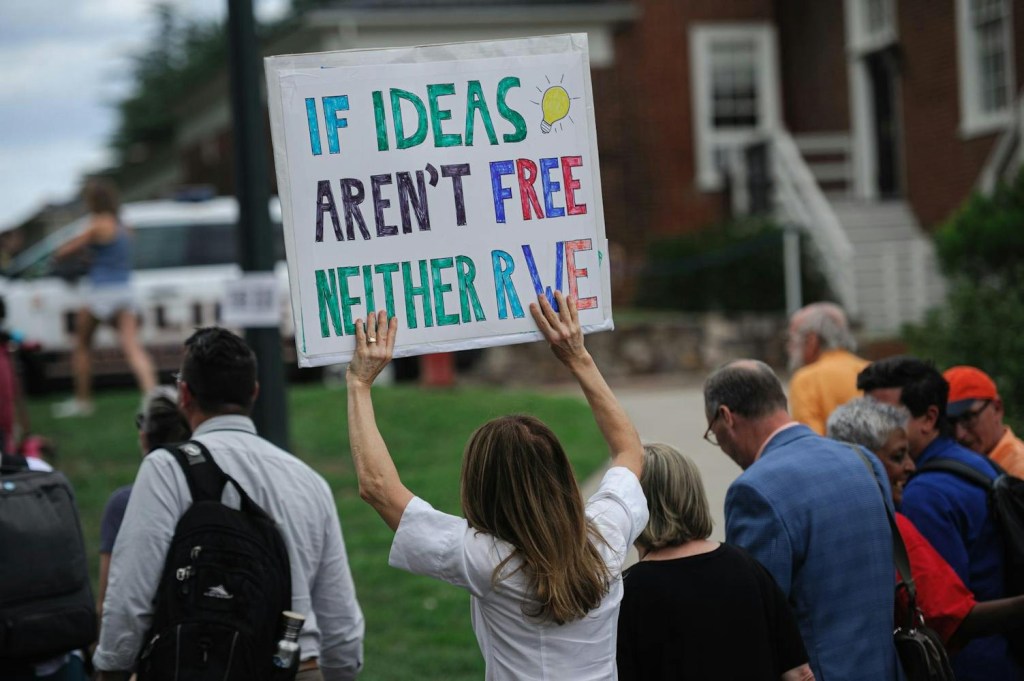
“These inactive investigations are going to interfere with our hiring, our research goals, and faculty are going to engage in anticipatory compliance under the shadow of federal scrutiny, and it’s going to definitely have an impact on academic freedom,” he added.
And even after Mahoney’s stint as interim president is over, the next president will still “inherit the loss of independence and decision-making under the shadow of this agreement and ongoing federal scrutiny,” Heinecke said.
Ingram agreed that the deal opens the door to breaches of academic freedom, despite the fact that the agreement itself explicitly states that it does not give the government the “authority to dictate the content of academic speech or curricula.”
“When looking at academic freedom from a collegiate standpoint, it’s not just about learning that happens in the classroom,” Ingram told Charlottesville Tomorrow. “These are people who are on campus, being civic leaders, engaging in issues and institutions, and when you don’t have the support of your institution it leads to an academic community that’s just less enriched.”
“Because, let’s be clear, you can’t tell me that professors who are being invited to a panel about Black Lives Matter at UVA now are going to feel as comfortable even speaking of those things,” he said. “I’ve seen this in other states. These sort of encroaches also lead to schools not wanting to give funding to groups that involve race or gender or sexual orientation.”
‘Going forward, we’re going to have to undo this.’
Moving forward, the university will continue its review of its practices and policies to ensure compliance with all federal laws, according to Mahoney’s Oct. 22 message the the UVA community, and could potentially adjust some of these to “satisfy” the terms of the agreement.
Heinecke, meanwhile, hopes that the agreement might still be overturned through enough joint opposition at UVA and beyond.
“Going forward, we’re going to have to undo this,” Heinecke said. “We have to refuse it right now, we have to think of ways of restoring the university’s autonomy and shirking these control mechanisms that are being foisted on us.”
“Most of the schools that were approached with this compliance deal rejected it,” Ingram of the Legal Defense Fund added. “And I think they know they rejected it because — were they to face adverse action by the administration — they could go to court and likely prevail.”
“But the fact that we have a place like UVA saying, sorry Black students, sorry Queer students, we’re going to roll back on our commitments that we made just a few years ago to foster a community that reflects all of your values — one has to ask, why are they capitulating?” he asked. “If UVA is purportedly training world leaders and trying to foster future decision-makers and change-makers in a multiracial country, what does it mean when they capitulate to an administration that’s trying to take us back to an era where people of color did not have access to these spaces and resources?”