


Is the University of Virginia quietly negotiating a deal with the U.S. Department of Justice — as Columbia University did — to keep its funding and close a federal investigation into the university?
Neither UVA nor the DOJ will answer that question. A DOJ spokesperson refused to say. And a university spokesperson told Charlottesville Tomorrow they could not confirm or deny whether the negotiations are taking place, referring instead to a prepared statement:
“UVA is committed to complying with all federal laws and has been cooperating with the Department of Justice in the ongoing inquiries. The federal government’s support of the University is essential to continue the core mission of research, education, and clinical care.”
But members of UVA’s Faculty Senate say that university leaders told them in July that such negotiations were underway.
Board of Visitors Rector Rachel Sheridan and Vice Rector Porter Wilkinson told members of the Faculty Senate Executive Committee that UVA’s counsel had advised them not to answer questions about President Jim Ryan’s recent departure because the university was negotiating a “voluntary compliance agreement” with the DOJ, a faculty member told Charlottesville Tomorrow. The faculty member asked to remain anonymous due to concerns of career reprisal.
“When we are done with this agreement, or done talking with the DOJ, we can share the facts as we understand them,” a speaker who identified herself as Sheridan can be heard saying in a recording of the meeting shared with Charlottesville Tomorrow.
Sheridan and Wilkinson did not reply to Charlottesville Tomorrow’s request for comment.
What is a voluntary compliance agreement?
A voluntary compliance agreement is a legally binding settlement between the DOJ and another party that would allow it to resolve a federal civil rights investigation without admitting wrongdoing or going to court. These agreements typically arise when the DOJ raises concerns about potential violations — such as discriminatory practices in admissions, hiring or programming — and can be used to avoid lawsuits or the loss of federal funding.
However, according to Inside Higher Ed, the Trump administration has intensified this approach by pressuring universities like UVA — via aggressive letters and demands — to make changes even before formal investigations or agreements are finalized.
Recent DOJ letters to institutions like UVA illustrate a more aggressive strategy, former deputy director of the FBI and president emeritus of Anderson University told Inside Higher Ed. The approach pushes the Trump administration’s ideological views while targeting vaguely defined diversity, equity and inclusion initiatives, added Brandt Hill, a lawyer with the higher education practice group of Thompson Coburn LLP. This represents a shift from past practices, which generally involved negotiations after a legal finding or complaint, rather than preemptive interventions driven by political priorities.
The DOJ’s federal investigation into UVA, which was announced in May, hinges on allegations outlined in a series of seven increasingly forceful letters sent to UVA between April and June. In the letters, the DOJ alleges that the university’s use of race-conscious admissions policies and DEI initiatives violate Title VI of the Civil Rights Act, which prohibits discrimination on the basis of race, color or national origin.
In the letters, DOJ officials also raised concerns about alleged antisemitic discrimination against Jewish, Israeli, or Israeli-American students and employees on campus and threatened to suspend or terminate federal funding if UVA did not take immediate corrective measures to comply with federal demands.
What could a voluntary compliance agreement mean for UVA?
Absent any more detailed communication from the university or the DOJ, some UVA faculty members told Charlottesville Tomorrow they are concerned about the consequences that a voluntary compliance agreement could have on the university and broader community — particularly if the agreement has any of the same stipulations as the one the Trump administration signed with Columbia University on July 23.
That’s a real possibility. The Trump administration said Columbia’s agreement would serve as a model for future deals with other institutions, according to Inside Higher Ed.

Columbia’s voluntary compliance agreement with the DOJ put an end to a months-long federal investigation into the university and restored around $400 million in previously cancelled federal funding.
It also required that Columbia pay a $221 million fine and make a range of concessions. These included changes to academic programs, admissions and hiring practices, disciplinary procedures and more — even as the university has publicly maintained it will retain autonomy over hiring, admissions, and academic decisions.
At UVA, some members of local faculty organizations worry that a similar deal could be disastrous — not only for the university, but also for the community partners and nonprofits that depend on its funding. That concern is especially acute for groups serving underrepresented populations, which now face uncertainty about whether UVA will be able to continue funding them down the line, Javier Raudales, executive director of local nonprofit Sin Barreras, told Charlottesville Tomorrow.
William Keene, a UVA professor and member of the university’s American Association of University Professors chapter (AAUP-UVA), said that Columbia was “giving into extortion” by signing the deal, and UVA would be doing the same by signing a similar agreement.
Some faculty are also worried that such a deal might happen sooner rather than later, expressing concern that UVA’s newly appointed interim President Paul Mahoney might “rubber stamp” an agreement with the DOJ similar to Columbia’s before the next president is chosen.
“That’s kind of what some of us are thinking is going to happen,” Keene told Charlottesville Tomorrow.
Columbia basically made a deal with the devil.
—William Keene, UVA professor and member of the university’s American Association of University Professors
The AAUP-UVA sent a letter to the Board of Visitors on Aug. 3 expressing concern “about the agreements currently being negotiated with the federal government” and calling for more transparency. The letter warned against allowing outside authorities to influence leadership appointments, hiring, admissions, curriculum, or research and opposed sharing detailed applicant or faculty data — especially political or ideological information — with government agencies.
“Columbia basically made a deal with the devil,” Keene told Charlottesville Tomorrow. “They can keep their research funding — although they have to pay a hefty fine — but they give up autonomy in admissions, in hiring and promoting and in the structure of their academic programs. And to me, that’s a death knell for universities.”
“There’s no easy solution to this, because cutting off federal funding will destroy a large research institution — certainly their research programs — but sacrificing autonomy to do that is a mistake,” he added. “I think history shows us that capitulating to authoritarians is not a viable option. But it’s their calculation, and I wouldn’t be surprised if a lot of other universities make the same calculation.”
Agreement could lead to stricter policies on campus protests
In Columbia’s case, its agreement with the DOJ codifies multiple policies that were originally announced in March. These policies were based on the Trump administration’s demands after it first announced that it would be revoking the university’s federal funding that same month.
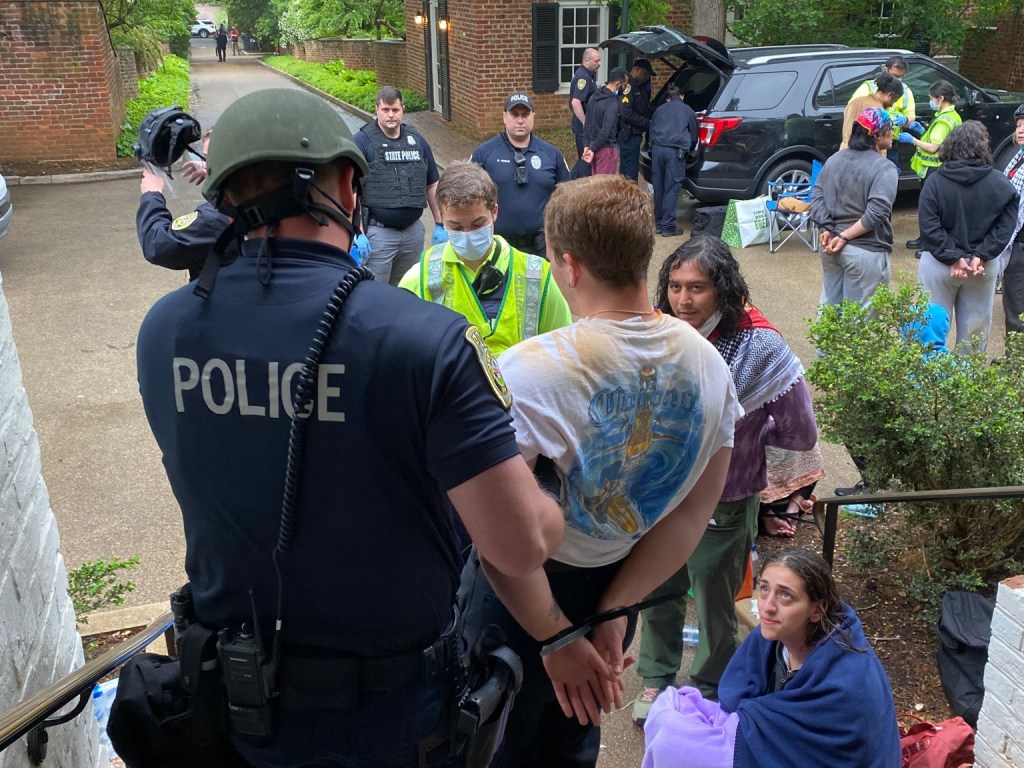
They include stricter policies around campus protests following widespread student-led encampments in support of Palestine at universities across the country in 2024. The policies prohibit demonstrations inside academic buildings — restricting protests to designated locations during designated hours — and ban face masks or coverings during demonstrations. A multi-agency police force made 25 arrests while clearing a pro-Palestine protest encampment at UVA in May 2024.
Changes to Columbia’s disciplinary process that were first announced in March were also included in the agreement. For instance, students will no longer be allowed to serve on the University Judicial Board, which hears alleged charges of conduct violations and determines appropriate sanctions.
Columbia agreement included new requirements on hiring, admissions practices
The agreement further imposes new requirements on Columbia’s hiring practices. It requires that the university share data on who it hires and promotes with the DOJ and bans the use of personal statements, diversity statements, or any reference to race in the hiring process.
It also requires that Columbia submit detailed admissions data to the federal government each year, including demographic information, standardized test scores, and grade point averages for both admitted and rejected applicants. Additionally, the agreement mandates “strictly merit-based admissions,” leveraging the 1964 Civil Rights Act to forbid any preference based on “race, color, or national origin” in admissions, and bars consideration of personal statements or diversity narratives that reference race.
While the Supreme Court’s June 2023 ruling on affirmative action effectively barred considering race as a specific factor in college admissions, it still allowed applicants to discuss how race had shaped their life experiences in personal statements.
However, the Trump administration has said that such statements were being used as “racial proxies,” allowing universities — knowingly or not — to account for an applicant’s race in the admissions process
But critics say prohibiting such statements goes beyond what the law requires and sets a harmful precedent for future students.
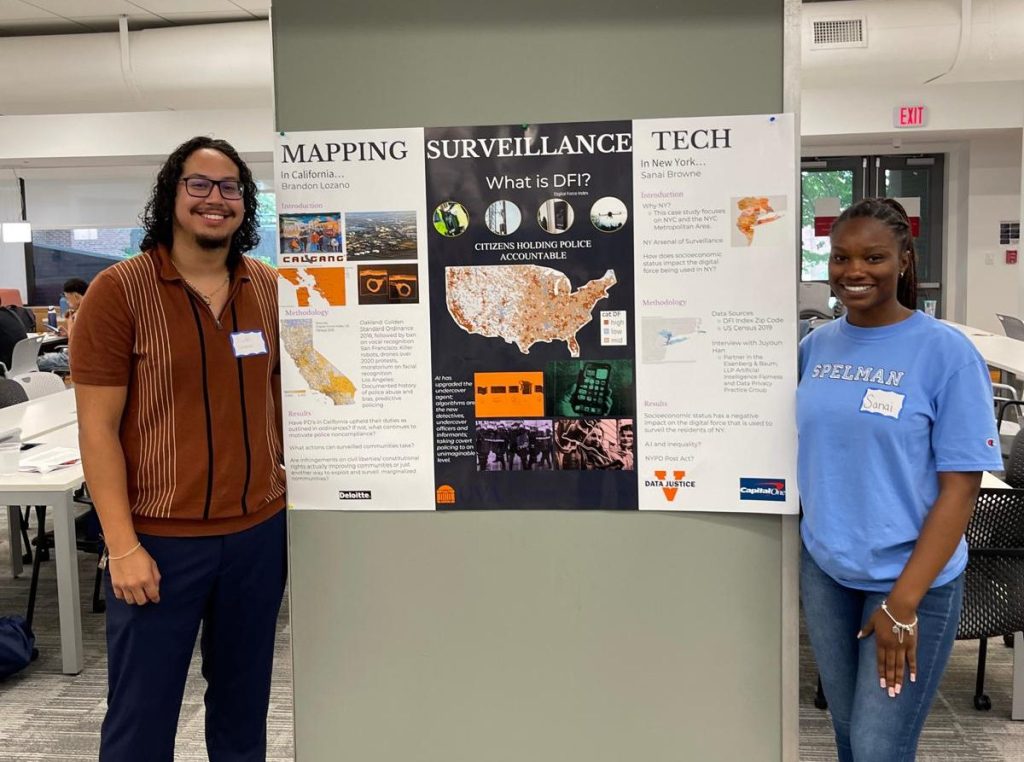
“That’s what’s so concerning in this current moment — we have an administration that is not bound by precedent,” Legal Defense Fund Senior Counsel Antonio Ingram II told Charlottesville Tomorrow. “They will issue executive orders and enforce voluntary compliance agreements that require parties to do something that’s not legally required. But through fear and intimidation, they’re trying to effectuate what even courts would not order.”
Rules barring any consideration of race in admissions and hiring also twist civil rights laws — originally intended to remedy generations of discrimination in higher education — into tools that restrict access for underrepresented groups, Ingram added.
“I think we need to remember why we need diversity statements, why we need the targeted recruitment of underrepresented minorities, because these demographics did not become underrepresented because they were less qualified, because they did not work hard enough,” he said. “They were underrepresented because they were the victims of state-sanctioned exclusion for centuries, and these tools were meant to remediate this exclusion.”
“The state created these disparities through laws, policies and social norms, and they can also work to lay the foundation to reverse these disparities,” he said. “But in this current administration, there’s both the denial — not only of the existence of the disparities — there’s a denial that they need to be reversed.”
The outcome, Ingram said, will undoubtedly be fewer students and professors from underrepresented or marginalized groups being recruited and retained at universities that sign these voluntary compliance agreements.
“The only way in which you can view these tools as preferential or discriminatory is to decontextualize them,” Ingram added. “That’s why it’s important to note that these moments of regressive interpretations of civil rights laws are always coupled with the erasure of histories and discussions related to race and gender, because they reinforce each other.”
Policies on international student enrollment could change
Columbia’s agreement also includes policies targeted at international student enrollment.
It requires that Columbia “examine its business model and take steps to decrease financial dependence on international student enrollment.” It also requires that Columbia conduct a review of its current international admissions policies and processes.
And — to the extent that the Family Educational Rights and Privacy Act allows — the university will have to share information with the federal government on all international students who are suspended, expelled or arrested.
While the Trump administration has not publicly explained its reason for these stipulations, they are in line with the administration’s increasingly restrictive policies and enforcement actions aimed at international student enrollment in the country, according to the Presidents’ Alliance on Higher Education and Immigration.
In early June, for instance, President Trump signed a proclamation denying visas to international students headed to Harvard, claiming that the university had a “demonstrated history of concerning foreign ties and radicalism,” according to a fact sheet from the White House.
“Our adversaries, including the People’s Republic of China, try to take advantage of American higher education by exploiting the student visa program for improper purposes and by using visiting students to collect information at elite universities in the United States,” stated the proclamation. The policy was later blocked by a federal judge for raising serious constitutional concerns.
Columbia settlement includes review of ‘Middle East’ programs
Per the agreement, Columbia must also appoint a senior vice provost to “conduct a thorough review of the portfolio of programs in regional areas across the University, starting immediately with the Middle East.”
This includes a review of educational programs, the processes for approving curricular changes and “all aspects of leadership and curriculum,” according to the agreement.
The agreement lists a number of university programs focused on the Middle East that will be placed under review, but also includes South Asian and African Studies under what it collectively refers to as the “Middle East Programs.”
In addition to reviewing existing programs, the provost will “steward the creation of new programs,” according to the agreement and partner with the university to “create a standard review process for the hiring of non-tenured faculty across the university” and make recommendations “about any necessary changes, academic restructuring, or investments” at Columbia.
“It’s interesting that they’re trying to monitor Middle Eastern Affairs, and they’re not monitoring European affairs, you know?” UVA’s Keene said. “It’s just so racially charged and politically motivated.”
The Trump administration has not publicly explained its reasons for these stipulations either. However, critics argue that they’re not only discriminatory, but set a dangerous precedent that violates the academic freedom of colleges and universities.
“This is not about combatting discrimination — there are already university policies and procedures designed to address hate speech and things that may be incendiary of violence,” Legal Defense Fund’s Ingram agreed. “This is an attack on specific demographics and independent academic discourse.”
“It represents a violation of the academic freedom of professors and universities,” he added. “We have to remember that attacks on universities are attacks on the core foundations of an engaged citizenry, and it’s quite troubling when we have the federal government trying to regulate subject matters in universities in a way that has not been done in prior generations.”
Antisemitism being used in ‘broader assault on higher education’
Under its agreement, Columbia must also amend its antidiscrimination policies to include the International Holocaust Remembrance Alliance’s (IHRA) definition of antisemitism, appoint dedicated staff to respond to antisemitism allegations on campus, add a new student liaison to support “the wellbeing of Jewish students on campus” and deliver additional training programs on antisemitism.
But the IHRA’s definition of antisemitism has been criticized by human rights groups for impeding free speech by restricting legitimate criticism of Israel, according to Human Rights Watch.
Students and professors at UVA have also expressed concerns that disingenuous accusations of antisemitism are being weaponized by the Trump administration to suppress political dissent.
On July 10, 40 Jewish faculty signed a statement condemning the “weaponization of antisemitism” to justify DOJ interference and dismantle DEI at UVA.
“We write united in extreme concern as we witness an exploitation of the term antisemitism deployed in an effort to harass, expel, arrest, deport, dox, and defame students, faculty, staff, and other academic workers across the country as part of a broader assault on higher education,” the statement said. “Politically disfavored speech is disingenuously being labeled ‘antisemitic.’ This misrepresentation makes Jews the face of political repression and the face of the suppression of speech; this, itself, is a form of scapegoating. This makes Jews less safe.”
“We also note we have heard the word ‘antisemitism’ used more in the last 18 months than we did in the immediate aftermath of August 11th and 12th [2017], when Donald Trump called the neo-Nazis who marched on our campus ‘very fine people,'” the statement added.
‘When UVA sneezes, we catch a cold.’
Finally, Columbia’s agreement prohibits the university from maintaining any DEI-related programs or initiatives and requires regular compliance reports to the DOJ on adherence to the ban.
At UVA, the DEI ban would largely affect programs that help underrepresented students enter traditionally exclusionary academic and professional fields.
Combined with the many other stipulations that raise concerns about ideologically motivated federal interference in higher education, the ban could also have ripple effects throughout the community, given that UVA is Charlottesville’s largest employer, landowner and healthcare provider.
Some local nonprofits, for instance, aren’t sure to what extent their relationships with UVA will continue following an agreement with the federal government.
Raudales, executive director of local nonprofit Sin Barreras — which provides services to Hispanic immigrants and their families in central Virginia — said he has not received any communication from UVA about the future of the organization’s partnerships with the university. However, he expressed concern about the uncertainty of future funding — something he said is affecting nonprofits across the city.
“With these changes and UVA pulling back on DEI and anything that’s focused on equity or demographically-focused, the concern is about the future,” he said. “Will we still be afforded the same opportunities? Will there still be the same funding? It’s wait and see if they cut it right now.”
“UVA and the community are closely connected. When UVA sneezes, we catch a cold,” Charlottesville Mayor Juandiego Wade added. “The city will be watching the various transitions and changes at the UVA very closely.”