

A group of energy companies hopes to build a 765-kilovolt electric transmission line spanning 115 miles across parts of central Virginia.
Though state regulators have not yet approved the project, the companies are moving ahead with planning to determine what route the line could take — and they are seeking input from residents.
At a series of meetings throughout the month of March, residents of impacted counties will have the opportunity to weigh in on the line’s path.
Take action
Share your thoughts about the route for the Joshua Falls-Yeats power project
Valley Link will host a series of meetings open to the public throughout the month of March about the Joshua Falls-Yeats transmission line project. In addition to the in-person meetings, two virtual meetings will take place on Thursday, March 5, and Monday, March 16, from noon to 1 p.m.
Community members will be able to ask questions and provide feedback on the two proposed routes for the transmission line. To view a map of the proposed project or to leave a comment online, visit Valley Link’s interactive tool. To reach a member of the project team, call (855) 617-6107 or email JF2Y [AT] vltransmission [DOT] com.
- Appomattox County
- Tuesday, March 10, 5:30 to 7:30 p.m., Appomattox Community Center, 220 Community Ln., Appomattox, 24522
- Buckingham County
- Tuesday, March 24 (two meetings): 11 a.m. to 1 p.m. and 5:30 p.m. to 7:30 p.m., Buckingham County Community Center, 16268 N. James Madison Highway, Dillwyn, 23936
- Campbell County
- Monday, March 23, 5:30 p.m. to 7:30 p.m., Lynchburg Regional Business Alliance, 300 Lucado Pl., Lynchburg, 24504
- Culpeper County
- Thursday, March 5, 5:30 p.m. to 7:30 p.m., Brandy Station Fire Department, 20057 Fleetwood Heights Rd., Brandy Station, 22714
- Fluvanna County
- Tuesday, March 10, 5:30 p.m. to 7:30 p.m., Fluvanna Community Center, 5725 James Madison Highway, Fork Union, 23055
- Goochland County
- Monday, March 23, 5:30 p.m. to 7:30 p.m., Central High Cultural and Education Complex, 2748 Dogtown Rd., Goochland, 23063
- Louisa County
- Thursday, March 12, 5:30 p.m. to 7:30 p.m., Betty J. Queen Center, 522 Industrial Dr., Louisa, 23093
- Orange County
- Monday, March 9, 5:30 p.m. to 7:30 p.m., Lafayette Station, 26322 Constitution Highway, Rhoadesville, 22542
- Spotsylvania County
- Monday, March 9, 6 p.m. to 8 p.m., Ni River Middle School, 11632 Catharpin Rd., Spotsylvania Courthouse, 22553
In a Feb. 13 news release, Valley Link — a partnership between Dominion Energy, Transource Energy and FirstEnergy Transmission — invited community members to a series of ten open houses, plus two virtual meetings, to offer input on route proposals for the Joshua Falls-Yeat transmission line, as the companies are required to do by state law. The proposed project would stretch from the existing Joshua Falls substation in Campbell County, near Lynchburg, up to a new proposed substation near Richardsville in Culpeper County.
There are currently two proposed routes under consideration, with several smaller variable options for each. Regardless of which of the two main routes is chosen, the transmission line would run through Appomattox, Buckingham, Fluvanna, Louisa and Orange counties, in addition to Culpeper and Campbell counties. Depending on the route chosen, the path may also include parts of Goochland and Spotsylvania counties.

The project would require clearing a 200-foot corridor along the entire route, much of which cuts through forested and agricultural areas. According to a report from 29 News, Valley Link has already sent out letters to 120,000 Virginia residents whose properties fall within the potential corridor for the transmission line, and “is hoping to form relationships with landowners to obtain their land through voluntary easements.” Valley Link would then compensate owners for their properties “at fair market value.”
That same report states that Valley Link plans to use eminent domain — the seizure of private property for public use by the government without the owner’s consent — as a last resort. However, Dominion Energy, one of the partners that comprise Valley Link, has previously demonstrated a willingness to utilize eminent domain, as was the case in 2025 when a farmowner in Charlotte County, Virginia refused to voluntarily sell part of his property for $1,500 per acre to be cleared for a 230-kV transmission line, according to a report by ABC 13. A 2025 land values summary by the U.S. Department of Agriculture placed the average value of farmland in Virginia at $6,100 per acre.
Regardless of how Valley Link plans to acquire the land for the proposed transmission line, the developers will need to clear a number of administrative hurdles to get to that point.
The project was approved in 2025 by PJM, the regional organization that manages the electrical grid in Virginia and a dozen other states in the Mid-Atlantic and Midwest, but will require final approval by the Virginia State Corporation Commission (SCC). Before Valley Link can even apply with the SCC, it needs to fulfill a list of the commission’s guidelines for large-scale public utility projects, of which the upcoming community meetings are a part.
During the subsequent review period by the Virginia SCC, there will be opportunities for community members to give their feedback on whether or not the project should be approved. Public comments can be submitted on the SCC website once the case is added to the SCC’s hearing schedule and the comment period opens. Community members can also serve as public witnesses on the day of the hearing either by telephone or in person in Richmond.
Charlottesville Tomorrow reached out to both Valley Link and the State Corporation Commission for an approximate timeline for the SCC proceedings, but did not receive a response as of publication.
Valley Link has characterized the project as a necessary part of ensuring an adequate supply of electricity as demand continues to increase throughout the commonwealth due to a variety of factors, including data center expansion and population growth. A study released by the Joint Legislative Audit and Review Commission in 2024 forecasted that without constraints, overall demand for power in Virginia is likely to double in the next decade, largely due to demand from data centers.
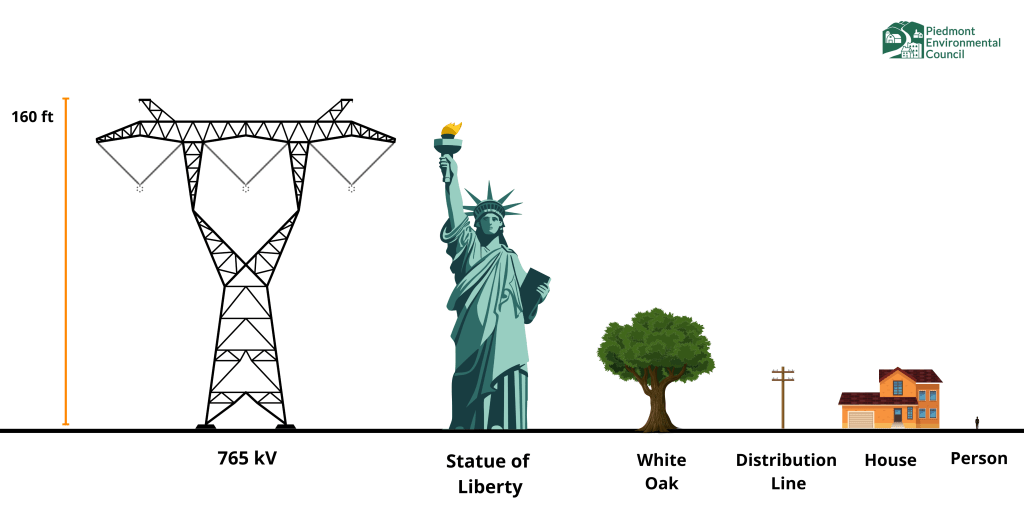
The 765-kV lines, like the one proposed by Valley Link, are the highest-voltage AC power lines used in the United States, and are capable of delivering approximately three times the energy of standard 500-kV lines. However, the lines also require more structural support. According to the Valley Link website, the Joshua Falls-Yeats project is still in early development and Valley Link has “not yet determined the type of structures that will be used.” The types of steel-lattice towers that generally support high-voltage transmission lines range from 135 to 160 feet tall — which is about the height of a municipal water tower or the Statue of Liberty.
Some residents and organizations have already begun to voice concerns with the project, including the Piedmont Environmental Council. In an email alert sent out on Feb. 23, Senior Energy Infrastructure Policy Analyst Mike Barber wrote that if the transmission line is constructed, “over 2,500 acres of land that is currently forested, farmed, providing valuable habitat and contributing to the rural economy and character of the region would be cleared and converted to utility right-of-way.”
Tammy Purcell of Engage Louisa reported that at a recent Louisa Board of Supervisors meeting, both supervisors and residents raised concerns about land preservation, distance from local schools, and potential health impacts, among other issues.