
Days after teachers performed a “sick out” at Charlottesville High School in response to the ongoing fights on campus, Charlottesville City Schools announced their plans for a new alternative education program.
The Knight School offers a chance for CHS students who struggle in a traditional high school to achieve academic success and prepare for post-secondary life, said Lamont Trotter, orientation facilitator for Knight School and principal for Lugo-McGinness Academy.
“They are going to know that they are loved,” said LaToya Brown, co-site facilitator and teacher at the program and instructional coach at Buford Middle School.
The idea of Knight School originally started with Superintendent Royal Gurley and his vision of improving academic success for all students, said Brown. It simmered for a couple of years until 2023 when Trotter revisited the idea of having a night program for high school students. The district decided to make it a reality, and was planning to launch the new program sometime during the spring semester.
The Nov. 17 CHS teacher sick-out accelerated the start date for the Knight School, said Brown. After several teachers called out in protest of the continuous fighting going on within the high school, City Schools canceled three days of classes for students. The incident forced staff, students and community members to take a deeper look at how the school division is creating a safe environment for everyone involved.
Ten days later, Knight School began.
The district presented the Knight School as a solution for students who are experiencing academic and social challenges at CHS. Though, that doesn’t mean that the students involved in the fights were all moved to Knight School.
“The students are alternatively placed by their school or by the Board, but for the students’ privacy, we decline to state their specific disciplinary or other backgrounds,” said Amanda Korman, spokesperson for City Schools. “The placement is part of a larger evaluation of the student’s needs.”
The Knight School is now one of six alternative programs available at City Schools. Lugo McGinness-Academy allows for students in grades eight through 12 who are at academic risk or wish to go to school with a more personalized course load. New Pathways is a similar program to Knight School, where Charlottesville’s 7th and 8th and grade students who need additional academic, social, emotional or behavioral help are placed in smaller settings. The middle school students work at the Boys and Girls Club at Cherry Avenue.
City School’s Work Achieves Lasting Knowledge, or WALK, program follows a similar structure to Knight School, but students still attend CHS during the day time. Charlottesville-Albemarle Technical Education Center — which was recently acquired by City Schools — offers career and technical courses. And students with “emotional and behavioral disabilities” can attend Ivy Creek School, which serves students in grades K-12 throughout nine school districts within the Piedmont region.
The point of the Knight School is to allow students the daytime to engage in work, volunteer, or other self-development activities. They get their core studies — math, reading, science and history — at night. And some students were already working part-time jobs before beginning at Knight School, said Trotter.
Students at the night school have been identified as kids who encounter several academic challenges, and are in need of a personalized curriculum with increased support from community members in a setting outside of CHS in order to make it to graduation. Whereas other alternative programs in City Schools may allow students to opt in themselves, students at Knight School can only be referred by City School officials.
Operating out of Lugo McGinness-Academy, school for those in Knight School will go from Monday through Thursday, and start at 3:45 p.m. and go on until 6:45 p.m. Students are also provided transportation, largely by Trotter himself in a school-registered vehicle.
By the end of the fall semester, five students were enrolled in the school. Now, that number is up to eight, said Brown. Trotter said they are hoping to enroll up to 30 students.
To protect the children’s privacy, the school district did not allow Charlottesville Tomorrow to speak with any directly. However, the district shared several questions from Charlottesville Tomorrow with the students, and provided their answers anonymously.
To protect the student’s privacy, the school district did not allow Charlottesville Tomorrow to speak with any directly. However, the district shared several questions from Charlottesville Tomorrow with the students, and returned their answers anonymously.
What’s your favorite part of Knight School?
- It’s only my second day.
- That it’s night and I don’t have to get up early.
- It’s small and barely any students here.
What’s something interesting you’ve learned about yourself in the time you’ve been in Knight School?
- If I work on my grades I may be able to have more time with my friends while attending Knight School.
- Teachers don’t have to be here but they give up more of their day to be here.
- I can pay attention more than I did at Charlottesville High School because all I did was skip.
How would you compare your learning experience at Knight School to Charlottesville High School?
- Knight School is better. There are no outside distractions.
- Kinda like Charlottesville High School because it gives you the whole high school experience.
- Knight School is for students who don’t want to be in school all day.
- Class sizes are smaller and it’s easier for the teacher to help us.
- Knight School is better because I can comprehend and learn better.
Do you have any goals you want to achieve while in the program? If so, what are they?
- Gain extra credit.
- To graduate.
- Make better grades.
The students who responded said they enjoy the timing of Knight School, and how it opens up their day for other opportunities.
One student wrote: “I can pay attention more than I did at CHS because all I did was skip.” Another wrote that the lack of distractions makes it easier to focus on their work, and another said that Knight School was better for them because they are able to “comprehend and learn better.”
One pupil appreciates how the employees there “give up more of their day to be here.” A different student is looking forward to having more time to spend with friends while getting their school in at Knight School.
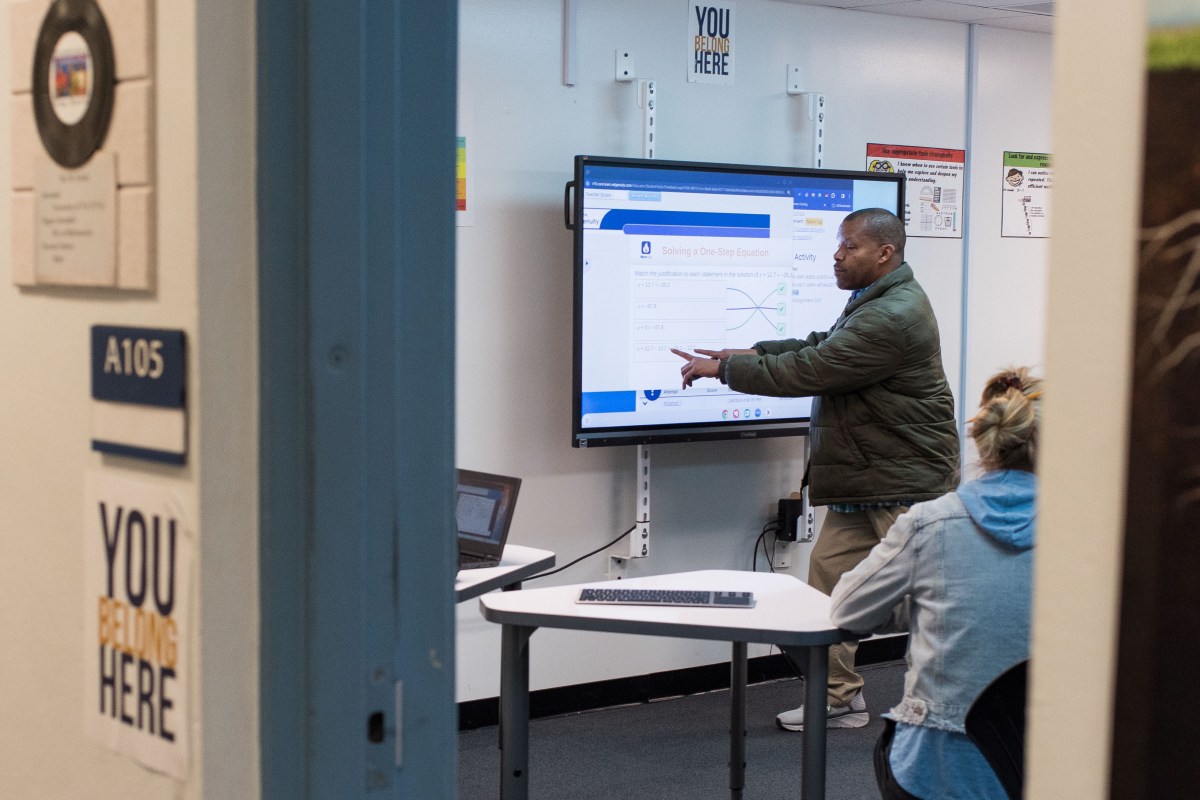
On Monday, Jan. 9 at around 4:30 p.m., students and teachers were slowly piling into Lugo-McGinness Academy. One student was having math class from teachers Melvin Grady and Holly Faulkner. The student nodded along while slouching over his school laptop as Faulkner talked him through the lesson.

Grady then clicked through a different computer to project a similar lesson full of line graphs on the white board for the other students who were expected to come later. The building was otherwise quiet as students and faculty alike were setting up for the evening.
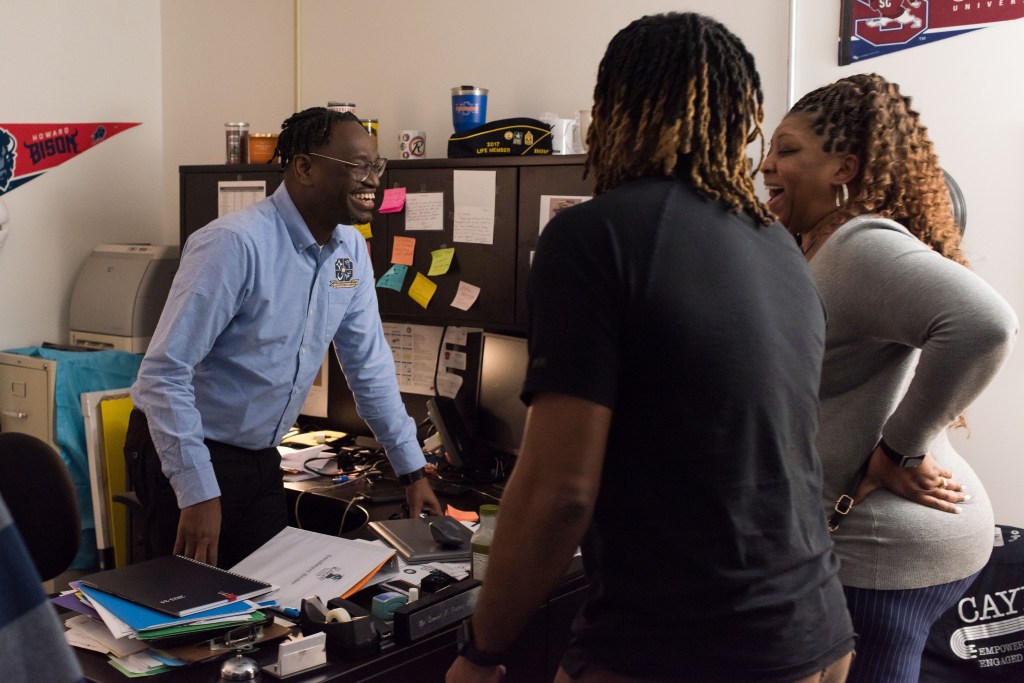
Brown welcomed another girl who walked in masked up with her headphones in. She responded with a slight groan when Brown asked her to take them off before sitting down at a desk. Across the hall Charmaine Williams, who teaches English and language arts at Knight School, was setting up her classroom while laughing with a former teacher who stopped by to say hello.
Starting this month, facilitators at the school are hoping to allot time for community partners — such as the Community Attention Youth Internship with Charlottesville, Virginia Career Works, or the Uhuru Foundation — to engage with students on their jobs, conflict resolution skills, and more.
Some students already work with a trauma-informed counselor from City Schools, said Trotter. Knight School plans to partner with the University of Virginia at some point in the semester, and offer students dialectical behavioral therapy from a clinical psychology intern. Counseling and daytime obligations are not required for each student, said Trotter.
Education and counseling are just some of the things students can expect at Knight School. Students are also given — or sometimes cook — a meal between classes with food from local restaurants or grocery stores. At the end of the school day, all the students and employees have “townhouse” time: a wrap-up conversation in which students discuss the highs and lows of their day, Trotter said.
And students aren’t completely removed from what they had at CHS. Students may be able to still enroll in their favorite electives, but can only attend them virtually or through asynchronous, project-based learning. Students who are taking an elective will typically do their work on Friday, said Brown.
Knight School isn’t a permanent solution for its students, Trotter said. If a student were to make improvements in their academics, they may be referred to Lugo-McGinness Academy, or in some cases, back to CHS.
“The goal is never for students to come to Knight School and remain there,” said Trotter.

Currently, many of the workers at the Knight School hail from CHS, Lugo-McGinness Academy and Buford Middle School and have “done their shifts,” said Joseph Patterson, co-site facilitator at Knight School and Algebra teacher at CHS. Meaning, Knight School isn’t the first, or only, time the teachers and facilitators have advocated for City Schools students outside of their usual positions.
Everyone who works in Knight School comes in with a great amount of intention, said Patterson and Brown. The staff at Knight School find moments throughout the day to connect with students on a deeper level and engage in restorative practices.
For instance, students are encouraged to write a letter to themselves that paints out their goals within or outside the school. Teachers like Brown or Charmaine Williams will review the entries from time to time and help students stay on track with their goals.
Given the high spirits of staff and students at Knight School, teachers still run into some challenges. Staff at the school are cognizant of the tension some students may have with each other, and make an effort to alternate days or times with them to avoid any further conflict, said Brown.
Melvin Grady, math teacher at Lugo-McGinness and Knight School, says the students who are in the program now are doing the “work.”
“They’re producing good work. They’re doing their school work and honestly feel good about themselves,” said Grady. “If they weren’t doing the work and showing up, I wouldn’t be doing this. I’m doing it so that I can help whoever comes there to get ahead and move forward.”
City School is in the early beginnings of what they envision Knight School could be. For instance, high school students won’t be the only ones getting help. Trotter said the Knight School is working to kick off its parent component, in which they will reach out to the families of Knight School students and see what areas they may need assistance. The facilitator anticipates offering guidance regarding obtaining general educational diplomas, or GEDs, programs, or housing opportunities to name a few.
Workers at Knight School are still collecting data, Trotter said, and hopes to have a soft launch of the parent program in the spring.
Trotter said he wants Knight School to change the stigma regarding alternative programs, like how it’s only for students who have caused “turbulence” rather than a student who needs additional support in order to achieve academic success.
“It’s not always punitive, where it’s someone that has gotten in trouble, but it just may be that student that’s saying, ‘Hey, I just needed to take a step back,'” said Trotter. “I want to be able to breathe because I’m a little tense. That’s the kind of place we want to provide support with.”