

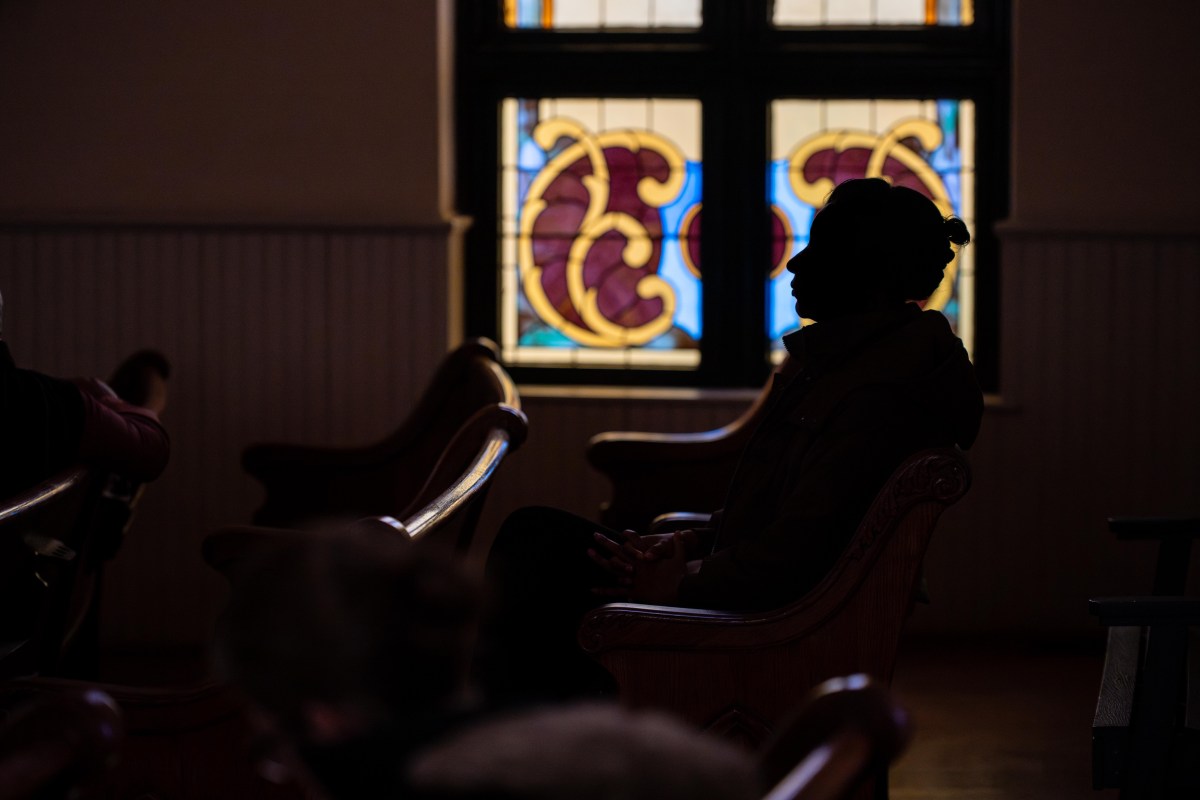
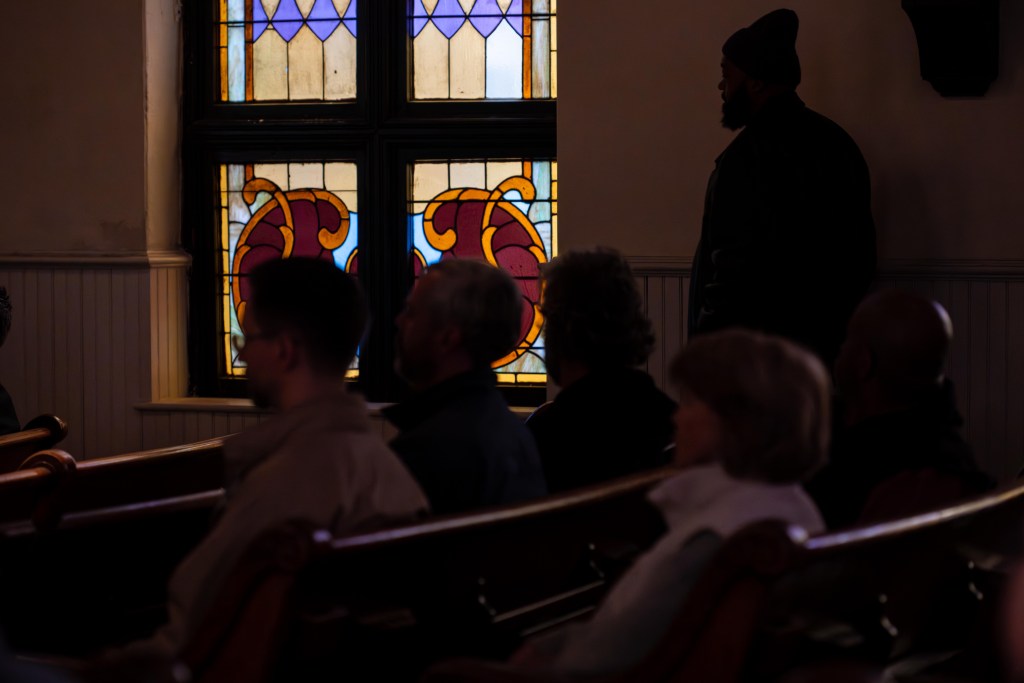
Thursday afternoon, pale light filtered through the stained glass windows of The Haven sanctuary.
Owen Brennan, executive director of The Haven day shelter, softly plucked hymns on a guitar as about 60 people slid into creaking wood pews and looked down at the small paper programs in their hands. Some held a single red or white rose.
They had gathered for a vigil to remember those community members whose lives were shortened this year by the experience of homelessness.
“Each name we read and remember today represents a life,” Shayla Washington, executive director of the Blue Ridge Area Coalition for the Homeless, said in her opening remarks. “A person who laughed, hoped, struggled and mattered. Someone’s child. Someone’s sibling. Someone’s friend. Too often, their stories were overlooked while they were alive. Today, we say clearly and collectively: they were here, they mattered and they are remembered.”
Throughout the hour-long event, Washington and other local homelessness service providers who spoke were clear: The vigil is a way for the community to remember those who’ve passed. But it is also an acknowledgement of the pain that the at least 249 people in the community who are currently experiencing homelessness, are living through.
It is also a call to action for the entire community to come together to help solve this problem, Washington said.
“Homelessness is not a personal failure,” she told everyone in the sanctuary. “It is the result of systems that do not provide enough affordable housing, accessible healthcare, living wages, or adequate support for people facing trauma, disability or crisis. When we lose someone to homelessness, it is not because they were invisible — it is because society failed to act with urgency and compassion.”
The Haven has hosted the vigil annually since 2010, either near or on National Homeless Persons’ Memorial Day, which is celebrated on the winter solstice, the longest night of the year. This year, it falls on Dec. 21. Communities all across the country hold similar events.
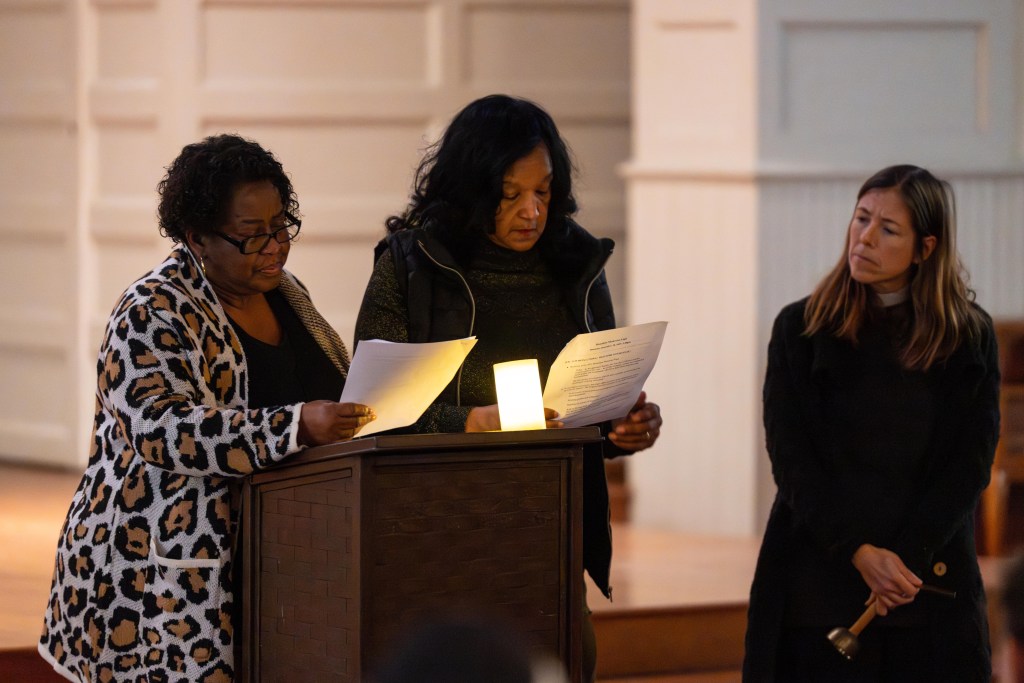
The sanctuary was silent Thursday afternoon while two shelter workers stood up and alternated reading aloud the names of those who passed. After each name, a third person rang a bell, waiting for the chime to end before reading the next one.
Danny. Joe. Nelson. David. Darren. Michael. Michael. Michael. Robert. Howard. Jeffrey. Mitchell. Timothy. Connie.
(Charlottesville Tomorrow is not publishing their last names because they are not alive to give their consent.)
Fourteen people.
And those are the people the service providers know of, said Ocean Aiello, operations director for The Haven. It’s likely that there are others that, despite their best efforts, shelter and social workers just don’t hear about.
That’s not unusual, Aiello said.
It’s difficult to know exactly how many people in the U.S. die each year while experiencing homelessness, or because they had been homeless at some point in their lives. The National Health Care for the Homeless Council, a national organization working to improve health care for people experiencing homelessness, estimates it’s between 5,800 and 46,500 people.
The gap is so large because the data is woefully incomplete, the NHCHC found. In 2018, the NHCHC identified 68 localities throughout the U.S. — a small fraction — who recorded the deaths of people experiencing homelessness that year. The counts came from a combination of local news reports, medical examiner and coroner findings, public records requests, and service providers, who often organize Homeless Persons’ Memorial Day in their communities.
In Virginia, the medical examiner does record this information, but only if informed that the deceased person is homeless.
“When the death is reported to us and the caller states that the decedent is homeless, we have a box that we check in our database,” Arkuie Williams, Administrator Deputy in the Office of the Chief Medical Examiner, told Charlottesville Tomorrow in an email Thursday.
But whether or not someone was unhoused at the time of their death isn’t always clear, service providers say. It can be even less clear if a person had been homeless, but was housed when they died. And the person calling the medical examiner might not know that status.
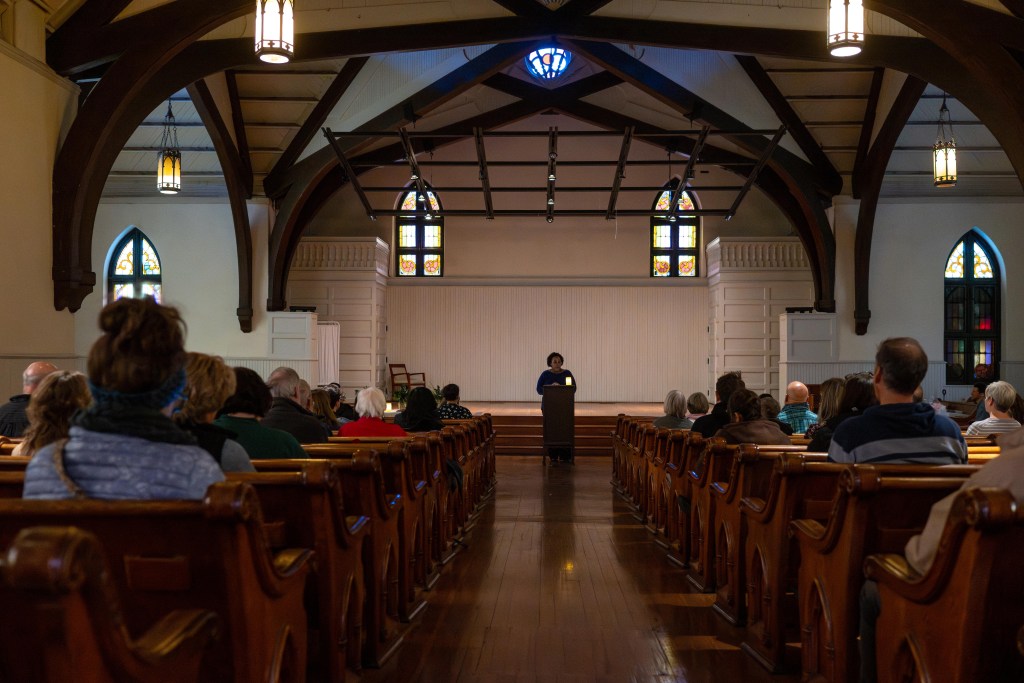
In the Charlottesville Community, the service providers are the ones who keep track. Since The Haven started hosting the vigil in 2010, they’ve read 137 names and grieved the ones that aren’t known.
Service providers often make up most of the crowd at the vigil. Many of their clients and shelter guests find it too hard to attend, said Aiello.
“They say it’s too painful, too fresh,” she said. “They’re still living in it.”
Homelessness significantly shortens life expectancy
People who experience homelessness die nearly 30 years earlier than the average American, often from preventable and treatable illnesses, according to the United States Interagency Council on Homelessness.
This is for a variety of reasons, according to peer-reviewed studies collected by Community Solutions, a nonprofit organization working to end homelessness nationally.
The research shows that experiencing homelessness often encounter barriers to getting the health care they need, whether it’s lack of transportation, health insurance or even identification. They might not have a place to store temperature-sensitive medications. Others might avoid the health care system altogether due to being previously stigmatized or discriminated against for their housing situation. Therefore, chronic conditions like anemia, asthma, epilepsy and cirrhosis are more common in people who are, or have been, homeless.
Homelessness also puts people at a greater risk for contracting an infectious disease. For instance, in the U.S., tuberculosis is about 46 times more common, and hepatitis C infections are four times more common, in the population experiencing homelessness compared to the general population, according to those studies cited by Community Solutions.
A person’s risk of suffering a traumatic head injury and experiencing violent crime — including gun violence (especially for youth) and sexual assault (particularly for women) — also increases when they are experiencing homelessness.
“When someone is experiencing homelessness, their number one goal is survival,” Brennan told Charlottesville Tomorrow a few days before the vigil.
When someone can’t get into a shelter at night — either because the shelter is full, they don’t meet the criteria to stay in that shelter or a shelter doesn’t exist — they spend the day figuring out where they’re going to stay that night, Brennan said. If they do have a spot to sleep, they spend a lot of time making sure it’s safe and that their belongings are safe. It takes time to get to a soup kitchen or a day shelter (like The Haven) for a meal. It’s a struggle to find a bathroom. It is hard on the body and the mind to be outside in the sweltering heat or the freezing cold.
“So much of their time is taken up with just addressing their basic needs,” Brennan said.
“Homelessness is very dangerous,” Aiello added. “I think that flies in the face of the stereotype that homelessness is a choice, which, of course, it isn’t. It’s many broken systems that lead people to the point where they can’t afford housing.”
Some of the folks who passed this year did so while experiencing homelessness.
One man died in Market St. Park on a freezing cold morning in early December. A morning commuter found him lying on one of the park’s benches. He was wearing a coat, but no shoes.
“He was not in great health, but the conditions contributed to his death,” said Aiello.
Another died in his sleep in an overnight shelter. He had been in good spirits before going to bed, laughing with shelter staff and fellow guests. Washington is grateful that he passed peacefully, and while sheltered.
Others passed while housed, but after experiencing homelessness. It’s not unusual for someone who has experienced homelessness for years to die shortly after getting housed, Washington said.
“Folks will move into their housing and their health will rapidly improve in a short period of time because they’re housed, they have supportive services, all after struggling along for so long,” she said. “Then they pass away. It’s like a shock to their system.”
These folks are memorialized in the vigil, too, because of the toll the experience of homelessness took on their lives.
For many of the people whose names were read Thursday night, this is the only service they’ll have, Washington said.
Per tradition, there were no eulogies at the vigil, no remarks about specific people. But near the end of the service, attendees were invited to share what they were reflecting on.
Sue Hess, a nurse and mental health professional, said that she “walks alongside” some community members experiencing homelessness, and was worried that she would hear familiar names that afternoon. She was relieved she did not.
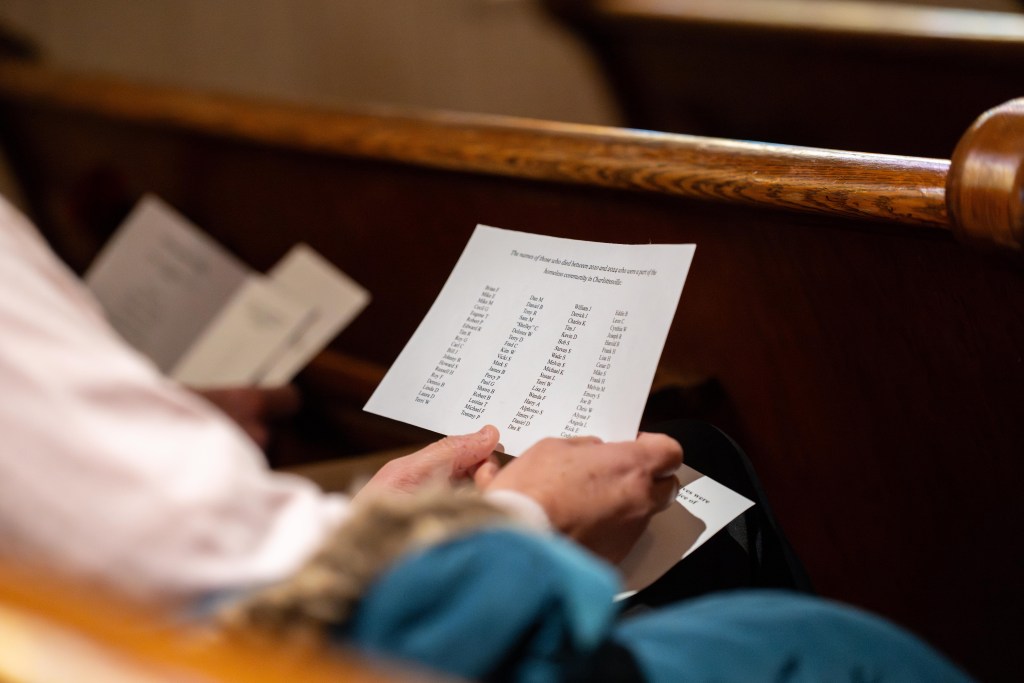
Samantha, another service provider, said she had lost a cousin to homelessness — her name was on the piece of paper handed out with the programs, with the names of folks who died in years past.
“We have to keep everyone in our prayers who are out here struggling,” she said. “It hurts me to tell them, ‘no, I don’t have housing for you.’ As a community, we have to keep pushing to help folks.”
Ang Conn, programs director at The Haven, asked for the community to have compassion for those living outside.
Charlottesville Mayor Juandiego Wade got up to say that City Council is committed to working with local service providers to address the causes of homelessness in the community.
One speaker, Amy, who didn’t give her last name, held a white rose as she tearfully shared a realization she’d had: Over the last few years, no one had said “God Bless You” to her more than folks experiencing homelessness.
After the closing remarks, people sat in stillness for a moment more before getting up to greet one another. Service providers, EMTs, lawyers, shelter guests and clients spoke with one another.
The vigil ended on a hopeful note for some of the organizers.
As Aiello gathered up the remaining flowers, she remarked that this year’s crowd was quite a bit bigger than last year’s. Usually they have about 30 people, compared to the 60 or so there that afternoon. She was especially surprised to see so many community members who don’t work directly in homeless services.
Washington nodded in agreement.
“This is the biggest crowd I’ve seen in years,” she said.
They’re taking it as a good sign: maybe the community is becoming more aware.