

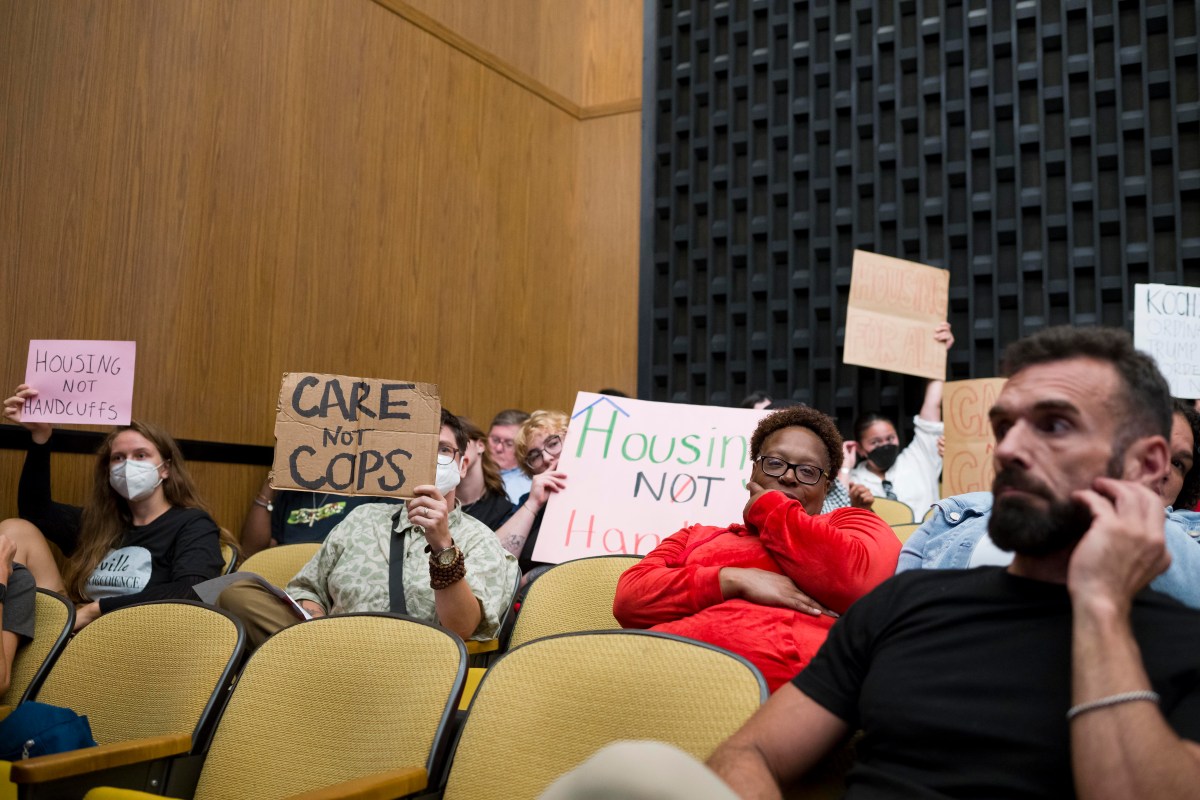
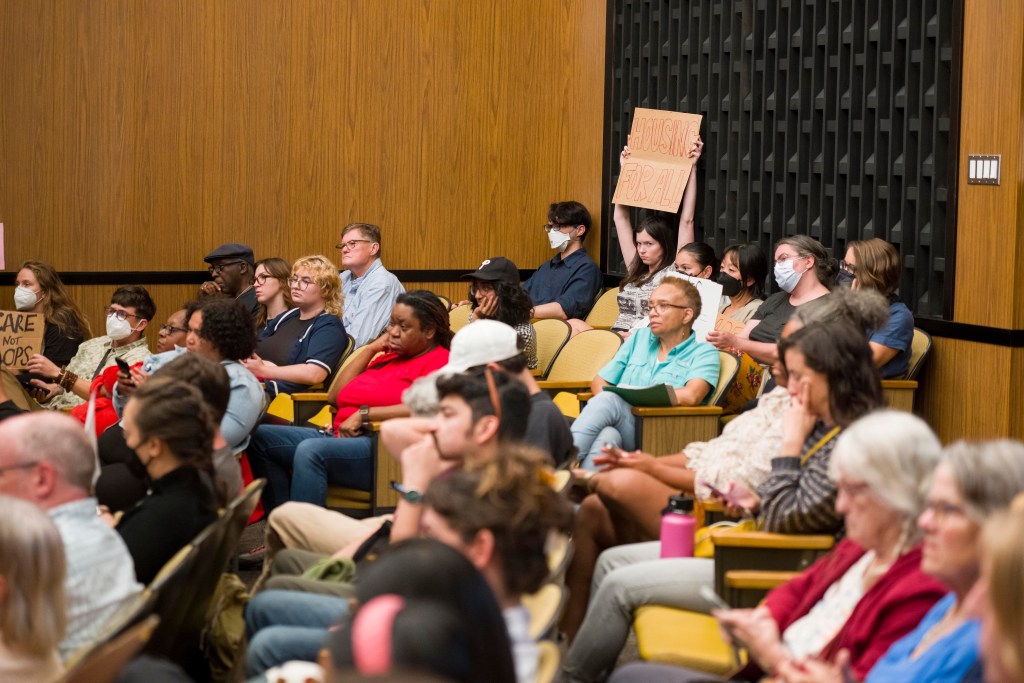
It was standing room only for most of a lengthy and impassioned City Council meeting Tuesday, Sept. 2, when dozens of community members lambasted city leaders over a proposed ban on camping, sleeping and storing personal belongings in public areas.
Over the course of the nearly four-and-a-half-hour meeting, community members raised three main concerns. One was that the ordinance unfairly targets unhoused community members who have nowhere else to go. Charlottesville does not currently have sufficient shelter space, or supportive housing, for everyone who needs or wants it.
Another was that the ordinance was developed behind closed doors, without community knowledge or participation.
And, they objected to how the ordinance was created without input from unhoused community members or from local nonprofit homelessness service providers — the people who are most familiar with the problem city leaders claim the ordinance is trying to address.
Community members who spoke against the ordinance called it “cruel,” “inhumane,” “dystopian,” “draconian,” “criminal,” and “Trump-like,” among other things. Others held signs saying “Care not Cops” and “Housing not Handcuffs.”
Only one person, representing some downtown business owners, spoke in support of the ordinance at the meeting.
Councilors said that in advance of the meeting, they’d received hundreds of emails about the ordinance expressing a variety of opinions on it.
Ultimately, the Council unanimously decided to table the ordinance, indefinitely. But people at the meeting still took the opportunity to share their thoughts on it just in case, as community member Rolph Braun put it, it “comes back from the dead.”
They did not hold back.
‘I would never have been able to build my life back had I been cited, fined or jailed simply for trying to survive’
Charlottesville Police Chief Michael Kochis presented the proposed ordinance to the council. It was the last item on the night’s agenda, and came up around 9 p.m.
The proposed ordinance banned sleeping, camping, and storing personal belongings on city-owned property, including sidewalks, parks, and rights-of-way.
Violation of the ordinance would be considered a Class 4 misdemeanor and punishable by a fine, according to the policy briefing summary on the ordinance.

A Class 4 misdemeanor is the lowest-level criminal offense in Virginia, and is punishable by a fine of up to, but no more than, $250 per the state code. A person thought to be in violation of the ordinance could be detained or arrested by a police officer, then brought before a magistrate who would decide whether to convict them, and how much the fine would be for.
Fines of any amount can be dangerous for folks who are already struggling financially, Charlottesville Public Defender Nick Reppucci told Charlottesville Tomorrow during a phone call Wednesday afternoon.
“The punishment is largely unenforceable,” Reppucci said. “You can’t squeeze blood from a stone.” What’s more, fines often come with additional court costs, he said.
Those fines often only punish people after they’ve done the hard work of getting back on their feet, Reppucci added. Sometimes the fines are washed away after a certain amount of time. But sometimes outstanding fines are sent to civil collections — meaning the amount could be garnished from their paycheck or their tax return, which could knock them down once again.
“It doesn’t do anything other than further marginalize people who by definition don’t have any financial security or don’t have any money,” Reppucci said.
During the meeting, some residents who had lived on the streets stood up to tell city officials, for the first time, about their experiences and what they thought of the ordinance.
Joshua Ballou has been homeless in Charlottesville for the past seven years, and said that in that time he has watched a community take care of itself.
“Some are drug users, some are mental. Some are just like people in this room,” he said. “Some have day jobs. Not once when I was sleeping under a bridge did anyone know I was sleeping under that bridge, including the pastor of my church and my boss.”
Beth Robinson talked about facing long, cold, dark nights with nowhere to go.
“Those nights were terrifying,” she said. I would never have been able to build my life back had I been cited, fined or jailed simply for trying to survive. You cannot punish people out of poverty, and you cannot legislate away human need.”
Some wondered why city officials haven’t learned this by now.
“Are y’all blind?” Rosia Parker, who was homeless for 5 years, 20 years ago, asked city officials. “This is nothing new.”
Police chief cites ‘quality-of-life’ complaints
This wouldn’t be the first time city officials have tried unsuccessfully to use legislation to curb the presence of people experiencing homelessness in the downtown area. In 2010, the city passed an ordinance banning panhandling on and around the Mall. Some business owners had complained about “aggressive panhandling,” C-VILLE Weekly reported that same year. Soon after the ordinance took effect, a couple of residents sued the city over it, claiming that the ordinance targeted beggars specifically.
The case made it up to the U.S. District Court for the Western District of Virginia, where Judge Norman Moon sided with the plaintiffs, C-VILLE Weekly reported in 2015. The plaintiffs received a nearly $126,000 settlement from the city, and the city had to do away with most of the ordinance. Parts of it, however, including a ban on soliciting restaurant patrons, remain.
“My examination of the record reflects that the city’s focus was on panhandlers, and the city created an ordinance reflecting that focus,” the judge wrote in his decision.
The reason for the ordinance Kochis proposed Tuesday night, he wrote in his policy briefing summary, was “a marked increase in quality-of-life complaints in and around locations where unhoused community members are residing.” He mentioned complaints of blocked sidewalks and rights-of-way, sanitation concerns and accumulation of personal belongings on public property, saying they have negatively affected surrounding neighborhoods and businesses.
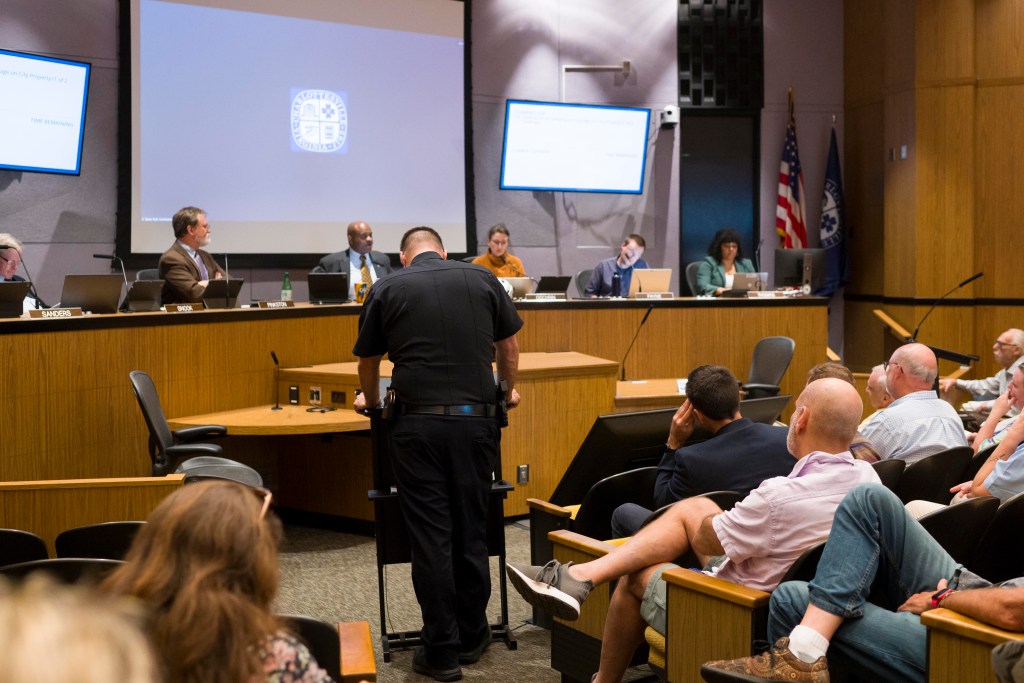
“While these concerns must be addressed, the enforcement of this ordinance is intended to be carried out with care and understanding, recognizing the challenges faced by individuals experiencing homelessness,” Kochis continued.
During the meeting, he said he’d heard from people on “all sides” of the matter, and that the ordinance was mostly about health and safety issues in large encampments, such as the one under the Free Bridge near the Rivanna River, which Charlottesville Police cleared in late August. (Read more on that here from 29 News).
There is a dam near the bridge Kochis said, and whenever it opens, water rushes in quickly, often carrying away the belongings of the people staying in the encampment. It posed a safety risk, Kochis said, claiming that the community there asked for an alarm system to be installed so that they could be alerted, rather than taken by surprise, when the dam opened.
“We owe it to our unhoused neighbors to ensure their safety, just as much as we do to our housed neighbors,” he said.
That didn’t sit well with many of the community members at the meeting, who booed, laughed at, and interrupted Kochis at multiple points, questioning whether the safety and wellbeing of unhoused community members was being considered at all.
During a public comment, Mo Van de Sompel accused city leaders of “blatant double speak” in their claims that the ordinance is for everyone’s safety.
The policy summary of the ordinance mentions “the city’s intent not to criminalize homelessness, but to provide a framework for ensuring safe and accessible public spaces.”
And yet, de Sompel pointed out, that’s exactly what making the offense a Class 4 misdemeanor does.
“You are making it a crime to do the things that homeless people have to do to exist,” he said. “This is literally double-speak. This is no law. It’s just an excuse to harass people.”
Community members skeptical on origin of the ordinance
During his presentation, Kochis also touched on the origin of the proposed ordinance.
He said that the process began on April 3, and that he had discussed the ordinance with city staff and Councilors in “2-2-1” meetings.
“2-2-1s are briefings from the City Manager and staff to Council,” city spokesperson Afton Schneider wrote in an email to Charlottesville Tomorrow the day after the City Council meeting. She emphasized that “they are NOT decision-making moments.”
But it seemed to community members that a decision had been made in those meetings — the decision to draft such an ordinance in the first place.
Community member Rolph Braun told city leaders that he found their use of the 2-2-1 meetings suspicious. He wondered out loud during the public comment period whether that type of meeting was used because it is a loophole in the public meetings provision of the Virginia Freedom of Information Act (FOIA).
Also called “two by two,” “daisy chain,” “serial,” or “Noah’s Ark” meetings, they are indeed exempt from Virginia FOIA laws, Megan Rhyne, associate director of the Virginia Coalition for Open Government, told Charlottesville Tomorrow.
“They are designed specifically to avoid Virginia FOIA’s requirement,” she said.
All meetings about public businesses with three or more members of a public governing body are required to have notice, minutes, and public attendance, said Rhyne. Charlottesville has five city councilors, and a gathering of three or more would be considered a quorum, which would trigger FOIA laws. If two councilors are present, the laws are not triggered.
Local governments often justify these types of meetings as being more efficient, a way to get things done, Rhyne said. To be fair, they’re not always used for nefarious purposes or to purposefully keep things from the public, she added.
Just because the meetings are legal doesn’t mean they’re a good idea, Rhyne said.
“The public hates them. What ends up happening is, all the issues get worked out in these two by two meetings, and by the time the public sees them, all the public’s getting is a done deal. So the public feels very left out, and their reaction is perfectly reasonable and justified.”
Not only did community members feel left out, they felt taken by surprise.
“In the future, let’s try to be respectful of the community when we’re trying to solve our hard problems, by not dropping a total change in the city’s approach to addressing homelessness on a holiday weekend,” said Matthew Gillikin, a representative of housing and transportation advocacy group Livable Cville, referring to the ordinance being made public right before the Labor Day weekend.
“Luckily, we have some people who pay attention, to make sure that the community came out to speak up tonight,” said Zyahna Bryant, a lifelong resident, activist and current Charlottesville City School Board candidate. “If we didn’t, that ordinance would probably have been approved.”
The timing was a surprise to at least one councilmember, too.
Councilor Lloyd Snook said during the meeting that he didn’t see the ordinance text until the weekend before the Tuesday meeting.
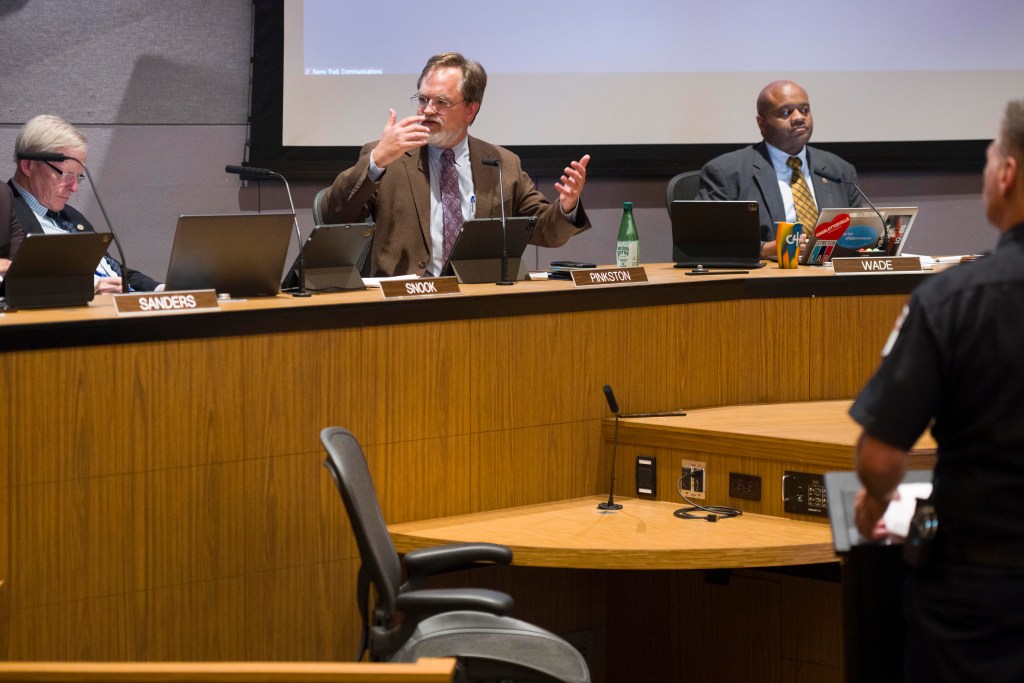
Throughout the meeting, people pressed city officials to tell them who had asked for the ordinance. Kochis deflected, saying that he had talked about it with city officials, gesturing to the dais where all five city councilors, and City Manager Sam Sanders, sat.
When someone from the audience asked who wrote it, City Attorney John Maddux said that his office did, because they had been asked to. He did not say who asked them.
“Why won’t you answer the very simple question that everybody wants to know? Who proposed this abomination?,” asked attorney Jeff Fogel “No one has the guts.”
By the end of the meeting, none of the city officials took responsibility for it.
Councilor Pinkston, however, said that the community itself had asked for the ordinance, or some form of it.
Pinkston said that every week, the City Council gets approximately a dozen emails “about issues on the Mall.” Though he did not specify what those “issues” are, it was implied that they were related to the presence of unhoused people on the Downtown Mall.
“I don’t think these people are bad people because they have concerns about things that they see,” he said. “I don’t think that the business community is composed of bad people because they have concerns. I don’t think I’m a bad person because I would like that situation to be better.”
Representative of downtown business owners raises concerns about decreased foot traffic, says the ‘atmosphere of the mall is diminished’
Earlier in the evening, Greer Achenbach, executive director of Friends of Charlottesville Downtown, was the only person at the meeting to speak in favor of the ordinance, and a handful of downtown business owners were there to support her.
On its website, Friends of Charlottesville Downtown describes its mission “to make Charlottesville a better-than-ever, more inclusive place for everyone by working with city government and the community to craft strategies and programs that stimulate downtown social and economic vitality.”
Achenbach said she was there to “represent the many visitors and business owners who are afraid to speak in favor of this ordinance for fear they will be misrepresented in a way that affects their businesses and their families.”
“We have a serious problem on the Downtown Mall, and the lack of ordinances is leading to a decrease in visitors and business activity,” she continued. “The city has invested millions of dollars into the downtown mall and seen a return on that investment ten-fold in the form of tax revenue. You have a fiduciary responsibility to protect the tax base that funds vital social programs.”
She blamed slow business on the presence of unhoused people.
“When visitors encounter encampments and cluttered belongings, aggressive panhandling, the atmosphere of the mall is diminished. This perception not only discourages tourism and local engagement, but threatens the long-term vitality of the businesses that rely on that foot traffic.“
“They should change their hearts,” someone called out.
Not all downtown business owners feel this way. “Unhoused folks have not affected our business negatively at all, and we have not heard from customers that it’s a problem,” Senlin Means, co-owner of The Beautiful Idea book store and maker’s market, told 29 News in July 2024.
Throughout the meeting, multiple people refuted Achenbach’s claim, saying that it’s not unhoused people, but high prices and lack of events to draw crowds that keeps them away.
“The reason why the businesses are small and they’re struggling is not because of homelessness,” said The Rev. Dr. Arthur Long Jr. from First Baptist Church. “It’s because of the price point. When a person cannot afford to purchase goods at a reasonable cost, the businesses diminish.”
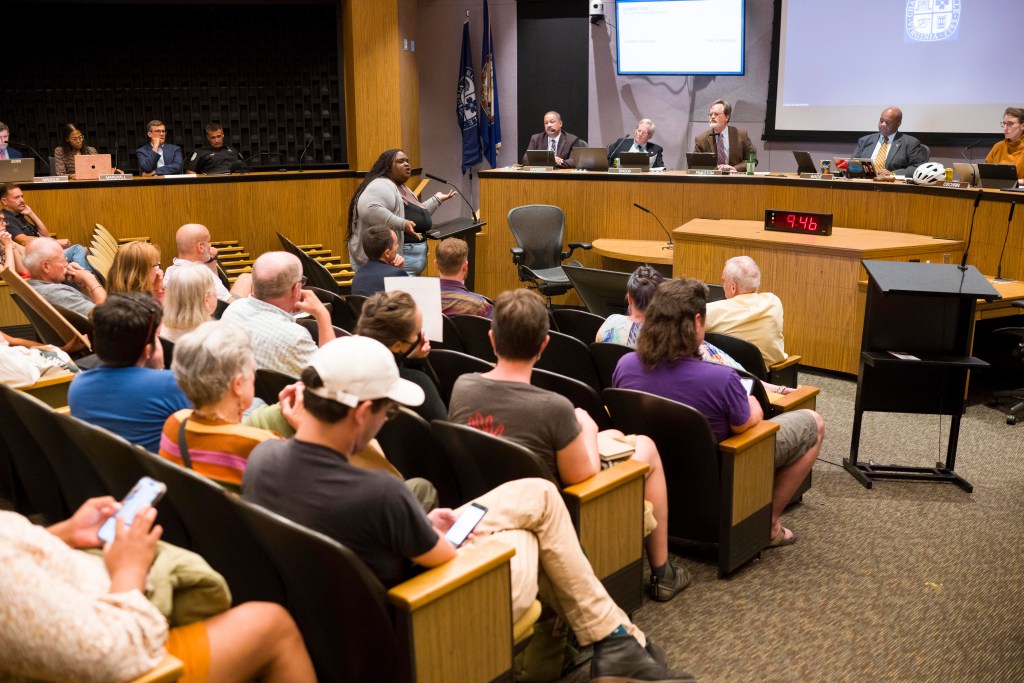
Zyahna Bryant, a lifelong city resident, echoed that sentiment.
“The Downtown Mall is often dead because we don’t need that many trinkets and pottery shops,” said Bryant. “We need things to do.” She pointed out that when things like the annual Tom Tom Festival are happening on the mall, or when go-go bands play The Pavilion for Fridays After Five, people come out for them. “I don’t think it’s rocket science.”
Aidan Workman, lead organizer and executive director of Interfaith Movement Promoting Action by Congregations Together (IMPACT), said that he feels safe when he takes his young daughter to the Mall. The reason why it’s not a particularly pleasant trip is because there is no public restroom where he can change his daughter’s diaper, nor is there a comfortable place to sit that is not associated with a business.
“I think that a lot of these decisions are made out of wanting to make it harder for homeless people to exist on the Downtown Mall,” Workman said.
In her statement to Council, Achenbach said that it was just “a small contingent of vocal people who feel that these ordinances are considered lacking conscience.”
A little later, Councilor Pinkston said something similar.
“What I have observed is that there’s a very deep cognitive dissonance within the city,” he said. “People come tonight, they’ll email us with hundreds of emails, and their hearts are in the right place. But when I go meet with people on their front doors, people do not want a shelter in their neighborhood.”
Community members present in the chamber vocally rejected that sentiment from both Achenbach and Pinkston, booing both of them.
Gillikin later said, to applause from the audience, that he resented the idea that the people who had packed the Council Chambers, who spilled out into the hallway to show their support for unhoused people and their opposition to the ordinance, were “a vocal minority,” “rabble-rousers” who say one thing in public and another in private.
People experiencing homelessness and their service providers left out of ordinance development process
Another major issue community members had with the ordinance was that it was created without the input of people actually experiencing homelessness in the community, or the service providers who work with them every day.
Kochis said during his presentation that the ordinance had been developed by a working group. Councilor Natalie Oschrin asked him what conversations the group had with homeless services providers like The Haven, People and Congregations Engaged in Ministry (PACEM), The Salvation Army, and the Blue Ridge Area Coalition for the Homeless (BRACH).
“There were none,” Kochis replied.
Some people in the audience laughed at his reply.
On Tuesday afternoon, a few hours before the meeting, leaders from three local homelessness services organizations opposed the ordinance in an open letter to Charlottesville City Council, City Manager Sam Sanders and Chief Kochis.
“Forcibly removing people from these spaces is not a solution,” wrote leaders from The Haven, a day shelter on Market Street; PACEM, an organization that runs a roaming low-barrier overnight shelter in the colder months; and the Blue Ridge Area Coalition for the Homeless, an agency that helps coordinate efforts across local shelters and social services departments
“Criminalizing people for the simple act of existing without shelter is both unjust and ineffective.”
They wrote that the ordinance would only deepen the crisis, because national data and experiences from other cities show that sweeps of encampments often lead to the loss of people’s personal belongings, medications, identification, and connections to social services. Without these things, it is even more difficult for people to escape homelessness, they wrote.
A recent ProPublica report gives a look at what people have lost when their encampment has been destroyed.
The service providers asked Council to delay voting on the ordinance until Charlottesville has a year-round low-barrier shelter. Until that shelter is built, they asked the city to provide up to three designated areas where people experiencing homelessness will be permitted to camp. Charlottesville Police Department could monitor the sites, which would be regularly visited by service providers, they offered.
The idea of a campground caught the attention of various people at the meeting. Kochis, some councilors, and some community members all expressed interest in it, though opinions on where it should go varied.
“It should not be in our business district,” Achenbach, the Friends of Downtown Charlottesville representative, said.
Another person, whose name Charlottesville Tomorrow could not hear, said that it should indeed be in the business district, because that’s where many homeless services are located. The Haven Day shelter, a few soup kitchens, and the city’s Department of Social Services are all located on, or very near, the Downtown Mall.
Jordan McNeish, who has been homeless off and on since he left home at 16, said sleeping in a park was a lifeline for him. The nights he had to sleep outside in the cold were the worst, he said, and when the sun came up the next morning, he was grateful he could sleep for a few hours, safely, in the sunshine in a park.
Camping areas give people “autonomy,” he said, and while he supports the creation of a low-barrier shelter, that won’t work for everyone. He said that he doubts he would have made it back on his feet if he had been in a shelter environment.
Wanting to remind the city of its prior decisions, Gillikin pointed out that there was a tent community at Market St. Park in September and October 2023, but the city cleared it.
“You didn’t want a campground. The same folks here, we said keep the campground going. You said ‘no, the business community is upset.’ I’m just reminding us of our past.”
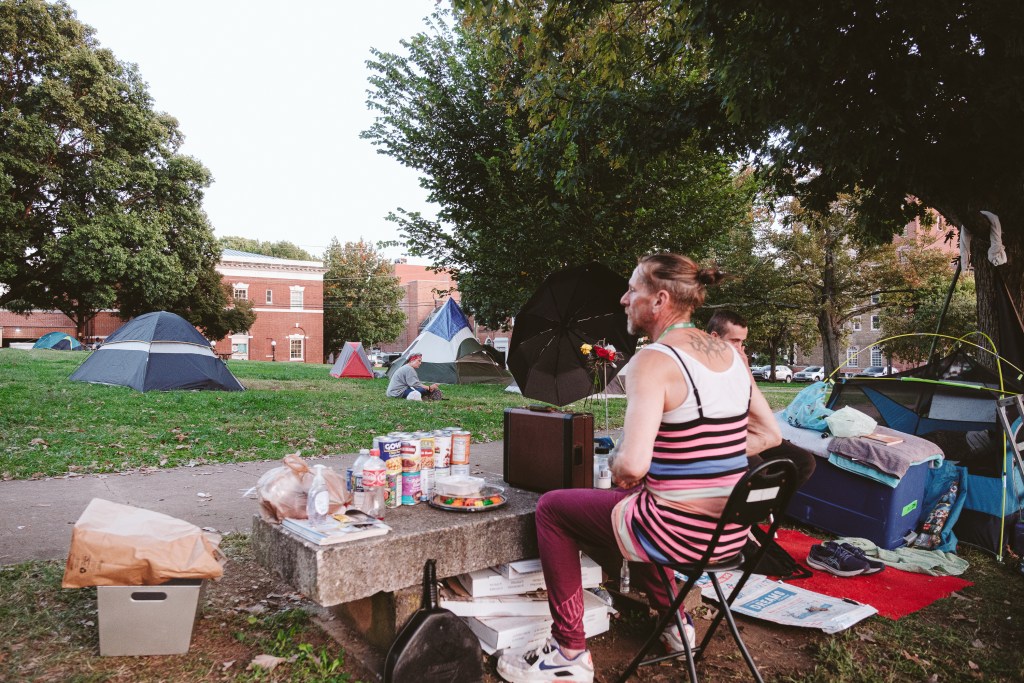
Isis Neumann, who herself has experienced homelessness, questioned whether a campground is an adequate solution, no matter its location.
“It does not put us any closer to this ordinance being okay,” she told the council. “I’ve lived on the street at multiple points in my life,” she said, her voice cracking. “I don’t want to go live where everybody else can see me. That’s scary.”
“I don’t understand who the hell you think you are, or who the hell the cops think they are, to say ‘this is your little field, and this is the only field you can be in,’ and try to call that humanity. That’s not humanity. That’s fucked up.”
A camping area is not the only solution city officials have proposed in recent years. For the past couple of years, Charlottesville City Manager Sam Sanders has been looking for a location for a permanent overnight low-barrier shelter — something the city does not currently have. Sanders revealed a “homelessness intervention strategy” to City Council in Oct. 2023, and a year later proposed that the city use $600,000 in American Rescue Plan Act (ARPA) funds, which is taxpayer money, to purchase six micro-shelters, Charlottesville Community Engagement reported. Those six would serve as a sort of pilot program, to see if the city could create a micro-shelter community. When the Council allocated ARPA funds at the end of 2024, it did not allocate any for micro-shelters.
Sanders also considered a building on the corner of Avon St. and Levy Ave. as a possible shelter site, and faced pushback from some community members. City council voted unanimously to buy the building in February 2024, but later that year, Sanders said there was no plan for the property. Instead, he was looking into partnering with The Salvation Army to convert its thrift store in Fifeville into the shelter the city needs — that idea was controversial as well.
City Council is ready to support a low-barrier shelter, councilor Michael Payne said during the meeting, but there needs to be an agreement on how that shelter should be run, and who should run it. And if such an agreement is made, and the money committed, it won’t come online right away.
“It’s going to take years and millions of dollars,” Payne said.
In their letter, The Haven, PACEM, and BRACH offered their expertise in helping the city develop a response to homelessness that is “humane, cost-effective, and rooted in long-term solutions,” and asked to be part of a working group composed of city leadership, Charlottesville police, homeless services providers, Downtown Mall business owners, and community members.
Shayla Washington, executive director of BRACH, repeated these requests at the meeting.
Her experience isn’t just in homelessness services, she told city officials. She has experienced homelessness, in Charlottesville, too.
She talked about living in her car, how police would turn their car headlights on her and she would wake up in a panic, wondering if she was going to get arrested because she didn’t have a place to live. What she really should have been worried about, she realized later, was someone breaking into her car — her home — or, worse, raping her, she said.
She implored city leaders to act with compassion when it comes to unhoused community members, and to remember that people are living on the streets in part because there is so little permanent affordable housing available to them.
“This conversation should not be happening without talking about affordable housing at the end of it. Charlottesville should not be considered a world-class city unless we are talking about housing for all,” she concluded, citing one of the city’s oft-used slogans.
“I’ve been on the other side of this trauma and I’ve made it through,” she said, “but not everybody is as lucky as me.”