

Wednesday afternoon, the Albemarle County Board of Supervisors will hear from county staff about how it might create an affordable housing trust fund — something local housing advocacy groups have been asking the county to do for years.
A housing trust fund is a special type of fund established by a local government specifically for the purpose of building and repairing low-cost housing. What makes this type of fund different from others is that it has a dedicated source of revenue. For instance, a local government could dedicate a certain amount of a tax rate toward the fund. While the amount of money might change year to year, that revenue source would remain the same.
The idea is that with guaranteed money in the fund, developers can feel more confident applying for project funding from the local government to help offset construction and maintenance costs, which is the biggest roadblock to building affordable housing.
What’s more, for every dollar put into an affordable housing trust fund, counties leveraged an average of $8.50 in additional public and private funds, according to the 2016 Housing Trust Fund Survey Report. (That amount varied by state, and is different for cities.)
IMPACT Cville, an interfaith group of about 25 congregations throughout the Charlottesville area, has asked Albemarle County every year since 2017 to establish an affordable housing trust fund. For at least the past couple of years, the group has asked the Board to both establish the fund and contribute at least $10 million to it.
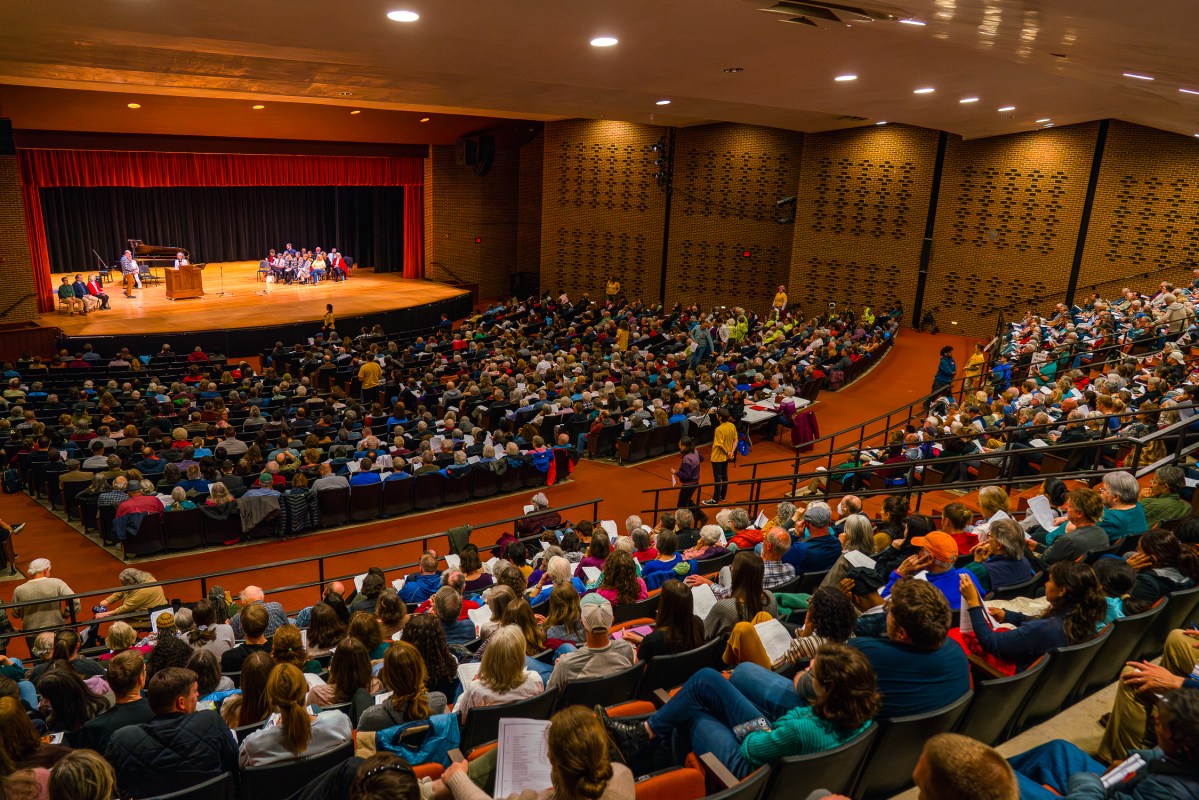
On April 8, more than 1,100 people gathered at Charlottesville High School’s Martin Luther King Jr. Performing Arts Center for IMPACT’s annual social justice action, to make that request of the board once again.
And before that, in January, a coalition of 50 local organizations signed a letter urging the Board to invest more deeply in affordable housing in a few different ways, including committing $10 million annually to an affordable housing trust fund.

Since IMPACT has been pressing Albemarle County for stronger commitments to affordable housing, the county has made “some progress,” Vikki Bravo of Congregation Beth Israel noted during the April 8 rally.
In July 2021, the Board adopted a new housing policy, one designed to not only increase the overall supply of housing, but to increase the supply of and preserve existing affordable housing. The policy makes a number of recommendations toward that end, including establishing an affordable housing trust fund with a dedicated and sustainable source of money. The staff report the Board will hear on Wednesday is the first step in that process.
Additionally, the Board recently made its biggest single-year commitment to affordable housing yet. Earlier this month, the Board adopted a $638.1 million budget for fiscal year 2026, which includes $5.2 million for the county’s Affordable Housing Investment Fund. That’s the most the Board has ever committed to that fund, which is the only pool of money the county dedicates solely to affordable housing projects and programs.
That $5.2 million will come from a variety of sources, all of it taxpayer money, according to County budget documents. The largest portion, $3 million, is a one-time allocation. Another portion, $1.2 million, will come from real estate taxes, which the Board is increasing in part to fund affordable housing initiatives.
The remaining $1 million was added during an April 7 budget work session. Supervisor Mike Pruitt, who represents the Scottsville Magisterial District, motioned to reallocate that sum from the County’s Strategic Priorities Reserve to the Affordable Housing Investment Fund. Pruitt’s motion passed unanimously, with the five other Supervisors voting in favor of it.
Pruitt wanted to add $1 million more, but Supervisor Ned Gallaway, who represents the Rio Magisterial District, pointed out that the Affordable Housing Investment Fund isn’t the only pot of money the county can use to support affordable housing projects. For instance, the Board has given economic development fund money to affordable housing projects, such as Habitat for Humanity’s redevelopment of the Southwood Mobile Home Community.
That could happen again, Gallaway said.
But “could” is the sticking point for IMPACT and other groups. Albemarle County’s Affordable Housing Investment Fund is not a trust, meaning that the amount of money that goes into it — and toward low-cost housing projects — varies from year to year.
For instance, for the 2024 fiscal year, the county put $3.9 million into the Affordable Housing Investment Fund (then called the Housing Fund). The following year, in FY25, it was $2 million.
So, while $5.2 million for FY26 is the most the Board has ever promised for affordable housing, it’s “not enough,” Bravo said to Pruitt, Gallaway, and Ann Mallek, the three Supervisors who attended the April 8 event.
Bravo asked them and their fellow Supervisors to figure out how to dedicate more money to the fund “so that we don’t have to scrape together the money in the budget every year.”
“We’re glad they found the additional money” this year, Bravo said to the audience. “But we know that $10 million is needed this year, and every year after.”
The Supervisors present at the rally said they support establishing an Affordable Housing Trust Fund as laid out in the Affordable Housing Plan. Getting to a $10 million annual commitment might be difficult, they said, but they want to try.
Supervisors Diantha McKeel (Jack Jouett District), Jim Andrews (Board Chair, Samuel Miller District), and Bea LaPisto-Kirtley (Rivanna District) did not attend the meeting.
McKeel said that while she didn’t attend, she’s committed to continuing to meet individually with representatives from IMPACT, and to establishing a housing trust fund.
“I support the objective,” McKeel wrote in an email to Charlottesville Tomorrow.
LaPisto-Kirtley said that while she received an invitation to the April 8 rally, she did not see a way to RSVP, which is why she did not attend. In a phone call with Charlottesville Tomorrow, she talked about the investments in affordable housing that Albemarle County has made recently, including permanent supportive housing at Vista29 (the old Red Carpet Inn) on Route 29, and Habitat for Humanity’s redevelopment of the Southwood mobile home community.
“We are trying,” LaPisto-Kirtley said, pointing out that the county has added new incentives for developers and have approved the constructions of thousands of new units of housing at different price points. “We increased the number of affordable housing units. We are continuing to do so. It’s not an easy solution, and it’s a lot of money — and the people who pay for that are the taxpayers.”
She said she’s not sure if IMPACT is “looking at the whole picture” when it asks the Board to commit $10 million to affordable housing every year. Doing so would involve increasing the tax rate even more than the Board already has this year, which would increase the burden on taxpayers.
“I don’t know how many people you would get to support that,” she said.
Board Chair Jim Andrews, who represents the Samuel Miller district, said that if he received an invitation, he didn’t see it. “I don’t remember an invitation with specific questions,” he wrote in an email to Charlottesville Tomorrow. “It is possible that one came in the U.S. Mail and I missed it. I don’t have anything in my email this year about the meeting.”
After the 2024 IMPACT event, Andrews pointed out to Charlottesville Tomorrow that creating an affordable housing trust fund is part of the county’s housing policy.
Take Action
Attend or watch the Albemarle County Board of Supervisors regular business meeting in Lane Auditorium in the Albemarle County Office Building at 401 McIntire Rd. in Charlottesville. The meeting begins at 1 p.m. on Wednesday, May 21, and the affordable housing trust fund presentation is scheduled for 3:15 p.m. See a draft plan for the fund here.
Between fiscal years 2021 and 2025, Albemarle County invested about $17.24 million total into affordable housing projects and programs, according to a presentation slide county spokesperson Abbey Stumpf shared with Charlottesville Tomorrow.
Those investments include:
- $10.5 million for phases 1 and 2 of Habitat for Humanity’s redevelopment of the Southwood Mobile Home Community, which will turn a 341-space mobile home community into a mixed-income neighborhood with 1,000 units available to rent and own;
- $3.1 million for the first phase of Virginia SupportWorks Housing and Piedmont Housing Alliance’s Vista29 project, which will have 80 units of permanent supportive housing for people experiencing chronic homelessness;
- $3 million for Piedmont Housing Alliance’s Hickory Hope apartments at Southwood, which will be affordable to families with incomes between 30% and 60% Area Median Income (and include amenities like social activities and food bank distributions);
- $625,000 to help Piedmont Community Land Trust purchase 12 newly constructed townhomes in the Spring Hill Village development, which will become homeownership opportunities for families earning no more than 80% of Area Median Income.
(Area Median Income is calculated by the U.S. Office of Housing and Urban Development annually, so it is a changing number. In 2025, a family of four at 80% AMI in the Charlottesville area earns $100,650; at 60% AMI, that family earns $75,480; at 30% AMI, that family earns $37,740.)
Funding for those projects came from a few different sources, including the Affordable Housing Investment Fund; Human Services Funding Program allocations; and American Rescue Plan Act (ARPA) funding, which was one-time federal relief money that is no longer available.
Those investments went to the construction or preservation of 1,703 units of rental and owner-occupied low-cost housing. They also went to support services for hundreds of victims of domestic violence, people experiencing homelessness, and families and individuals who needed help staying in their homes or finding a new place to live, Stumpf said.
Wednesday’s staff presentation about establishing an affordable housing trust fund is purely informational. The Board will not be making a decision or taking a vote on whether or not to establish one that day.
Editors’ Note: This article was updated on May 23, 2025, to clarify that dedicated sources of public revenue are used for a housing trust fund.