

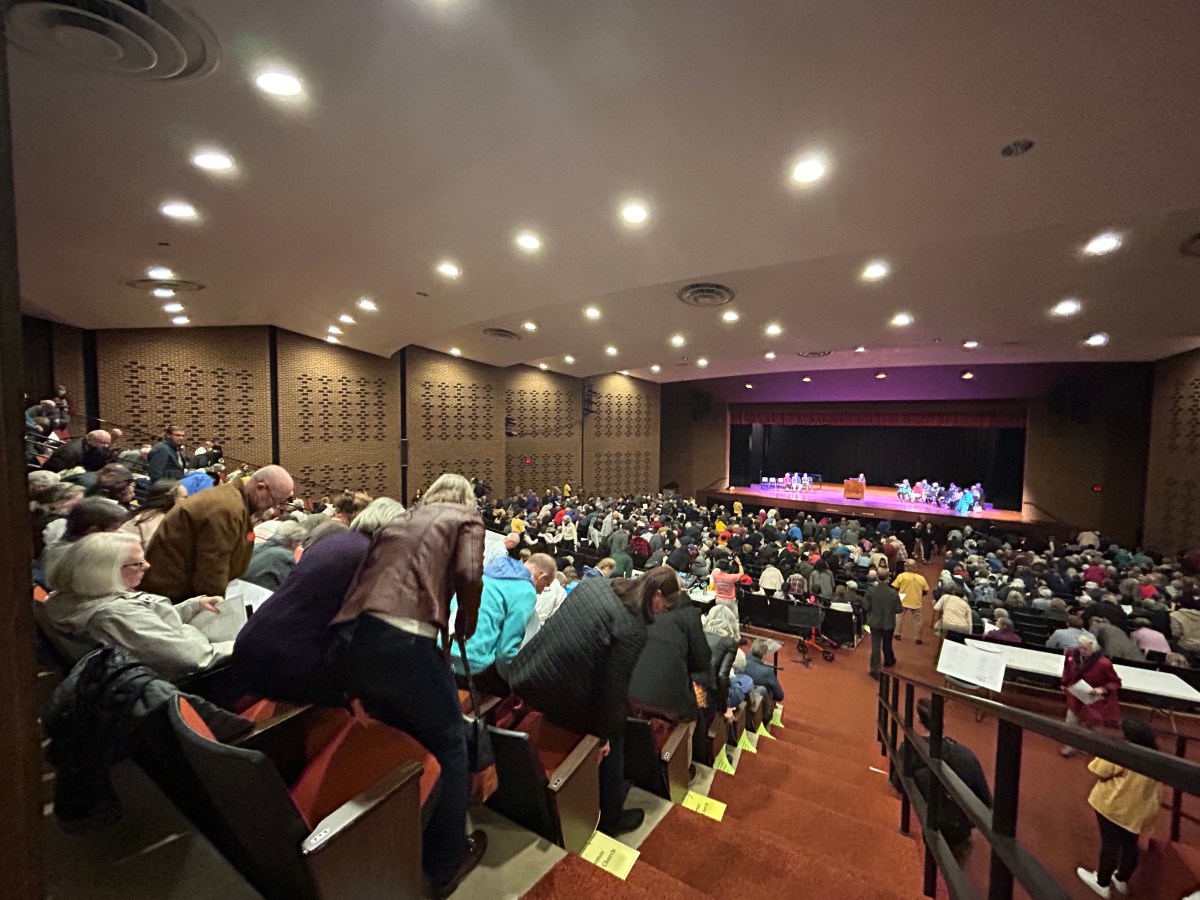
During a massive public meeting at Charlottesville High School’s auditorium Monday night, Laura Swift took the stage to tell her story.
“Born and raised here, working in local businesses until I became disabled, and then volunteering at a number of social support organizations, I am a law-abiding member of my community,” she said, speaking into a microphone before more than 1,000 people. “Yet I feel there is no place here for me.”
She wants to live on her own, she said. But she can’t afford to. She’s far from the only one in this situation. And that’s why IMPACT Cville, an interfaith group of more than 25 local congregations of various faiths, organized this particular rally.
Its purpose was to ask the Albemarle County Board of Supervisors to establish something called a housing trust fund. IMPACT wants the county to commit at least $10 million annually to it, and prioritize funding projects that would create housing for families making less than 60% of the area median income, or about $75,000 per year for a family of four.
Three of Albemarle County’s six supervisors attended the rally, Mike Pruitt, Ann Mallek, and Ned Gallaway. (State law prohibits more than half of governing boards from gathering without giving legal notice and calling a meeting.) By the end of the rally, all three had committed to creating the fund.
That doesn’t mean it’s happened. The supervisors will need to reconvene with the full board and formally agree to establish such a fund. And at least some of the supervisors are skeptical that this is something the county can do quickly.
Still, the fact that the three attending supervisors showed such willingness to commit the time and money was encouraging to those who attended.
“Many of our neighbors are beaten down by low income, high rent,” Apostle Sarah Kelley of the Faith, Hope, and Love Church of Deliverance, said during the gathering’s opening reflection. Kelley, who was born and raised in Charlottesville, is known throughout the area for her social and racial justice advocacy.
Pastor Liz Emery of New Beginnings Christian Community said that because her congregation is “especially open to addicts and alcoholics, we have a lot of poor people.” Right now, two of her congregants live in homes without running water. Another was just evicted from his apartment because his rent kept going up and up, and his housing subsidy would no longer cover it. The county has “done little on affordable housing,” Emery said.
Joshua King, an Albemarle County firefighter, said that he and his wife, a special education teacher for Albemarle County Public Schools, want to continue living in the community they serve at work. But the rent on their 650 square-foot duplex is high, and they’re unable to save much money toward buying a home of their own. They worry that, like many of their colleagues, they’ll have to move out of Charlottesville and Albemarle County, if housing costs keep going up like they are.
These stories represent just a few of the thousands of local households facing the same issues every day, said Bravo.

More about affordable housing
“Let us not close our hearts to those who need help,” said Kelley. “May our hearts not be hardened to the needs of others. Let us fight for affordable housing. We need affordable housing.”
After making their verbal commitments to the enormous crowd, the three attending Supervisors were given the chance to make a statement.
Ten million dollars is “very reasonable,” said Pruitt, noting that Charlottesville, which has one-third the population and half the budget of Albemarle County, has the same goal. “But we’ll have to think carefully about how we get there.”
Pruitt, an attorney who is retraining in the housing law field, said he wants to make building affordable housing in Albemarle County into a “competitive process.” He wants developers to be excited to propose projects there.
“We have a lot to work on,” said Mallek, who added that her priority will be making sure that the trust fund will be used to help the people who need it most.
“For people of all ages to have a stake, to have a place to rent or to own, is absolutely astonishingly challenging,” she said. “Albemarle County needs to up our game.”
Affordable housing is something that the county already invests in, though not quite to that scale.
Currently, Albemarle County has a housing fund with about $4.6 million in it.
Last year, the County spent $6.5 million on affordable housing projects, Supervisor Diantha McKeel, who did not attend the meeting, wrote in an email to Charlottesville Tomorrow on Thursday. Those projects included: creating and preserving existing affordable units; providing housing counseling services for 295 aspiring homebuyers; providing supportive services for 200 individuals experiencing homelessness as well as for 200 individuals experiencing domestic violence.
So far this year, Albemarle County has dedicated $2.2 million to projects, including $1.5 million to keep 14 homes in Habitat for Humanity’s Southwood Village affordable for the next 28 years. The County has also earmarked $700,000 for Virginia Supportive Housing’s Premier Circle project, which will be an apartment building for very low income people with support staff on site to help residents stay housed. (Overall, the County has given $4.85 million to the multi-phase Premier Circle project since 2021.)
But the sticking point for IMPACT is that Albemarle County’s housing fund is not a housing trust fund. It doesn’t have a dedicated amount of money, Vikki Bravo of Congregation Beth Israel said during the rally.
“Some supervisors we’ve met with have even called it a slush fund,” said Bravo.
A housing trust fund is a special type of fund established by a local government specifically for the purpose of building and repairing affordable housing. Each year, a local government promises to put a certain amount of money — all of it local taxpayer money — into the fund. Developers can then apply for project funding from the local government to help offset costs, which is the biggest roadblock to creating affordable housing.
The idea is that if developers know there’s a reliably-funded pot of money to help fund these projects, they can feel more confident in proposing and ultimately building them, said Bravo.
And because it would all be done with taxpayer money, IMPACT is asking the county for full transparency on how the trust money is spent.
“If we want to be taking this problem seriously and make an impact, we need at least $10 million annually in the fund, and it can’t wait,” said Bravo.
Though, they may have to.
Board Chair Jim Andrews is open to creating such a fund, but he wants to rely on county staff analysis before committing to it, he told Charlottesville Tomorrow in an email on Thursday.
“While I think the County has shown strong support to date for several important affordable housing projects, I will also state that I support the County doing more to promote affordable housing,” he wrote.
Andrews said he was unable to attend the event because he had to attend a previously scheduled meeting of the county’s agricultural-forestal districts committee. Andrews is a voting member of that committee and could not miss the meeting.
“A lot depends on the viability of the projects that may be proposed,” Andrews said. “I am not of the opinion that we have done enough, but any increase in the County’s commitment should continue to be data-driven and a prudent use of the funds entrusted to the County by taxpayers. Raising much larger amounts for an affordable housing trust fund must be balanced against other essential needs, including basic fire and safety and other essential government functions.”
Diantha McKeel, who did not attend the meeting, also said she is not ready to commit to a housing trust fund.
“The main difference between a housing fund and a housing trust fund is a dedicated funding source year after year,” she wrote Charlottesville Tomorrow. “At this time, I prefer flexibility within our budget allowing us to respond based on the community’s affordable housing needs, circumstances, and available financial resources, which can change dramatically from year to year.”
McKeel said that some of IMPACT’s requests, like prioritizing creating housing for families of lower incomes, are goals outlined in the Housing Albemarle housing policy, adopted in 2021. That plan “currently prioritizes households at or below 60% AMI for rental and 80% AMI for homeowners,” she said, and she “will continue to support implementation of Housing Albemarle.”
Both Andrews and McKeel said that the County’s housing policy recommends establishing an affordable housing trust fund.
But that’s only “after we identify sustainable sources for the annual $10 million appropriation, establish an application process for the trust fund, hire and fund the staff to implement and operate the Fund, and develop success measures for tracking and reporting,” said McKeel. “As a Board, we have not yet had that discussion.”
Supervisor Bea LaPisto-Kirtley also did not attend the meeting, and did not respond to Charlottesville Tomorrow’s questions.
Monday’s rally was part of a countrywide movement called the Nehemiah Action, where organizations like IMPACT call on local officials to make real change in their communities.
IMPACT has participated in the Nehemiah Action for the past 17 years.
One of the organization’s biggest accomplishments has been getting Charlottesville City Council to establish its affordable housing trust fund in 2007. The city’s goal is to allocate $10 million to affordable housing projects each year — though not all of that money goes into the trust fund. The city divides its affordable housing contributions between more than 10 projects. Next year, the city plans to invest about $8.9 million between the various projects. In 2026, the amount is projected to jump to $11.4 million.
The trust fund receives $1.5 million a year. Two years ago, City Manager Sam Sanders expressed interest in beefing up the fund and having all affordable housing projects go through it, as the Affordable Housing Plan recommends, but that has not happened yet.