
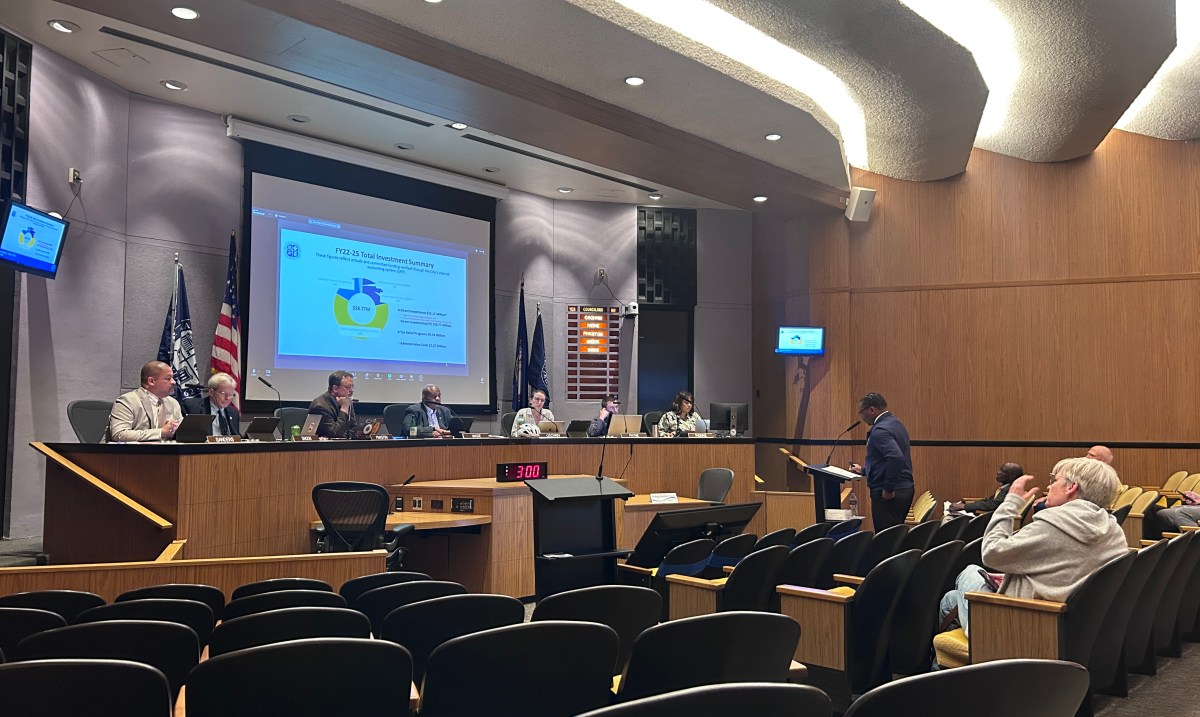
Monday afternoon, Charlottesville City Council received its annual affordable housing update during the opening session of the April 21 Council meeting.
“It’s a mirror, a reflection, of how we’re doing,” said Antoine Williams, housing program manager in the city’s Office of Community Solutions, who delivered the report.
The Council seemed satisfied with what it saw — all of them smiled or nodded at some point during Williams’ presentation.
Williams’ report showed that the city is meeting — and in some cases exceeding — its affordable housing goals, contributing at least $10 million per year to affordable housing initiatives throughout the city.
In 2021, the Council set a goal to contribute $10 million per year for 10 years toward affordable housing. That goal, among many others, was laid out in the Affordable Housing Plan the Council adopted in March of that year, as part of its update of the comprehensive plan for the city.
But the impetus for the Affordable Housing Plan came even earlier, in 2018, when a housing needs assessment conducted by Partners for Economic Solutions, a consulting firm hired by the Thomas Jefferson Planning District Commission, showed a dire situation in Charlottesville and surrounding counties.
Housing prices “have increased rapidly as new construction failed to keep pace with the increase in demand at all but the highest rent and price levels. Wages have not kept up with rent increases due to international competition and the stagnant minimum wage,” the report said.
That created a host of problems for both renters and homeowners, the assessment found. The bottom line was that more and more people were spending larger portions of their incomes on housing costs — particularly in the City of Charlottesville and the urban areas of Albemarle County. Charlottesville had an affordable housing crisis.
So, how well is the city doing on that $100 million goal? Quite well, Williams said.
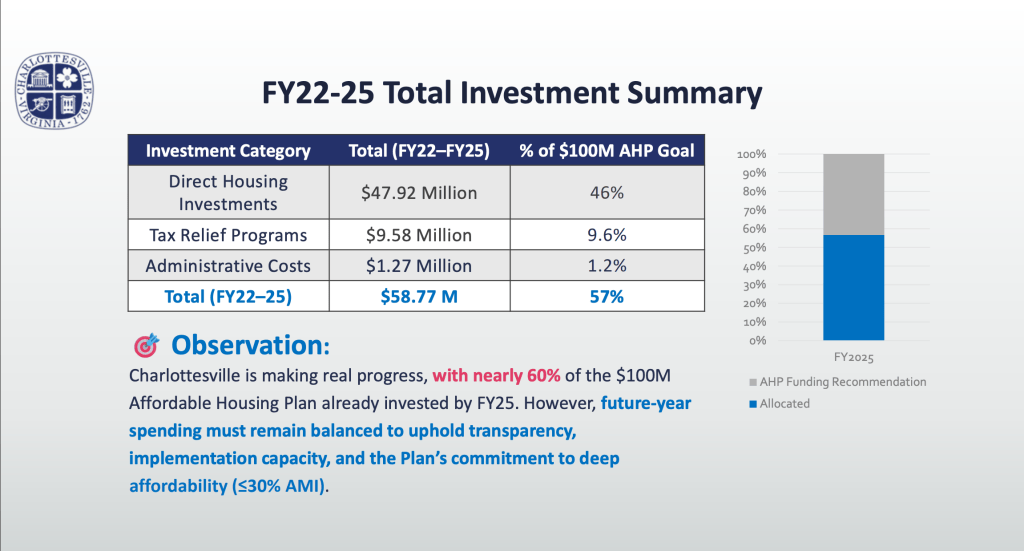
“Charlottesville is making real progress,” he said. Between direct investments in housing projects, tax relief programs, and administrative costs associated with both, the city has spent $58.77 million on affordable housing efforts since 2022. That means Charlottesville is nearly 60% of the way to its goal after just four fiscal years (FY22-25).
Most of that money — $47.9 million — has been direct investments in specific properties, like Kindlewood, South First Street, Vista 29, and Carlton Mobile Home Park. The rest has been spent on tax relief programs ($9.58 million) and administrative costs ($1.27 million).
And while there’s much to celebrate, a few things could be improved, Williams told the Council.
Currently, there are 938 city-supported affordable units, both rentals and owner-occupied, for households at various income levels, that either already exist or are in the pipeline, Williams said.
That number might seem low, Williams said, because the 10-year target is for 4,600 city-supported units: that includes 1,100 new units, the preservation of 1,300 units, and stabilization of an additional 2,200 households through tax relief, home rehabilitation, and rental assistance.
But as the Charlottesville Redevelopment and Housing Authority continues to redevelop its public housing communities with financial help from the city, that number will jump, Williams said.
Within that 10-year target for 4,600 units, there are goals for different income levels. The city is hitting one, exceeding another, and behind on a third.
The city is hitting its suggested target for households earning between 61-80% of the Area Median Income, and exceeding its goal for households earning 31-60% AMI.
Area Median Income is calculated by the U.S. Office of Housing and Urban Development annually, so it is a changing number. In 2025, a family of four at 80% AMI in the Charlottesville area earns $100,650; at 60% AMI, that family earns $75,480; at 30% AMI, that family earns $37,740.
The city is behind on its goal for families at or below 30% AMI, Williams said. The Affordable Housing Plan suggests that 50% of city-supported units target these families; currently, 35% of units do.
Perhaps the biggest piece of news that Williams delivered was that, if city staff projections hold true, the city could potentially exceed its 10-year, $100 million commitment by about $20 million.
City Councilor Michael Payne took that as good news. The $10 million number came about in 2018 or 2019, and might be outdated now, he said.
Right after that number was developed, the COVID-19 pandemic “completely exploded” building costs, and effectively changed how far $100 million toward housing can go, Payne said.
“The cost per unit has gone up, and will continue to go up,” Payne said, citing President Donald Trump’s tariffs and increasing costs of building supplies.
(The cost of building materials is up 34% since December 2020 and could go higher with a proposed increase in tariffs on goods from Canada — where most of the U.S. softwood lumber comes from, according to the National Association of Home Builders.)
“So I think it makes sense to anticipate going over that $100 million in a 10-year period,” Payne added.
Still, he’s proud of what the city is doing.
“Even though the report clearly highlights that there’s more to do, I think we still have the highest per-capita investment in affordable housing in Virginia; one of the highest on the east coast,” Payne said. He wants the Council to prioritize housing opportunities at the lower end of the income spectrum to correct the imbalance Williams mentioned.
Money for additional affordable housing commitments could come from the “payment in lieu of” fees from two large apartment buildings — with nearly 800 units between them — being constructed near the University of Virginia and geared toward its students. Instead of incorporating the number of affordable units required by the city’s zoning ordinance, the developers of those buildings will pay the city a lump sum. Together, the developers’ “in lieu of” payments will add around $10 million to the city’s affordable housing fund, according to the developers’ offers.
That money could be directed toward affordable housing on top of the annual $10 million commitment, Payne said. The Council had informally discussed this, but Payne indicated that he wanted to make it official.
Councilor Lloyd Snook disagreed with Payne’s suggestion about how to use the payments.
“We are being asked to make a lot of other commitments,” Snook said, naming a few: Buying more buses, hiring more people to drive those buses and rebuilding city schools.
After Williams’ report, the Council heard two more during the opening session, both about additional tools the City could add to its affordable housing toolkit, if Council chooses: a land bank and a tax abatement program. The Affordable Housing Plan recommends the Council consider both options.
A land bank would allow the city to purchase properties that are vacant, abandoned, or tax-delinquent and turn them into affordable housing. Another way it could be used is for purchasing low-cost housing that is in danger of being sold and redeveloped — which usually displaces low-income tenants.
A tax abatement program is meant to incentivize developers to build more low-cost housing. Here’s how it could work: A developer would agree to build more low-cost housing and receive a real estate tax break. The amount of that tax break would be determined by the Council — for instance, it could be 15% for 30 years. The developer would pay 100% of its annual real estate taxes but would then receive a check for 15% of that amount from the city.
“This may be an optimal way to make your commitment to funding affordable housing more sustainable going forward,” said Alan Peura, grants analyst for the Office of Community Solutions, who made the tax abatement presentation.
It is not a direct subsidy, but it would create more city-supported units of affordable housing.
Both the land bank and the tax abatement presentations were purely informative — the Council is not expected to vote on implementing either in the near future. But it did direct city staff to continue research and developing both for further consideration at a later time.