

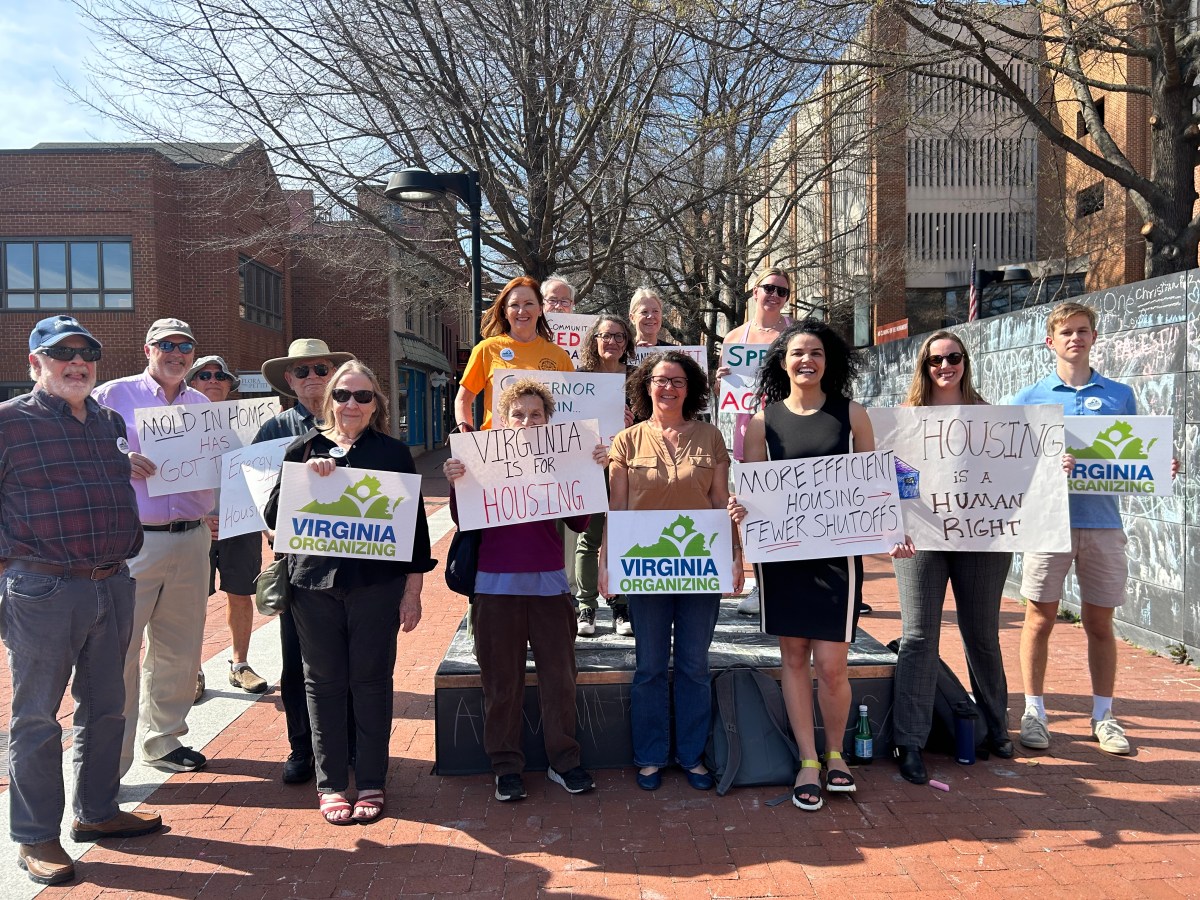
Holding up signs that read “Housing Is A Human Right,” “Mold In Homes Has To Go,” and “Gov. Youngkin…Sign the Bills!,” about a dozen people gathered at the Free Speech Wall on Charlottesville’s Downtown Mall last Thursday to urge Gov. Glenn Youngkin to sign into law bills that they say will expand tenants’ rights in Virginia.
It was one of 10 such events Virginia Organizing, a nonpartisan policy advocacy organization, hosted across the state last week.
“If he hears from people all over the state, maybe he’ll listen,” said former Charlottesville City Councilor Kristin Szakos.
A flurry of tenants’ rights bills have hit the governor’s desk after passing the Democrat-controlled House of Delegates and the Senate during this year’s General Assembly Session.
Most of the housing-related bills that passed, including those focusing on tenants’ rights, passed the House and the Senate on party lines, said Del. Amy Laufer, a democrat who represents district 54, which includes most of Albemarle County and parts of Louisa, Nelson, and Fluvanna counties. Laufer attended the Thursday rally, along with Del. Katrina Callsen.
(Democrats control the Virginia legislature by a small margin. There are 21 Democrats and 19 Republicans in the Senate, 51 Democrats and 49 Republicans in the House.)
Because the bills were largely partisan, supporters are uncertain that Youngkin will sign the bills his party, the GOP, hadn’t supported. He hasn’t responded to Charlottesville Tomorrow’s request for comment. Already, the governor quashed one of the bills — HB597 (identical to SB479) — with a reenactment clause that essentially blocks its path to becoming law this year.
That bill, introduced by Newport News Del. Cia Price, would make it possible for local governments to sue a landlord over bad living conditions. Youngkin vetoed it outright during the 2023 session. But this year, after it passed the General Assembly again, the governor added a reenactment clause. That means the bill will have to pass the General Assembly next year in order to take effect. He also added an amendment, which asks for a report on how this proposed change to the law would influence “housing availability, accessibility, and affordability.” The text of the amendment is unclear about how such a report would affect the bill.
The bill will return to the General Assembly in April, at which point legislators could reject Youngkin’s amendment and force him to act again — but only if a two-thirds majority votes for it.
Bringing more accountability to poor living conditions is one of the reasons Rev. Alex Joyner attended the rally. Before moving to Charlottesville to serve as lead pastor of the Charlottesville First United Methodist Church, he lived on the Eastern Shore of Virginia.
“The biggest issue there was a lack of indoor plumbing, and absentee landlords charging these exorbitant rents for places that had no insulation and no plumbing,” he said.
“It’s horrible” to see one’s neighbors live that way, he added.
Some of the other housing-related and tenants’ rights bills on Youngkin’s desk include:
HB73, which would scrub eviction proceedings from an individual’s record if the case is dismissed or the judge rules in favor of the tenant. Currently, that stays on a person’s record whether they were actually evicted or not, and can make it difficult for them to rent another place in the future.
HB442, which would require a landlord to allow a tenant who is behind on rent to enter a payment plan, if the rent owed is less than or equal to one month’s rent plus late fees.
HB598, which would increase the grace period for late rent payments from 5 days to 14 days.
HB817, which would prohibit retaliatory actions by a landlord against a tenant. Some retaliatory actions are already prohibited by law, but this would expand that list.
HB993 (identical to SB422), would prohibit landlords from charging fees for maintenance and repairs on damages not caused by the tenant. It would also prevent landlords from charging tenants a fee to submit a rent payment.
HB1251, which would allow tenants to sue a landlord in court even if they’re behind on rent.
The governor has until 11:59 p.m. on April 8 to take action — pass, veto, or amend — on these bills. If he takes no action, the bills automatically become law without his signature.
Youngkin has passed a few amendments to the Virginia Residential Landlord-Tenant Act, including one that allows military personnel to end a lease without consequence if called to duty, and another that requires landlords to perform maintenance within 14 days of notifying a tenant that it will be happening.
“We did a lot of work for tenants. We did not get a lot of traction on broader base locality fixes,” Callsen said. “But that’s what we’re trying to change. It’s changing the balance to be more fair.”
The rally was brief — just under an hour — but folks discussed plans to call the governor’s office and urge him to sign these into law.
“These all seem common sense to me,” said Brian Johns, director of Virginia Organizing, as he handed out sheets explaining the content of each bill. “Like things that should already be in place.”
Click here for the full list of bills approved by the governor. It’s updated regularly, as he takes action.
Want to comment on the bills? Call Gov. Glenn Youngkin’s office at 804-786-2211.