

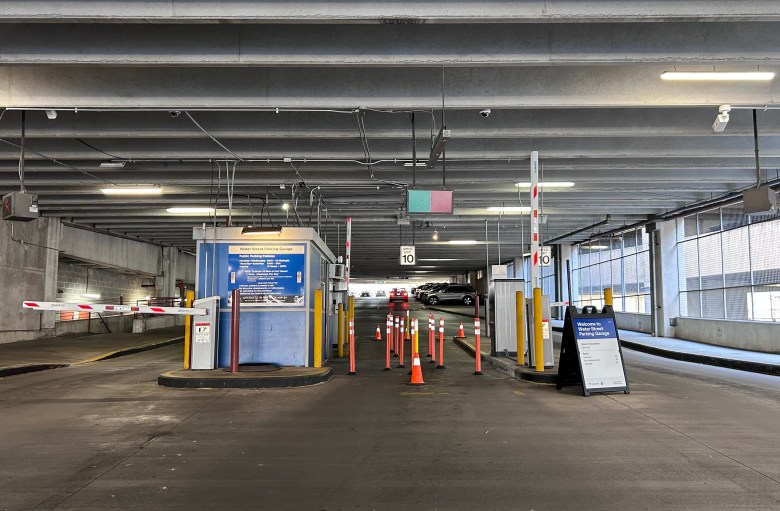
The new parking management system in the Water St. and Market St. garages in downtown Charlottesville was only in place for a few hours before drivers encountered problems.
The new technology, which was installed in the garages the morning of Dec. 16, 2025, uses artificial intelligence to identify cars coming in and out of the garages and automatically charge the credit card the driver has put on file.
That day, people were charged the wrong hourly rate, Chris Engel, Charlottesville’s director of economic development, told City Council during its meeting Monday night. There was also a payment issue between two cars with the same license plate characters from two different states. Those issues were resolved quickly, Engel assured them.
But for many community members, plenty of issues remain. Most folks had no idea this change was being made, and after learning more about the technology and the company, Metropolis, they’ve raised concerns about privacy and data security.
It’s “one of the few times” that residents, activists, and business owners have all agreed on an issue, City Councilor Michael Payne said from the dais Monday night.
City Manager Sam Sanders admitted that the implementation of the new technology wasn’t handled as well as it should have been.
“I think it is regrettable,” Sanders said during an hourlong presentation and discussion about the new technology (The presentation begins at the 1:06:00 mark.)
“Chris [Engel] and I both acknowledge that we probably should have thought about this a little bit more and made sure that we thought about when to roll it out, as well as how to roll it out.”
And, in response to public concern about being required to use a new app and web-based payment in order to use the two largest and most convenient downtown parking garages, the city has purchased two kiosks that will allow people to pay with cash or card. The kiosks should arrive in February, Engel said.
But the contract with Metropolis runs through 2029, and even if someone uses the cash and card kiosks, they’ll still be subject to Metropolis’ technology. Technology that is becoming standard across the industry, leaving the city few alternatives, Sanders said.
The city announced the new system in a media release sent out at 3:17 p.m. on Friday, Dec. 12, 2025 — just a few days before people would have to use it starting the following Tuesday morning.
Though Engel gave a brief presentation on the switch to City Council in June 2025 detailing the benefits of the new system, its installation came as a surprise to many community members, evidenced by the hundreds of comments on social media sites like Facebook and Reddit about the switch.
During that June 2025 presentation, Councilors asked a few questions and had some concerns, mostly around how people who are not smartphone-savvy, or who do not have a phone at all, could use the system. They asked a couple of questions about how driver data might be collected and stored, and what it could be used for, but Engel assured them “it’s only used for the payment cycle” and that staff would “need to clarify” what happens to it.
Council would not get to vote on whether or not the system would be installed, Engel said, it was a staff decision.
But Monday night, councilors had many more questions — and significant concerns.
Metropolis, a California-based company that is the largest parking lot operator in North America, is now managing the garages with its proprietary AI technology.

Today, in order to park in the Market St. and Water St. garages, a driver must register their vehicle with Metropolis, either via a smartphone app or the Metropolis website from a desktop or laptop computer browser in advance. Metropolis asks for information like name, phone number, email address, credit card information, and license plate number. Metropolis cameras also collect information on all cars that enter and exit the garages.
Engel said during the meeting that the cameras capture an image that includes the license plate and six inches around it on all sides.
However, a Metropolis spokesperson told Charlottesville Tomorrow last month that the cameras create a “vehicle fingerprint” based on “everything that makes one car different to another.” The spokesperson added that “the technology doesn’t just read plates; it recognizes vehicles, adapts, and responds. It is continuously learning, and it gets smarter with every interaction.”
That’s not the only inconsistency that’s come up. Monday night, Councilor Natalie Oschrin asked how long Metropolis keeps the data it collects.
“There’s language that says as long as they need to, but I’ve also seen 90 days,” Engel said, adding that people can ask Metropolis to delete their data.
More than once, Engel admitted that the company’s policies around data collection are unclear.
Councilor Michael Payne asked if city staff had any concerns about the data Metropolis may or may not be collecting on its users, based on the company’s own stated policies.
“There was a lot there,” Engel replied. “Its policy is hard to decipher. It flips over on itself a few times,” he said. “I haven’t been through it word-for-word, but I’ve asked the specific questions that we’ve heard, of which you’re reflecting in your concern.” Engel said that when he asked Metropolis about the data it collects, the company shared the link where people can opt out of having their data stored.
“In the current political realities, I have no confidence whatsoever” that users’ data is secure, Councilor Lloyd Snook said. “I’m concerned about the Big Brother aspect of it all.”
Most of Engel’s presentation focused on how easy the Metropolis system is to use (much as he did in his June 2, 2025 presentation about it), and why the city is using it.
He said that more than 8,000 local people have already registered with the system.
Additionally, there are about 900 “enterprise accounts” with the garage, Engel said. These are accounts used by regular drivers and by businesses and agencies (like the public library) that validate parking for employees and patrons. Every entity with an enterprise account was supposed to receive guidance on how to validate parking using a special code. So far, 56 of them have used their code, Engel said.
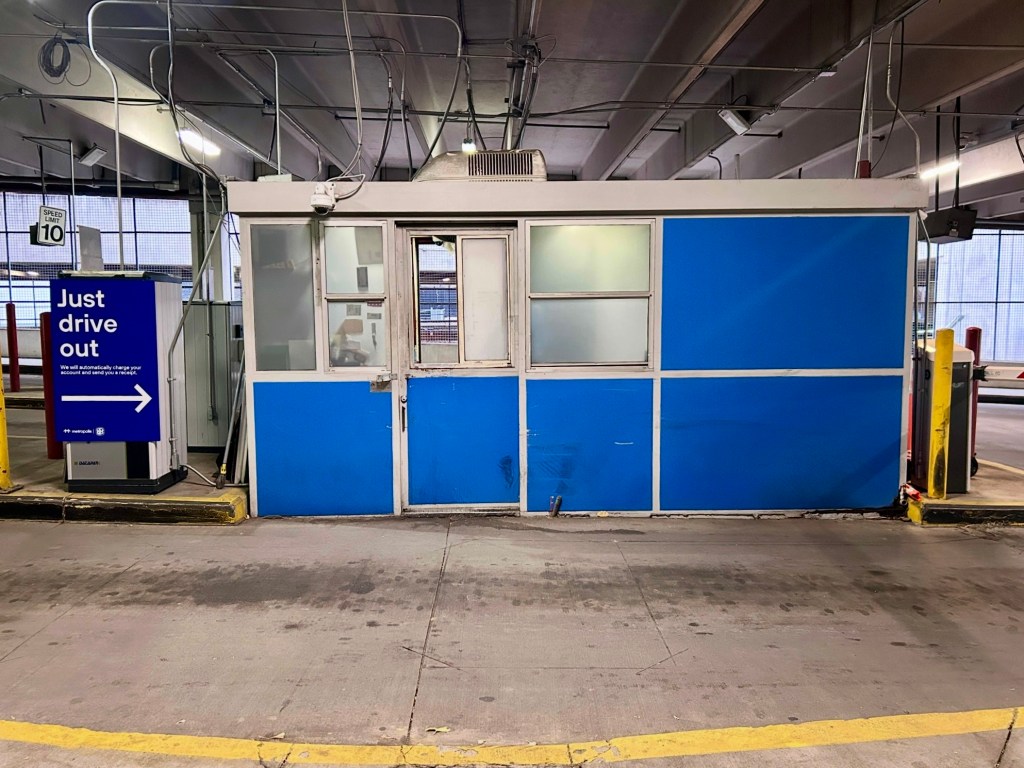
Various companies have managed the public parking garages downtown since 1975, when the Market St. garage opened, Engel said. A local company managed it for decades, until about 2016.
In 2018, the city paid $350,000 for new payment kiosks in both garages, and also paid for a service contract to fix the kiosks if anything went awry. Just a few years later, the equipment was failing, Engel said, and it was getting increasingly difficult to fix. The maintenance company was difficult to get in touch with, and the parts for the machines became harder to procure.
In 2024, the city began a five-year contract with a company called SP+. Metropolis bought SP+ that same year and has been consolidating the companies’ operations. That’s how the city came to work with Metropolis.
There was no option to get out of the contract when that sale happened, Engel said in response to a question from Councilor Jen Fleisher.
“They just moved to merge,” he said.
The city currently pays the company about $40,000 annually to operate the garages, plus reimbursements for employee expenses.
Currently, the money the city collects from parking fees covers that amount, plus rent in the Market St. garage, and that’s about it, Engel said. (The city owns the Water St. garage, but rents the Market St. one.)
The two kiosks that are expected to arrive this February cost “under $20,000 total,” city spokesperson Afton Schneider told Charlottesville Tomorrow in an email Tuesday morning.
Still, people who use those kiosks won’t be able to bypass Metropolis entirely.
“They will still be subject to the recognition technology, but their data will not be stored,” Schneider said.
The city’s contract with SP+/Metropolis is up in 2029, and at that point, the city can explore other options, Engel said.
But there might not be many other options, Sanders suggested. This technology is now “common practice in the industry,” which is likely part of why staff went ahead with it, he said.
“I think it’s a bad system,” Payne said. “I think after the community had such concerns about automatic license plate readers — Flock, Peregrine — to implement this on the part of the city government is hypocrisy and is hard to defend.” In December, the city ended its Flock camera pilot program, which used AI to track license plates of cars moving around the city for law enforcement use.
A few readers have written to Charlottesville Tomorrow with concerns and questions about the new technology, and have said they’re hesitant to use the new system, if they’ll use it at all.
“I do not like the idea of an unknown national company having information, photos of my car, me in my car, my credit card info, and other details that I don’t know about,” local real estate broker Donna Goings told Charlottesville Tomorrow in an email Tuesday morning. “If I want to dispute a charge, it is highly time consuming. I do not plan to use the parking garages anymore.”