
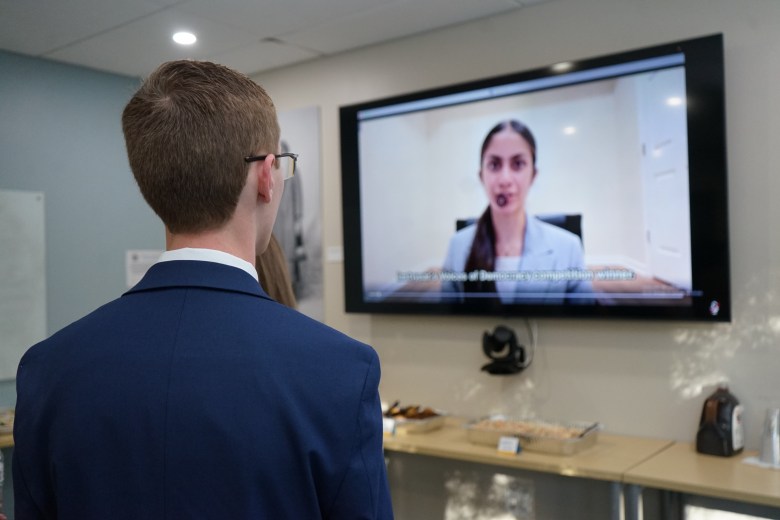
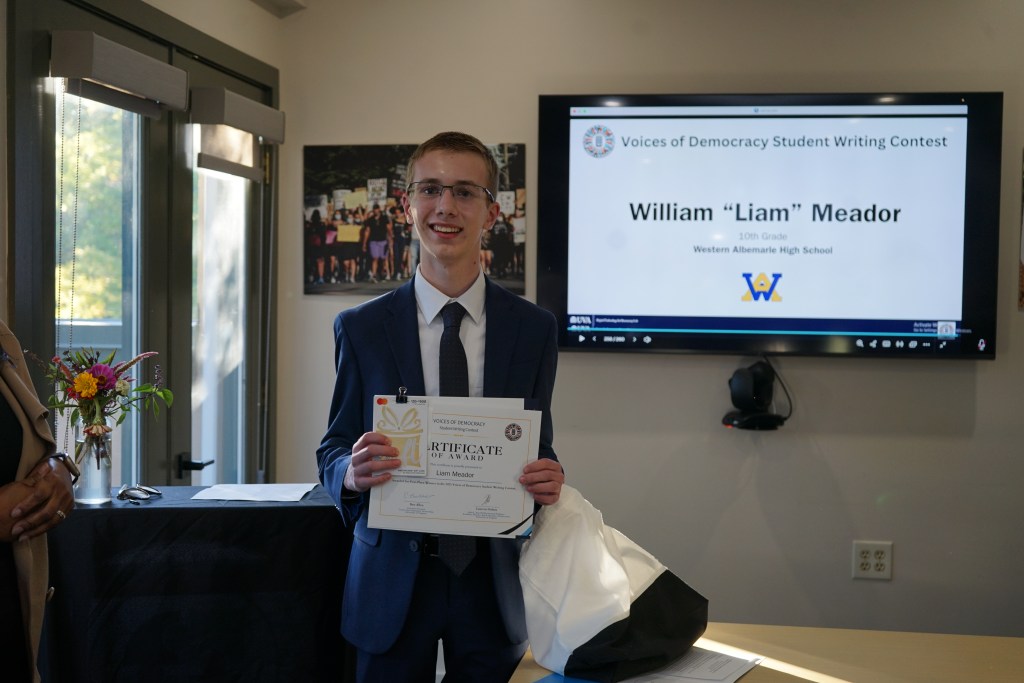
In his poem, “Beyond the Screen,” William “Liam” Meador explores how technology has negatively impacted communication, and, by extension, our democracy.
As technology comes and goes like early May showers,
William “Liam” Meador, “Beyond the Screen”
to many democracy should follow,
growing on like a starburst flower.
Yet, as I look across the meadow, it is quite hollow.
Meador’s words blend seamlessly with the 2025 Voices of Democracy Student Writing Contest’s theme, “Democracy in a Digital World.” A 10th-grade student at Western Albemarle High School, Meador entered his poem in the contest organized by the University of Virginia’s Center for Community Partnerships and Digital Technology for Democracy Lab. The contest sought essays, poems and articles from middle and high school students in Charlottesville and Albemarle County.
The response was significant. Submissions to the program, now in its second year, nearly tripled from last year: Students in grades six through 12 submitted a total of 141 works, compared to last year’s 42 entries.
On Oct. 14, Meador was notified that his poem won the grand prize of $500. Lennox Meslar, a sixth grader at Joseph T. Henley Middle School, won $250 as the contest’s second-place winner, and Gabriel Guex Petros, a seventh grader at Jackson P. Burley Middle School, won $100 for third place. In addition, Milan Mookerjee, an 11th grader at Albemarle High School, received an honorable mention and $50.
Six judges selected the winning submissions based on style, grammar and composition.
Another criterion included students using their creativity to include a personal approach in addressing the impact of technology on democracy in communities.
“They were asked to do a couple of things, like make sure you relate this to your own experience and talk about what this looks like in the future,” said Daniel Fairley, one of the judges, in a telephone interview with Charlottesville Tomorrow. “And that’s what I think the winner really was — an opportunity to kind of think both creatively as well as provide some hard facts, but in their own experience and how it related to this idea.”
A UVA news release announcing the winners said that teachers in Charlottesville and Albemarle County also incorporated the contest’s prompts as an instructional tool, helping students engage with the concept of democracy and its relationship with technology.
“I think that’s one of the biggest factors in democracy, and that’s what this poem is about,” said Meador in a telephone interview with Charlottesville Tomorrow. “About how technology has negatively impacted how we communicate.”
Meador also said the presence of online videos made by artificial intelligence is concerning, and can often lead to misinformation.
“AI [is] taking over,” Meador said. “And I feel like we’re going to lose so much more than we’re going to gain — in the long run — with technology.”
When explaining his thought process for the writing assignment, Meador said he wanted to show that many people no longer have meaningful relationships with one another.
“We’re in a position where we have a lot of different tools and different things to communicate and create things,” said Meador. “During and after the pandemic, a lot of people started using Zoom to communicate — like they could see each other, from using the screen — and it just started some of the idea that we didn’t have to be in-person.”
Meador said he believes off-screen relationships among people are essential.
Lennox, the sixth grader who won the contest’s second-place prize for her poem, “democracy aflame,” also explores the potential for technology to negatively impact communication and understanding.
but misinformation and lies
Lennox Meslar, “democracy aflame”
go unchecked online
they spread to eyes of people
who believe them
it easily deceives them
Gabriel, the contest’s third-place winner, writes about Habitat for Humanity’s redevelopment of the Southwood housing community to help its residents avoid being displaced.
“Technology has helped democracy in Southwood in two main ways: residents have helped design the neighborhood themselves, and energy efficient homes are accessible to all,” he wrote.
Mookerjee, who received honorable mention for his essay that highlights how technology has made democracy more inclusive, also believes technology can inspire a movement and even change the world.
“Technology has democratized democracy. It has precipitated inclusivity: now, anyone can participate,” wrote Mookerjee. “Whereas once age or status would be barriers to a high school student, I can now be taken seriously in an online debate or start my own social media channel or account.”
Several students commended the contest for helping them to find their own voices and learning new things about their environment.
“I felt really empowered,” said Micah Ohlms, a student at Charlottesville Middle School (formerly Buford Middle School) about her experience participating in the contest.
“I hear a podcast in the kitchen below me, I know what it’s about without hearing the words. It’s about how America is falling to ruin,” wrote Ohlms in the first part of her essay. “How in this dark time, we should build each other up, but all we’re doing is tearing each other down.”
The writing and research process left Ohlms confident enough to finish some of her previous writing projects, including a couple of books.
“It’s good to feel like I can actually make an impact,” she said. “So I’ll go back to them and try to keep writing.”
Stefani Martinez Peña, 14, a freshman at Monticello High School, submitted her poem in Spanish with a focus on the area’s Latino immigrant community.
“No somos criminales somos soñadores, de un futuro diferente y en seguir viviendo, nuestras vidas dignamente todos los días,” she wrote. The passage translates to “we are not criminals, we are dreamers of a different future and in continuing to live our daily lives with dignity.”
While doing research for her article, Stefani realized the sacrifices that many immigrants make as they dare to move to a new country where they don’t know anyone.
“They don’t know anybody, don’t know the language, they don’t know where they’re coming, but they come, and they have built something great,” she said.
Stefani said that although she prefers spoken word poetry and debating interesting topics with her friends, she entered the competition on a whim.
“I like the power of the words moving through my body as I say it,” she said, adding that she likes to maintain anonymity in her writing. “I just really like the power that poetry gives me, because I can express myself.”
Although her future plans include a career in nursing, she hopes to pursue poetry as a hobby.
For 14-year-old Halil Stinnie, the contest meant learning more about his peers at Albemarle High School. Conducting research for his essay helped, he said.
“I learned that in the library, there’s something called student-peer-tutoring,” said Halil in a telephone interview. Student-peer-tutoring involves students tutoring one another, and AHS has a “block” or teaching hour for students to help each other with subjects they find challenging.
Halil’s mother encouraged him to participate in the Voices of Democracy contest after she received an email from Starr Hill Pathways, a program that encourages students to explore careers or college courses.
“I always try to motivate him to do things when opportunities arrive like this, because I know that it basically helps him as a student,” said Stephanie Stinnie during a telephone interview with Charlottesville Tomorrow. She added that such programs also make a difference because they allow students to be recognized.
“Not every student gets the opportunity to basically be heard and voice their opinions, feelings or thoughts,” she said.
Halil felt good about the work he put in for the essay, not just for the potential recognition, but for what he achieved.
“I felt pretty proud, I’d say,” said Halil Stinnie. “It felt like I was not just speaking for myself, but speaking for what I saw from the people around me. Not just using somebody else’s research, but finding my own research and kind of putting that in so I could speak about how my school, as a whole, operates.”