

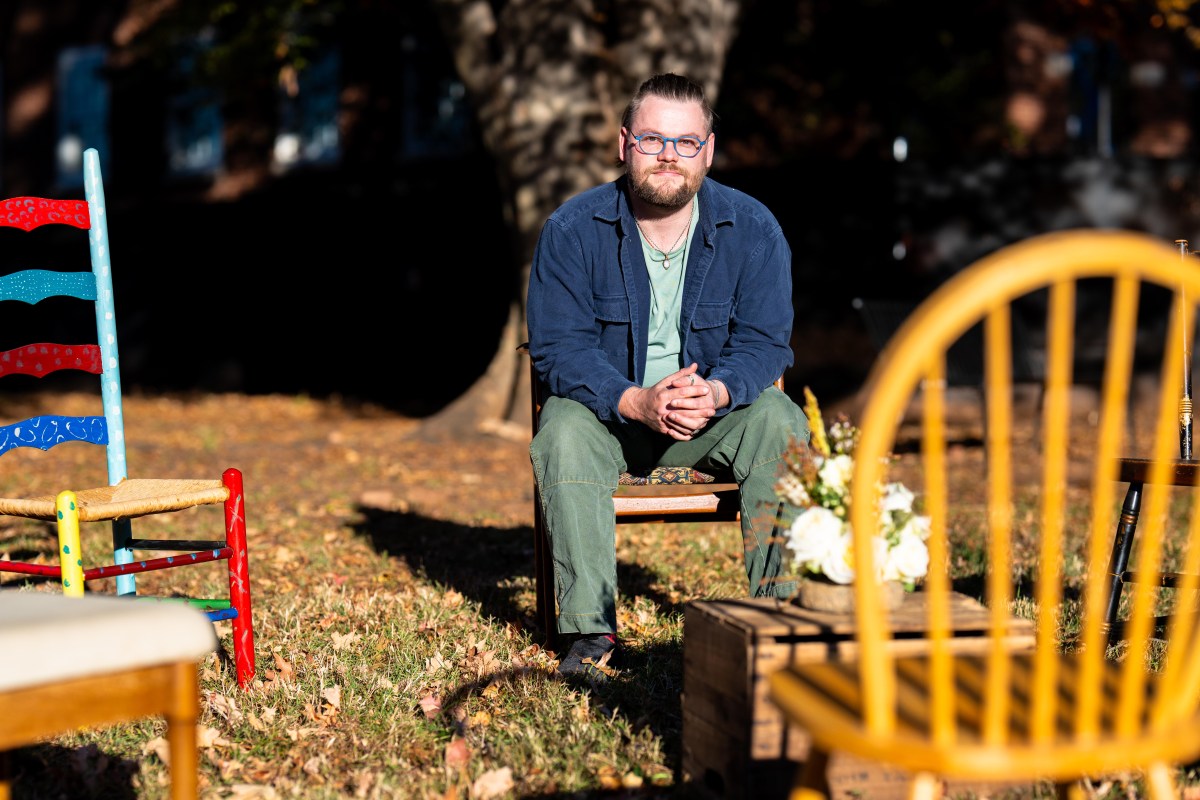
Author’s note: This essay is about child sexual abuse, my own and the allegations in a case now before the Albemarle County Circuit Court, Commonwealth v. Swiney. I do not discuss specific acts of sexual harm, but acknowledge the subject carries a great deal of charge and stigma and shame in our culture. I know many of you carry it in yourselves, your families and your networks of care. I invite you to read at whatever pace you need, to set this down and come back, and to take care of yourself in whatever other ways you can.
I arrived at the courthouse early for Michael Swiney’s bond hearing on Friday, Oct. 9. Michael was a Social Emotional Learning Coach at Hollymead Elementary School, and he is charged with 20 felonies involving seven children who were students there. He’d been held without bond in the Albemarle-Charlottesville Regional Jail since his arrest in June.
In court he is the defendant, and in news reporting he is Swiney. I call him Michael, even though we have never met, to hold him as human. I recognize that might be difficult for some people to understand given the circumstances.
I walked into the courtroom during a recess and found myself alone in the room except for a few bailiffs and a deputy clerk. I chose to move between seats and figure out exactly where I wanted to be, which in itself felt restorative. I ended up in the back row with the wall behind me, my back to Court Square, the double doors at the rear of the courtroom beside me, and the whole room in front of me, the bench, and the well, and the rail, and the rows of the gallery that hadn’t yet filled.
Judge Cheryl Higgins came back to the dais. She and I exchanged eye contact several times. I don’t remember what her face did, or what mine did. I wondered whether she was curious about me. I was curious about her. I don’t think she knew who I was. The last time I was in a room with her I was 20 years old and a deeply wounded boy.
It was a different room then, her old courtroom across the street in Court Square, which is being renovated now. I sat in it once, in April 2014, for David Watkins’ sentencing hearing. I was there with my whole family, my mother and father, my twin sister and my younger brother. I don’t have much procedural memory of that day, and I don’t remember choosing my seat. What I remember is that the room had much more grandeur than this new one. Back then, I didn’t have the resources to be both the deeply wounded boy and my healthy adult self at once.
David had been the scoutmaster of Troop 1028 in Keswick, and in January 2014, he pleaded guilty to 36 counts of carnal knowledge of a child. I was the scout who reported him to the Albemarle County Police Department in November 2012. I use his first name, David, too. That took me years to do. In his sentencing hearing, David asked for mercy from the court, and his lawyer called the sex we had consensual. I don’t even remember that. My parents do.
Judge Higgins said, “What is especially concerning to the court in this case is the lack of acknowledgment by the defendant,” and then she sentenced him to 195 years in prison. She suspended 165 of them. He would serve 30. As far as I can tell, the building gave her little else to do with her concern about David’s lack of acknowledgment.
I was angry back then. Angry at David. Angry that I’d been harmed and left to deal with it on my own. Angry that I hadn’t been protected. My parents were especially angry. I disclosed the abuse to them after returning home from college for Thanksgiving break in 2012. After two years working with the prosecution, I believed David deserved to be punished, the way the dominant culture insists that people like him need to be punished. When Judge Higgins sentenced him to 30 active years I felt vindicated. That feeling didn’t last.
Over time my anger softened into curiosity. Justice had been served, but I was not healed. The coping strategies I’d picked up to survive were still running my life, and wearing me down. I was dogged by shame, on watch in every room I entered, sleeping poorly and struggling in my relationships. More and more, I carried the weight of having taken part in a process that felt increasingly as if it had impinged on the basic human dignities of another person, even one who had caused such significant harm. Through the investigation, I had given the police names of other boys who David abused. They were drawn into the process without choosing, and the weight of that rested on me too.
I can’t say which came first, compassion for David or compassion for myself. They came together, as I returned to the teachings of restorative and transformative justice, and came upon an organization called generationFIVE, a group determined to end the sexual abuse of children within five generations. Part of my path to healing from harm, I learned, was to hold an expansive compassion for myself and for the ways I had found to survive. I also learned I could seek amends for the harm my survival patterns cause to myself and to others. I’m still seeking them.
One of the first rooms I found that was built for the acknowledgment of the harms of child sexual abuse was a grid of faces on a screen. A Zoom room.
I’ve sat in circle at Hidden Water since 2023, and now I’m a senior circle keeper in that community. Hidden Water is a restorative justice response to child sexual abuse. This fall I’m holding a healing circle with other men who were sexually abused as children.
Circle is a practice of sitting together so that everyone in the room can be seen and heard. One person speaks at a time, holding a talking piece, while the rest of us listen without interrupting or answering back. We speak from our own experiences.
At Hidden Water, we hold circles for folks across the ecosystems of the harms of child sexual abuse, each named by a color: Green circles for people who were sexually harmed as children or young people; Purple circles for people who have caused harm, as adults or as children, and are seeking to take responsibility; Orange circles for non-offending parents and caregivers of children or young people who were harmed, caused harm or both; and Blue circles for other loved ones.
Sitting in circle is the best medicine I have found for the profound shame at the core of the wounding of child sexual abuse.
This past summer I organized a series of multicolor circles on justice and healing, bringing fellow circle keepers from across the colors into one room together, seven of us joining from across the United States. We followed the usual pattern of Hidden Water’s healing circles: several weeks of building the container, then a personal share week for each of us on one prompt. What is the current edge of your healing? We’d all sat in many circles with our own colors first, dozens each, and for some of us, myself included, nearly every week for years. We still needed those first weeks to build the trust and capacity to hear one another.
My co-keeper for those summer circles spent just over five years incarcerated for harms he caused a young boy he was supposed to be babysitting. When he shared about his arrest and the investigation and his plea, I felt so heard listening to him. So heard in my listening. The room held him and it held survivors, together. Parents and other loved ones were in the circle too. There was acknowledgment of harm there, and responsibility. No judge had ordered us into that room. We’d each found our way there: and chosen to stay.
Back in the gallery of the Albemarle County Circuit Court awaiting Michael’s bond hearing, the room started to fill, a few at a time and then quickly. Part of what I was doing in there, and what I could appreciate others doing too, was trying to figure out who everyone was.
A family group sat together. Reporters were there. Among them, the Daily Progress reporter Hawes Spencer, who contributed reporting on David’s arrest in 2012. The coordinator of the Albemarle County Victim/Witness Assistance Program was there, coming in and out. A few school staff, identifiable by their badges, were present too.
Before Michael’s case, the three school administrators charged that week with failing to report suspected child abuse, one of them his former principal, made their first appearances alongside their attorneys. Their cases are due back in court on Dec. 7.
I’d expected to bring all of it in with me, the fear and the unmetabolized anger at the system that failed me — and I mean the whole system, including the courtroom that gave me the most it could and called it done. This time in the courtroom, I was both wounded parts and my healthy adult self. I was grounded and I was unafraid, of Judge Higgins, of Michael when he came in, of his family, of the attorneys, of what I was about to watch the court do. I’m still not sure when I set my anger down.
Michael came in wearing a bright green jumpsuit, looked at his family and winked a time or two in their direction. His lawyer, Christopher Leibig, who had come in earlier with a worn banker’s box and sat in the row ahead of me, now sat by his side at the defense table.
The hearing was long and weirdly pedestrian. Michael has admitted nothing. On Sept. 25, the Court of Appeals had sent the bond question back to Judge Higgins, asking her to make clear whether she found his release an unreasonable danger to himself, his family or the public, and why the conditions the defense proposed would not be sufficient.
Chief Deputy Commonwealth’s Attorney Lawton Tufts again argued, as he had at the first bond hearing in August, that Michael posed an ongoing danger to the public. The defense proposed home detention with GPS monitoring, a family member’s accompaniment whenever he was permitted to leave home, no contact with children other than his own and only under his wife’s direct supervision, no internet or internet-capable devices, the surrender of his passport, and a waiver of his Fourth Amendment protections against searches of his home. These would be orders of the court, the defense argued.
Judge Higgins took a half hour recess before returning with her ruling. I went out through the double doors onto the second floor of the building. I leaned against the railing of the atrium, an ellipse that opens all the way down to the first floor, and looked out the windows toward Court Square. I smiled at the elongated architectural circle in front of me. I didn’t know yet what the ruling would be, and I let myself not know.
Standing at that rail I turned my curiosity toward the building itself. The brick and the statutes, the centuries of practice behind them, and the belief so many of us carry into a courtroom, that harm, and harm against children most of all, demands punishment. I wonder what it would take for a courtroom to hold acknowledgment and repair alongside the law.
When she came back, Judge Higgins found the defense’s proposed restrictions sufficient and ordered Michael released on a $50,000 secured bond. I nodded. I’d walked into the court believing that this would be the just outcome. Not because the allegations were anything less than horrifying, or because I knew whether they were true, but because I don’t believe a jail cell is necessary to protect the community while the case proceeds. My belief goes further than her ruling did.
I don’t think a prison cell, or the threat of one, is what keeps children safe from people who have sexually harmed children or from those who might.
Michael’s family let out a relief I couldn’t compress into words, but it was palpable. There was no fanfare. The journalists had their headlines and were quick to decamp to writing and publishing. It was orderly. The hearing was orderly.
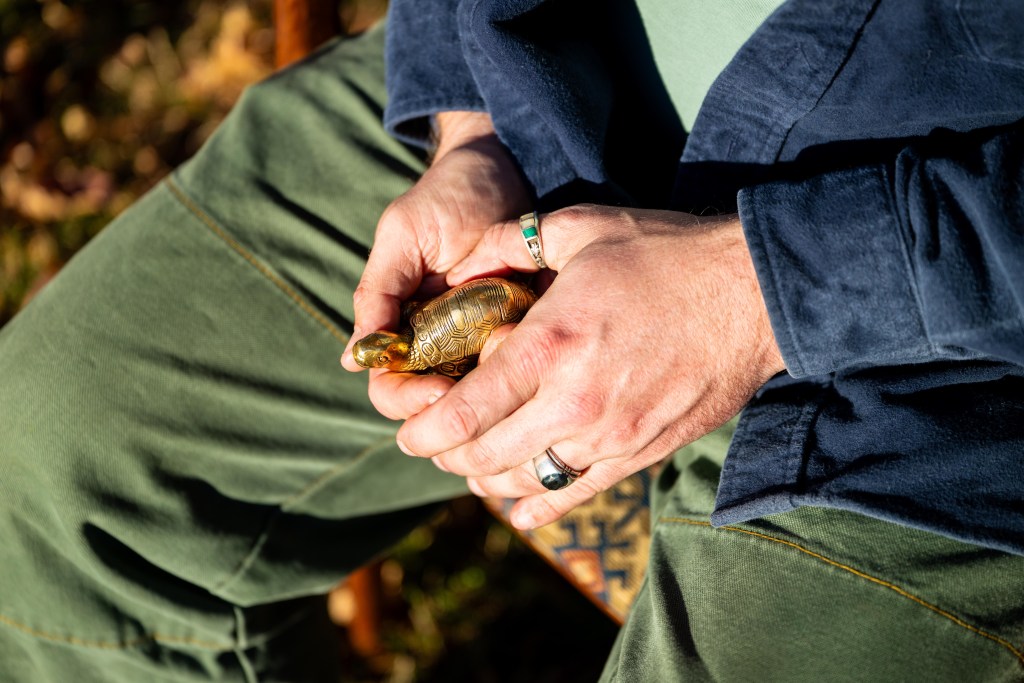
I’m writing this from the room in my home where I host video calls to hold circle. It’s also where I take calls from folks individually and offer peer support as they navigate and learn about and walk their paths to healing from harm, which is as much for them as it is for me on my own path. The thinking I carried out of the courthouse has come here with me, and it’s been amplified in my being since that afternoon.
I wouldn’t go so far as to call home electronic monitoring non-carceral. But it’s a bridge, I think. It keeps Michael at home, and leaves open possibilities that a jail cell would foreclose. The orders of the court make no room for a community healing process and nothing about his release on bond establishes that he would participate in one.
But there is a glint of possibility, anyway.
Glints like this one have opened to real possibility in other places. Beginning in the 1980s, people in Hollow Water, an Anishinaabe First Nation in Manitoba, and in three neighboring Métis communities developed a process alongside the courts, involving people who had caused harm, many of them responsible for child sexual abuse, and the people and families impacted by it. The work included years of community accountability and healing circles. More than a hundred people went through that process over a decade, and a 2001 Canadian government study found just two who reoffended. It asked a great deal of everyone involved, and it was neither simple nor without criticism, including concerns about pressure on survivors to participate. Hidden Water is named in tribute to Hollow Water, though its circles stand apart from any court. They are voluntary and they are held by the community. What might it look like for a court to have circles like that to turn to, for the people harmed, for the people who caused harm, and for their loved ones?
The Monday night after the bond hearing, Oct. 12, I opened our men’s healing circle with a guided somatic invitation, describing how I feel the ground through my feet and tail, my breath expanding omnidirectionally, and my back body with all the space behind me, without fear of what might be lurking there.
And I felt myself feeling all of that in the courtroom, my feet and tail, my breath, and all the space behind me, including that old courthouse across the street, without fear of what was lurking there.
The following Monday, Oct. 19, was my personal share week in circle. I shared about my experience in Judge Higgins’ court and the new memory I’d been able to make there, 12 years after sitting in her old courtroom for David’s sentencing. I shared about my growing conviction that what we’re facing is not merely a failure of response from the criminal legal system and from our collective insistence on punishment and denial, but a culture that literally creates the conditions out of which these harms arise in the first place. I shared about my budding community justice practice, too, and having just secured the money to incorporate the In Search of Peace Fund, a nonprofit I’m starting to hold circles and other community justice processes with folks impacted by sexual harms, and to fund the circle keepers and practitioners who do that work.
I got to share all of that, and then hear from six other men about what came up for them in their own lives and experience as they listened. I felt so heard.
I closed that evening’s circle with a poem I wrote several years ago and have read into circle a number of times, “To Stand Next to You and Your Spine After Falling.” In it I offer, “I want a spine who knows I didn’t cause this but doesn’t fold in the shadow of he who did,” and further on, “I am that spine and parts of me haven’t met him yet but that doesn’t mean he isn’t already here, he hasn’t already been here.”
Sitting in the back row of the Albemarle County Circuit Court, with the wall behind me and the old courthouse behind that, parts of me got to meet that spine anew.
Not without fear but swaying in the wind of it.
How magnificent it is to stand again after falling. To stand next to you and your spine after falling.
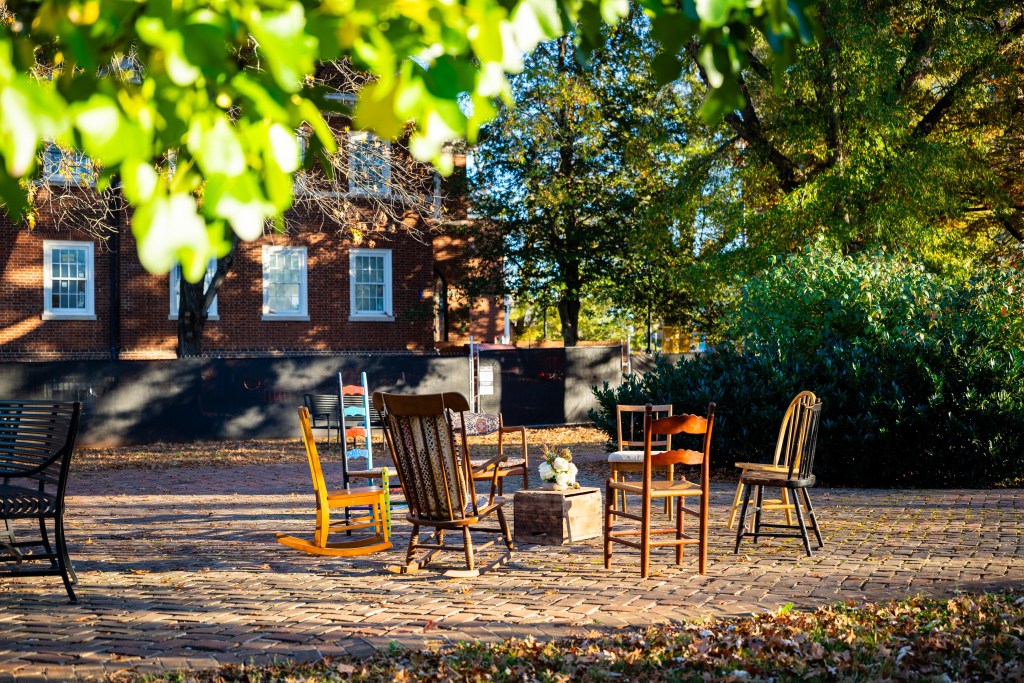
After Judge Higgins’ bond ruling, the gallery emptied a few at a time, the way it had filled, and I stayed in my seat a little longer before I walked out. Michael’s family was huddled with his counsel at the top of the stairs along the far end of the ellipse. The television reporters were already running their takes in the courtyard as I exited the building. I crossed over into Court Square and walked past the old courthouse building, thinking to myself that sometime in 2027 the circuit court will move back in, and this case or the next one will be heard in the room where David was sentenced.
I carry the question I asked at the atrium rail a little further, to that room, and every courtroom in Charlottesville and Albemarle County, and across the Commonwealth of Virginia, past the gallery rails and up to the daises and the judges themselves, and further out than any one case, to what it would take for our communities to become places where these harms happen less, and then less, and then not at all.
I wonder about the families at Hollymead Elementary School, too. If any of them were in the gallery, I couldn’t tell. They weren’t sitting together as a block, anyway, and I can only imagine what they wanted from that afternoon. Looking up at the old courthouse, I held them alongside the boy I’d been in that building 12 years ago, and all the healing I’ve done since, and I felt stretched large by pain and hope, at once.
Standing there, I felt the gravity of the day land on my shoulders, and for a moment I felt lonely under the weight. The criminal legal system does that. It keeps us apart from each other even in the same room. The wounding of child sexual abuse does that too. It works by secrecy and shame, and it tells each of us we’re the only one.
I felt the weight move down through my spine to my feet, to the brick of the sidewalk and into the ground under it. Then I felt the space behind me, and my breath. And I remembered I’m not alone. I hadn’t been alone in that courtroom, either. For all that kept us apart in there, it was a room full of fellow humans, all of us impacted by these harms. I’m not alone in circle, or in the community at Hidden Water, or among my colleagues and friends and family here at home, or among the more than a billion people alive today who carry the weight of this wounding too.
This time, in Judge Higgins’ courtroom, I had chosen my seat. I could because I’ve had years of practice choosing one, in circles where harm can be spoken and heard, and where the people who caused it are held too, rooms built for acknowledgment and repair the way the room I’d just left was built for judgment. Choosing my seat, and listening from it, stoked a deep curiosity in me about seats that don’t yet exist. We need new seats.
I don’t know yet what those rooms will look like. I don’t know yet who would want a seat in them; the Hollymead families if they ever want one, Michael, if there is responsibility he’s willing to take, and his family either way, the teachers and administrators, the judges who hear and attorneys who argue these cases, the rest of us whose stories touch these wounds.
I only hope they’re rooms any of us can decide to arrive early to, and choose our seats in.
Take action
Find more resources if you have been impacted by child sexual abuse.
Registration for the Winter 2027 season of Hidden Water’s online healing circles opens Jan. 25. You can learn more and register on their website. Hidden Water also offers a Safer Adults training, a 12-week online course on preventing child sexual abuse and responding to disclosures with care. Here’s more about that program.
If you are a guardian or student in Albemarle County Public Schools, or looking for resources during their investigations of abuse, here is where you can find a list of local and national programs and organizations.